

How to launch a parking garage permit hang tag program

Managing parking at a hotel, casino, or event venue means juggling competing priorities every single day. Guests expect seamless access, staff need reliable reserved spots, and enforcement teams need clear credentials to verify at a glance. When permits are misplaced, expired tags go unchallenged, or citation disputes pile up at the front desk, the entire guest experience suffers. A well-structured parking garage permit hang tag program addresses all of these pain points with a physical credential that is visible, verifiable, and easy to manage. This guide walks through every step, from assessing your facility’s needs to modernizing with RFID technology, so you can build a program that actually works.
Table of Contents
- Assessing your facility’s needs and prerequisites
- Policy design and enforcement playbooks
- Determining permit allocation and utilization benchmarks
- Modernizing with RFID hang tags and integrated systems
- Verifying results and troubleshooting common pitfalls
- What most facility managers overlook about permit hang tag programs
- Upgrade your parking garage permit hang tag program with proven solutions
- Frequently asked questions
Key Takeaways
| Point | Details |
|---|---|
| Clear display rules | Require permits to be hung visibly to prevent enforcement disputes and reduce guest frustration. |
| Credential-vehicle linkage | Link permits to license plates to curb misuse and improve tracking. |
| Optimal permit allocation | Cap permit spaces at industry benchmarks (e.g., 25%) to balance garage efficiency and guest satisfaction. |
| RFID modernization | Adopting RFID hang tags automates access and logging for high-turnover venues. |
| Continuous verification | Regularly check permit display and update policies for ongoing program effectiveness. |
Assessing your facility’s needs and prerequisites
Before ordering a single hang tag, a thorough site assessment is essential. Every facility has a different layout, traffic pattern, and guest mix, and those differences directly shape the permit program design.
Physical requirements to evaluate first:
- Total number of parking spaces and how many will be designated as permit-only
- Number and location of entry and exit access points
- Existing signage infrastructure and whether new permit zone signs are needed
- Lighting conditions that affect credential visibility during enforcement
- Whether the facility operates 24 hours or has defined peak windows
Credential type and durability needs are equally important. Hang-tag style permits are commonly issued as physical credentials hung from the rear-view mirror and are treated as the permit credential for verification and enforcement. This means the physical quality of the tag matters. A tag that fades after two weeks or tears easily creates enforcement problems and guest complaints. Look for materials rated for UV exposure, humidity, and repeated handling, especially in covered garages where temperature swings are significant.
Software and integration needs should be mapped out early. Will your team use a spreadsheet to track issued permits, or does your facility use a parking management platform? Some operations need barcode scanning at the gate, while others rely on visual enforcement patrols. Review permit display best practices to understand what credential formats work best with your current enforcement workflow.
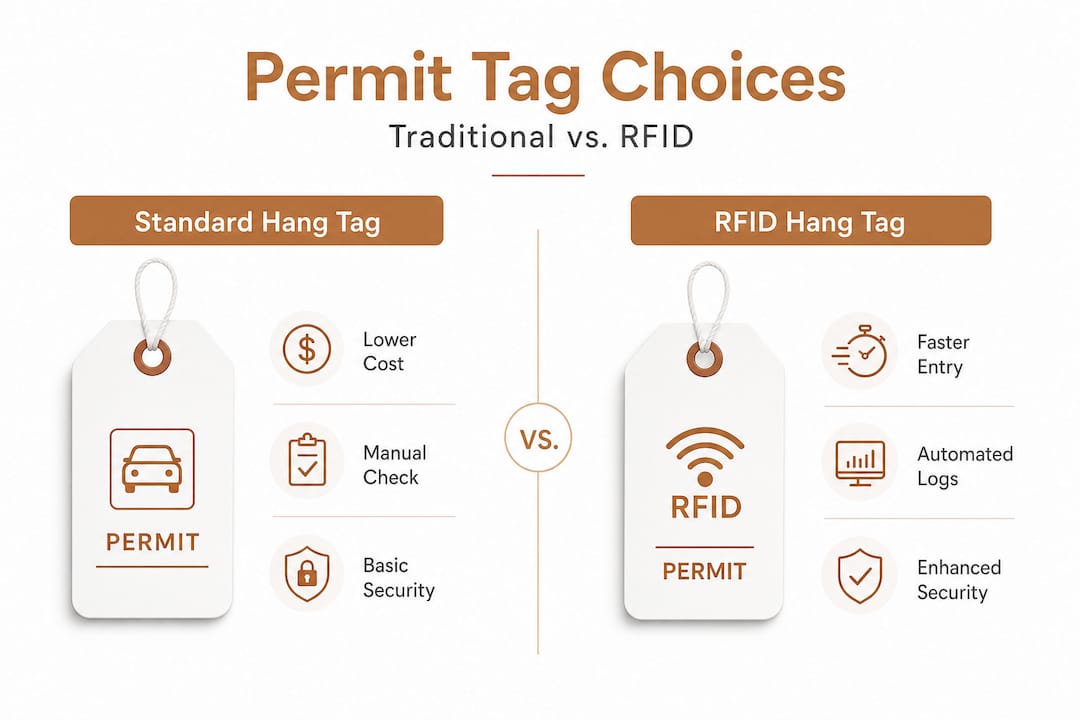
Here is a quick comparison of the two most common credential approaches for permit programs:
| Feature | Standard printed hang tag | Barcoded or RFID hang tag |
|---|---|---|
| Cost per unit | Lower | Higher |
| Enforcement method | Visual inspection | Scan or automated reader |
| Fraud resistance | Moderate | High |
| Integration with gate systems | Not applicable | Yes, with compatible hardware |
| Best for | Smaller or lower-volume facilities | High-turnover hotels, casinos, event venues |
Basic policy framework decisions also belong in this early phase. Will you issue separate credentials for guests, staff, and monthly permit holders? What is the validity period for each category? Can a permit be transferred to a different vehicle? These questions, answered now, prevent policy gaps later. Check out hang tag program tips and review your permit management forms to build a complete documentation package from the start.
With your facility’s unique requirements defined, you’ll be ready to develop a robust policy and playbook for hang tag enforcement.
Policy design and enforcement playbooks
A hang tag is only as effective as the rules that govern it. Vague policies create gray areas that staff and guests will exploit, intentionally or not.
Step-by-step policy design process:
- Define display requirements precisely. Specify that the tag must hang from the rear-view mirror with the printed face visible from the front of the vehicle. Ambiguity here is the number one cause of false citations.
- Link credentials to specific vehicles. Many parking programs tie the credential to vehicle identity and explicitly prohibit transfer or resale, using either license plate linking or permitholder account rules. Build this into your application form.
- Create separate permit categories with distinct visual identifiers. Use different colors or numbering sequences for guest permits, staff permits, and temporary day passes.
- Set clear expiration protocols. Date-specific validity printed directly on the tag removes any ambiguity during enforcement patrols.
- Write a staff enforcement workflow. Who issues citations? Who handles disputes? What documentation is required?
“Mechanics for a robust hang-tag permit program: clear rules for display placement, credential-device linkage to curb misuse, date and zone-specific validity, and operations playbooks that address staffing instructions and enforcement verification to reduce disputes.” — Boise State University Transportation
Dispute resolution is where many programs fall apart. When a guest claims their tag was properly displayed but still received a citation, your team needs a documented review process. Require enforcement officers to photograph the vehicle before issuing any citation. This single step dramatically reduces unresolvable disputes.
Pro Tip: Create a one-page quick reference card for enforcement staff that covers the top five display violations and the correct citation procedure for each. Laminate it and keep it in every patrol vehicle or enforcement station.
Review your enforcement procedures and use display enforcement examples to train staff on what proper and improper display looks like in practice.
Strong policies and enforcement playbooks lay the foundation, but getting the right permit allocation is key for high-demand venues.
Determining permit allocation and utilization benchmarks
How many permits should you issue? This is one of the most consequential decisions in the entire program, and it is often made with too little data.
Key factors that drive permit allocation decisions:
- Peak occupancy rates by day of week and time of day
- Ratio of staff to guest parking needs
- Seasonal demand fluctuations for event venues and resort hotels
- Whether overflow parking is available nearby
For high-demand contexts, some garages expand permit programs by reallocating a percentage of spaces to permit holders, and benchmarking is often structured to cap the permit share to control utilization. The critical insight here is that over-issuing permits is just as damaging as under-issuing. When too many permit holders arrive simultaneously and cannot find a space, the program loses credibility instantly.
A widely cited operational benchmark: one facility limits permit parking to a fixed share of total parking at a 25% cap while measuring real utilization to adjust allocations over time. This approach prevents the program from creating a parallel demand lane that causes congestion at entry points.
How to set your initial allocation:
- Start with a 30-day utilization study before launching the program. Count actual vehicles in permit zones at peak and off-peak hours.
- Set your initial permit issuance at 80% of your target capacity to leave buffer room.
- Review utilization monthly for the first quarter and adjust up or down based on real data.
- Track the ratio of permits issued versus permits actively used. A high issuance rate with low active use suggests over-allocation.
Explore allocation strategies and consider upgrading to RFID or barcoded permits to automate utilization tracking with gate-level data rather than manual counts.
Once permit allocation is set, upgrading to modern identification technologies can streamline operations and enforcement.
Modernizing with RFID hang tags and integrated systems
Traditional printed hang tags work well for lower-volume facilities, but hotels, casinos, and large event venues operate at a pace where manual visual enforcement cannot keep up. RFID technology changes that equation significantly.
How RFID hang tags work in practice:
- Each tag contains a small embedded chip with a unique encoded identifier
- Readers mounted at entry and exit gates detect the tag as the vehicle approaches
- The backend authorization database confirms whether the credential is valid in real time
- Entry is granted or denied automatically, with a full log entry created for each transaction
RFID-enabled hang tags are a common modernization path for permit programs, allowing contactless identification and automated entry and exit logging when integrated with gates, readers, and backend authorization databases. For a hotel with 400 rooms and a busy valet operation, this level of automation is not a luxury. It is a necessity.
Some established deployments use RFID tags specifically for valet services to streamline garage access, indicating a proven fit for high-turnover hotel and casino workflows where valet is a special-case circulation mode.

Comparing RFID and traditional hang tags:
| Capability | Traditional hang tag | RFID hang tag |
|---|---|---|
| Entry speed | Manual gate or visual check | Contactless, under 2 seconds |
| Utilization tracking | Manual counts | Automated, real-time |
| Fraud prevention | Color coding, serial numbers | Unique encoded chip, anti-clone |
| Staff required for enforcement | Higher | Lower |
| Upfront cost | Lower | Higher, offset by labor savings |
Security improvements with RFID are substantial. Security and convenience trade-offs for hang tags support flexibility and transfer, which is useful for staff or multi-vehicle users, but security improves significantly by adding unique encoded credentials such as barcode, QR code, or RFID combined with explicit linking and anti-transfer rules. An RFID tag that is linked to a specific license plate and automatically deactivated when transferred to a new vehicle closes one of the biggest loopholes in traditional permit programs.
Pro Tip: When specifying RFID hang tags, ask your supplier about read range. A tag with a 3-to-5-meter read range works well for most garage entry lanes, but high-speed entry points may require a longer range to avoid gate timing issues.
Review your options for valet RFID integration to understand how these systems connect with your existing valet ticketing workflow.
With your program modernized, it is time to verify ongoing effectiveness and troubleshoot common operational challenges.
Verifying results and troubleshooting common pitfalls
Even a well-designed program develops problems over time. Routine verification keeps small issues from becoming costly ones.
Step-by-step verification process:
- Conduct weekly spot checks of permit zones during peak hours. Look for expired tags, improperly displayed credentials, and vehicles without permits in designated spaces.
- Review your citation log monthly. A spike in citations for the same violation type usually signals a policy communication gap, not a guest behavior problem.
- Audit your issued permit inventory quarterly. Confirm that the number of active permits matches your allocation targets.
- Collect guest and staff feedback through brief surveys or front desk comment cards. Permit confusion is often reported informally before it shows up in formal data.
- Update your enforcement playbook whenever a new edge case arises. Document the resolution and share it with the team.
Enforcement and guest instructions must address accurate display location and expiration specificity to avoid false citations when a parking facility uses hang tags as credentials. This is a common source of guest disputes that can be prevented entirely with clearer printed instructions on the tag itself.
Common mistakes and how to fix them:
- Misplaced hang tags: Guests often set tags on the dashboard instead of hanging them. Add a diagram to the permit envelope showing correct placement.
- Outdated credentials still in circulation: Implement a color rotation system where each permit period uses a distinct color. Enforcement staff can spot expired tags instantly without reading the date.
- No process for lost or damaged tags: Create a documented replacement procedure with a small administrative fee to discourage casual replacements.
Pro Tip: Use display and expiration troubleshooting resources to build a visual training guide for your enforcement team. A one-page illustrated reference reduces citation errors and speeds up patrol training significantly.
What most facility managers overlook about permit hang tag programs
After working with parking operations across hotels, casinos, and event venues for decades, one pattern stands out clearly. Most managers treat permit allocation as a logistics problem when it is actually a guest experience problem.
The number of permits issued directly affects how guests feel about your facility. Issue too many and permit holders arrive to find no available spaces, which creates frustration that gets directed at your front desk and your brand. Issue too few and you leave revenue on the table while staff compete with guests for limited spots. Neither outcome is acceptable, yet both are common because allocation decisions are often made once at program launch and never revisited.
The real risk of loose enforcement is subtler than most managers expect. When enforcement is inconsistent, permit holders who follow the rules start to resent those who do not. That resentment surfaces in reviews, in conversations with your concierge, and in lower satisfaction scores. Tight, consistent enforcement actually improves guest experience for the majority who play by the rules.
Policy ambiguity is the other underestimated risk. When your permit policy does not clearly define transfer rules, display requirements, or expiration procedures, your enforcement staff will interpret those gaps differently. Inconsistent enforcement is worse than no enforcement because it creates the perception of favoritism.
The facilities that run the most effective permit programs treat the hang tag as one component of a broader parking management system. They integrate RFID credentials with gate software, they review utilization data monthly, and they update their playbooks when edge cases arise. Explore parking program case studies to see how other facilities have built programs that hold up under real-world demand.
The investment in getting this right pays off in reduced disputes, faster entry times, and a parking experience that reflects well on your property overall.
Upgrade your parking garage permit hang tag program with proven solutions
Running a permit hang tag program at scale requires more than a good policy document. It requires credentials built to last, forms designed for accurate record keeping, and ticketing solutions that integrate with the systems your team already uses.
Caymil Printing Co. has supported parking operations at hotels, casinos, event venues, and commercial garages since 1937. Whether you need custom-printed parking permit forms to document permit issuance, barcoded valet tickets that integrate with your gate system, or machine-issued valet tickets compatible with Amano, TIBA, SKIDATA, and other major platforms, Caymil delivers durable, customizable solutions with fast nationwide shipping. Contact our team to discuss your facility’s specific requirements and get a quote on a permit solution built for your operation.
Frequently asked questions
What is the best way to display a parking garage permit hang tag?
Hang tags should be hung from the rear-view mirror with the printed face visible from the front of the vehicle, as specified by facility policy, to ensure visibility and prevent citations. Placing the tag on the dashboard is a common error that enforcement staff should be trained to address.
How can we prevent permit misuse and unauthorized transfers?
Linking permits to license plates and enforcing strict anti-transfer rules reduces misuse and increases accountability across both staff and guest permit categories. Adding unique barcodes or RFID encoding makes unauthorized transfers easier to detect and enforce.
What is a typical cap or ratio for permit spaces in high-demand parking venues?
Industry benchmarks recommend reserving no more than 25% of spaces for permit holders, and Sound Transit reported that its permit program serves roughly 5 to 10% of garage users while capping permits at 25% of total parking capacity. Starting below your maximum cap gives you room to scale without creating congestion.
How can RFID hang tags improve our permit hang tag program?
RFID-enabled hang tags enable contactless vehicle identification and automated entry and exit logging, which reduces the need for manual enforcement patrols and speeds up gate access for permit holders. The integration with backend authorization databases also makes it easy to deactivate credentials instantly when a permit is reported lost or transferred.
What are the most common mistakes managers make with hang tag programs?
The most frequent issues include unclear display rules, allowing expired tags to remain in circulation, and failing to update permit allocations based on actual utilization data. Enforcement instructions must address accurate display location and expiration specificity to avoid false citations that damage guest trust.