
Avoid Costly Reprints: RFP Ready Specs for City Parking Permit Decals
For most municipal resident and visitor programs, a UV-laminated vinyl windshield decal or a polystyrene hang tag with sequential numbering delivers the best mix of durability, enforcement visibility, and administrative control. Either format holds up outdoors, reads clearly at a glance, and resists tampering when specified correctly. The sections below cover materials, security features, artwork specs, application rules, and the procurement steps needed to issue municipal parking permits without costly reprints.
TL;DR:
- Most decals are made from UV-stable vinyl with lamination to resist fading, cracking, and moisture for outdoor durability, especially for annual programs.
- Sequential numbering combined with barcodes or QR codes provides the best anti-fraud security, logging permit issuance against specific vehicle and applicant records.
- A pilot batch of about 100 decals is essential before full production to identify potential printing or adhesion issues, saving costs and compliance failures later.
- Custom artwork should be high-contrast, legible from outside a vehicle, and submitted in vector format with approval of a physical proof for optimal results.
- Permit decals should be placed consistently in the lower driver corner of the windshield, with digital plate-linked permits emerging as a no-physical-decal enforcement option.
Table of Contents
- Choosing Between Windshield Decals, Hang Tags, and Digital Permits
- What Material and Adhesive Hold Up Outdoors the Longest?
- How Do Security Features Prevent Decal Fraud?
- What Print Specs Should Go in a Decal Order?
- Where Should Permits Be Displayed, and What Happens When One Is Lost?
- What Documents and Steps Does Municipal Issuance Require?
- Why Manufacturer Track Record Matters When Sourcing Decals
- What Should Municipal Budgets Account for on Decal Programs?
- How Long Does It Take From Order to Delivery?
- What Mistakes Cause Decal Programs to Fail Compliance Checks?
- An Editorial Take on Getting Decal Procurement Right
- Get Permit Decals, Samples, and Quotes Direct From the Manufacturer
- Sources
- FAQ
Choosing Between Windshield Decals, Hang Tags, and Digital Permits
The right format depends on program duration, enforcement style, and how often vehicles change within a household. Custom decals make sense when a municipality needs zone-specific colors, sequential serial numbers, or a logo tied to a particular district. Stock preprinted decals work fine for smaller programs with a single zone and no branding requirement, and they typically ship faster since there’s no design cycle involved.
Windshield decals adhere directly to glass and stay put for the life of the permit period, which makes them the standard choice for annual resident programs. Enforcement officers can verify them without leaving their vehicle, and they’re difficult to move between cars without visible damage.
Reusable hang tags, often made from polystyrene, work better for programs where the vehicle changes frequently, such as employee parking or visitor programs tied to a person rather than a plate. They cost more per unit but survive multiple renewal cycles without a new adhesive application each year.
Bumper stickers see limited use in municipal programs today because they’re harder to inspect quickly and easier to peel and transfer.
License-plate-linked digital permits are gaining traction in cities like Eugene, where the residential parking program now lets some zones skip the physical decal entirely and tie enforcement to plate lookup instead.
A quick decision checklist:
- Annual resident permits: windshield decal with sequential numbering
- Short-term visitor passes: stock hang tag or dated paper decal
- Event or temporary lots: adhesive-free hang tag for fast turnover
- Multi-zone districts: custom decal with zone color coding
What Material and Adhesive Hold Up Outdoors the Longest?
Material choice determines whether a decal survives one Midwest winter or three. Polymer vinyl with UV-stable inks is the workhorse for windshield decals because it resists cracking, fading, and moisture intrusion far better than uncoated paper stock. Polyester film offers similar toughness with a slightly stiffer feel, often chosen for decals that need extra tear resistance during removal attempts.
Lamination matters as much as the base material. A laminated decal adds a clear protective layer over the print, which extends outdoor life and blocks fading from direct sun exposure. Unlaminated decals cost less but degrade faster, usually a poor tradeoff for a 12-month permit that has to survive summer heat and winter salt spray.
For hang tags, polystyrene at roughly 30 mil thickness is the standard. It’s rigid, lightweight, resists bending, and takes full-color printing with UV-stable inks, which is why so many reusable visitor and employee tags use it instead of vinyl.
Adhesive type affects enforcement as much as durability:
- Permanent adhesive: best for annual decals, tears on removal, discourages transfer between vehicles
- Removable/repositionable adhesive: suited to short-term or trial permits, but easier to lift and reapply elsewhere
- Static cling: convenient for month-to-month passes, though it can shift or fall in extreme temperatures
When writing a purchase order, specify UV and solvent resistance directly: “Decal substrate must retain color and adhesion after a minimum of 12 months outdoor exposure and resist fading under direct UV without lamination failure.”
Pro Tip: Request rub-test and UV-exposure data from any supplier before committing to a full print run. A five-minute conversation about lamination grade can save a municipality from reissuing thousands of decals mid-cycle.
How Do Security Features Prevent Decal Fraud?
Sequential numbering is the single most useful anti-fraud tool a municipality can specify, and it costs almost nothing extra. Every decal gets a unique number logged against the applicant’s address and plate, which makes it immediately obvious when a permit shows up on a vehicle it wasn’t issued to.
Barcodes and QR codes take that a step further by linking a physical decal to an online record that enforcement staff can scan in the field. This matters most for programs with hundreds or thousands of active permits, where a visual number check alone slows down patrol officers.
Tamper-evident adhesives, microtext borders, and holographic or void-pattern graphics add another layer, though they raise per-unit cost. Smaller municipalities often skip these and rely on sequential numbering plus periodic audits instead.
When drafting a spec, include:
- Sequential numbering range and starting point
- Barcode or QR format compatible with existing scanners
- Tamper-evident adhesive requirement, if budget allows
- A logging method for issued numbers tied to applicant records
What Print Specs Should Go in a Decal Order?
Getting the artwork specs right the first time avoids the back-and-forth that delays issuance by weeks. Windshield decals typically run 2 to 3 inches in diameter for circular badge shapes or 3 by 4 inches for rectangular formats; hang tags run slightly larger, often 3 by 5 inches, to accommodate a hole punch and larger print area.
- Submit vector artwork in PDF, EPS, or AI format, built in CMYK color with a minimum 1/8 inch bleed on all sides.
- Keep zone labels, expiration dates, and permit numbers at 14 point or larger so officers can read them from outside a vehicle in daylight.
- Use high-contrast color pairings (dark text on light background or vice versa) rather than mid-tone combinations that wash out in sunlight or headlights.
- Approve a digital proof first, then request a small physical pilot batch before committing to the full run.
- Package decals in numbered sets of 25 or 50 with the number range labeled on the outside for easy distribution tracking.
Lead times run longer for fully custom artwork with security features than for stock designs, so build in extra weeks when a program launches for the first time.
Where Should Permits Be Displayed, and What Happens When One Is Lost?
Consistency in placement is what makes enforcement fast. The City of Cambridge requires resident permits on the inside lower driver-side corner of the windshield, a standard most municipalities have adopted because it puts every decal in the same visual spot for a walking patrol officer.
Some cities are shifting toward decal-to-plate linking instead of a physical sticker, letting enforcement look up a plate against a database rather than checking glass. Santa Barbara’s application guidance documents this transition directly, noting that some permit types are moving to digital-only formats tied to a vehicle’s plate.
Key operational rules:
- Record plate numbers at issuance so a sold or transferred vehicle can be flagged and its old permit revoked
- Set a clear replacement fee and process for lost or damaged decals, requiring the same proof of ownership as original issuance
- Warn residents that permits do not override ADA space restrictions, posted tow-away zones, or temporary no-parking orders, regardless of zone eligibility
What Documents and Steps Does Municipal Issuance Require?
A clean issuance workflow keeps invalid applications from clogging the queue before a single decal ever gets printed. Berkeley’s resident permit program requires a government-issued photo ID, current vehicle registration, and proof of residency such as a utility bill or lease agreement, a document set most municipalities mirror with minor variations.
Checklist for administrators building or refining an application flow:
- Government photo ID and DMV vehicle registration on file for every applicant
- Proof of residency (utility bill, lease, or property tax statement)
- Online portal steps: eligibility check, document upload, payment, approval, decal order trigger, issuance tracking
- Distribution method decided in advance: mailed decal, in-person pickup, or staged mailings for large zones
Running a pilot batch of 100 to 200 decals before the full issuance run catches material or numbering errors early, a step worth the short delay given how expensive a full reprint gets after distribution starts.
Why Manufacturer Track Record Matters When Sourcing Decals
Caymil Printing Co. has manufactured ticketing and permit products since 1937, giving municipal buyers a supplier with decades of experience producing sequentially numbered, barcoded permit decals and hang tags for programs of varying size. That kind of history matters because parking permit production isn’t a one-size print job. It has to account for adhesive chemistry, outdoor durability, and compatibility with whatever access system a city already runs, whether that’s Amano, TIBA, SKIDATA, FLASH Parking, Scheidt & Bachmann, or Flowbird.
Before signing a purchase order, ask any supplier for:
- Material rub-test and UV-exposure data
- A sample decal for barcode or QR scan testing against your existing readers
- Written tamper-evidence assurances if your program requires them
- Stated lead times and a warranty on print and adhesive defects
What Should Municipal Budgets Account for on Decal Programs?
Per-unit decal cost depends heavily on material grade, lamination, and security features, so budgeting on a flat per-decal number without those variables tends to underestimate total spend. A basic stock hang tag or decal costs less than a custom vinyl decal with sequential numbering, a barcode, and lamination, and that gap widens further if tamper-evident adhesive or microtext is added.
Municipalities should budget for more than the print run itself. Design time for custom artwork, proofing rounds, shipping, and packaging into numbered distribution sets all add to the real cost of a program. A pilot batch, while a smart safeguard against reissue costs, is itself a line item that needs a small allowance before the full order goes out.
Renewal cycles also affect the math. A one-year windshield decal that gets replaced annually costs less per unit than a five-year decal, but the annual version means printing and distribution every single year, which adds recurring labor cost even if material cost per unit stays low. Programs with high turnover, like university or event parking, often find that a slightly more durable hang tag pays for itself by surviving several reissue cycles instead of one. Building a two-to-three-year cost projection, rather than pricing a single order in isolation, tends to reveal which format actually saves money over the life of a program.
How Long Does It Take From Order to Delivery?
A typical timeline runs four to six weeks from finalized specification to delivery for a standard custom decal order, though that window shifts based on complexity and order volume. The clock starts once artwork is finalized and approved, not when a municipality first reaches out to a supplier, so building in time for internal design review before contacting a printer matters.
A realistic sequence looks like this: artwork submission and CMYK conversion take a few days; a digital proof cycle usually adds another week if revisions are needed; a physical pilot batch, when requested, adds one to two weeks for production and shipping before the full run even starts. Full production and shipping for the main order typically takes two to three weeks once artwork is locked, though rush orders with simpler stock designs can move faster.
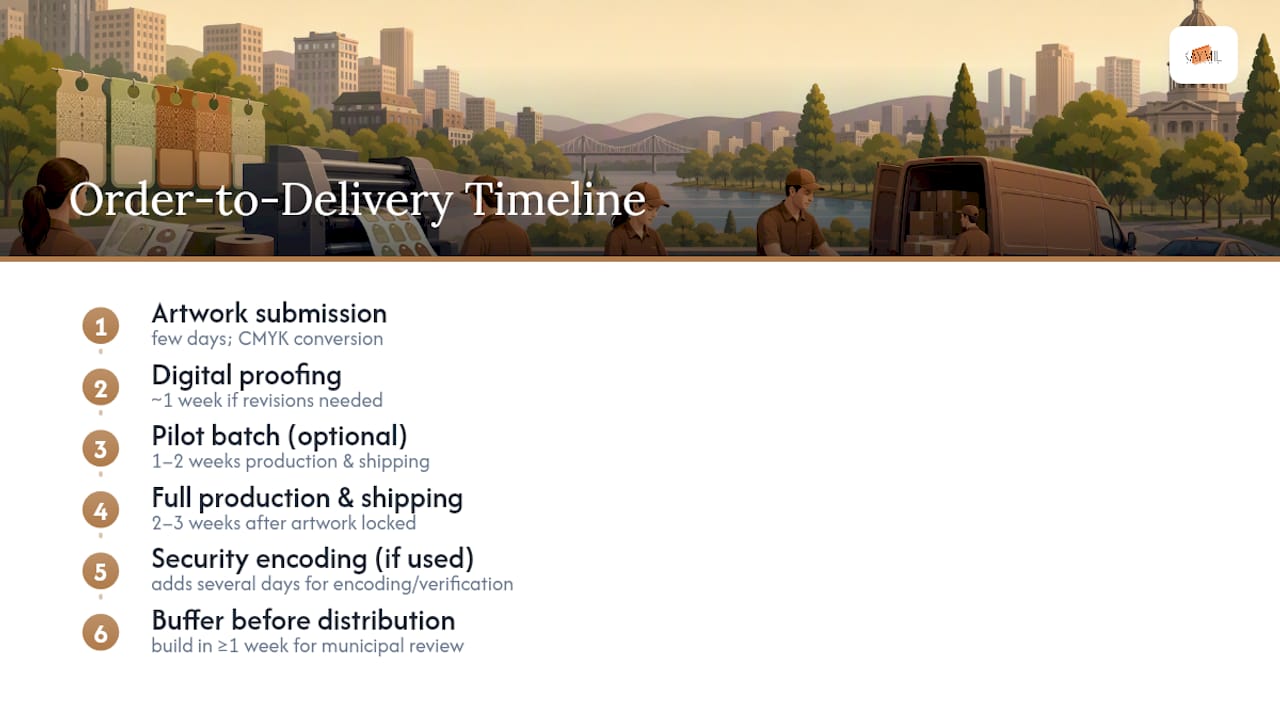
Security features add time. Sequential numbering and barcoding require an extra production step to encode and verify each unit, which can add several days versus a plain printed decal with no tracking elements. Municipalities planning a program launch or a major renewal cycle should work backward from the distribution date and build in at least a week of buffer beyond the supplier’s stated lead time, since document review and portal approval on the municipal side often takes longer than expected once applications start arriving.
What Mistakes Cause Decal Programs to Fail Compliance Checks?
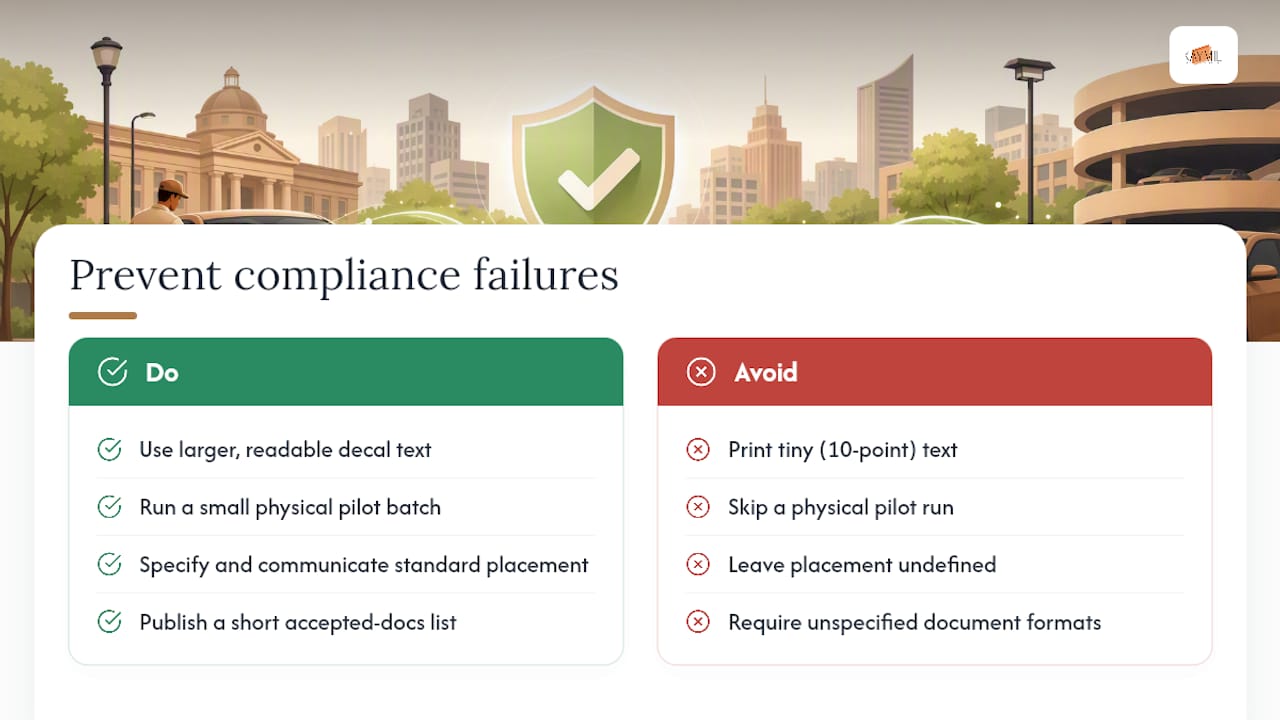
The most common design mistake is undersized text. A permit number or expiration date printed at 10 point might look fine on a screen proof, but it’s unreadable to an officer checking a windshield from outside the vehicle, which defeats the entire point of a numbered decal.
Skipping a physical pilot batch is the second recurring problem. A design that looks correct on a digital proof can print differently once it hits the actual laminate and adhesive combination, and catching that after 5,000 units have already shipped is far costlier than catching it in a 100-unit test run.
Inconsistent placement rules create enforcement gaps. If a municipality doesn’t specify and communicate a standard windshield location the way Cambridge does, officers waste time hunting for decals that residents have placed inconsistently, and some residents place them somewhere enforcement never checks at all.
Documentation mismatches cause the most applicant frustration. Requiring a specific proof-of-residency format without listing acceptable alternatives, such as a lease versus a utility bill, generates repeat submissions and slows down issuance timelines. A short list of accepted document types published upfront, as Berkeley does, cuts down on that back-and-forth substantially. Municipalities that skip pre-application eligibility checks, letting residents apply before confirming their address even qualifies, tend to see the highest rate of rejected applications and reissued paperwork.
An Editorial Take on Getting Decal Procurement Right
The conventional advice on parking decals treats them like a minor line item, something to order after the real policy decisions are made. That’s backward. Material and security choices made at the procurement stage determine whether a program runs smoothly for three years or generates a support ticket every time a decal peels, fades, or gets challenged by an officer who can’t read a faded permit number.
The most overlooked variable isn’t material grade. It’s the pilot batch. Municipalities that skip a small physical test run before full issuance almost always discover a readability or adhesion problem after the fact, when fixing it means reissuing thousands of units instead of adjusting a proof. That single step, more than any material upgrade, separates programs that run for years without complaint from ones that get reworked mid-cycle.
Prioritize documentation clarity and a pilot run before agonizing over lamination grades. Get those two right, and the material choice becomes a much smaller risk.
— Richard
Get Permit Decals, Samples, and Quotes Direct From the Manufacturer
Caymil is a direct alternative to working through a design intermediary or a generic print broker for municipal decal orders. As a manufacturer producing sequentially numbered, barcoded permit products since 1937, Caymil handles design, security features, and production in-house, which means fewer handoffs and a faster path from spec sheet to delivered decals.
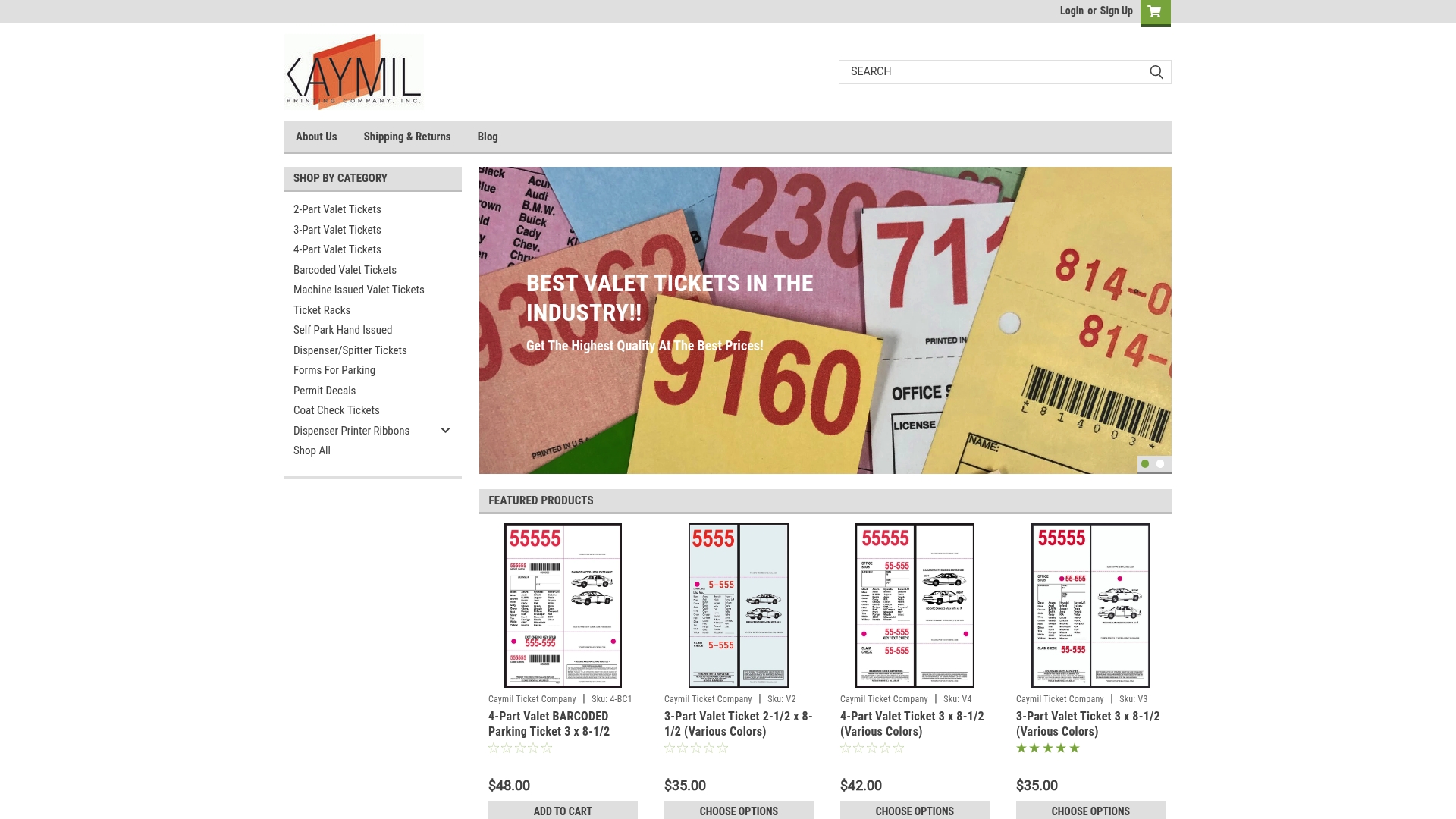
Caymil’s Permit Decals line covers windshield decals and hang tags with sequential numbering, barcode options, and custom zone colors. Pricing details are available on Caymil’s website. For municipalities also managing valet or event lots alongside resident permits, the shop-all catalog covers ticket racks and related supplies in one place. If your program needs application forms alongside decals, the Forms For Parking line runs $1 to $25 depending on format.
Contact Caymil’s sales team to request a sample decal or a quote for a custom run, including pilot batches sized for testing before a full municipal issuance.
Sources
- Resident parking permits | City of Berkeley
- Residential Parking Permits | City of Eugene
- How to Apply: Residential Parking Permit (Santa Barbara)
- Apply for/Renew a Parking Permit | City of Cambridge
FAQ
How Do I Get a Resident Parking Permit Sticker?
Most cities require a government-issued photo ID, current vehicle registration, and proof of residency such as a utility bill or lease, submitted through an online portal or in person. Requirements and portal steps vary by city, as documented in Berkeley’s resident permit program and Eugene’s residential permit process.
What Is a Parking Permit Decal?
A parking permit decal is a printed sticker or hang tag that authorizes a specific vehicle to park in a designated zone, typically showing a permit number, expiration date, and zone identifier. Municipalities issue them for resident, visitor, or employee programs, and materials range from adhesive vinyl to rigid polystyrene tags.
How Should a Parking Permit Be Displayed?
Standard practice places the decal on the inside lower driver-side corner of the windshield, the placement rule the City of Cambridge specifies for its resident program. Consistent placement lets enforcement officers verify permits quickly during a walking patrol.
How Do I Design a Custom Parking Sticker?
Submit vector artwork in PDF, EPS, or AI format in CMYK color with a 1/8 inch bleed, keeping permit numbers and dates at 14 point or larger for outdoor readability. Approve a digital proof, then request a small physical pilot batch before committing to a full production run, since laminate and adhesive can shift how colors and text render compared to a screen proof.
What Does Permit Decal Renewal Involve?
Renewal typically requires reconfirming residency and vehicle registration, then receiving a new sequentially numbered decal for the upcoming permit period. Cities that link permits to license plates digitally, an approach Santa Barbara’s application guidance describes, can streamline renewal by updating the plate record instead of reissuing a physical decal.