

Valet parking log: Essential guide for efficient operations

A valet parking log is far more than a list of cars that came and went during a shift. For hotel valet managers, casino parking directors, and event venue operators, it is the operational backbone that connects every vehicle to a claim ticket, every key to an attendant, and every guest interaction to a documented record. When a guest returns to find a scratch on their door or a set of keys goes missing, the log is what stands between your facility and a costly dispute. This guide breaks down exactly what a valet parking log contains, why each element matters, and how to build a system that protects your operation and reinforces guest trust.
Table of Contents
- What is a valet parking log: Breaking down the essentials
- Key control and custody: Why it matters in your log
- Incident tracking and audit trails: The log’s role in risk mitigation
- How to build an effective valet parking log: Best practices and templates
- What most managers overlook about valet logs
- Streamline your valet log system with Caymil solutions
- Frequently asked questions
Key Takeaways
| Point | Details |
|---|---|
| Comprehensive log essential | A complete valet log tracks vehicles, keys, operations, and guest signatures to prevent disputes. |
| Key custody accountability | Logging key movements and ticket associations minimizes errors and supports operational security. |
| Audit and incident tracing | Valet logs enable efficient incident tracking and compliance audits, reducing liability risks. |
| Best practices boost trust | Consistent log procedures, guest confirmations, and regular audits improve customer experience and manager peace of mind. |
What is a valet parking log: Breaking down the essentials
A valet parking log is a record of valet operations, typically used to track each vehicle and key/claim ticket through check-in, staging/parking, retrieval, and return to the guest. That definition sounds straightforward, but the operational reality is more layered. A well-designed log captures every handoff point in a vehicle’s journey through your facility, from the moment a guest steps out of the car to the moment they drive away satisfied.
Think of the log as a chain of documented events. Each link in that chain corresponds to a specific action taken by a specific attendant at a specific time. If any link is missing or vague, the entire chain loses its value as an accountability tool.
A simple valet ticket system works best when the physical ticket and the log entry are treated as inseparable. The ticket number is the anchor for every log entry tied to that vehicle.
Core components of a valet parking log
A complete log entry should include the following elements for every vehicle processed:
- Claim ticket number: The unique identifier linking the physical ticket to the log record
- Attendant identity: Name or employee ID of the attendant who accepted the vehicle
- Vehicle description: Make, model, color, and license plate number
- Pre-condition notes: Any existing damage, scratches, or notable conditions observed at check-in
- Parked location: Specific bay, row, or zone where the vehicle is staged
- Key custody notation: Who holds the keys and when they were transferred
- Check-in timestamp: Exact time the vehicle was accepted
- Retrieval timestamp: Exact time the vehicle was pulled for return
- Guest return confirmation: Signature or acknowledgment from the guest upon vehicle return
Pro Tip: Always tie the guest return confirmation step directly back to the original log entry. If a guest later claims damage occurred during valet, your signed return confirmation is the clearest evidence of what condition the vehicle was in when it left your care.
Key log fields and their operational purpose
| Log field | Purpose |
|---|---|
| Claim ticket number | Links physical ticket to log record for fast lookup |
| Attendant identity | Establishes accountability for each vehicle handoff |
| Vehicle condition at check-in | Documents pre-existing damage to prevent false claims |
| Parked location | Enables fast retrieval and reduces search time |
| Key custody record | Tracks who handled keys and when |
| Check-in/out timestamps | Supports billing accuracy and shift accountability |
| Guest return signature | Closes the loop and confirms satisfactory return |
Every one of these fields serves a distinct operational function. Skipping even one, such as the parked location, can cost your team minutes per retrieval during a busy event night, multiplying into significant delays and frustrated guests.
Key control and custody: Why it matters in your log
Once you understand the basic structure of a valet log, the next layer to master is key control. Valet logs often function as key control logs (chain-of-custody), documenting who accessed keys and when, and tying keys to claim tickets/tags to reduce mis-keys and support accountability.

A mis-key incident, where the wrong keys are handed to a guest or the wrong vehicle is retrieved, is one of the most damaging errors a valet operation can experience. Beyond the immediate safety risk, it creates liability exposure and can permanently damage your facility’s reputation. A rigorous key custody log is your primary defense against this scenario.
Manual vs. electronic key logs: A practical comparison
| Feature | Manual key log | Electronic key log |
|---|---|---|
| Accountability | Relies on handwriting legibility and staff discipline | Automated entries with user login timestamps |
| Error rate | Higher risk of illegible or missed entries | Significantly reduced through required field completion |
| Audit process | Manual page-by-page review | Searchable by ticket number, date, or attendant |
| Cost | Low upfront cost | Higher initial investment, lower long-term risk |
| Speed of lookup | Slow during disputes or audits | Near-instant retrieval |
| Backup capability | Requires physical storage and copying | Digital backups can be automated |
Both systems can work effectively, but the choice should reflect your volume and risk exposure. A high-volume casino valet operation processing 500 or more vehicles per night has very different needs than a boutique hotel handling 40 vehicles per evening.
Common mis-key scenarios and how logs prevent them
- Duplicate ticket numbers: Sequential numbering on barcode tracking for valet keys eliminates the risk of two vehicles sharing the same identifier
- Unlogged key transfers: When attendants hand off keys between shifts without a log entry, custody gaps appear that are nearly impossible to reconstruct
- Illegible handwriting on manual logs: Pre-printed fields and structured formats reduce the chance of critical information being misread
- Missing return confirmations: Without a signed return step, there is no documented proof that keys were handed back to the correct guest
Using key-tracking ticket solutions with multi-part carbonless formats means every copy of the ticket carries the same identifying information, reducing the chance of a mismatch between the log and the physical ticket.
Key custody errors are a leading cause of guest disputes in valet operations. A single mis-key incident can trigger insurance claims, legal action, and loss of repeat business that far outweighs the cost of implementing a structured log system.
Incident tracking and audit trails: The log’s role in risk mitigation
Key custody is critical, but the valet log’s role extends further into incident management and operational compliance. Valet logs may be implemented as structured audit/checklists (paper or digital) that summarize operational compliance and capture incidents such as damage, missing items, or theft with traceability to ticket number and date.
When an incident does occur, whether it is a reported scratch, a missing item from a vehicle, or a complaint about service, the log is your primary tool for investigation. Without traceability to a specific ticket number and timestamp, reconstructing what happened is largely guesswork.
Steps to document and follow up on incidents using the log
- Identify the claim ticket number associated with the vehicle or guest involved in the incident
- Pull the full log entry for that ticket, including check-in condition notes, attendant identity, and timestamps
- Review the pre-condition documentation to determine whether the reported damage was noted at check-in
- Identify the attendants who handled the vehicle from check-in through retrieval
- Gather witness statements from the attendants listed in the log entry
- Document the incident as a separate notation tied to the original ticket number
- Escalate to management review with the full log record attached
- Archive the incident record alongside the original log entry for the retention period
Using audit log valet tickets with two-part carbonless formats means your operation retains a copy of every transaction, even when the guest takes the original ticket. This is a simple but powerful safeguard.
“Condition checks and signature closure are your strongest defense against damage claims. If you document the vehicle’s condition at check-in and collect a guest signature at return, you have covered the two most critical risk points in the entire valet transaction.”
Connecting incident records to incident traceability solutions that are compatible with your parking management system makes the audit process faster and more reliable, particularly for facilities that process high volumes of vehicles.
How to build an effective valet parking log: Best practices and templates
Understanding what a log should contain is one thing. Building a system that your team actually uses consistently is another challenge entirely. The best log system is one that is simple enough for attendants to complete quickly under pressure and detailed enough to hold up during an audit or dispute.
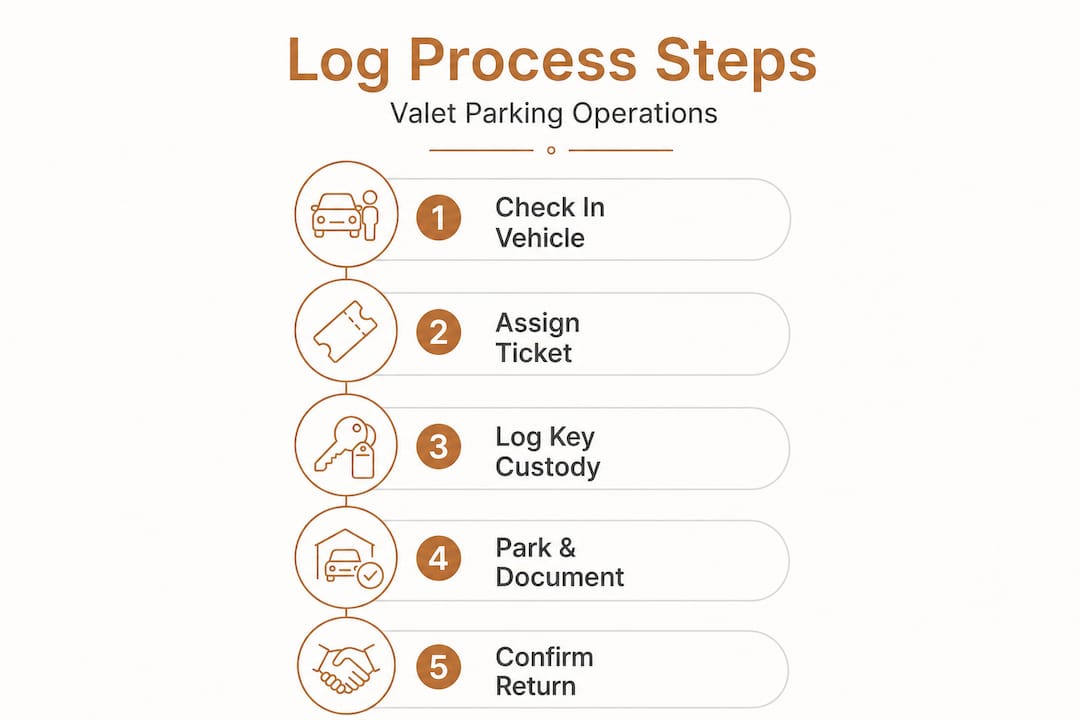
Vehicle retrieval and guest return should be logged with a customer-facing proof step, such as a guest signature or return confirmation, tied back to the original ticket/checklist entry to close the loop. This single practice eliminates more disputes than any other procedural change you can make.
Best practices for valet log implementation
- Use consistent, pre-numbered ticketing so every log entry has a unique, traceable identifier from the start
- Require attendant sign-off at each handoff point, not just at check-in and return
- Conduct periodic shift audits where supervisors spot-check log entries for completeness and accuracy
- Maintain digital backups of paper logs by scanning or photographing completed log sheets at the end of each shift
- Train new attendants on log procedures during onboarding, not just on vehicle handling
- Standardize your pre-condition checklist so every attendant uses the same criteria when noting vehicle condition
- Collect guest signatures at return as a non-negotiable step, not an optional courtesy
Template considerations by facility type
Different facilities have different log needs. A hotel valet operation typically processes vehicles over extended periods, requiring logs that track overnight storage and multiple-day stays. Casino valet operations often deal with rapid turnover and high volume, making speed of entry and barcode scanning critical. Event venue valet operations face surge periods where dozens of vehicles arrive simultaneously, requiring templates that allow for fast, accurate entry without slowing the guest experience.
For hotels, consider log templates that include a field for room number or guest name to support concierge coordination. For casinos, custom ticket templates with barcodes that integrate with your parking management system dramatically reduce manual entry time. For event venues, pre-printed multi-part tickets allow attendants to complete entries quickly while retaining a copy for the log.
Pro Tip: Archive completed valet logs for a minimum of two years. Many liability claims related to vehicle damage or theft surface weeks or months after the incident. Having retrievable records from that period is often the difference between a resolved claim and an undefended one.
What most managers overlook about valet logs
Most valet managers understand that logs are important. Fewer understand why specific elements of the log carry disproportionate weight in protecting their operation. The common focus tends to be on vehicle tracking, which is necessary but incomplete.
The operational nuance is that the log is not only about cars. It must cover key custody and condition documentation. Missing either one increases dispute risk from damage claims and can cause security issues when wrong keys or wrong vehicles are involved.
Many operations document the vehicle at check-in and then treat the log as complete once the car is parked. The retrieval and return steps are often rushed or skipped entirely during busy periods. This is precisely when the risk is highest. A vehicle that is retrieved incorrectly, or returned without a signed confirmation, creates a gap in the chain of custody that cannot be reconstructed after the fact.
Monthly operational audits are one of the most underused tools in valet management. By reviewing a sample of completed log entries each month, managers can identify patterns: which attendants consistently skip condition notes, which shifts have the most incomplete entries, and where the log system is breaking down under pressure. This kind of proactive review is far more effective than reacting to incidents after they occur.
“A complete log isn’t just for compliance. It’s for reputation and repeat business. Guests who trust that your operation is organized and accountable are guests who return and recommend your facility to others.”
The best practices for valet tickets reinforce this point. A well-designed ticket that supports complete log entries is not just an operational tool. It is a visible signal to guests that your facility takes their vehicle and their experience seriously.
Streamline your valet log system with Caymil solutions
Building a reliable valet parking log starts with having the right ticketing products in place. The physical ticket is the foundation of every log entry, and its design directly affects how accurately and efficiently your team can document each transaction.
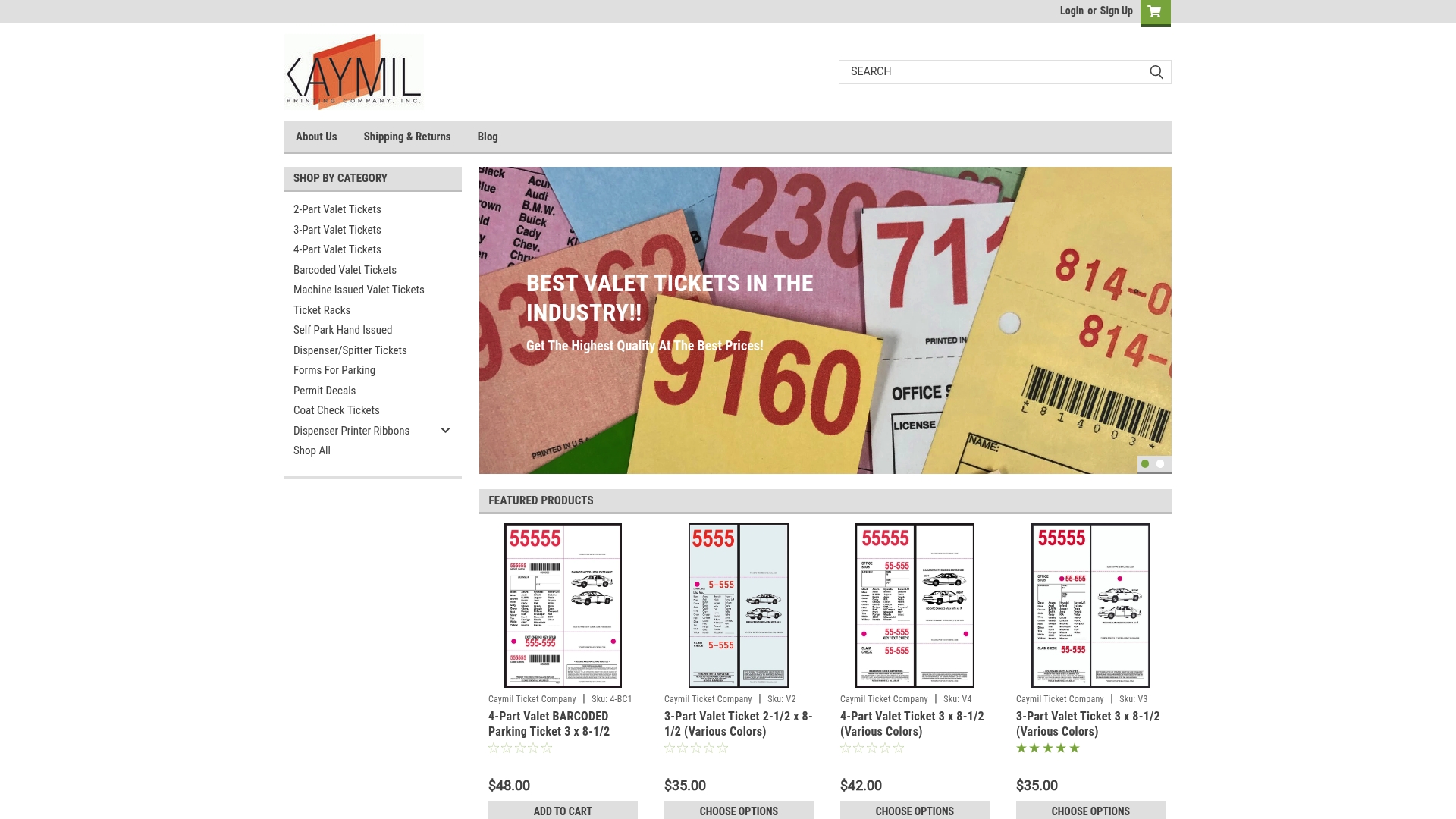
Caymil Printing Co. has been manufacturing valet and parking ticketing solutions since 1937, and that depth of experience shows in every product. From parking log forms designed to support structured log-keeping, to machine-issued valet tickets that integrate with high-volume operations, Caymil offers solutions for every facility type and scale. For operations that need fast, accurate key and vehicle tracking, barcode ticket solutions with sequential numbering and scannable codes reduce manual entry errors and speed up the audit process. Whether you manage a hotel, casino, or event venue, Caymil’s team can help you select or customize the right products to support a log system that holds up under pressure.
Frequently asked questions
What information should a valet parking log always include?
A valet parking log should capture claim ticket number, vehicle details, attendant identity, key custody, parked location, condition checks, and guest return confirmation. According to valet parking operations guidance, these elements together create a complete record from check-in through return.
How does a valet log help prevent disputes?
By precisely documenting vehicle condition, key custody, and guest interactions, the log provides proof to resolve claims and reduce liability. Structured audit/checklists that capture incidents with traceability to ticket number and date are especially effective in defending against false damage claims.
Is an electronic log better than paper for audits?
Electronic logs offer easier auditing, faster lookup by ticket number or date, and better incident tracking, but paper logs with pre-printed fields and multi-part carbonless formats can be highly effective for smaller or mid-volume operations. The best choice depends on your facility’s volume and existing parking management infrastructure.
How long should valet logs be kept for liability purposes?
Valet logs should be archived for at least one to two years to support liability defense and incident review, since damage or theft claims can surface long after the original transaction date.