
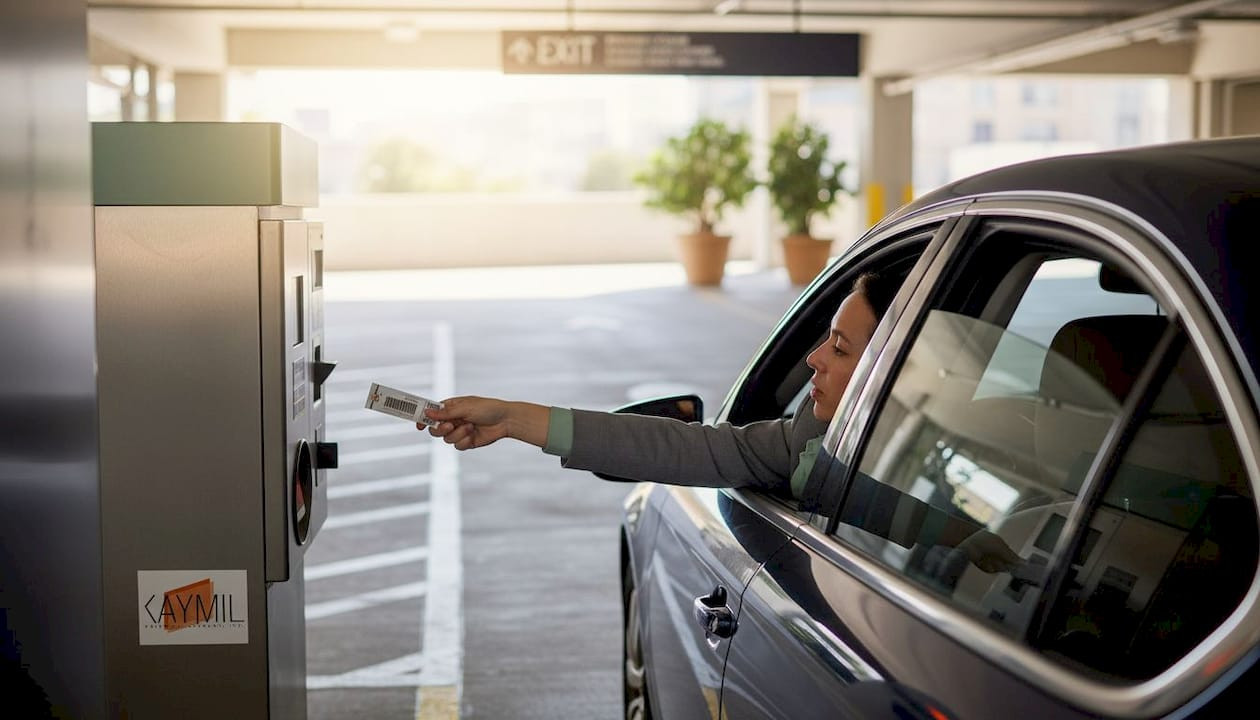
Why barcode tickets make parking garages more efficient
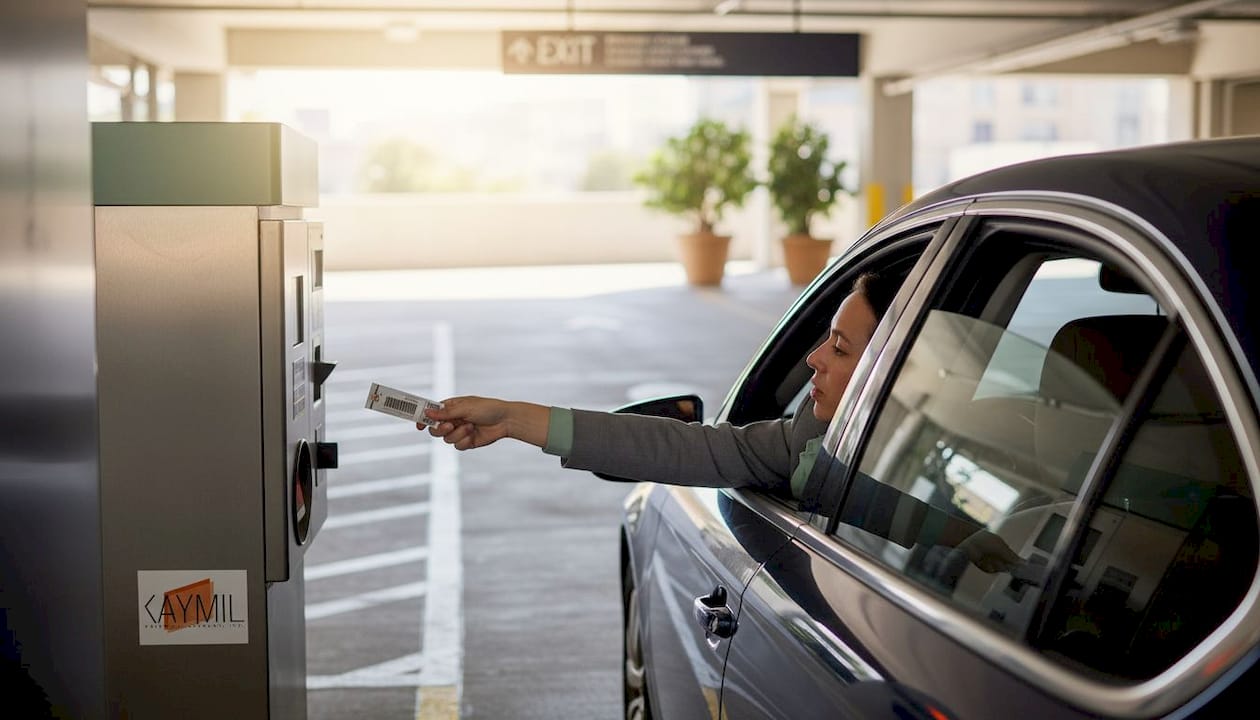
Walk into almost any parking garage in the United States and you will find the same scene: a line of cars at the entry lane, a dispenser spitting out a small ticket, and drivers tucking that slip of paper onto their dashboard. It seems simple enough. But the moment that barcode gets printed, a structured workflow kicks in behind the scenes, linking fee calculation, access control, and fraud prevention into one seamless process. Barcode tickets are not a relic of pre-digital parking management. They are a deliberate operational choice that solves real problems, and understanding exactly how they work gives facility managers a meaningful edge in keeping their garages running smoothly.
Table of Contents
- The role of barcode tickets in access control
- How barcode tickets streamline parking operations
- Fraud prevention and validation: Barcode advantages and limitations
- Auditability and dispute management with barcode validation
- Why barcode tickets persist despite new technologies
- Barcode ticketing: What most operators get wrong (and how to do it better)
- Upgrade your garage’s ticketing system with proven barcode solutions
- Frequently asked questions
Key Takeaways
| Point | Details |
|---|---|
| Universal access | Barcode tickets allow anyone, including walk-up and transient customers, to access garage services with ease. |
| Speed and efficiency | Barcodes streamline entry and exit processes, reducing lines and operator workload without sacrificing control. |
| Fraud control | Encoded data on barcode tickets supports advanced validation and reduces common parking abuses. |
| Audit and dispute protection | Barcode ticketing enables accurate logs for auditing transactions and quickly resolving service disputes. |
| Enduring relevance | Barcode tickets persist because they balance simplicity, cost, and accessibility even as technology evolves. |
The role of barcode tickets in access control
A barcode ticket is the physical session identifier for every transient parking customer. The moment a driver pulls up to a lane, the entry dispenser issues a ticket printed with a unique barcode, and that barcode becomes the vehicle’s credential for the entire stay. As noted in RFID vs. LPR vs. Ticket Access Control, barcode tickets serve as a physical parking credential, linking entry time, gate activity, and fee accumulation under one scannable code.
At the exit lane, the driver presents the ticket to a pay station or validator. The scanner reads the barcode, retrieves the session record, calculates the fee based on duration, and authorizes the gate to open. No ticket means no gate opens. This simple logic is what makes barcodes so effective for parking garage ticketing in facilities that serve a high volume of short-term, one-time visitors.
Why barcode tickets work well for access control:
- Each ticket carries a unique, machine-readable code tied to a specific entry event
- Entry and exit gates will not open without a valid credential scan
- Physical tickets support walk-up access for visitors who have no pre-registered account
- The system creates an automatic timestamp log for every lane interaction
- Lost or duplicated tickets are manageable through rate caps and validation rules
| Feature | Barcode ticket | No-ticket (open lot) |
|---|---|---|
| Access control | Gated, credentialed | None |
| Session tracking | Automatic via scan | Manual or none |
| Fraud exposure | Low to moderate | High |
| Walk-up friendly | Yes | Yes |
| Fee enforcement | Strong | Weak |
Pro Tip: Review your entry and exit lane signage at least twice a year. Clear instructions on how to take, hold, and present a barcode ticket reduce driver confusion and cut down on the stop-and-fumble delays that cause congestion.
How barcode tickets streamline parking operations
Having established the basics, it is important to see what sets barcode tickets apart operationally from other access control methods. The core value is speed combined with structure. A scanner can read and process a barcode in under a second, which is far faster than a human attendant manually logging plate numbers or verifying pre-paid passes by hand.
According to how parking garage tickets work, barcode tickets improve operational efficiency in gated garages because the barcode provides a fast, structured way for equipment to identify the session and calculate charges at exit. That speed matters most during peak hours, when dozens of vehicles are queuing to leave within the same 15-minute window.
A typical customer journey with barcode tickets:
- Driver approaches entry lane and triggers the dispenser sensor
- Dispenser issues a thermal barcode ticket with entry timestamp encoded
- Entry gate opens and the driver proceeds to park
- Before returning to the vehicle, the driver pays at a pay station, which reads the barcode and calculates the fee
- Driver approaches the exit lane and presents the validated ticket
- Exit scanner confirms payment, the gate opens, and the session is closed in the system
Barcode vs. other access control methods:
| Method | Cost to implement | Speed at exit | Walk-up friendly | Hardware needed |
|---|---|---|---|---|
| Barcode ticket | Low to moderate | Fast | Yes | Dispensers, scanners, pay stations |
| RFID tag | Moderate to high | Very fast | No | Readers, tag issuance |
| License plate recognition (LPR) | High | Very fast | Limited | Cameras, processing servers |
| Manual attendant | Variable | Slow | Yes | Staff only |
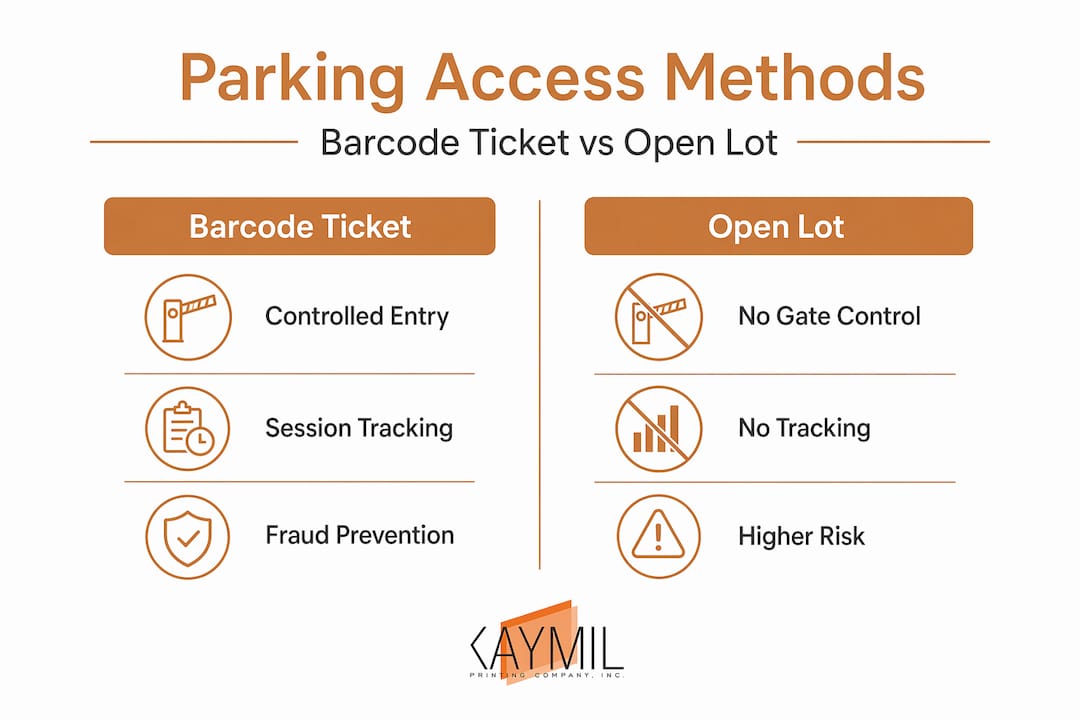
The comparison makes one thing clear: barcode tickets occupy a practical middle ground. They are faster and more structured than manual systems, and far less expensive to deploy than full RFID or LPR infrastructure. For mixed-use garages and urban facilities that see a rotating population of daily visitors, that balance is hard to beat. Barcode valet parking tickets follow the same logic, giving valet operations a structured, scannable record for every vehicle key handed over.
Pro Tip: Even with barcode automation in place, schedule routine equipment calibration every quarter. Dirty or misaligned scanner heads are responsible for a surprising share of exit lane slowdowns, and the fix takes minutes when caught early.
Fraud prevention and validation: Barcode advantages and limitations
With speed and efficiency in play, attention naturally turns to how barcode ticketing provides robust fraud prevention and validation capabilities. Barcode data can be encoded with session-specific information that limits reuse, discounting abuse, and unauthorized exits. According to the parking validation programs guide, barcode ticketing supports fraud and abuse controls via encoded validation and exit validation workflows, but its effectiveness depends on compatible hardware and operational controls.
“The validation approach uses magnetic codes or barcodes… the pay station reads the encoded validation and applies discounts, improving fraud control compared with less-encoded validation, while requiring regular calibration and compatibility with ticket technology.”
This is a meaningful distinction. Encoding validation data directly into the barcode means the pay station can automatically apply a merchant discount or a time-based rate without relying on a human to enter codes manually. That automation closes a major abuse vector: staff manipulation of rates or unauthorized rate sharing between customers.
Fraud prevention best practices for barcode systems:
- Use one-use barcode codes configured to reject re-scans after successful exit
- Set rate caps that prevent a single ticket from accumulating fees beyond the maximum daily rate
- Require hardware calibration schedules so scanners read encoded validation accurately
- Audit validation partners regularly to ensure their validation devices are functioning correctly
- Post clear signage explaining the validation process to reduce disputes from confused customers
The real-world risks are worth naming directly. Code sharing happens when one paying customer passes a validated ticket back through the exit to a second vehicle. Failed validation is another pain point, where a merchant’s validator dispenses an unreadable code and the customer is charged the full rate at exit, triggering a dispute. Good process design and machine-issued validation equipment go a long way toward preventing both scenarios. Clear lane instructions on what a valid ticket looks like and what to do when validation fails reduce the volume of frontline staff escalations significantly.
Auditability and dispute management with barcode validation
Beyond fraud control, barcode ticketing also strengthens auditability and streamlines dispute management for garage operators. Every scan generates a data event. When those events are captured and stored by a ticket validator or parking management system, you get a timestamped trail of every entry, payment, validation attempt, and exit, and that trail is extraordinarily useful when a customer claims they were overcharged or locked out of the exit lane.

As outlined in the ticket validator function and deployment checklist, barcode-ticket workflows are often paired with ticket validators that capture the credential, evaluate validation rules, and log events for auditability and dispute handling. The logging does not happen by accident. It requires validators and pay stations that are configured to store event data, which is one reason why choosing compatible, well-maintained equipment matters so much. Reviewing your parking system ticket logging setup periodically ensures you are capturing the data you will need when a dispute arises.
How the barcode validation and audit workflow operates:
- Customer arrives at pay station and inserts or scans barcode ticket
- System retrieves the session record tied to that unique barcode
- Validation rules are evaluated: merchant discount, duration cap, pre-payment status
- Fee is calculated and payment is processed; the event is logged with a timestamp
- Customer proceeds to exit lane; scanner re-confirms the session was paid
- Exit gate opens; session is closed and the full event log is archived
A well-run garage handling 3,000 to 5,000 transactions per month can generate tens of thousands of individual log entries. Most parking management systems retain those logs for 90 days to two years depending on operator configuration. When a dispute comes in, a manager can pull the exact sequence of events for a specific ticket number in minutes, which is far faster and more accurate than relying on an attendant’s memory or handwritten records.
Why barcode tickets persist despite new technologies
After seeing what barcode tickets offer, it is essential to weigh them against the shifting technology landscape now influencing operator choices. RFID and LPR systems are growing in adoption, particularly for monthly parkers and subscription-based access programs. But the key limitation of both is that they require pre-registered credentials. A first-time visitor, a hospital patient, or a convention attendee cannot walk up to an RFID reader without a tag already linked to their account.
According to RFID vs. LPR vs. Ticket access control, operators use barcode tickets largely to keep universal walk-up access in short-term, transient-heavy facilities, where ticketing remains more accessible than tag-only or fully tagless systems. That insight explains why so many urban garages, hospital parking structures, and event venue lots still rely on barcode dispensers even when they have invested in RFID for their permit parkers.
Situations where barcode tickets consistently outperform alternatives:
- Event venue lots with high one-time traffic and unpredictable demand
- Transit hub garages where daily commuters mix with occasional visitors
- Hospital and medical campus parking where patient volume fluctuates constantly
- Mixed-use urban garages serving both monthly tenants and transient customers
- Facilities without the capital budget for LPR camera infrastructure
| Method | Access for walk-up users | Infrastructure cost | Best use case |
|---|---|---|---|
| Barcode ticket | Excellent | Low | Transient, mixed-use facilities |
| RFID | Poor without pre-issued tag | Moderate to high | Monthly permit parkers |
| LPR | Moderate (plate enrollment required) | High | High-throughput, tech-forward facilities |
Exploring parking system technology across platforms like Amano, TIBA, SKIDATA, and FLASH makes it clear that barcode compatibility remains a standard requirement across virtually every major system. That tells you something important: even as the industry evolves, barcode ticketing has not been designed out of the picture.
Barcode ticketing: What most operators get wrong (and how to do it better)
Here is the part that most discussions leave out. Barcode tickets improve speed and structure, but they do not automatically eliminate congestion or operational confusion. The technology is only as effective as the process around it. As noted in RFID vs. LPR vs. Ticket access control, ticket-based systems can still be slow because every vehicle must stop and physically interact with a dispenser or pay station. The barcode speeds up how that interaction is processed, but it does not remove the stop itself.
From decades of working with parking operators across the country, the most common problems are almost never the barcode technology itself. They are human and procedural. A scanner head that has not been cleaned in months causes exit lane errors. A pay station that accepts payment but fails to update the session record leads to a gate that will not open. Confusing signage at the validation kiosk generates a wave of customer complaints that land on the front desk. These are fixable problems when operators treat equipment maintenance and customer communication as part of the ticketing system, not as afterthoughts.
The operators who get the most out of barcode ticketing best practices are the ones who look at the entire workflow: ticket quality, scanner calibration, pay station software updates, validation partner training, and exit lane signage. Cutting corners on any one of those elements pushes the friction back onto the customer and the staff.
Pro Tip: Audit your validation workflow and customer-facing instructions every quarter. Even small changes, like a validator being relocated or a new parking rate taking effect, can create confusion that compounds quickly in a high-volume garage.
Barcode ticketing works best when it is treated as a system, not just a product.
Upgrade your garage’s ticketing system with proven barcode solutions
With greater clarity on barcode ticketing’s value and best practices, the next step is selecting suppliers and solutions tailored to your facility’s needs. The right ticket stock makes a measurable difference in scanner read rates, system compatibility, and customer experience.
Caymil Printing Co. has manufactured high-quality barcode parking tickets since 1937, supplying garages, municipalities, hospitals, and event venues across the United States. Our barcoded valet parking tickets and machine-issued dispenser tickets are compatible with Amano, TIBA, SKIDATA, FLASH Parking, Scheidt & Bachmann, and Flowbird systems. Whether you need stock rolls or a fully custom-printed solution with sequential numbering, security features, or your facility’s branding, Caymil delivers fast with millions of tickets in inventory. Explore our full range of parking forms and supplies and dispenser spitter tickets to find the right fit for your operation.
Frequently asked questions
Do barcode tickets work in all types of parking garage equipment?
Barcode tickets require compatible dispensers, validators, and pay stations, so it is important to confirm your hardware supports barcode scanning before ordering ticket stock. Checking with your parking management system provider ensures full compatibility across entry, pay, and exit points.
How do barcode tickets help with fraud prevention?
They encode session and validation data directly into the barcode, helping prevent duplication and misuse through unique, one-use credentials that the exit system verifies before opening the gate. Encoded validation also automates merchant discounting, reducing manual rate manipulation by staff.
Are barcode tickets faster than RFID or LPR solutions?
Barcode tickets significantly speed up exit payment and session verification, but RFID and LPR generally offer even faster throughput by removing the physical ticket interaction entirely. For transient and mixed-use facilities, the trade-off in speed is offset by barcode ticketing’s universal walk-up accessibility.
Why not go ticketless and skip barcodes entirely?
Ticketless systems are expanding, but barcode tickets remain essential for short-term transient users who have no pre-registered plate or account in the system. Removing tickets entirely creates access barriers for the walk-up customers that most public garages depend on.
How do barcode tickets support resolving entry or exit disputes?
Each ticket interaction is logged with a timestamp by the validator or pay station, giving managers a clear audit trail covering entry, validation, and payment events. That logged data allows most disputes to be resolved quickly and accurately without relying on staff recollections.