
Procurement: Scheidt & Bachmann Ticket Specs, 5,000 feeder & 170–760 µm
Scheidt & Bachmann publishes exact media and hardware specifications for its fare-collection equipment, covering thermal paper, composite tickets, and PVC cards with magnetic stripe or barcode encoding. The manufacturer’s datasheets, including the PMS/S ticket specification, the S30/B printer sheet, and the entervo pay station technical sheet, define thickness ranges, stripe placement, roll and stack capacities, and environmental ratings. Procurement teams should pull these three documents directly before writing an RFP.
TL;DR:
- Media thickness ranges from 170 to 200 microns for thermal tickets, 170 to 260 microns for composite, and up to 760 microns for PVC cards, affecting feed reliability.
- Magnetic stripe application must precisely adhere to 20 to 40 microns thickness using cold-glue to ensure reliable validator reads.
- The S30/B printer supports up to 5,000 tickets in its feeder, and the entervo pay station has an IP43 rating with a 100 to 240 VAC power range.
- For outdoor use, pay stations typically operate between -15°C to +50°C and require verification of certifications like CE and NRTL via the physical certificate number.
- Testing physical media samples and verifying site-specific power, mounting, and environmental conditions prevent procurement failures more reliably than relying solely on datasheet specifications.
Table of Contents
- What Are the Core Scheidt & Bachmann Ticket Specs?
- Ticket Media Specifications: Thermal, Composite, and PVC
- Hardware Features and Interfaces to Specify
- Payment and Cash Handling Features
- Environmental Ratings and Certifications to Confirm
- Procurement Checklist for RFPs and Acceptance Testing
- Caymil’s Role in Compatible Ticket Media
- What the Spec Sheets Don’t Tell You
- Get Ticket Media Built to Scheidt & Bachmann Spec
- Sources
- FAQ
What Are the Core Scheidt & Bachmann Ticket Specs?
Every Scheidt & Bachmann fare device is built around three published documents, and knowing which one answers which question saves procurement teams hours of back-and-forth with vendors.
- Media thickness and composition: thermal paper tickets (TFC.1) run 170 to 200 microns, composite thermal tickets run 170 to 260 microns, and PVC cards run 250 to 760 microns, per the PMS/S Ticket Specification.
- Magnetic stripe application: cold-glue method, stripe thickness 20 to 40 microns, referenced against ISO/IEC 15457 and ISO 7810/7811.
- Printer feed capacity: the S30/B thermal printer holds up to 5,000 tickets in its feeder, with RS232 connectivity and roughly 70 VA power draw during operation.
- Pay station environment: the entervo pay station sheet lists an IP43 housing rating and a 100 to 240 VAC power range at 50 to 60 Hz.
Media thickness determines whether a ticket physically feeds through a given printer module without jamming. Stripe application method determines whether your card supplier’s cold-glue process matches the reader’s magnetic sensitivity. Print technology (thermal direct versus barcode overprint) determines what resolution and contrast your validators expect at the gate. Get any one of these three wrong on a purchase order, and you end up with a pallet of tickets that read poorly, jam the feeder, or fail acceptance testing outright. Scheidt & Bachmann’s product line has also shifted toward paper roll ticketing (PRT) in recent years, a format that trims moving parts and supports barcode-only fare media, according to the manufacturer’s own TVM innovations brochure. If your agency is still specifying magstripe by default, it’s worth asking your systems integrator whether your validators already support barcode-only reads.
Ticket Media Specifications: Thermal, Composite, and PVC
Media selection is where most procurement mistakes happen, because the difference between “compatible” and “technically similar” is measured in microns.
Thermal paper tickets designated TFC.1 fall in the 170 to 200 micron range and carry specific optical-density requirements for the thermal coating, meaning the print contrast has to stay consistent even after months in a warehouse. Composite thermal tickets, built from layered stock rather than single-ply paper, run thicker at 170 to 260 microns and hold up better under repeated handling at fare gates. PVC cards span the widest range, 250 to 760 microns, and are the format of choice when a ticket needs to survive multiple trips through a reader over weeks or months rather than a single ride.
Magnetic stripe application uses a cold-glue method rather than hot lamination, with the stripe itself running 20 to 40 microns thick. That thin a tolerance matters: a stripe applied even slightly outside spec can misalign with the read head inside the validator, producing intermittent read failures that are maddening to diagnose in the field. Barcode printing adds its own constraints around resolution and contrast, since abrasion and dirt on a ticket’s surface degrade scan reliability faster than they degrade a magnetic signal.
| Media Type | Designation | Thickness Range | Application Method |
|---|---|---|---|
| Thermal paper ticket | TFC.1 | 170–200 µm | Direct thermal print |
| Composite thermal ticket | Composite | 170–260 µm | Direct thermal print |
| PVC card | PVC | 250–760 µm | Magnetic stripe, cold-glue |
Packaging follows the Leporello fold format, a continuous zigzag stack that feeds cleanly into automatic dispensers, boxed in standardized carton quantities for storage. Keep cartons in a climate-controlled space; humidity swings warp thermal stock and shift stripe adhesion over time.
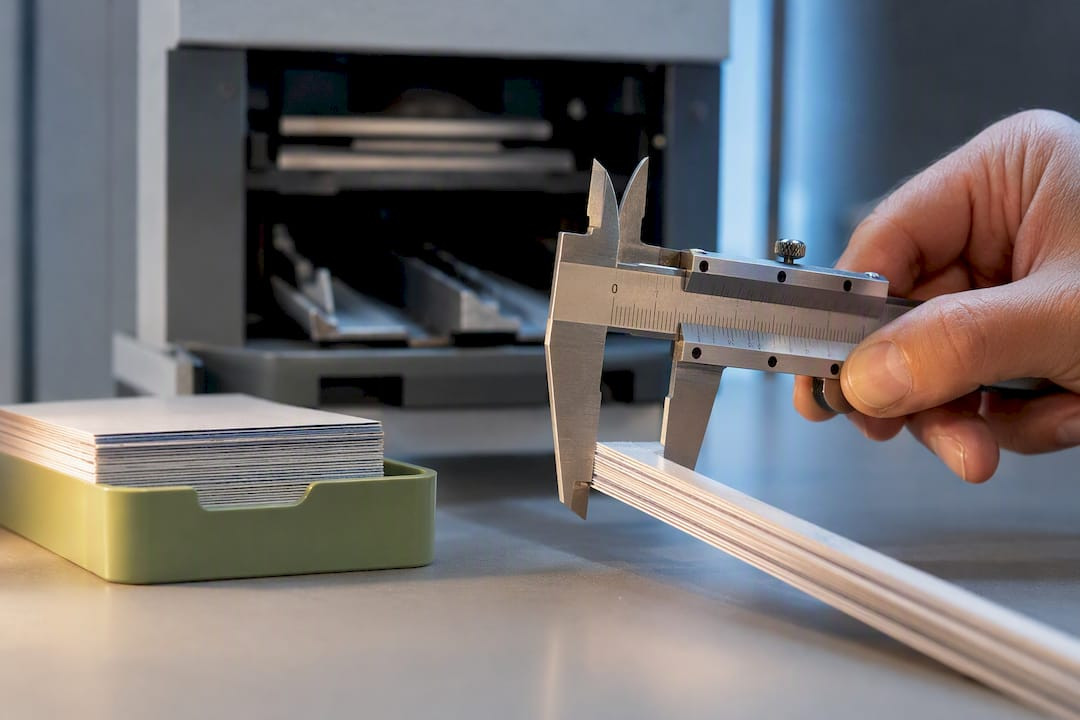
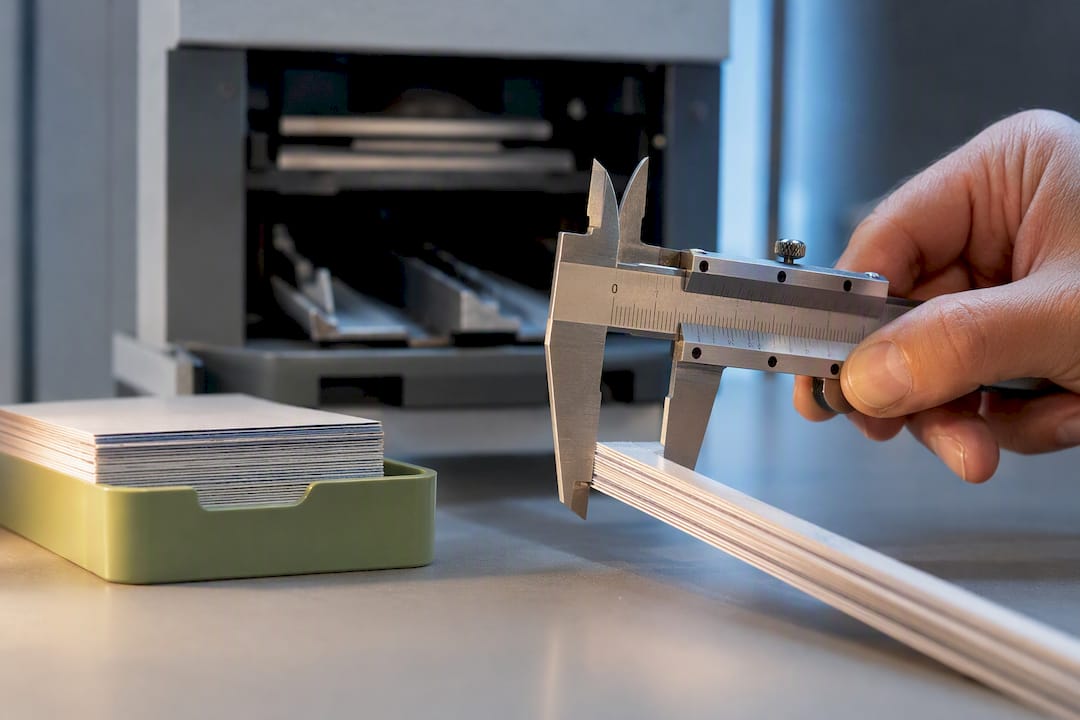
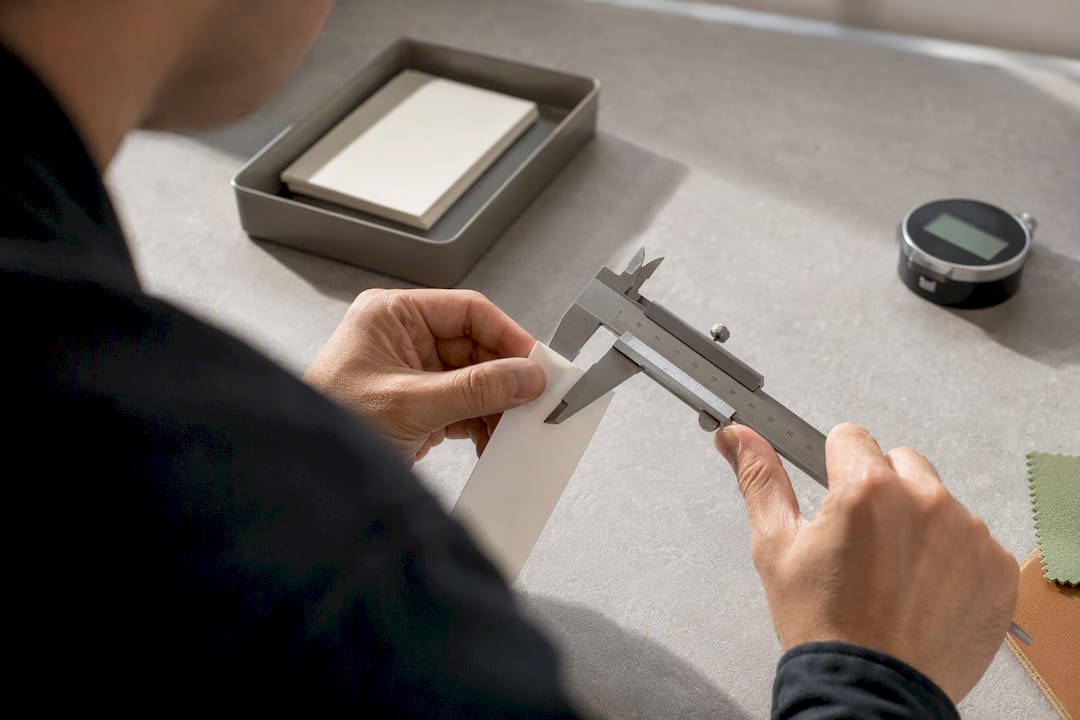
Pro Tip: Request a physical media sample before placing a full production order. A caliper reading takes thirty seconds and catches a thickness mismatch that a spec sheet alone won’t reveal until the tickets jam in the field.
Hardware Features and Interfaces to Specify
The printer module and its housing are where mechanical and electrical requirements meet, and a purchase order that skips these details tends to generate change orders later.
The S30/B thermal printer, one of the most commonly deployed modules in this product family, holds up to 5,000 tickets in its feeder and prints via direct thermal technology rather than impact or inkjet methods. It’s rated for indoor use across a temperature range of +5°C to +45°C, drawing approximately 70 VA during active operation.
- Power supply: 100 to 240 VAC ±10%, 50 to 60 Hz, with the S30/B specifically supporting 120 V / 60 Hz configurations common in North American installations.
- Data interfaces: RS232 as standard, with LAN connectivity, optional intercom modules, and 2D barcode scanner integration available depending on the device family.
- Housing: stainless steel construction across most entervo-family units, with pedestal mounting options for standalone kiosk deployments.
- Weight and footprint: pay station housings run roughly 250 kilograms fully assembled, per the entervo entry-exit technical sheet, which matters when you’re planning floor loading and mounting hardware, not just the electrical drop.
Plan your electrical circuits around the higher end of the draw range rather than the nominal figure, especially if you’re running multiple units off a shared panel. Site engineers who lay out kiosk placement early, before conduit runs are finalized, tend to avoid the retrofit costs that come from discovering a power gap after installation. Teams working through broader system-design questions, including traffic flow and kiosk siting, often find it useful to review parking system design software approaches before finalizing a site plan.
Payment and Cash Handling Features
Fare devices in this product line handle both coin and cashless transactions, and the entervo pay station spec gives procurement the clearest picture of what’s actually inside the cash compartment.
- Coin acceptance: electronic coin acceptors support up to 16 coin types in a single unit, letting one machine serve multiple currency configurations without hardware swaps.
- Cashbox security: a self-locking stainless-steel cashbox secures collected cash, designed so the box detaches for collection without exposing the internal mechanism.
- Cashless integration: pay stations integrate with cashless terminals for card and contactless payment, alongside standard receipt printing for every transaction type.
- Offline behavior: the entervo pay station can store transactions locally during a network outage, with the manufacturer citing storage capacity in the tens of thousands of records, so a connectivity drop doesn’t halt fare collection or lose revenue data.
Banknote processing units are typically specified separately from the base coin and card configuration, so request the banknote module’s own datasheet if your fare policy requires bill acceptance rather than coin-and-card only.
Pro Tip: Write offline transaction storage into your acceptance test script explicitly. It’s easy to test a device while the network is up and never actually confirm what happens when it isn’t, which is exactly the scenario you’re paying for that storage capacity to handle.
Environmental Ratings and Certifications to Confirm
Outdoor kiosks live a harder life than any indoor printer module, and the environmental spec sheet is where that difference shows up in numbers.
- Operating temperature: ranges cited in manufacturer datasheets run from around -15°C to +50°C for outdoor-rated pay stations, with the S30/B printer module itself rated narrower, +5°C to +45°C, since it’s designed for indoor or enclosed deployment.
- Humidity: non-condensing humidity tolerance is standard across the product line, meaning condensation control matters as much as raw temperature range in humid climates.
- Ingress protection: IP43 appears as a reference rating on entervo housings, a level that handles splashing water and small debris but isn’t a submersion-grade enclosure.
- Certifications to request: CE marking for European deployments, and NRTL certification through TÜV SÜD America for U.S. and Canadian installations, with a specific certificate number listed on the nameplate.
Verify the certificate number on the physical nameplate against the manufacturer’s documentation before final sign-off. A model number match isn’t the same as a certificate match, and inspectors will ask for the latter.
Procurement Checklist for RFPs and Acceptance Testing
Turning these specs into a working purchase order comes down to four categories of documentation and testing, in this order:
- Request the full documentation set upfront: the device datasheet, the ticket media spec sheet, electrical and nameplate data, and copies of CE or NRTL approval certificates.
- Pull physical media samples before committing to volume: get thermal, composite, or PVC samples in hand and run basic readability and abrasion checks against your actual validator hardware, not just a bench scanner.
- Confirm feeder reliability under load: cycle a full stack through the printer module and check jam rates, since feeder issues rarely show up in a five-ticket demo.
- Verify site readiness before delivery: confirm mounting footprint, power circuit capacity, and network connectivity match the datasheet’s stated requirements.
- Lock in packaging and replenishment details: confirm carton counts, Leporello fold specifications, and climate-controlled storage conditions with your ticket supplier ahead of the first production run.
Pro Tip: Build your spare-parts and consumables order at the same time as your main equipment order. Lead times on printer modules and specialty ticket stock rarely align, and a stocked-out fare gate generates more complaints per hour than almost any other operational failure.
Caymil’s Role in Compatible Ticket Media
Caymil has manufactured ticket stock since 1937, and its Scheidt & Bachmann compatible ticket line covers thermal, barcoded, and machine-issued roll formats built to match the media specs above. Custom runs support sequential numbering, barcoding, security features, and roll or stack packaging suited to S30/B and entervo feeder capacities. The standard workflow starts with a sample request, moves to print-proof approval, and finishes with a replenishment schedule so fare devices never run dry. For background on how ticket stock choices affect system performance more broadly, see this guide to ticket media in parking systems.
What the Spec Sheets Don’t Tell You
The datasheets are precise about thickness, voltage, and temperature. What they don’t tell you is that most procurement failures on this equipment happen not because a number was wrong, but because nobody checked the number against the actual site conditions or the actual media supplier’s tolerances.
I’d argue the conventional procurement approach, treating the spec sheet as a checkbox exercise, undersells how much variance exists between “meets spec on paper” and “performs reliably at a fare gate in July.” A PVC card at 250 microns and one at 760 microns are both technically in spec, but they behave completely differently in a feeder tray, and a supplier who doesn’t tell you which end of that range you’re getting is setting you up for a service call in month three.
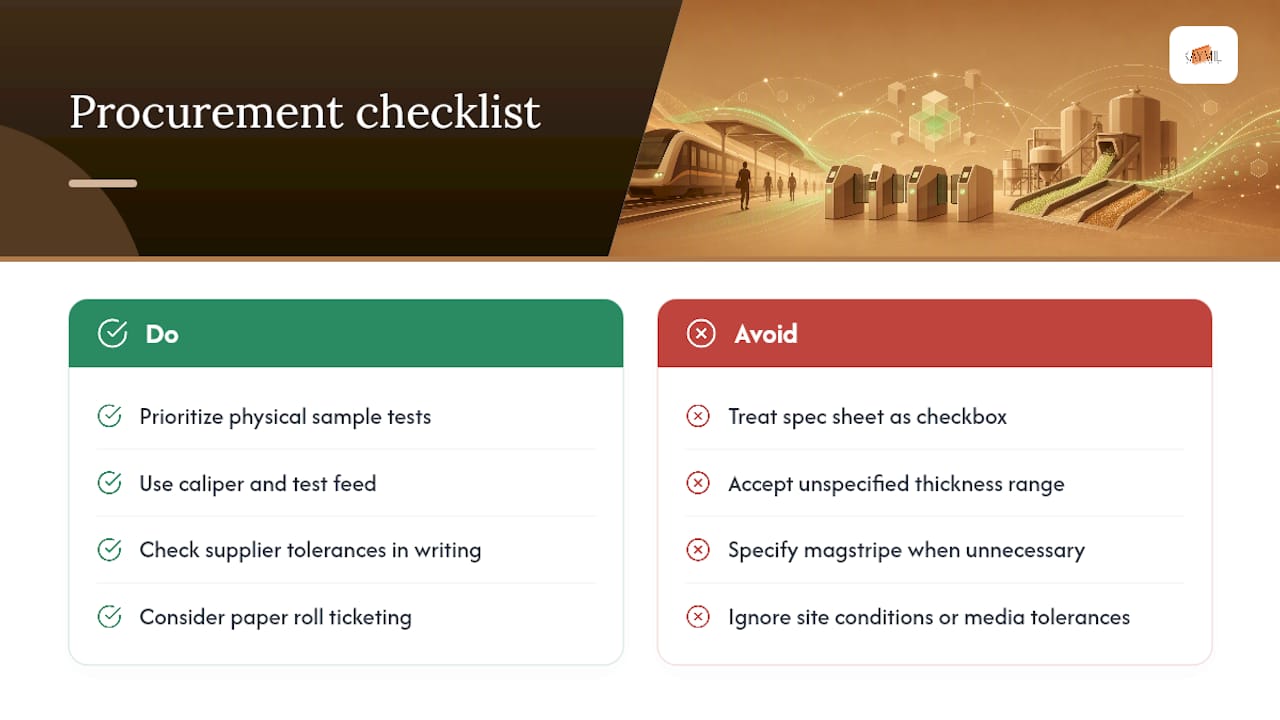
The industry’s quiet shift toward paper roll ticketing deserves more attention than it gets in most procurement conversations. Fewer moving parts means fewer failure points, and that’s the kind of unglamorous reliability gain that never shows up in a sales pitch but shows up constantly in maintenance logs. If your validators already read barcodes, ask why you’re still specifying magstripe at all.
Prioritize the physical sample test over the spec sheet review every time budget forces a tradeoff. A caliper and a test feed catch problems a PDF never will.
— Richard
Get Ticket Media Built to Scheidt & Bachmann Spec
Ticket stock that matches Scheidt & Bachmann’s published media requirements can be obtained directly, without the guesswork of vetting a generic printer against those thickness and stripe tolerances. Orders may include options such as sequential numbering, barcoding, custom security features, and roll or stack packaging sized to feeder capacities, compatible with modules like the S30/B or entervo pay stations.
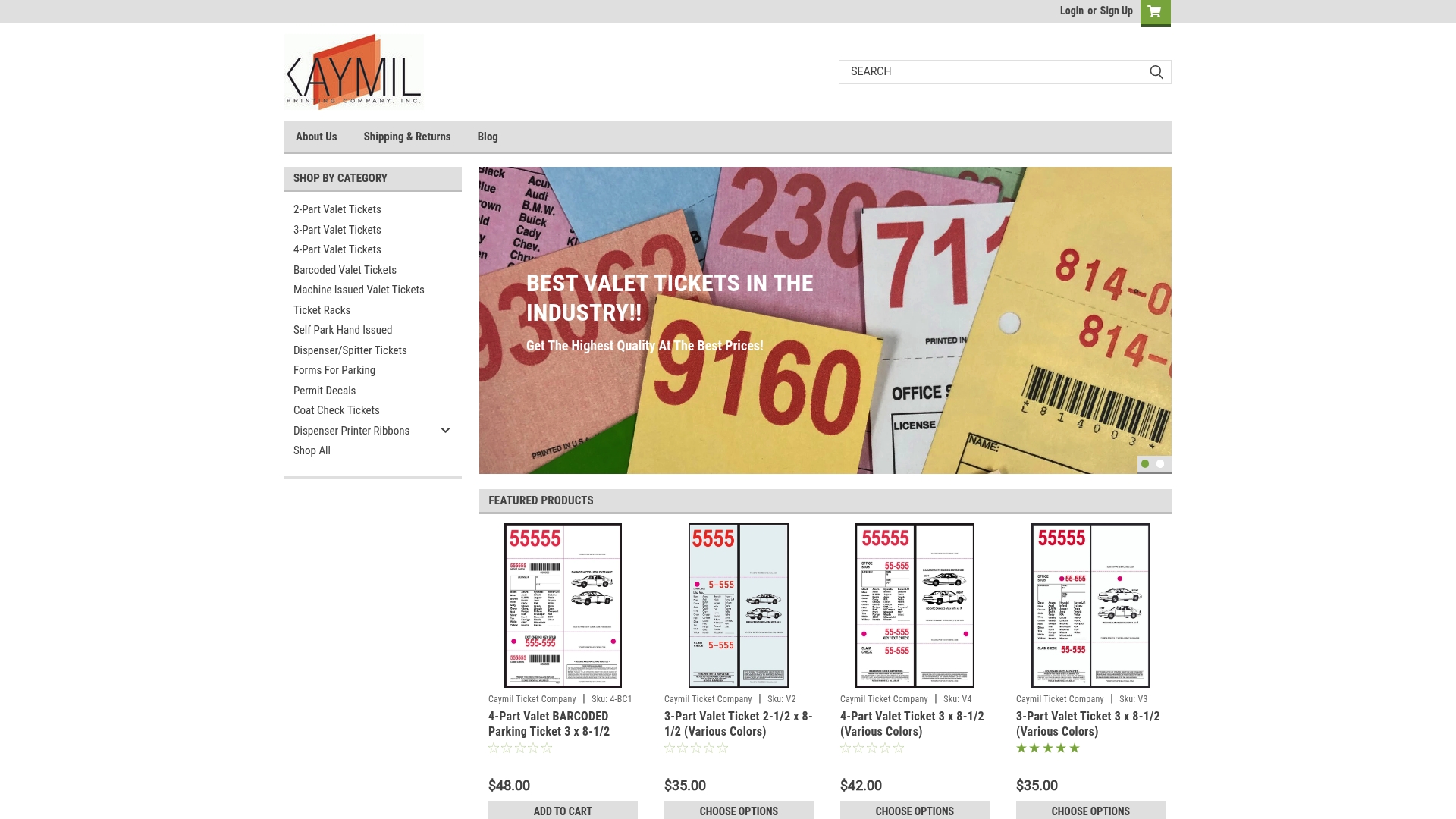
Transit agencies and parking operators switching suppliers, or specifying a new fare device for the first time, get the same benefit: tickets tested against the actual media spec before they ever reach a live fare gate. Browse available parking and ticket forms to find formats that match device families, or request a media sample directly to run feeder and readability tests before committing to a production run.
Sources
- PMS/S Ticket Specification (Scheidt & Bachmann)
- S30/B thermal printer technical specifications (Scheidt & Bachmann)
- entervo pay station technical specification (Scheidt & Bachmann)
FAQ
What Ticket Sizes Does Scheidt & Bachmann Support?
Scheidt & Bachmann devices accept thermal paper tickets (TFC.1) at 170 to 200 microns, composite tickets at 170 to 260 microns, and PVC cards at 250 to 760 microns, per the manufacturer’s ticket specification datasheet.
How Many Tickets Does an S30/B Printer Hold?
The S30/B thermal printer’s feeder holds up to 5,000 tickets, according to the manufacturer’s technical specification sheet.
What Happens to Transactions During a Network Outage?
The entervo pay station stores transactions locally during connectivity loss, with manufacturer documentation citing storage capacity in the tens of thousands of records, so fare collection continues uninterrupted until the connection restores.
Can Caymil Supply Tickets Compatible With Scheidt & Bachmann Devices?
Yes. Caymil manufactures thermal, barcoded, and machine-issued ticket stock built to match Scheidt & Bachmann media thickness and stripe specifications, with samples available for feeder and readability testing before production runs.
What Certifications Should Procurement Verify on Fare Devices?
Confirm CE marking for European deployments and NRTL certification through TÜV SÜD America for U.S. and Canadian installations, then match the certificate number on the physical nameplate against the manufacturer’s documentation.