

Real-world temporary parking permit examples and best practices

Choosing the right temporary parking permit is rarely straightforward. Whether you manage a university lot, a municipal street, a hospital campus, or a large-scale event venue, the stakes are real: a poorly scoped permit creates confusion for users, undermines enforcement staff, and opens the door to unauthorized parking. The criteria you apply when selecting and issuing permits, including applicant identity, vehicle details, validity windows, and physical display rules, directly determine whether your program succeeds or fails. This article walks through concrete, real-world examples organized by setting so you can make better decisions faster.
Table of Contents
- Key criteria for issuing temporary parking permits
- Municipal temporary parking permits: Application form examples
- University and campus temporary permits: Hangtag rules and display requirements
- Event and contractor permits: Digital issuance, hangtag and signage mechanics
- Comparison: Selecting the right temporary permit for your operation
- Expert perspective: Why permit clarity and workflow matter more than format
- Get custom temporary permit forms and supplies
- Frequently asked questions
Key Takeaways
| Point | Details |
|---|---|
| Permit applications require detail | Successful temporary parking permits depend on collecting applicant identity, vehicle details, and explicit start/end dates. |
| Physical display is crucial | Hangtag and decal permits must be visibly displayed according to clear rules to facilitate enforcement. |
| Advance timing ensures compliance | Applying and posting at least 48 hours in advance helps avoid permit errors and enables enforcement. |
| Digital workflows streamline operations | Online permit issuance and management reduce bottlenecks and improve audit trails, especially for events and contractors. |
| Signage mechanics prevent confusion | Temporary ‘no parking’ signs must follow height and attachment rules to be legally enforceable. |
Key criteria for issuing temporary parking permits
Before looking at specific permit formats, it helps to understand what separates a well-designed temporary permit from one that creates headaches in the field. The core criteria fall into three categories: scope, enforcement clarity, and workflow.
Scope means tightly defining who gets the permit, which vehicle it covers, and when it is valid. A common best-practice methodology across official permit programs is to tightly scope temporary permits with vehicle-specific identity inputs, explicit date and time validity windows, and clear physical display rules. When any one of these elements is vague, enforcement breaks down.
Enforcement clarity means your staff and your permit holders should never have to guess. Display rules, like where to hang a tag or where to place a decal, must be unambiguous. The moment a parking officer has to make a judgment call about whether a permit is valid, you have a problem.
Workflow means the process for applying, approving, and issuing permits must be documented and repeatable. Using standardized forms for parking procedures removes guesswork from the issuance side and creates a paper trail for audits.
Key criteria to build into every temporary permit program:
- Applicant full name and contact information
- Vehicle make, model, color, and license plate number
- Driver’s license number and state
- Specific start and end dates, including time of day where applicable
- Designated parking zone or lot
- Display instructions printed directly on the permit
Pro Tip: Always print the expiration date prominently on the permit itself, not just in your internal records. Officers in the field rely on what they can see, not what is in your database.
With the selection criteria established, let’s look at specific permit examples organized by setting.
Municipal temporary parking permits: Application form examples
Cities across the United States have developed detailed application forms for short-term visitor permits and temporary street restriction permits. These forms serve as excellent operational templates because they reflect real enforcement needs and legal requirements.
City-run short-term visitor permit applications collect applicant identity, vehicle details, and specific start and end dates as standard fields. The structure is deliberate. Every field on the form corresponds to something an enforcement officer can verify in the field.
Municipal no-parking and temporary street restriction permits provide a concrete operational template tied to posting rules, advance timing requirements, and enforcement verification. These permits are not just paperwork; they are the legal basis for towing unauthorized vehicles.
Typical fields found in municipal temporary permit application forms:
| Field | Purpose |
|---|---|
| Applicant full name | Establishes accountability |
| Vehicle license plate | Ties permit to a specific vehicle |
| Vehicle make, model, color | Provides visual verification support |
| Driver’s license number | Identity verification |
| Permit start date | Defines validity window |
| Permit end date | Prevents indefinite use |
| Requested parking zone | Limits permit to a defined area |
| Reason for request | Helps staff prioritize approvals |
Important: Many municipal programs cap temporary visitor permits at a maximum of 14 consecutive days and prohibit renewals within a set period. Permits are non-transferable and enforcement officers are authorized to void permits that do not match vehicle details on file.
For facilities that need a physical permit solution, window decals for permits and badge-shaped permit decals offer durable, clearly visible options that work well with municipal-style programs. These products hold up in outdoor conditions and can be printed with lot numbers, expiration dates, and custom branding.
Building on the application form criteria, let’s explore how universities operationalize temporary permits through display rules and hangtags.
University and campus temporary permits: Hangtag rules and display requirements
University parking programs are among the most operationally detailed in the country. They serve a rotating population of students, faculty, staff, and visitors, and they typically manage hundreds of permits simultaneously. The physical display rules they publish are instructive for any manager running a high-volume temporary permit program.
University parking offices publish specific temporary hangtag rules, including exact display requirements and expiration-date handling. These rules exist because ambiguity in display leads directly to disputed citations, which cost time and money to resolve.
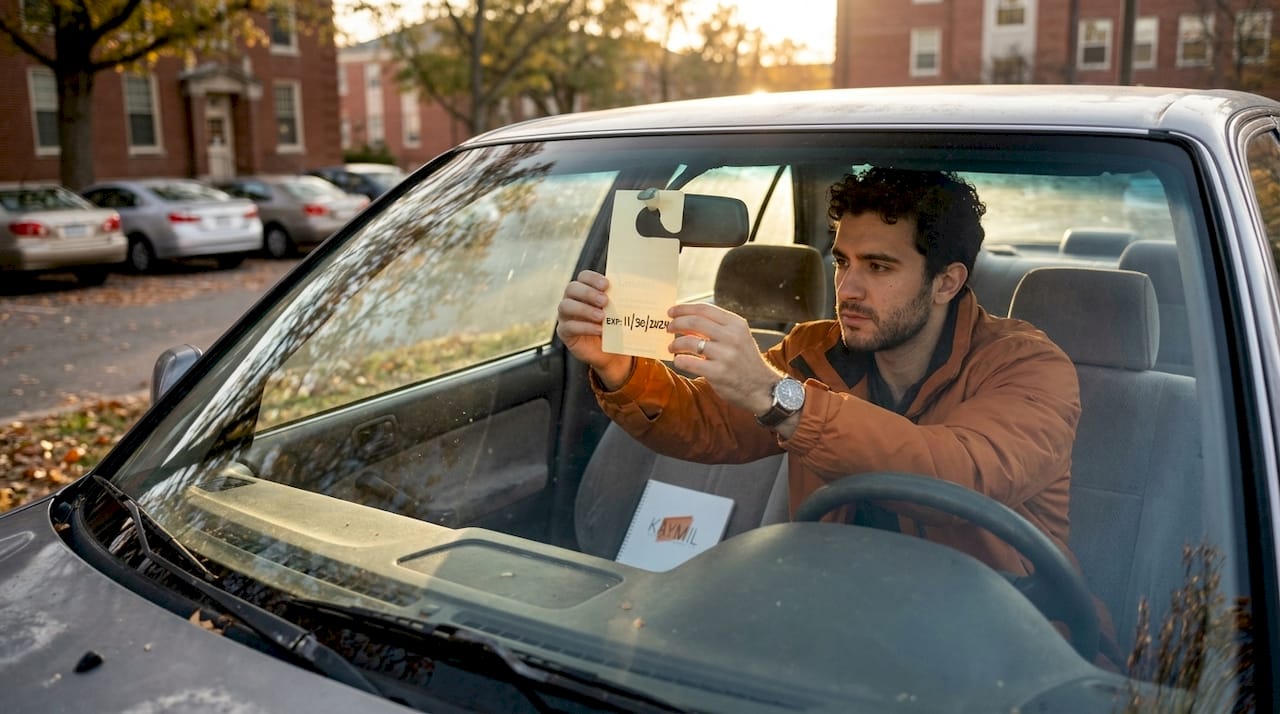
Indiana University specifies that hangtag permits must be clearly displayed at all times while the vehicle is parked, with detailed guidance on mirror and windshield placement. This level of specificity is not bureaucratic excess; it protects both the permit holder and the enforcement officer.
Display requirements for university hangtag permits typically include:
- Hang the tag from the rearview mirror with the front face visible through the windshield
- Do not place the tag on the dashboard; it must hang freely
- The expiration date must be clearly visible from outside the vehicle
- Do not use tape, adhesive, or temporary attachment methods that obscure any printed information
- Remove the hangtag when the vehicle is not parked in a permitted zone to prevent misuse
Pro Tip: If your program uses hangtags, invest in durable stock with a reinforced hole. Cheap tags tear off mirrors and end up on dashboards, which creates enforcement disputes. Review our hang tag permit program tips for guidance on launching a reliable program.
Hangtag vs. municipal decal: A practical comparison
| Feature | University hangtag | Municipal decal |
|---|---|---|
| Display method | Hung from rearview mirror | Adhered to windshield or bumper |
| Reusability | Often single-use or short-term | Typically single-use |
| Enforcement visibility | High, visible from outside | High, visible from outside |
| Transfer risk | Higher (can be moved between vehicles) | Lower (adhered to specific vehicle) |
| Typical validity | Days to one semester | Days to weeks |
| Best use case | Campus visitor, temporary faculty | Residential visitor, event access |
For operations that need both physical and digital options, reviewing permit decal best practices helps clarify which format fits each use case.
Beyond campus examples, event organizers and managers often use digital systems or special request forms for temporary permits.
Event and contractor permits: Digital issuance, hangtag and signage mechanics
Event-specific temporary permits introduce a different set of challenges. You are often dealing with a large volume of vehicles, a fixed time window, and a mix of staff, vendors, contractors, and guests who all need different levels of access.
Campus parking departments operationalize temporary permits via event and temporary permit request forms and digital intake systems rather than relying solely on static paper examples. This approach allows for faster processing, better record-keeping, and easier enforcement because officers can verify permits against a live database.
For metered or controlled areas, municipal hangtag permit programs show example temporary access rates and durations, along with clear instructions for purchasing and applying permits. These programs are useful models for event planners who need to manage short-term access in high-demand areas.
Common elements of event and contractor temporary permit programs:
- Online or paper request forms submitted in advance
- Separate permit categories for vendors, contractors, and general attendees
- Time-stamped permits that expire at the end of the event
- Designated loading zones with separate short-term access permits
- Digital verification options for staff using mobile devices
Example temporary access rates and durations (municipal models)
| Permit type | Typical duration | Typical cost range | Best use case |
|---|---|---|---|
| Visitor hangtag | 1 to 7 days | $0 to $25 | Short-term residential visitors |
| Event access permit | 1 day | $10 to $50 | Concerts, sporting events, festivals |
| Contractor permit | 1 to 30 days | $15 to $75 | Construction, repair, service access |
| Street restriction permit | 1 to 3 days | $25 to $100 | Moving trucks, film crews, large deliveries |
For large events that also involve transportation logistics, coordinating with charter or shuttle services adds another layer of planning. Resources covering event chartering logistics can help planners think through vehicle flow and temporary access needs holistically.
Pro Tip: For events with multiple access categories, use color-coded permits. A different color for vendors, contractors, and general attendees lets enforcement staff make quick visual assessments without needing to read every permit in detail.
For operations that need printed solutions, reviewing parking system ticket examples and self-park ticket solutions provides a clear picture of what is available for event-scale operations.
To bridge these examples, a side-by-side comparison clarifies how each permit type fits different operational needs.
Comparison: Selecting the right temporary permit for your operation
With multiple permit types in play, selecting the right format comes down to matching the permit’s design to the operational context. The table below summarizes the main permit types covered in this article.
| Permit type | Format | Enforcement mechanism | Best setting |
|---|---|---|---|
| Short-term visitor permit | Paper or decal | Visual check against vehicle record | Residential streets, municipal lots |
| Street restriction permit | Signage with posted notice | Sign verification, police sign-off | Events, construction, film production |
| Campus hangtag | Physical tag | Visual display check | Universities, hospitals, corporate campuses |
| Event access permit | Paper, digital, or wristband | Gate check or officer patrol | Concerts, festivals, sporting events |
| Contractor permit | Paper or digital | Officer verification against work order | Construction sites, service access |
Steps for selecting the right permit format for your operation:
- Define your enforcement capacity. If you have limited staff, choose a format that allows fast visual verification.
- Determine the validity window. Short windows favor hangtags or digital permits; longer windows may warrant decals.
- Assess transfer risk. If permits could be passed between vehicles, use vehicle-specific decals or digital plate-linked permits.
- Consider your audit needs. Digital issuance creates automatic audit trails; paper requires manual logging.
- Match the format to your infrastructure. If you use a parking management system, choose a permit format that integrates with it.
Edge-case handling often shifts from permit design to posting and verification discipline when the control mechanism is street-restriction signage. Cities require advance submission, advance sign placement, and enforcement verification sign-off. This is a critical lesson: the permit itself is only as effective as the process surrounding it.
For managers planning efficient issuance workflows, digital issuance and management consistently delivers improved control, audit trails, and reduced bottlenecks compared to purely paper-based systems. That said, digital tools require staff training and reliable connectivity to function as intended.
Stay current with emerging permit management approaches by following permit visibility discussions from industry professionals.
Let’s wrap up with key lessons and an expert perspective on permit management that goes beyond usual advice.
Expert perspective: Why permit clarity and workflow matter more than format
Here is something the industry does not say often enough: the format of your temporary permit matters far less than the clarity of your rules and the discipline of your workflow. Facilities spend considerable time debating hangtags versus decals, paper versus digital, and color-coded versus plain stock. These are legitimate considerations. But they are secondary.
The permits that fail in the field almost always fail for the same reasons. The display rules were not printed on the permit. The expiration date was written in small type. The officer did not know whether a permit found on a dashboard rather than hanging from the mirror was valid. These are not format problems; they are clarity problems.
Clarity in display rules and workflow discipline is more important than permit format for successful enforcement and operational efficiency. This is a hard-won lesson from programs that have gone through the painful process of revising their permits after a season of disputed citations.
Timing also matters more than most managers realize. A permit issued the morning of an event, with no advance notice to enforcement staff, is nearly useless. Officers need to know what valid permits look like before they start writing citations. This means your issuance workflow must include a communication step, not just a printing step.
Digital tools can help with both clarity and timing. A digital permit linked to a license plate removes the display ambiguity entirely. But digital systems introduce their own failure points: connectivity issues, database errors, and staff who are not trained to use the verification interface. The solution is not to avoid digital tools but to layer them on top of clear physical processes, not use them as a replacement.
If you are launching a hang tag program or redesigning an existing one, start with the display rules. Write them in plain language. Print them on the permit. Then worry about the format.
Get custom temporary permit forms and supplies
Running a reliable temporary permit program starts with having the right materials in hand before you need them.
Caymil Printing Co. supplies custom parking permit forms designed for high-volume issuance environments, including multi-part carbonless formats that give you an instant paper trail without extra data entry. For operations that also manage valet or event parking, 4-part valet ticket supplies and ticket rack solutions round out a complete permit and ticketing workflow. Every product is available with sequential numbering, custom branding, and security features that reduce fraud and simplify audits. With nationwide shipping and decades of manufacturing experience, Caymil is ready to support your next permit program from design through delivery.
Frequently asked questions
How can I apply for a temporary parking permit for an event?
Most cities and universities require you to submit an application form or online request well before your event. Municipal no-parking permits typically require applications at least 48 hours in advance to allow for processing and sign placement.
What details are required for a temporary parking permit?
Typical permit applications ask for applicant identity, vehicle information, driver’s license, registration, and specific validity dates. City-run visitor permit applications collect applicant identity and vehicle details as standard required fields.
How should temporary hangtag permits be displayed?
Hangtags must be hung from the rearview mirror facing outward, with the expiration date clearly visible from outside the vehicle. University parking offices publish specific hangtag display rules, including exact placement requirements and expiration-date handling guidelines.
What are the main differences between hangtag and digital temporary permits?
Hangtags require physical display and are tied to a visible expiration date, while digital permits link to license plates and are managed online. Digital issuance and management improves inventory control and reduces bottlenecks, though physical display remains important where enforcement relies on visual checks.
What are best practices for event no-parking signage?
Signs should be placed 3 to 4 feet off the ground, attached to sturdy stakes or approved poles, and never using tape. City of Madison temporary posting guidance specifies these placement mechanics, and advance posting combined with police verification is required for enforcement to hold up.