
Avoid Citations: Windshield Permit Placement That Lasts Six Months
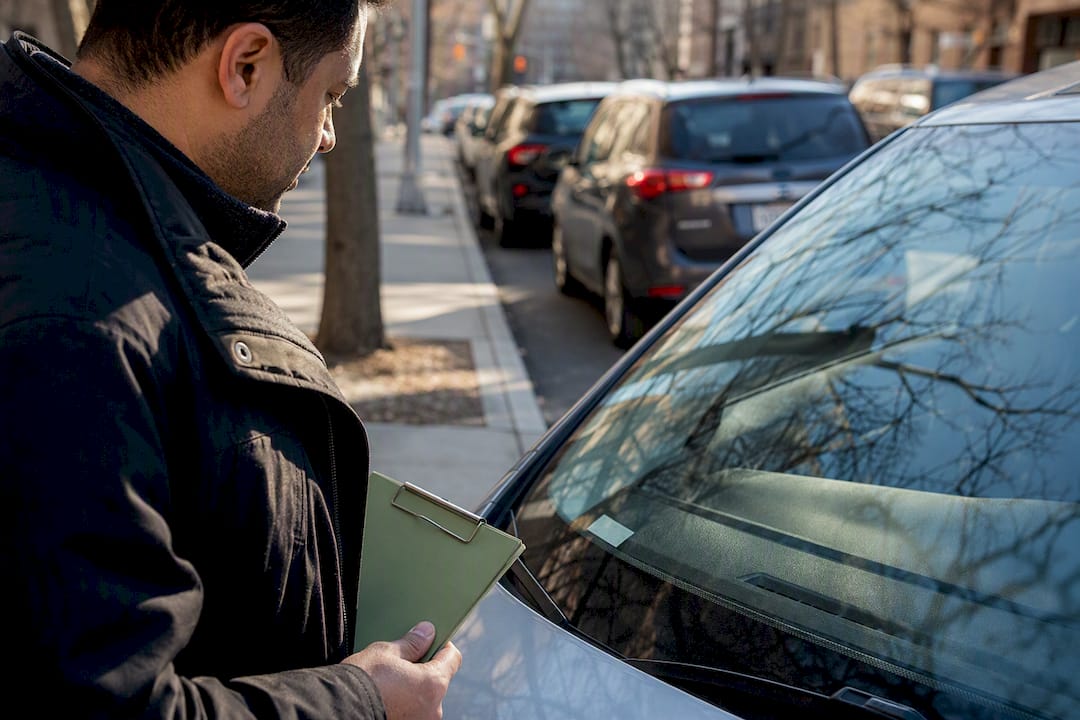
Place a windshield permit on the inside of the front windshield, in the lower corner visible to enforcement, usually the driver’s side, unless the issuer specifies otherwise. Hang tags typically hang from the rearview mirror. Motorcycles and similar vehicles often follow entirely different rules. When in doubt, the permit itself or the issuing agency’s instructions override any general guideline, including this one.
TL;DR:
- Most permits should be placed in the lower driver’s side corner of the windshield to ensure they are easily visible and scannable by enforcement.
- If the permit is a hang tag, it must hang from the rearview mirror with the face toward the windshield, and only one valid permit should be displayed at a time.
- Temporary permits are often placed on the dashboard or in the rear window only if explicitly allowed by the issuer’s instructions, and placement must follow those guidelines.
- Metallic tint, embedded antennas, or coatings can block RFID or barcode reading, so permits should be positioned below or away from these features for reliability.
- Always follow the exact placement instructions on the permit document or issued regulations, as ignoring them can lead to citations even if the permit is valid.
Table of Contents
- Standard Windshield Permit Placement: What Enforcement Actually Checks
- Hang Tags, Temporary Permits, and Motorcycle Placement Rules
- What State Rules and Issuers Actually Say About Display
- When Tint and Electronics Get in the Way
- How to Apply, Remove, and Preserve Your Permit
- Caymil’s Practical Experience With Permit Decals and Display Solutions
- Durable Permit Decals and Hang Tags for Compliant Display
- Where to Verify Issuer-Specific Placement Rules
- Why the “One Right Spot” Advice Oversimplifies Reality
- Sources
- FAQ
Standard Windshield Permit Placement: What Enforcement Actually Checks
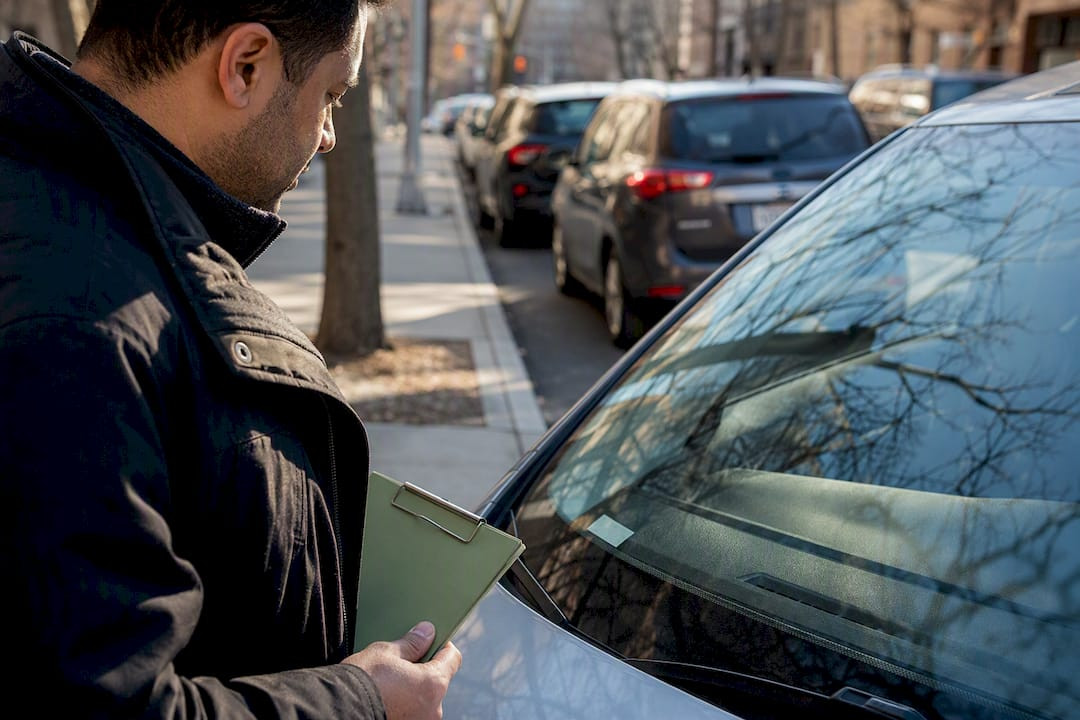
Most parking authorities, universities, and property managers ask for the lower corner of the front windshield, typically on the driver’s side. That default exists for a practical reason. An officer or attendant walking a row of parked cars scans from the same angle every time, and a permit fixed low and to the left is the fastest thing to spot without circling the vehicle.
Some issuers reverse that logic. Certain campus and municipal programs specify the passenger side, or ask for the permit centered just below the rearview mirror. A handful of hang-tag programs want the tag facing out from the mirror itself rather than sitting flat against glass. None of these variations are arbitrary. They usually reflect how a specific lot is patrolled, whether meter readers walk the driver’s side or the curb side, or whether the permit doubles as a toll or gate credential read from a fixed sensor.
What enforcement is actually checking for boils down to three things:
- The permit is inside the vehicle, not loose on a dashboard where wind or a bump could move it.
- Nothing else, like a second expired hang tag, a receipt, or a decal, obscures or competes with it.
- It’s readable from outside the car without the officer needing to press against the glass.
That third point is worth testing yourself. Walk to the curb, look at your own windshield the way a patrol officer would, and confirm the permit is legible at a glance.
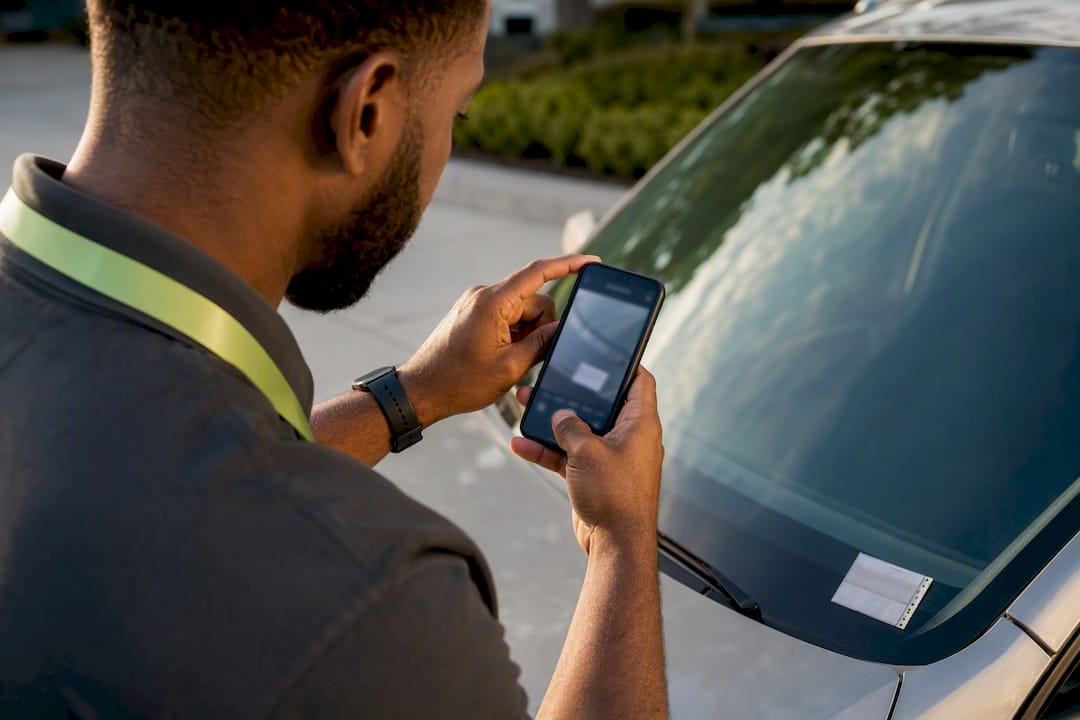
Pro Tip: Take a phone photo of your windshield from the sidewalk after you place a new permit. If you can’t read the expiration date or permit number in that photo, neither can enforcement, and that’s an easy way to end up disputing a citation you didn’t deserve.
Hang Tags, Temporary Permits, and Motorcycle Placement Rules
Not every permit sticks to glass, and not every vehicle has a windshield built for stickers in the first place.
- Hang tags hang from the rearview mirror mount, valid face toward the windshield. If you’re swapping an old tag for a new one, remove the expired tag completely. Layering tags, old behind new, is one of the most common reasons enforcement flags a vehicle, since it can’t always tell which one is current from outside the car.
- Temporary permits often go on the dashboard or in the lower rear window instead of the front windshield, but only when the issuing document explicitly allows it. A temporary paper permit taped to the inside of the front windshield can block sightlines the same way a permanent one does, so follow the printed instructions on the permit itself rather than assuming dashboard placement is always fine.
- Motorcycles, ATVs, and similar vehicles rarely have a comparable windshield surface, so placement shifts to the front fork, fender, or headlight assembly, and some jurisdictions simply require the operator to carry the permit rather than mount it anywhere. Riders should confirm with the issuing agency before assuming any one mounting point applies.
The through-line across all three: read what the permit or its accompanying paperwork says before defaulting to habit.
What State Rules and Issuers Actually Say About Display
The lower-corner rule isn’t just convention. It shows up in actual regulatory language. Kansas administrative code, for example, directs that certain vehicle permits be affixed to the lower corner of the driver’s side windshield, and specifies that annual decals be permanently affixed rather than propped against glass. That kind of statutory wording is common across states and institutions, even when the exact wording varies.
A few things follow from that:
- Ignoring the issuer’s documented placement instructions can lead to citations even when the permit itself is valid and current.
- Some permit types intersect with separate reporting requirements. Hunters, for instance, may need to satisfy federal harvest reporting obligations in addition to displaying a windshield card correctly.
- The most reliable source for your exact placement rule is never a general guide. It’s the permit document, the issuing state code, or the campus or park’s own parking guidance.
Keep that documentation. If a dispute comes up later, showing you followed the issuer’s own printed instructions carries far more weight than showing you followed a common convention.
When Tint and Electronics Get in the Way
A permit placed correctly by the book can still fail if the glass around it works against it. Factory tint strips along the top of a windshield, aftermarket tint film, and metallic coatings on some energy-efficient glass can all block a permit from view, either to a human eye or to an automated reader.
That last part matters more each year. Barcode and RFID-based permits depend on a scanner reading the credential from a fixed distance and angle, and a metallized film or an embedded antenna near the windshield’s edge can create a dead zone that has nothing to do with how well the permit itself was applied.
Before you trust a new permit’s placement, run through this:
- Confirm the permit sits below any visible tint band, not behind it.
- If the permit includes a barcode or RFID chip, ask the issuer whether a specific mounting zone is required for reliable reads.
- Where a test scan is possible, at a gate arm or garage entrance, use it once before relying on the permit daily.
Pro Tip: If your windshield has a metallic tint or heat-reflective coating and your gate reader keeps failing, don’t assume the permit is defective. Try shifting it two or three inches within the allowed zone first. It’s a common fix, though always confirm the new spot still meets the issuer’s placement requirement before treating it as permanent.
How to Apply, Remove, and Preserve Your Permit
- Clean the glass first. Use a mild glass cleaner and a lint-free cloth on the inside surface where the permit will sit, and let it dry completely.
- Remove the full adhesive backing and press the decal directly onto the glass. Skip tape or adhesive substitutes not designed for automotive glass. Agencies routinely flag taped-on permits as improperly displayed.
- Smooth out air bubbles from the center outward while the adhesive is still workable.
- To remove, apply gentle heat from a hair dryer to soften the adhesive, then peel slowly from one corner. Clean any residue with isopropyl alcohol or an adhesive remover safe for glass.
- Replace faded or peeling permits promptly. If you hold a spare, store it flat in its original sleeve rather than loose in a glove box, where corners crease and barcodes crack.
Caymil’s Practical Experience With Permit Decals and Display Solutions
Since many years ago, Caymil has printed ticketing and permit products used by parking operators, campuses, and hospitals, gaining practical experience with placement mistakes from the supply side. Adhesive quality decides most of the outcome. A decal with weak backing lifts at the corners within weeks and stops looking legible, while UV-stable inks keep a barcode or expiration date readable through a summer of direct sun rather than fading into a gray smear by August.
Display pockets solve a real problem for windshields with tint strips or awkward mounting spots. If your situation doesn’t match the standard guidance here, the safest move is still to call the issuer directly and confirm before you affix anything.
Durable Permit Decals and Hang Tags for Compliant Display
Every placement rule in this guide only works if the permit itself holds up: legible, correctly adhered, and readable by whatever scanner or officer checks it. This is an important factor for operators who issue these permits in volume. Our lineup covers standard parking permit decals for direct windshield application, pre-cut round stock through our window decal packs, and hang-tag formats for programs that mount permits from the mirror instead of the glass.
Custom features matter most when your program has specific compliance needs. Tamper-evident adhesives support annual decals that state code requires to be permanently affixed. Barcoding keeps automated gate readers and enforcement scans consistent across a large lot. UV-stable printing keeps serial numbers legible for the full length of a multi-year permit cycle. If your organization issues temporary permits alongside annual decals, our parking forms and permit supplies cover both formats under one order. Browse the current lineup and request a quote for the volume and features your program needs.
Where to Verify Issuer-Specific Placement Rules
State codes and institutional parking offices remain the most reliable check for your exact situation. Kansas’s administrative regulation on vehicle permit display shows how specific statutory placement language can get, right down to which corner and which side. Indiana University’s permit display page is a useful model for how campuses handle hang tags, display pockets, and tint interference. Washington State University’s vehicle permit guidance covers motorcycle and non-standard vehicle placement in detail. Some venues, like Mesquite Oasis’s parking policy page, publish their own display rules directly, which is worth checking for any lot with posted signage. Keep a copy of whatever instructions came with your permit; it’s your best evidence if a citation ever gets disputed.
Why the “One Right Spot” Advice Oversimplifies Reality
Most placement guides hand you a single rule and stop there, and that’s where they undersell the actual complexity. The lower driver-side corner works as a default because it matches how most enforcement routines are built, not because some universal law demands it. Treating it as gospel is how drivers end up disputing citations on permits that were valid but mounted somewhere their specific issuer never approved.
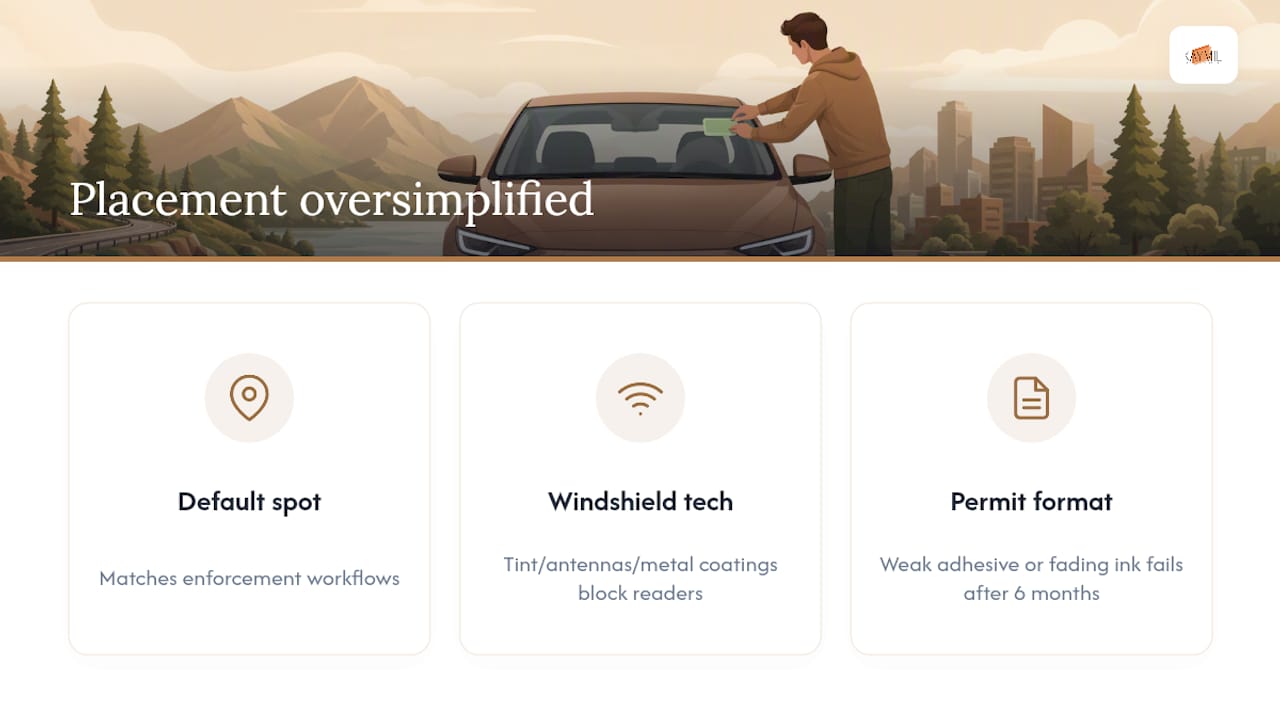
What gets overlooked most is the physical reality of modern windshields. Tint bands, embedded antennas, and metallic coatings didn’t exist when a lot of these placement conventions took hold, and they now quietly override paper instructions that assume plain, untreated glass. If your gate reader keeps rejecting a permit that looks perfectly placed, the glass itself, not your compliance, is probably the problem.
The other overlooked point: the permit format matters as much as the placement. A cheap decal with weak adhesive or ink that fades by midsummer will eventually fail the same visibility check a perfectly placed premium decal would pass for years. Compliance isn’t just about where you put the permit. It’s about whether the permit is still readable in that spot six months later.
— Richard
Sources
- Vehicle permits | Washington State University Transportation Services
- Displaying your permit: Permits | Indiana University Bloomington
- K.A.R. § 115-9-6 – Vehicle permits; display
- Where to put parking permit on car? (Parkmodo)
FAQ
Does a Transponder Have to Be Mounted on the Windshield?
Not always. Many transponders are windshield-mounted for consistent RF reads, but some vehicles, including motorcycles, use alternate mounting points or require the operator to carry the credential instead, so check your issuer’s specific instructions.
Where Is the Best Place to Put a Parking Sticker?
The inside lower corner of the front windshield, typically driver’s side, is the standard placement most institutions and state regulations recommend, since it stays visible to enforcement and clear of tint bands.
What Are the Equipment Requirements for Windshields Behind Tinted Areas?
Permits should sit below any tinted strip or metallic coating on the glass, since both can block visual inspection and interfere with RFID or barcode scanning, and some agencies provide display pockets specifically to work around obstructed windshields.
Can I Use Tape to Attach a Windshield Permit?
No. Most issuers specifically instruct removing the full adhesive backing and pressing the decal directly onto clean glass, since tape or substitute adhesives often cause the permit to fail or look improperly displayed.