
Branded Parking Ticket Examples for Lot Managers

Choosing the right parking citation is rarely as simple as it looks. The industry standard term is “parking violation notice” or “parking citation,” though most operators search for branded parking ticket examples when they want design-forward, operation-ready options. Your ticket is not just an enforcement tool. It is the last impression a guest or violator has of your property, and a poorly designed one sends the wrong message about your operation. This article breaks down real branded parking ticket examples, outlines what to look for before you order, and gives you a direct comparison to help you choose with confidence.
Table of Contents
- Key Takeaways
- 1. What makes branded parking ticket examples worth studying
- 2. Two-part permit and violation sticker kits
- 3. Printable branded violation notice templates
- 4. Hotel valet parking tickets that double as parking passes
- 5. Barcode parking tickets for automated and high-volume lots
- 6. Machine-issued valet tickets with sequential numbering
- 7. Multi-part carbonless valet tickets for detailed tracking
- 8. Comparison of featured branded parking ticket formats
- 9. Recommended choices by operation type and budget
- 10. Common pitfalls in branded parking ticket design and enforcement
- My perspective on where branded parking tickets are headed
- How Caymil can help you find the right branded ticket solution
- FAQ
Key Takeaways
| Point | Details |
|---|---|
| Branding starts with function | A ticket that looks great but lacks critical fields or proper adhesive will create enforcement gaps. |
| Hotel tickets need operational clarity | Guests must understand that their entry ticket converts to a parking pass at check-in to avoid confusion. |
| Proofing prevents costly shutdowns | A single spelling error can suspend enforcement operations and force expensive reprints. |
| Automation-ready designs matter | Barcode and machine-issued ticket formats reduce manual errors and speed up high-volume operations. |
| Match the ticket to your operation type | Valet, private lot, and hotel enforcement each require different formats, materials, and branding approaches. |
1. What makes branded parking ticket examples worth studying
Before reviewing specific branded parking ticket examples, operators need a clear framework for evaluating them. The design decisions you make affect enforcement results, not just aesthetics.
Start with ticket functionality. A well-designed citation should include fields for vehicle registration, date and time, location, violation type, and contact information for disputes. Printable ticket generators confirm these as the minimum required fields for any credible enforcement notice. Missing even one of these creates grounds for contest.
Branding elements matter, but they work best when they do not crowd out critical information. Logo placement, color choices, and property name should reinforce your identity without burying the violation details. Think of branding as the frame around the message, not the message itself.
Material quality and adhesive strength are non-negotiable for violation stickers. A sticker that peels off in rain or lifts without tearing gives violators a loophole. For hang tag permits, durability through weather cycles is what separates a three-month permit from one that disintegrates in a season.
Other factors worth evaluating:
- Compliance with local ordinances governing private parking enforcement
- Compatibility with your existing enforcement technology, including barcode scanners or parking management software
- Operational workflow, meaning how the ticket moves from issuance to resolution
- Customer-facing clarity, so the notice communicates what the vehicle owner needs to do next
Pro Tip: Before finalizing any design, run it through a parking ticket security review to confirm your citation resists tampering and supports your appeals process.
2. Two-part permit and violation sticker kits
The two-part permit plus violation sticker system is one of the most practical custom parking ticket designs for private lot enforcement. The concept is straightforward. Authorized vehicles receive hang tag permits that slip over the rearview mirror. Unauthorized vehicles get a fluorescent, hard-to-remove violation sticker applied directly to the driver-side window.
This approach speeds up enforcement significantly. Officers do not need to record every vehicle. They simply confirm the permit is present or apply the sticker. Permits are typically available in packs of 10, 25, 50, or 100 units, making it scalable for properties of any size.
What works well:
- Immediate visual compliance check
- Fluorescent stickers are highly visible and difficult to remove cleanly
- Permits can be branded with property name, lot number, and expiration period
Potential drawbacks:
- Requires a distribution system for permits
- Sticker removal can damage vehicle windows if not formulated correctly
- Branding space on hang tags is limited
For operators launching a new lot or formalizing enforcement on an existing one, this is often the first format worth testing. A full walkthrough of launching a hang tag program can help structure the rollout.
3. Printable branded violation notice templates
Digital-first operators and small private lot owners frequently use printable templates as a cost-effective starting point. A branded parking ticket form template can be configured with your property name, logo, violation categories, and officer fields. These work well for low-volume enforcement where staff fill out citations by hand.
The advantage is speed to deployment. You design the form, print a batch, and begin enforcement without a minimum order commitment. The trade-off is durability. Standard paper does not hold up in rain, and printed forms are easier to dismiss as unofficial.
These templates work best as a pilot format before investing in professionally printed stock.
4. Hotel valet parking tickets that double as parking passes
The branded parking ticket hotel design category includes one of the most operationally complex examples on this list. In hotel environments, entry tickets convert into parking passes at check-in, allowing guests to enter and exit independently throughout their stay without needing staff assistance each time.
The design challenge here is not artwork. It is messaging. The ticket must clearly communicate that the guest needs to bring their entry ticket to the front desk. Without that instruction printed on the ticket itself, guest confusion increases and staff time goes up.
What works well:
- Reduces reliance on reception for parking access
- Creates a branded touchpoint at arrival and throughout the stay
- Ticket data can link to the property management system for billing
Potential drawbacks:
- Requires clear signage reinforcing the check-in conversion step
- Any confusion at this step reflects on the brand, not just the parking operation
5. Barcode parking tickets for automated and high-volume lots
For parking garages and high-volume surface lots, barcode tickets issued by entry machines are the standard format. These barcode-enhanced parking tickets integrate with major parking management systems including Amano, TIBA, SKIDATA, FLASH Parking, and Flowbird. The barcode encodes entry time, lot identifier, and ticket sequence, allowing automatic fee calculation at exit.
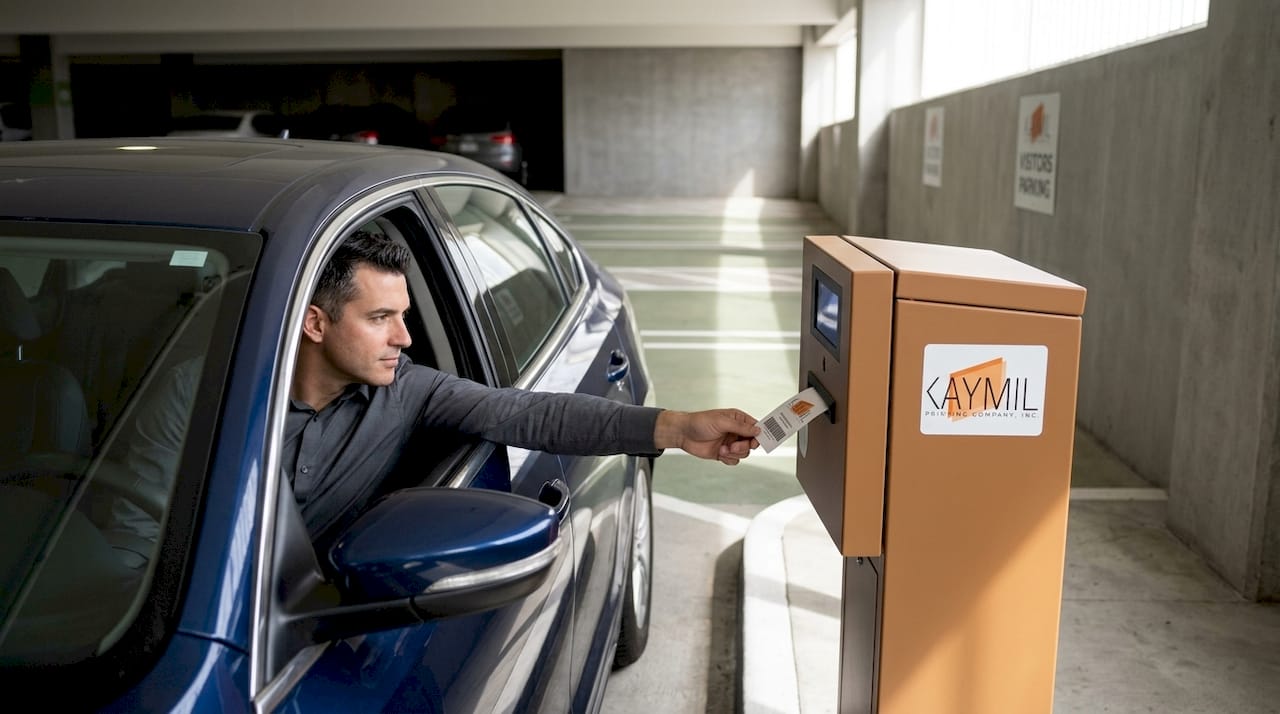
Branding on these tickets is typically limited to a header area with the property name, logo, and contact information. The functional data takes priority. But that header space is still prime real estate. A clean, well-printed logo on every ticket issued reinforces the operation’s professionalism with every transaction.
Pro Tip: When specifying barcode ticket orders, confirm paper stock compatibility with your specific machine model. Thermal paper rolls that do not match the printer’s heat sensitivity will produce faded or unreadable barcodes.
6. Machine-issued valet tickets with sequential numbering
Valet operations run on speed and accuracy. Machine-issued valet tickets printed on thermal rolls with sequential numbering solve the dual problem of speed at the stand and accountability in the lot. Each ticket ties a specific vehicle to a specific transaction, reducing disputes and retrieval errors.
Branding on valet tickets is highly visible because guests physically handle them. A ticket with the hotel name, logo, and valet hotline number doubles as a contact card guests keep in their pocket until retrieval. That is a branding opportunity very few operators take full advantage of.
7. Multi-part carbonless valet tickets for detailed tracking
For operations that need physical copies at the stand, the lot, and the cashier window, multi-part carbonless valet tickets are the format of choice. Two-part, three-part, and four-part formats each serve a specific accountability depth. The top copy stays with the vehicle, the second copy goes to the guest, and additional copies go to management or billing.
Each part can carry full branding, making every copy a professional representation of the operation.
8. Comparison of featured branded parking ticket formats
| Ticket Type | Best Operation Fit | Branding Flexibility | Material Durability | Automation Compatible |
|---|---|---|---|---|
| Two-part permit and sticker kit | Private lot enforcement | Moderate | High (sticker) | No |
| Printable violation template | Small private lots | High | Low | No |
| Hotel entry-to-pass ticket | Hotel parking | Moderate | Medium | Yes (PMS integration) |
| Barcode machine-issued ticket | High-volume garages | Low to moderate | High (thermal) | Yes |
| Machine-issued valet ticket | Valet operations | Moderate | High | Yes |
| Multi-part carbonless valet ticket | Full-service valet | High | Medium | No |
9. Recommended choices by operation type and budget
Selecting the right format depends as much on operational reality as it does on design preference.
Private lot operators get the most enforcement value from the two-part permit and violation sticker system. It requires minimal staff training and creates a consistent visual standard. Start with a smaller permit pack to test distribution logistics before ordering in bulk.
Valet operations should prioritize sequentially numbered tickets with clear branding. Machine-issued thermal rolls work for high-volume stands, while multi-part carbonless formats suit operations that need physical paper trails at every stage.
Hotel parking managers should focus less on ticket artwork and more on the operational message printed on the ticket. Clear guest instructions about the entry-to-pass conversion process are worth more than a premium paper stock.
Budget considerations worth keeping in mind:
- Printable templates cost almost nothing upfront but create ongoing per-copy costs and no durability
- Two-part enforcement kits represent a modest per-unit investment with significant enforcement ROI
- Barcode thermal ticket rolls require upfront compatibility confirmation but lower per-ticket costs at scale
- Multi-part carbonless tickets carry a higher unit cost but eliminate disputes and support revenue reconciliation
Pro Tip: Always run a pilot order before committing to a large print run. Testing 50 to 100 units in real enforcement conditions will surface design gaps that look invisible on screen.
10. Common pitfalls in branded parking ticket design and enforcement
The most expensive branded parking ticket mistake is one that grounds your entire enforcement program before it begins.
A real case from 2026 illustrates the risk clearly: a spelling error on parking stickers forced a complete suspension of enforcement while reprints were processed. The cost was $0.52 per sticker, but the operational disruption and lost enforcement credibility were far more damaging.
“Proofing branded parking permits and tickets is operationally critical to prevent enforcement delays and brand damage, as shown by suspension from simple typos.” — Insight from real-world enforcement case study.
Inconsistent enforcement is a second major risk. A well-designed ticket loses its authority when officers apply it selectively. Violators learn the pattern quickly. Brand credibility in parking management is built through consistent application, not just professional design.
Unclear messaging is a third issue that operators underestimate. A ticket that fails to explain appeal procedures, payment options, or next steps creates disputes and staff time costs. Every parking citation should answer three questions for the recipient: what happened, what it costs, and what to do next.
Finally, misaligned technology creates friction. Tickets designed without reference to your enforcement software or hardware often require manual workarounds. Integrating tickets into your enforcement lifecycle rather than treating them as standalone documents is what separates good programs from great ones.
My perspective on where branded parking tickets are headed
I’ve reviewed parking operations across a wide range of property types, and the pattern I keep seeing is this: operators spend significant time on logo placement and color choices, then almost no time on whether the ticket actually fits their enforcement workflow. The result is a beautiful citation that creates operational headaches.
In my experience, the most effective personalized parking citations I’ve come across are almost unremarkable visually. They are clean, clearly printed, and operationally precise. The branding is there, but it supports the message rather than competing with it.
What I’ve also learned is that automation-friendly ticket formats are no longer a luxury consideration. Any operation processing more than 50 transactions daily needs barcoded or machine-issued formats. Manual tickets at that volume introduce errors that compound quickly.
My recommendation for operators building or refreshing their ticketing program: start with the workflow, not the design. Map every step from issuance to resolution. Then design a ticket that supports each step. The logo comes last, not first. That shift in thinking tends to produce parking ticket branding strategies that actually hold up under real enforcement conditions.
— Richard
How Caymil can help you find the right branded ticket solution
When you need more than a template and less than a full custom print run, Caymil’s product range covers every point on that spectrum. With over 85 years of manufacturing experience, Caymil produces parking forms, valet tickets, barcode rolls, and multi-part carbonless citations designed specifically for real enforcement and hospitality operations.
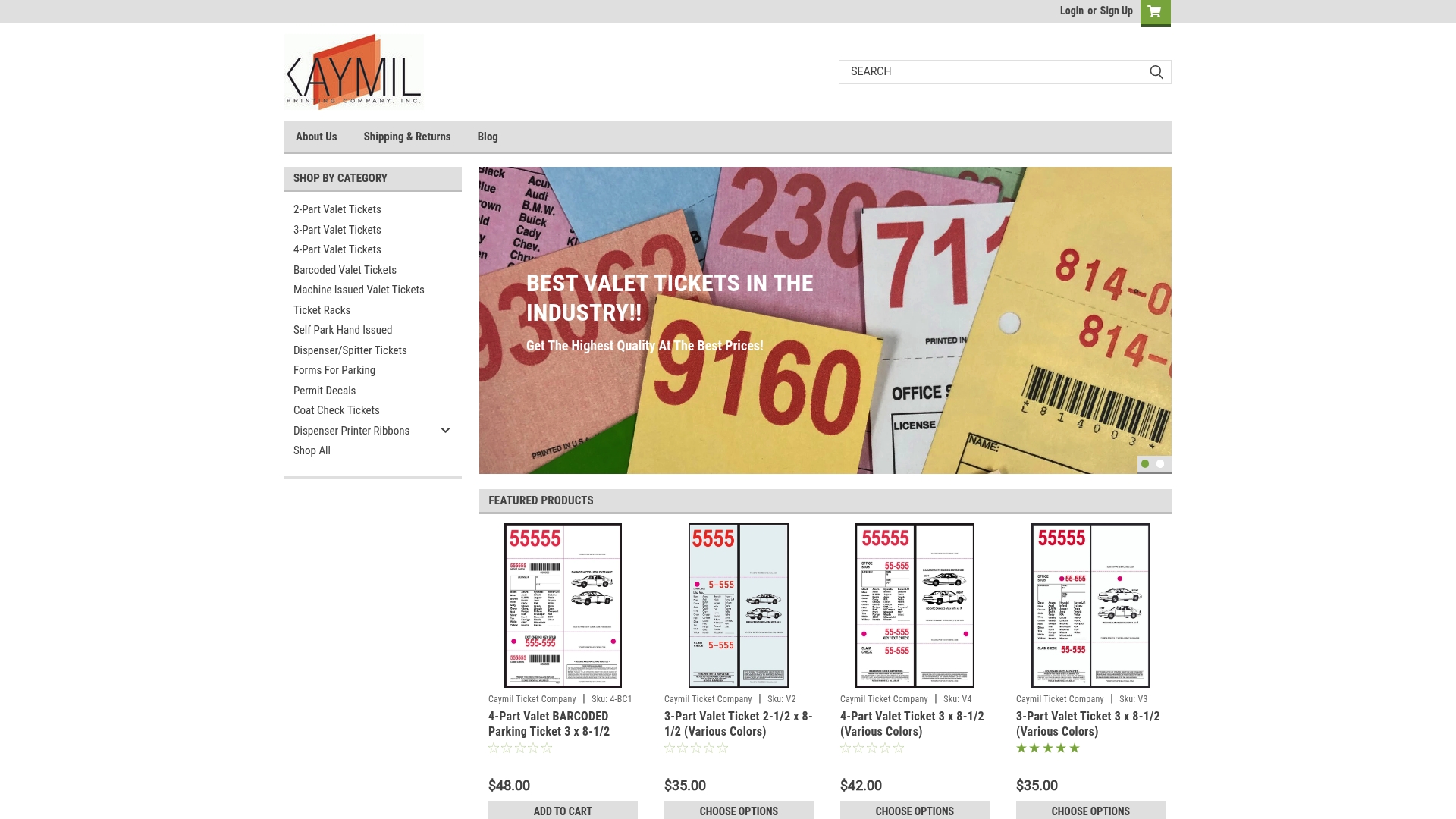
Caymil’s parking forms and citations include fully customizable options with sequential numbering, logo printing, color matching, and security features. For valet operations, the machine-issued valet ticket line is built for high-speed dispensers and carries your branding on every roll. For barcode-dependent garages, Caymil stocks and custom prints tickets compatible with Amano, TIBA, SKIDATA, FLASH Parking, and all major systems.
Every order ships with the print quality and material durability that enforcement operations demand. Millions of tickets are in stock with fast nationwide delivery. Contact Caymil directly to discuss your operation’s specific needs and get a quote tailored to your volume and format requirements.
FAQ
What fields should a branded parking ticket always include?
At minimum, a parking citation should include the vehicle registration number, date and time, location, violation type, and a contact method for disputes. These fields are required for any citation to hold up under review.
Why do hotels use branded parking tickets instead of generic ones?
Hotels use branded parking citations to reinforce guest experience and maintain a professional image at every touchpoint. More practically, hotel-branded entry tickets communicate the check-in conversion process that lets guests access parking independently throughout their stay.
How does a spelling error affect parking enforcement?
A single typo on a parking permit or sticker can legally compromise the citation and force a full enforcement suspension. In one documented case, reprints cost $0.52 per sticker and all enforcement activity stopped until corrected materials arrived.
What is the difference between a two-part and four-part valet ticket?
A two-part ticket provides one copy for the vehicle and one for the guest, while a four-part format adds copies for management and billing. The more parts, the greater the accountability trail, which matters for high-value or dispute-prone operations.
Are barcode parking tickets compatible with all parking systems?
Not automatically. Barcode tickets must be specified to match your machine’s paper sensitivity, roll dimensions, and barcode format. Caymil manufactures system-compatible ticket rolls for Amano, TIBA, SKIDATA, FLASH Parking, Scheidt & Bachmann, and Flowbird systems.