

Garage parking receipt explained for facility managers

Garage parking receipt explained is a phrase that sounds simple until you are standing at a front desk with a frustrated guest who cannot get reimbursed because their receipt shows a lump sum instead of itemized charges. For parking facility managers and hotel concierge staff, these documents carry far more operational weight than most people realize. They are the paper trail that resolves disputes, supports audits, and determines whether a guest’s expense report sails through or gets rejected by their finance department. This guide breaks down exactly what these receipts contain, how different payment systems produce them, what tax regulations require, and how to use them more effectively every day.
Table of Contents
- What is a garage parking receipt and what does it include?
- How different garage payment systems produce and manage parking receipts
- Sales tax and compliance requirements for parking receipts in the U.S.
- The role of parking receipts in travel expense reimbursement and recordkeeping
- Comparing common garage parking receipt types and optimizing their use
- A fresh perspective: why receipt handling can make or break your parking operations
- Optimize your parking receipt processes with Caymil Printing solutions
- Frequently asked questions
Key Takeaways
| Point | Details |
|---|---|
| Essentials of parking receipts | Garage parking receipts commonly show entry/exit times, amount paid, and payment method to serve proof and auditing needs. |
| Payment systems affect receipts | Ticket-based, pay-on-foot, and prepaid systems generate different receipt types affecting guest guidance and retrieval. |
| Tax compliance matters | Separately stating sales tax on receipts prevents legal issues and customer disputes in many U.S. jurisdictions. |
| Receipts support reimbursement | Accurate, itemized receipts aligned with IRS and organizational policies enable smooth expense reporting and reimbursement. |
| Staff training improves efficiency | Educating guests and staff on receipt types and retrieval prevents delays and enhances customer satisfaction. |
What is a garage parking receipt and what does it include?
A garage parking receipt is the formal record of a completed parking transaction. At its core, a U.S. parking receipt captures entry time, exit time, duration, total amount paid, and payment method. That sounds straightforward, but the actual format and completeness of that information varies significantly depending on the garage’s equipment and management system.
Receipts serve two distinct purposes simultaneously. For the customer, it is proof of payment and the document needed for reimbursement. For the operator, it is an audit trail, a dispute resolution tool, and a revenue record. When either function breaks down, it creates friction on both sides of the transaction.
The information a well-formatted receipt should include:
- Entry date and time, stamped at ticket issuance or gate entry
- Exit date and time, recorded at the pay station or exit lane
- Total duration of the parking stay
- Parking fee breakdown, including any flat rate, hourly rate, or daily maximum applied
- Applicable sales tax, shown as a separate line item
- Payment method (credit card, cash, mobile payment, or validation)
- Transaction or confirmation number for record matching
- Facility name and address
- Cashier or kiosk ID where payment was processed
Receipts generated by parking system tickets through automated systems like Amano, TIBA, or SKIDATA will typically populate most of these fields automatically. Manually issued receipts or basic thermal prints from older equipment may omit several of them, which is where problems start.
How different garage payment systems produce and manage parking receipts
Not all garages handle receipts the same way. The system a facility runs directly determines how and when a receipt is issued, and that affects what guests and staff can do with it afterward.
Here are the three most common garage payment models in the U.S.:
- Ticket-based, pay-on-foot: The driver takes a paper ticket at entry. Before leaving, they pay at a pay-on-foot kiosk, which validates the ticket and prints a receipt. The driver then uses the validated ticket to exit.
- Ticket-based, pay-at-exit: The driver takes a ticket at entry and pays at the exit lane directly, either to a cashier or an automated gate. A receipt prints at the exit point.
- Prepaid or QR code-based: The driver books in advance, pays online, and receives a confirmation email or a QR code. On arrival, they scan the code or their license plate is read automatically. No printed receipt is issued at the garage because the receipt was delivered digitally at the time of purchase.
SFO uses all three of these models across different lots, meaning a guest parked at the same airport can leave with a printed ticket, an emailed confirmation, or nothing at all if they forgot to save the digital receipt.
| Payment system | Receipt format | Receipt timing | Guest action required |
|---|---|---|---|
| Pay-on-foot kiosk | Printed thermal receipt | At kiosk payment | Retain printed receipt |
| Pay-at-exit cashier | Printed or handwritten | At gate | Retain printed receipt |
| Prepaid or QR code | Email confirmation | At booking | Save and forward email |
| License plate recognition | Email or app-based | At booking/exit | Check email or app |
Pro Tip: When a hotel guest says they parked at a nearby garage and “never got a receipt,” ask which payment method they used. If it was a prepaid booking, the receipt is almost certainly in their email inbox, not on paper.
Understanding which system a garage uses allows concierge staff to direct guests accurately. Sending a prepaid customer back to the kiosk to get a printed receipt is a dead end that creates frustration. Knowing the system eliminates that entirely.
Sales tax and compliance requirements for parking receipts in the U.S.
Tax compliance is one area where receipt design goes from administrative detail to legal requirement. Parking facilities cannot bundle tax silently into a total and call it done.
New York guidance on parking receipts: Sales tax must be separately stated on receipts for parking services, or the seller may be held liable for the uncollected tax.
New York is explicit, but this principle applies broadly. Many states require clear tax disclosure on parking receipts, and failing to separate the tax line exposes operators to liability. If a customer disputes that tax was charged, an undifferentiated total provides no defense.
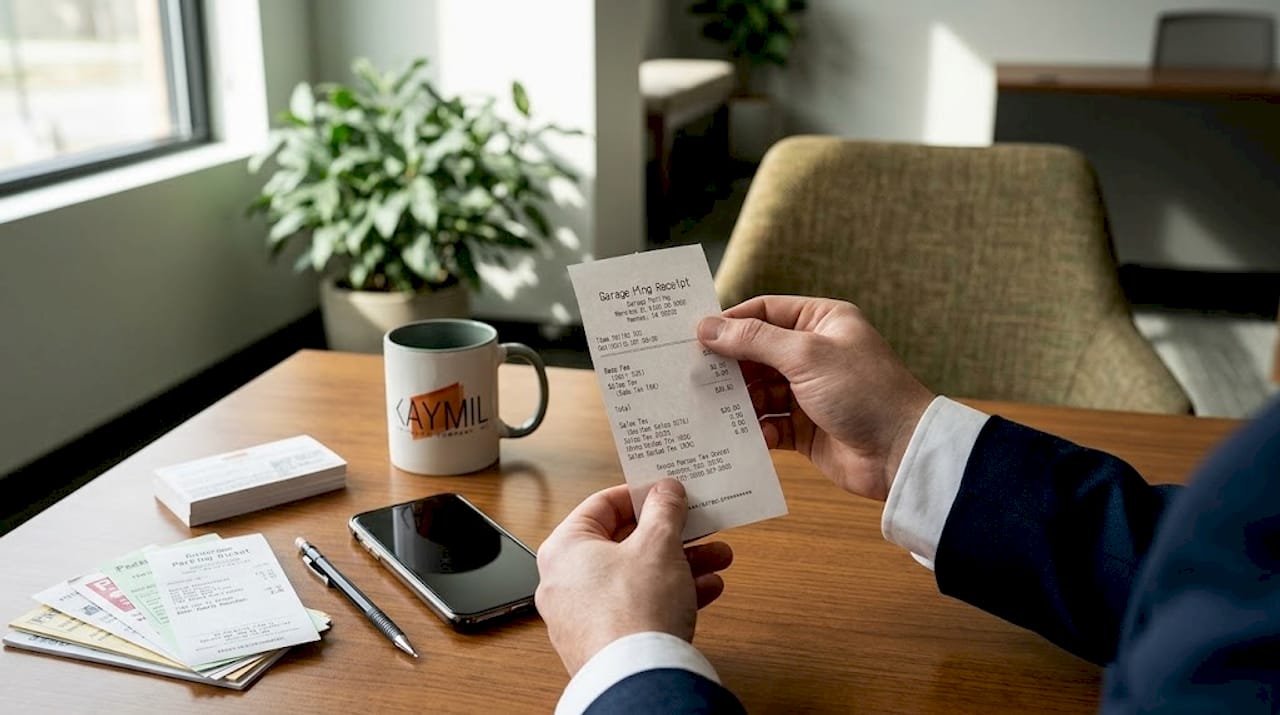
For receipt design, this means your printed or digital receipt must show the base parking fee and the tax as separate, labeled line items. Something like “$18.00 parking + $1.60 sales tax = $19.60 total” satisfies the requirement. A single line reading “$19.60” does not.
If your current parking receipt forms do not include a dedicated tax line, that is a compliance gap worth addressing before an audit finds it.
Pro Tip: If your garage cannot print itemized receipts due to equipment limitations, your jurisdiction may require you to post conspicuous signage at the entrance stating that the posted price includes all applicable taxes. Check your state’s specific regulations and document that signage as part of your compliance record.
The role of parking receipts in travel expense reimbursement and recordkeeping
For hotel guests and business travelers, the parking receipt is often the document that determines whether a cost gets reimbursed. Finance teams and corporate travel policies are not forgiving about missing or incomplete documentation.
IRS and organizational policies require receipts submitted for reimbursement to include the amount, date, location, payment method, and itemized charges. For parking expenses over $75, original itemized receipts are required. A credit card statement alone is not sufficient.
What this means practically for your operations:
- Your receipts must include a date and time, not just a transaction number.
- The facility name and address must be legible. Faded thermal prints or illegible handwriting disqualify a receipt.
- The payment method should be visible. A receipt that shows a credit card last four digits is stronger documentation than one that does not.
- Itemized charges matter. Overnight parking, event surcharges, and tax must each appear as distinct lines.
For hotel concierge teams, there is a practical workflow that prevents most reimbursement problems:
- Ask guests at checkout if they parked in an affiliated or nearby garage
- Remind them to retain both the parking receipt and their hotel folio
- If the facility is managed by the hotel, offer to print a duplicate receipt from the system before the guest leaves
- Keep a contact number for the nearby garage on hand so guests can request receipt reprints within the retention window
The connection between parking documentation and permit and tracking programs applies here too. Facilities that track vehicles with hang tags or permits can cross-reference stay records if a receipt is lost.
Comparing common garage parking receipt types and optimizing their use
Not every piece of paper that comes out of a parking interaction qualifies as a reimbursement-ready receipt. Understanding the difference between receipt types prevents misdirected guests and bottlenecks in expense reporting.
| Document type | What it shows | Reimbursement valid? | Where obtained |
|---|---|---|---|
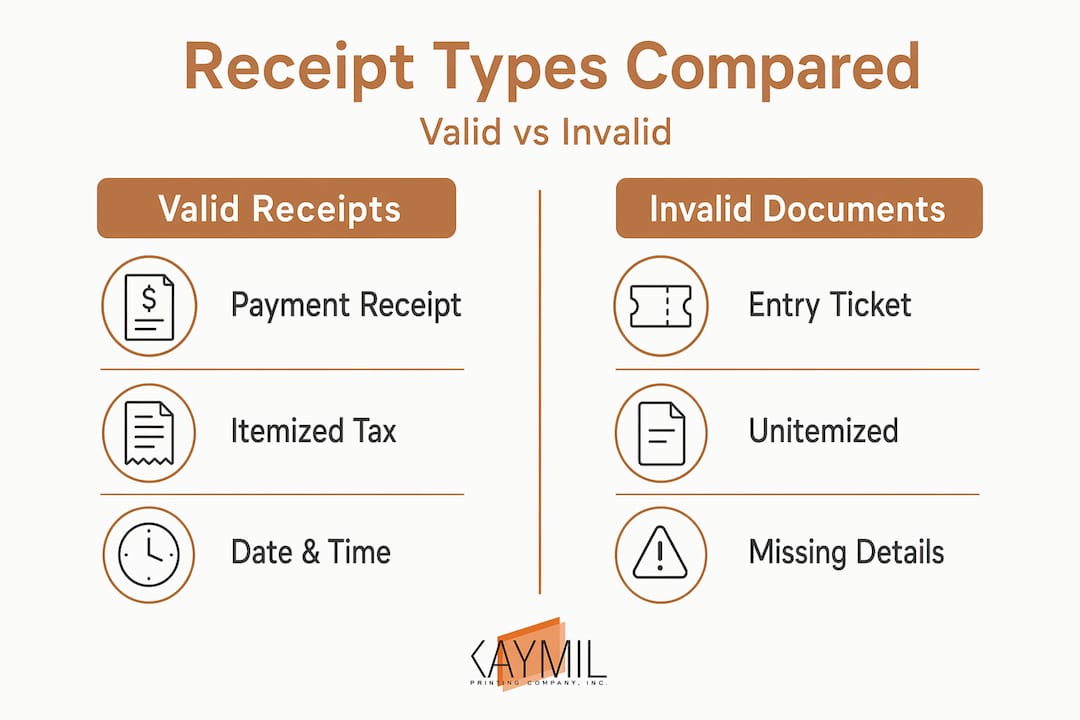
| Entry ticket | Date, time, location | No, proof of entry only | Entry gate or kiosk |
| Pay-on-foot receipt | Duration, total, tax, payment | Yes | Pay station |
| Exit lane receipt | Duration, total, payment | Yes | Exit gate |
| Email confirmation (prepaid) | Booking total, dates, reference | Yes, if itemized | Email inbox |
| Credit card slip | Amount, date, last four digits | Partial only | Payment terminal |
Matching the receipt type to the payment method is critical. A guest who paid at the exit lane and only saved the entry ticket is missing their actual receipt. This mismatch is one of the most common causes of reimbursement delays and disputes at both garages and hotel desks.
Best practices for receipt handling in your facility:
- Train staff to distinguish between entry tickets and payment receipts in all conversations with guests
- Post clear signage at pay stations explaining that the receipt printed there is the official record of payment
- For digital systems, send confirmation emails immediately and include a reprint link valid for at least 90 days
- Log transactions with reference numbers that staff can search when guests return for duplicate receipts
Pro Tip: For valet operations, efficient valet parking log management is directly tied to receipt accuracy. When valet logs include the same transaction reference printed on the customer receipt, disputes are resolved in minutes instead of hours.
A fresh perspective: why receipt handling can make or break your parking operations
Here is something that rarely gets said in parking operations training: the receipt is not a transaction summary. It is a trust document. And most facilities treat it like an afterthought.
The operational losses from poor receipt handling are largely invisible, which is why they persist. A guest who cannot get reimbursed does not complain about the receipt. They complain about the hotel. They complain about the parking garage. They leave a one-star review about “confusing fees” when the real issue was a thermal print that faded before they reached their office. That connection between receipt quality and customer satisfaction is almost never made explicit.
The other blind spot is the gap between payment flow and receipt retrieval. Staff often know the payment systems well but cannot answer the question “how do I get my receipt for a prepaid booking?” because that process lives outside their daily workflow. Proactively training hotel concierge staff to guide guests through receipt retrieval for every payment type is not an extra step. It is the step that prevents five guest complaints and two reimbursement disputes per week.
Facilities that have modernized their PARCS-compatible ticketing know that the physical quality of receipts matters as much as the data on them. A carbonless multi-part form that survives a trip through a wallet is more useful than a perfectly formatted thermal print that fades in 30 days. Durability, clarity, and complete data fields are not printing specs. They are customer service specs.
Optimize your parking receipt processes with Caymil Printing solutions
Caymil Printing Co. has helped parking facilities and hotel operations get their receipt and ticketing workflows right since 1937. Whether you need clearly formatted parking receipt forms that separate fees from tax, or high-volume printed solutions that hold up through high-traffic environments, Caymil manufactures products built for exactly this work.
For facilities that rely on pay-on-foot kiosks or valet lanes, machine-issued valet tickets are built to work with major parking systems including Amano, TIBA, SKIDATA, and Flowbird, and can be customized with your logo, sequential numbering, and tax line fields. Organized parking ticket racks keep receipts accessible at every station, reducing the time staff spend hunting for documentation during peak checkout periods. Contact Caymil to discuss custom receipt formats that meet your compliance and operational needs.
Frequently asked questions
What key information must a garage parking receipt include for reimbursement?
Receipts should include entry and exit times, total charge, payment method, and itemized sales tax if applicable. Organizational policies require amount, date, location, payment method, and itemized charges for a receipt to qualify.
How can hotel concierge staff help guests avoid parking receipt issues?
By directing guests to the correct receipt channel based on their payment type and reminding them to retain both their parking receipt and hotel folio, staff can prevent most reimbursement delays. Proactive documentation guidance is one of the most effective ways to improve guest satisfaction.
What should a garage do if it cannot provide a separate tax line on receipts?
The garage must post conspicuous signage stating that all charges include sales tax. New York tax regulations require this as an alternative to receipt-based disclosure to avoid seller liability.
What are common situations that cause disputes over garage parking receipts?
Disputes typically arise when guests lose paper receipts, confuse entry tickets with payment receipts, or tax charges are not clearly itemized. Matching receipt type to payment method is the most direct way to prevent these situations.
How long should parking operators retain records for receipt retrieval requests?
Transaction records at major facilities are typically retained for at least 90 days. Requests older than 90 days may require additional verification or may not be fulfilled depending on the operator’s retention policy.