

Optimize hotel parking: Integration, valet, and guest experience

Hotel parking bottlenecks rarely come down to too few spaces. The real culprits are system disconnects, manual handoffs, and mismatched data between platforms that should be talking to each other seamlessly. When a guest checks in and expects their vehicle to be accessible without re-entering credentials, hunting down a valet attendant, or standing at a kiosk confused about validation, every second of friction matters. This article walks hotel management professionals through the mechanics of modern parking systems, how integration with property management and point-of-sale platforms drives operational efficiency, where the risks live, and what practical steps lead to consistently smooth guest experiences.
Table of Contents
- Hotel parking systems: Core components explained
- How integration automates and optimizes parking operations
- Security, exception handling, and guest experience pitfalls
- Best practices for implementing or upgrading hotel parking systems
- Why ‘automation’ alone won’t fix parking: A manager’s reality check
- Streamline your parking operations with specialized solutions
- Frequently asked questions
Key Takeaways
| Point | Details |
|---|---|
| System integration is essential | Connecting PMS, LPR, and parking management software streamlines operations and guest experience. |
| Exception handling protects guests | Backup workflows for credential failures prevent disputes and ensure reliability. |
| Valet control reduces liability | Clear key tracking and audit trails are critical for guest trust and loss prevention. |
| Strategic planning pays off | Mapping every vehicle journey state to a system responsibility guides effective implementation. |
| Customize with the right tools | Tailored tickets, forms, and permits complete the operational loop for optimized parking. |
Hotel parking systems: Core components explained
Modern hotel parking environments are built on multiple layers of technology working in coordination. Understanding each component and its role is the first step toward identifying where your current setup may have gaps.
The key components in any well-functioning hotel parking system include:
- Gate controllers: Physical barrier arms that open and close based on signals from ticketing machines, LPR cameras, or validated credentials.
- License plate recognition (LPR) cameras: Optical systems that read vehicle plates on entry and exit, linking a physical vehicle to a digital record.
- Parking management software: The central platform that tracks occupancy, manages entitlements, logs transactions, and generates reports.
- Property management system (PMS) integration: The bridge between your parking platform and hotel operations. It handles check-in events, room folios, and guest profiles.
- Valet point-of-sale (POS) terminals: Tablets or kiosks used by valet staff to log vehicle arrivals, assign keys, record ticket numbers, and process payments.
- Ticketing systems: Physical or digital credentials issued at entry, including machine-issued barcode tickets, thermal tickets, or valet claim checks.
- Payment gateways: Platforms that process credit card charges, folio postings, or mobile wallet transactions at exit.
Modern hotel parking systems rely on integration with property management systems, point-of-sale platforms, LPR technology, and event management tools. When one of these components is missing or misconfigured, the entire chain breaks down.
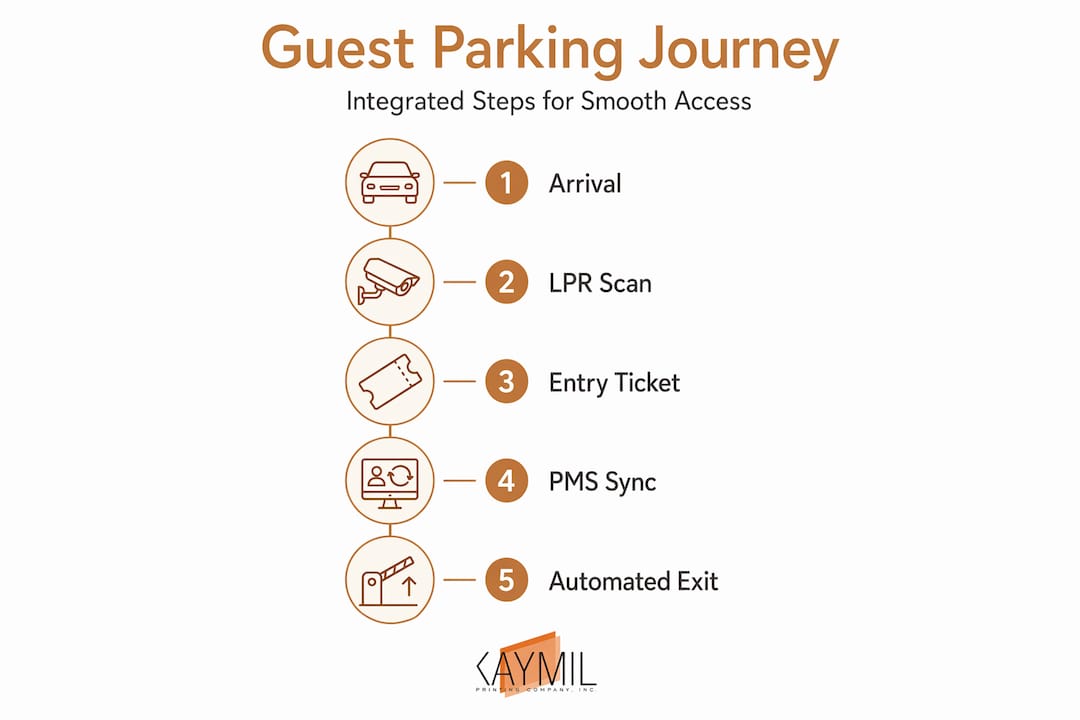
A typical guest parking journey touches every one of these systems. The vehicle arrives, the LPR camera reads the plate, the parking management software checks the PMS for an active reservation, the gate opens, and the parking charge is queued to the room folio. At exit, validation is confirmed, the charge posts automatically, and the gate releases. In a self-park environment, that entire sequence can be frictionless. In a valet operation, the POS layer adds a human handoff point that requires its own layer of accountability.
| Component | Primary role | Operational impact |
|---|---|---|
| Gate controllers | Physical access control | Reduces unauthorized entry and traffic backup |
| LPR cameras | Plate-based identity | Speeds entry/exit, enables touchless validation |
| Parking management software | Occupancy and transaction tracking | Improves revenue visibility and audit trails |
| PMS integration | Guest folio and entitlement sync | Automates billing and reduces front desk disputes |
| Valet POS | Staff-driven vehicle tracking | Controls handoffs and reduces liability |
| Ticketing | Physical or digital credential | Provides fallback when LPR or system fails |
| Payment gateway | Charge processing | Ensures fast, accurate settlement |
It’s worth noting that integrated parking system tickets play a critical role even in the most automated environments. They serve as the physical safety net when digital systems encounter issues. Industry data consistently shows that over 80% of hotel parking complaints trace back to process breakdowns rather than hardware failures. That means the problem is almost always procedural or integration-related, not the result of a broken sensor.
How integration automates and optimizes parking operations
Knowing the components is useful, but seeing how they connect in real time is what makes the difference between a parking system that works and one that runs itself.
Here is a step-by-step breakdown of how a fully integrated system processes a guest from arrival to checkout:
- Guest reservation is created in the hotel PMS, including a parking entitlement flag.
- Vehicle arrives and the LPR camera captures the plate, or the guest takes a barcode ticket from the entry machine.
- The parking management software queries the PMS in real time to confirm whether the plate or ticket matches an active guest record.
- Gate opens automatically based on confirmed entitlement. No staff interaction required.
- Parking session begins and is logged with timestamp, space assignment (if managed), and rate category.
- During the stay, any POS event such as a restaurant charge can trigger a validation that extends or adjusts the parking entitlement. LPR validation can trigger parking access when a guest checks in, pays for dining, or registers for an event.
- At checkout, the PMS signals the parking system. Remaining charges are calculated, posted to the room folio, and cleared for exit.
- Gate releases without the guest visiting a kiosk or paying separately.
This workflow eliminates multiple manual touchpoints that create friction and errors. The difference between manual and integrated operations is significant.
| Workflow element | Manual process | Integrated process |
|---|---|---|
| Entry validation | Staff check paper log or call front desk | Automated via LPR or ticket scan |
| Billing | Receptionist manually adds charge to folio | Posted automatically at exit |
| Dispute resolution | Staff must pull paper receipts | Audit trail is instantly available in software |
| Overstay detection | Requires periodic lot checks | Real-time alert generated by parking software |
| Valet key tracking | Physical log book, prone to error | Digital POS log with timestamped handoffs |
Parking-to-PMS integration exchanges check-in and check-out events, synchronizes entitlements, and automates billing and validation. The operational gains are not theoretical. Hotels that implement tight integration report measurable reductions in billing disputes, faster lane throughput, and improved guest satisfaction scores in post-stay surveys.

Pro Tip: If your parking vendor and PMS don’t offer native integration, middleware solutions can bridge the two platforms. This approach gives you flexibility to upgrade either system independently without rebuilding the entire stack. It also future-proofs your setup as your property’s needs evolve.
For properties using machine-issued ticketing as the backbone of their entry and exit workflow, automated parking ticket solutions designed for specific system compatibility ensure that barcodes scan reliably and thermal print quality holds up under high-volume conditions.
Security, exception handling, and guest experience pitfalls
Integrated systems boost efficiency, but they also introduce new risks that must be managed proactively. When something goes wrong in a fully automated environment, the failure can cascade quickly and create a guest-facing problem that is difficult to resolve in the moment.
Common failure points in hotel parking operations include:
- Entitlement mismatches: A guest’s plate is not linked correctly to their reservation in the PMS, causing the gate to deny access despite a valid booking.
- LPR read errors: Dirty plates, unusual fonts, trailer hitches, or low-light conditions can cause the camera to misread or miss a plate entirely.
- Lost or damaged tickets: In high-volume self-park environments, a guest who loses their entry ticket faces a confusing exception process.
- Valet key handling errors: Wrong keys assigned to claim tickets, or keys stored without proper labeling, create liability exposure and can delay vehicle retrieval significantly.
- System downtime: When the parking management software or PMS connection drops, gates may default to open or closed, neither of which is ideal from an operations or security standpoint.
“The biggest risk is not the sensor but synchronization errors between the PMS and parking system; backup workflows and clear exception handling prevent bottlenecks and customer disputes.”
This perspective holds up in practice. The most effective hotel parking teams are not the ones with the newest technology. They are the ones with well-documented exception procedures that staff can execute confidently under pressure.
Pro Tip: Pair your LPR system with a secondary ticketing workflow. When LPR fails to read a plate, a barcode ticket issued at the same entry point gives the guest and your staff a reliable fallback credential. This two-layer approach reduces exit lane backups and eliminates the awkward “the system doesn’t see your car” conversation.
Audit trails are equally important. Strong key management and tracking in valet operations prevent errors and minimize liability exposure. Every key handoff should be timestamped, linked to a ticket number, and logged in your valet POS. This creates a clear chain of custody that protects your property and your guests.
For teams managing valet operations at any volume, reviewing valet parking log best practices and understanding how using valet tickets for smoother operations can reduce handoff errors are practical starting points before evaluating any new technology.
Best practices for implementing or upgrading hotel parking systems
With a clear picture of risks and integration mechanics, hotel managers can take deliberate steps toward building or improving a parking system that serves both operations and guests.
Here is a practical framework for approaching the process:
- Conduct a needs assessment. Document your current parking volume, peak demand windows, self-park versus valet ratio, and existing system limitations. This baseline informs every subsequent decision.
- Map your vehicle journey states. Mapping vehicle journey states and explicitly assigning system responsibility enables strategic planning and effective integration. Know which system owns arrival, access, session tracking, validation, and billing.
- Plan your integration architecture. Identify whether your PMS has a native parking integration or requires middleware. Confirm API availability with your parking vendor before committing to a platform.
- Select vendors based on compatibility first, features second. A parking system with impressive features that cannot talk to your PMS will create more problems than it solves.
- Design your exception handling workflows before go-live. Document what staff should do when LPR fails, when entitlements don’t match, and when guests dispute charges.
- Train staff on both normal operations and exception cases. Technology training alone is insufficient. Staff need to understand the guest impact of each failure mode and how to resolve it with confidence.
- Measure guest impact after implementation. Track post-stay survey responses related to parking, monitor lane throughput times, and review billing dispute rates monthly.
When evaluating systems and supplies, the following features should be on your non-negotiable list:
- Real-time two-way PMS integration with event-driven triggers
- Reliable LPR with documented accuracy rates under various lighting and weather conditions
- A ticketing layer (barcode or magnetic stripe) that serves as a fallback for LPR failures
- Mobile validation options for restaurants, events, and valet operations
- Key management tools with digital logging and chain-of-custody tracking
- Reporting dashboards that break down revenue by rate category, guest segment, and time period
For properties evaluating physical ticketing components, guidance on choosing the right parking tickets compatible with your system equipment is essential. Similarly, parking permit program tips are valuable for properties managing monthly or employee parking alongside transient guest operations.
Why ‘automation’ alone won’t fix parking: A manager’s reality check
Here is what most implementation guides leave out. Automation is a tool, not a solution. The hotels that get the most out of integrated parking systems are not the ones that invested the most in technology. They are the ones that did the hard, unglamorous work of aligning their team’s workflows with how the system actually behaves on a busy Saturday night.
We have seen properties invest heavily in LPR and PMS integration only to watch the system fall apart because front desk staff were not trained to flag parking entitlements at check-in. The technology worked perfectly. The process did not. And the guest felt it.
Manual ticket backups are not a sign of an outdated operation. They are a sign of operational maturity. Properties that maintain physical ticket stock, keep valet claim checks stocked and numbered, and train staff to issue them confidently under system failures experience far fewer guest-facing crises than those who rely entirely on digital workflows without a fallback plan.
Regular audits matter more than most managers realize. A quarterly review of your parking transaction logs, entitlement records, and valet key logs will surface discrepancies that technology quietly accumulates over time. Catching a systemic LPR mismatch or a billing configuration error months earlier than your next contract review can save significant revenue and protect your property from liability.
The other lesson worth internalizing is this: don’t overpromise seamless parking to guests. Set realistic expectations through pre-arrival communications. Explain your validation process clearly at check-in. A guest who understands the process before they need it will be far more patient when an edge case occurs than one who was promised effortless parking and encountered friction. Build resilience into your operations by combining real-life hotel parking lessons with the right physical tools, and your team will be prepared for what the technology cannot anticipate.
Streamline your parking operations with specialized solutions
Ready to turn knowledge into action? Equipping your team with the right physical tools is just as important as selecting the right software platform.
Caymil Printing Co. has served hotel parking operations since 1937 with durable, customizable ticketing solutions built for real-world conditions. Whether your operation relies on self-park barcode systems, machine-issued tickets, or full valet service, Caymil offers products that close the gap between your software and your on-ground workflow. From barcode valet tickets that integrate with digital tracking systems to 2-part valet tickets that create a clear physical audit trail, every product is manufactured for reliability under high-volume conditions. Explore custom parking forms designed to support your property’s specific operational workflows and help your team manage exceptions with confidence.
Frequently asked questions
How does PMS integration improve hotel parking operations?
Parking-to-PMS integration automates validation and billing, reducing manual data entry and significantly lowering the risk of errors on guest folios. Guests move through the parking process without stopping at kiosks or visiting the front desk for charge adjustments.
What happens if license plate recognition fails for a hotel guest?
A backup ticket or manual credential process ensures guest access while staff handle exception verification. Pairing LPR with a backup workflow prevents exit lane bottlenecks and reduces guest disputes when the system cannot confirm a plate.
What is the biggest security concern in valet parking systems?
The claim handoff process is the highest-risk moment in any valet operation. Valet operations require strong key management and detailed audit trails to minimize liability and prevent unauthorized vehicle access or key errors.
Which features should hotel managers look for in a parking system?
Prioritize real-time PMS integration, reliable LPR with documented accuracy rates, a physical ticketing fallback layer, clear exception handling workflows, and robust revenue reporting dashboards. These features together create a system that works for your operation, not just in the vendor’s demo.
How do hotels bill guests for parking automatically?
When a guest’s vehicle entry is logged and linked to an active room folio, overstay billing gets posted back to the guest folio automatically at checkout, eliminating the need for manual charge entry or a separate payment transaction at the exit lane.
Recommended
- Valet parking log: Essential guide for efficient operations - Caymil Printing Co., Inc.
- Valet Tickets 101: The Simple System That Keeps Your Lot Moving - Caymil Printing Co., Inc.
- Why Quality Valet Parking Tickets Matter More Than You Think - Caymil Printing Co., Inc.
- Forms For Parking - Caymil Printing Co., Inc.