Operators: Parking Ticket Printing Rates $0.03–$1+ and How to Cut Costs
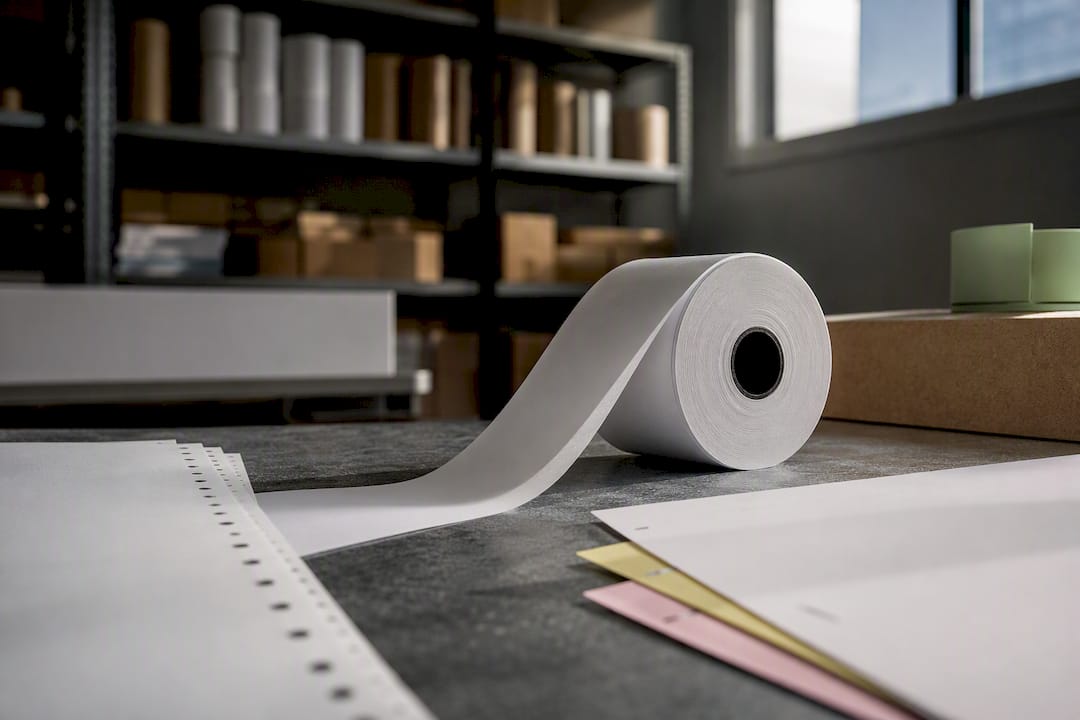
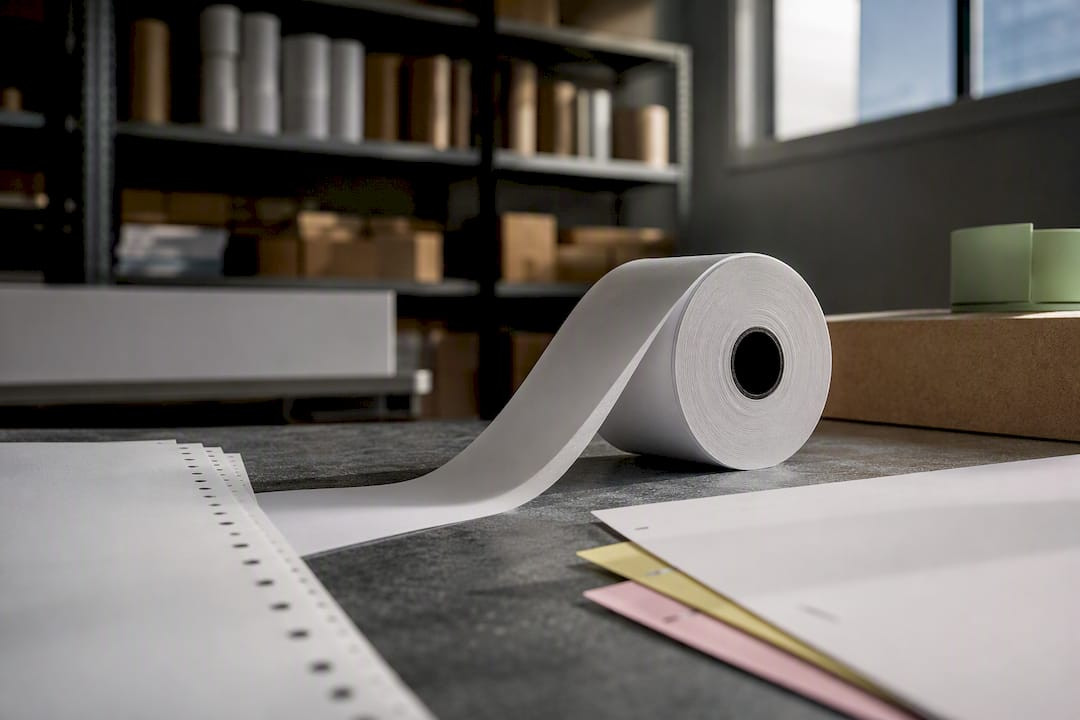
Delivered parking ticket printing costs typically run from $0.03 to $0.20 per ticket for stock fan-folded or citation-style tickets, roughly $0.05 to $0.50 per ticket for thermal rolls depending on roll length and quantity, and $0.10 to over $1.00 per set for custom multi-part valet books with color and numbering. The variables that move those numbers most are order quantity, color complexity, multi-part carbonless construction, sequential numbering and barcoding, rush or setup fees, and shipping. The calculator further down turns those ranges into a real delivered-cost estimate for your specs.
TL;DR:
- Thermal roll prices vary from about $0.04 to $0.10 per ticket depending on roll quantity, with costs flattening at higher volumes over 1,000 rolls.
- Multi-part valet books cost over $1.00 per set, with prices influenced by the number of parts, color, and custom features such as logos or barcoding.
- Setup fees, art charges, and shipping can significantly increase the total cost, especially for small orders below 1,000 tickets or units.
- Compatibility with your dispenser or PARCS hardware must be verified before ordering, as mismatched specs can cause machine jams and delays.
- Public procurement records show that actual delivered prices, often around $0.08 to $0.10 per ticket for large-volume orders, are more reliable benchmarks than list prices.
Table of Contents
- Parking Ticket Printing Cost by Format: Rolls, Stock, and Valet Books
- What Drives Parking Ticket Printing Prices Up or Down?
- How Do You Calculate Your True Delivered Ticket Cost?
- What Municipal Bid Data and Supplier History Reveal About Real Pricing
- What Operators Should Prioritize Beyond the Sticker Price
- Get an Exact Quote on Custom or Stock Parking Tickets
- Sources
- FAQ
Parking Ticket Printing Cost by Format: Rolls, Stock, and Valet Books
Every parking ticket format carries its own pricing logic, and mixing them up when comparing quotes is the fastest way to get burned. A dispenser roll and a valet book solve entirely different problems, and their cost structures reflect that.
Thermal and machine-issued rolls
Machine-issued “spitter” tickets, the kind that feed through Amano, TIBA, SKIDATA, and Flowbird gate systems, are priced by the roll rather than by the individual ticket. Municipal bid records give a useful anchor point here: Philadelphia Parking Authority’s bid addendum lists ticketing rolls at roughly $3.97 per roll, with 96 tickets per roll, which works out to about $0.04 per ticket at that contract’s negotiated volume. Retail-facing suppliers often start custom-printed roll promotions at 250 rolls, with free proofs and volume pricing kicking in as order size climbs. Below 250 rolls, expect to pay closer to the top of the range; past 1,000 rolls, per-ticket cost tends to flatten out fast because the setup charge gets spread across so many more tickets.
Stock fan-folded tickets and citation books
Fan-folded stock tickets and violation-style citation books are priced closer to the $0.03 to $0.20 per-ticket range, with the low end reserved for large, uncustomized orders and the high end applying to smaller runs with perforation, sequential numbering, or two-color printing. Bid documentation for blue and red paper tickets shows unit pricing around $0.135 per ticket in a municipal contract, which sits comfortably in the middle of that band. Ticket and violation books with perforated bottoms show similar positioning on supplier product pages, where per-book pricing scales down noticeably once you clear a few thousand units.
Multi-part valet ticket sets
Multi-part valet tickets, whether 2-part, 3-part, or 4-part carbonless sets, cost more per unit because each additional part adds paper, ink, and carbonless coating to every single ticket. A basic 2-part black-ink valet ticket might land near $0.10 per set at volume, while a 4-part set with full-color printing, a logo, and sequential barcoding can push past $1.00 per set. Some supplier landing pages list prices starting around $475 per 1,000 for certain printed ticket books before setup and add-on charges, which shows how quickly multi-part formats separate from single-ply stock on a cost basis.
Accessories that add to the order total
Envelopes, dispenser cores, and packaging aren’t line items most operators budget for, but they show up on every real invoice. Bid records put envelopes at roughly $0.078 per envelope in bulk municipal quantities, while retail suppliers price parking ticket envelopes at $210 to $345 per 1,000 depending on size and stock weight. Dispenser cores and shrink-wrapped packaging typically add a few cents per unit but rarely appear in a headline quote.
Here’s how per-unit pricing tends to shift as order size grows, based on the pricing patterns across bid documents and supplier catalogs:
A few takeaways sit underneath that table:
- Setup and art fees get amortized fastest between 1,000 and 5,000 units, which is where most operators see the steepest per-ticket price drop.
- Roll pricing depends heavily on ticket count per roll, so always compare cost per ticket, not cost per roll, across quotes.
- Multi-part sets rarely drop below $0.10 per set even at high volume, because each part still consumes its own paper and coating.
- Custom art, logos, and barcoding hold their added cost fairly flat in dollar terms as volume rises, which means their percentage impact shrinks as your order grows.
What Drives Parking Ticket Printing Prices Up or Down?
Once you understand the format, the next question is what specific choices inside that format change your price. Four factors do almost all the work: substrate, print complexity, added features, and order size relative to setup.
Paper and substrate. Standard bond stock is the cheapest option and works fine for hand-issued tickets and citation books. Thermal stock, required for machine-issued rolls, costs more per square foot because it needs a heat-reactive coating, and synthetic or weather-resistant stock for outdoor dispensers or long-term permits costs more still. If you’re deciding between paper types for durability rather than just price, Caymil’s breakdown of parking ticket paper options covers how each substrate holds up over time.
Color and print complexity. One-color printing on stock paper is the baseline. Spot color, meaning one or two accent colors layered onto black ink, adds a modest per-unit bump plus a small plate charge. Full-color printing with a logo, gradient, or photo raises both the per-unit cost and the upfront art setup fee, since full-color runs typically require more complex plate or digital press setup than single-color jobs.
Value-added features. Each of these adds cost, but the increase is rarely proportional to the value it delivers:
- Sequential numbering: usually a small per-thousand charge, often the cheapest add-on relative to the control it provides.
- Barcoding: modest per-unit increase, but essential if you’re feeding data into a PARCS system for automated tracking.
- Magnetic stripe encoding: a bigger jump, since it requires specialized stock and encoding equipment.
- Perforation: minor cost, mostly relevant for tear-off stubs on citation books.
- Multi-part carbonless construction: the largest single driver of per-unit cost among common features, since it multiplies material and coating across every layer.
Setup and minimum order amortization. Art fees, plate charges, and proof approval cycles are one-time costs, but they hit small orders much harder than large ones. A $75 setup fee spread across 250 tickets adds $0.30 per ticket; spread across 10,000 tickets, it adds less than a penny. This is exactly why suppliers can offer aggressive volume pricing starting at 250 rolls while still charging noticeably more per unit at that entry quantity.
Machine and dispenser compatibility. Not every roll fits every machine. Core size, roll diameter, and paper finish are often model-specific, and printer specifications from equipment manufacturers frequently set minimum stock requirements that suppliers must meet to preserve warranty and performance. Ordering the wrong roll spec for your dispenser doesn’t just waste money, it can jam the machine mid-shift.
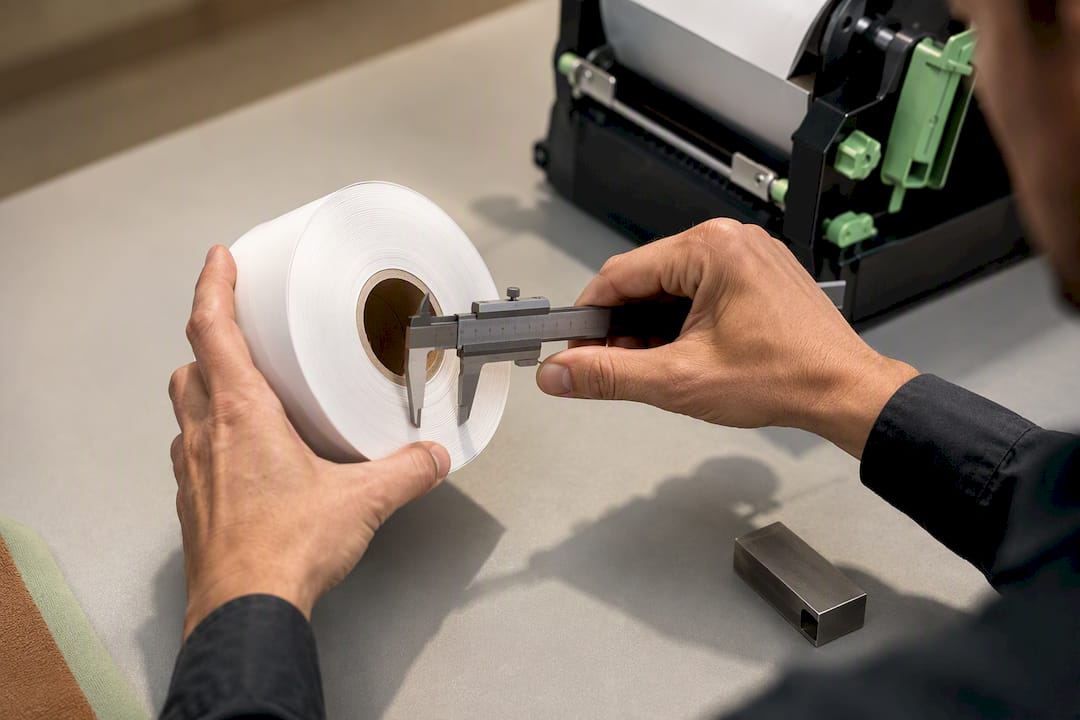
Pro Tip: Before requesting quotes, pull your PARCS or dispenser’s exact model number and confirm core size and roll diameter with your equipment manufacturer. A five-minute check now avoids a rejected shipment and a rush reorder later.
How Do You Calculate Your True Delivered Ticket Cost?
Quoted unit price rarely equals what shows up on your invoice. The real formula looks like this:
Total delivered cost = (unit price × quantity) + setup/art fees + shipping + taxes + finishing fees
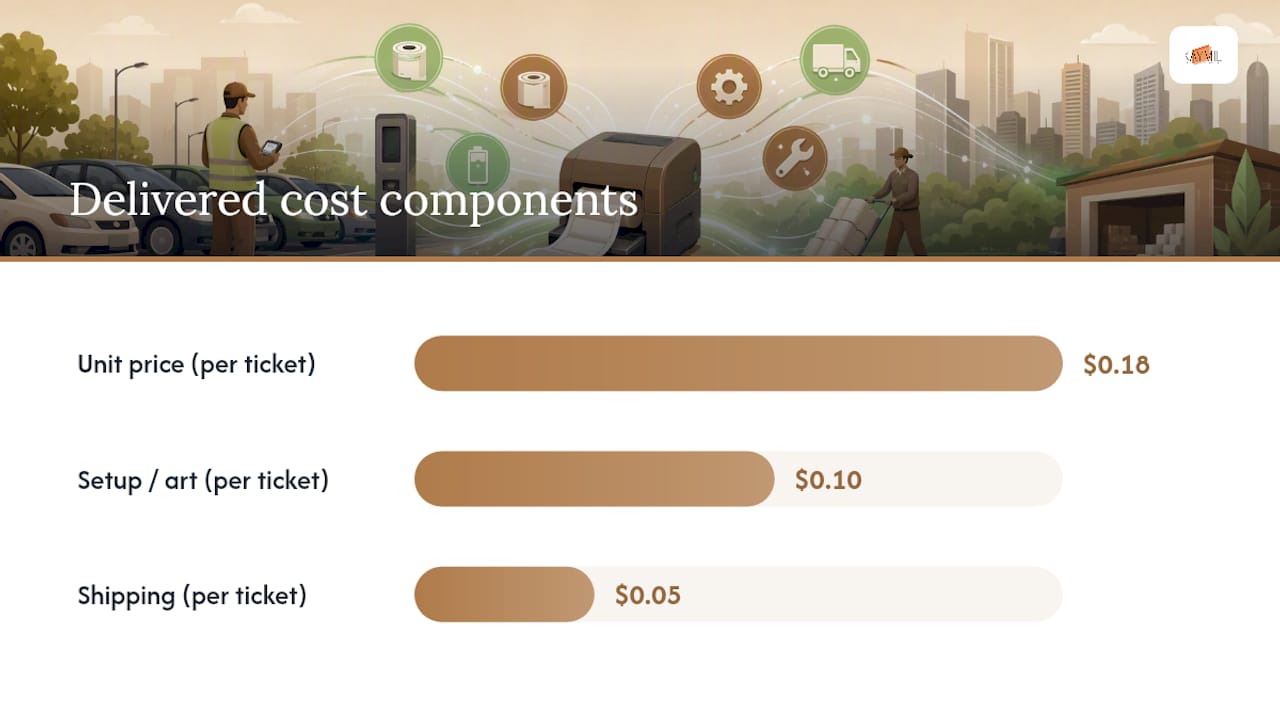
Finishing fees cover things like perforation, hole-punching, padding into books, or shrink-wrapping, and they’re the line items most likely to get left off an initial quote.
Here’s how that formula plays out across three common buyer profiles:
- One-off event order (250 to 1,000 tickets). A venue running a single weekend event might order 500 stock fan-folded tickets at $0.18 per ticket ($90), plus a $50 one-time art setup fee for a logo, plus $25 flat-rate shipping. Total: roughly $165, or about $0.33 per ticket delivered, once setup and shipping are folded in.
- Mid-size operator (1,000 to 5,000 tickets). A parking garage reordering thermal rolls quarterly might buy 2,000 rolls at $0.10 per ticket equivalent (roughly $200 per case of rolls depending on roll count), no new setup fee since art is already on file, plus $150 freight. That recurring order often lands in the $100 to $300 per case range that consumable suppliers typically quote.
- Municipal or bulk procurement (10,000+ tickets). A city parking authority ordering 10,000 multi-part valet-style citation books at $0.08 per ticket ($800), with no setup fee under an existing contract, plus negotiated freight, often included in the unit price itself under public-sector procurement rules that require delivered pricing rather than factory-door pricing.
Watch for these commonly missed fees when comparing supplier quotes: dispenser cores, padding charges for citation books, rush production fees, tape and box packaging, and proof rework charges if you request more than one round of revisions.
Before you request quotes, send every supplier the same specification checklist so the numbers you get back are actually comparable: ticket format (roll, stock, multi-part), exact dimensions, perforation needs, sequential numbering range, barcode type, paper stock, and your PARCS or dispenser machine model.
What Municipal Bid Data and Supplier History Reveal About Real Pricing
Public procurement records are some of the most reliable pricing benchmarks available, because they show contract-level unit prices with delivery built in rather than a marketing headline rate. The Philadelphia Parking Authority’s PARCS roll addendum requires bidders to submit delivered unit pricing across annual quantity tables, a format that forces true apples-to-apples comparison instead of letting shipping costs hide in the fine print. Any operator negotiating a supply contract can borrow that same structure: ask for delivered price per unit, at your specific annual volume, not a factory list price.
Inventory management deserves more attention than it usually gets in a pricing conversation. A dispenser that runs out of roll stock mid-shift doesn’t just cost the price of a rush shipment, it costs every transaction that couldn’t be processed until the machine was reloaded. Treating safety stock levels as part of your real ticketing budget, not an afterthought, tends to pay for itself the first time a shipment runs a day late.
A few procurement habits separate operators who get predictable pricing from those who get surprised by it:
- Confirm PARCS or dispenser model compatibility before ordering, not after a shipment arrives that doesn’t fit.
- Ask for delivered unit pricing across your actual annual quantity, not just a sample-quantity quote.
- Build a two- to four-week safety stock buffer into reorder timing rather than ordering at the last minute.
- Treat customization like sequential numbering and barcoding as control investments, not just cost adders, since they make revenue reconciliation and fraud prevention easier.
What Operators Should Prioritize Beyond the Sticker Price
The cheapest per-ticket quote is rarely the right decision, and most operators figure that out the expensive way, usually mid-shift, when a roll won’t seat in the dispenser. Compatibility should come before price on every comparison sheet. A ticket that’s a few cents cheaper but doesn’t match your Amano or SKIDATA spec isn’t a bargain, it’s a service call waiting to happen.
Stock tickets make sense for one-off events, seasonal overflow, or situations where branding doesn’t matter. Custom tickets earn their higher per-unit cost the moment you need numbering, barcoding, or a logo tied to daily operations, because the control and revenue tracking they add tends to outweigh the price gap fast. If you’re still weighing which category fits your situation, Caymil’s stock versus custom breakdown walks through that decision in more depth.
One negotiating lever gets overlooked constantly: setup fee amortization. Ask any supplier whether they’ll spread your art and plate charges across multiple scheduled orders instead of billing the full fee upfront on order one. Suppliers with repeat business often say yes, and it can shave real money off your effective per-ticket cost without changing your order size at all.
— Richard
Get an Exact Quote on Custom or Stock Parking Tickets
Caymil gives operators a straighter path to predictable pricing than piecing together quotes from a print broker who doesn’t stock parking-specific formats. As a direct manufacturer since 1937, Caymil produces stock rolls, custom-printed rolls, multi-part valet ticket books, barcoded tickets, and dispenser-compatible stock built to match Amano, TIBA, SKIDATA, FLASH Parking, Scheidt & Bachmann, and Flowbird specs, which means no guessing on core size or roll diameter after the order ships.
Pricing shifts with the same variables covered above: sequential numbering, barcoding, color, security features, and multi-part construction. To get a quote that’s actually comparable across suppliers, send your machine model, ticket dimensions, quantity, and any numbering or barcode requirements. Browse Caymil’s full parking ticket product line to see stock options and request a sample before committing to a full order.
Sources
- 16-33 Addendum No. 1 - Draft (Philadelphia Parking Authority bid addendum)
- Ticket and Violation Books with Perforated Bottom - Earle Press product pages
- Parking consumables: tickets and hardware explained (Parksy blog)
FAQ
How Much Does It Cost to Print Parking Tickets?
Delivered parking ticket printing cost typically runs $0.03 to $0.20 per ticket for stock formats, $0.05 to $0.50 per ticket for thermal rolls, and $0.10 to over $1.00 per set for custom multi-part valet books, depending on quantity, color, and features.
How Much Does a Parking Ticket Machine Cost?
A standalone ticket printer typically costs $2,000 to $5,000, while a fully automated payment kiosk runs $10,000 to $20,000, separate from the ongoing cost of ticket consumables.
How Much Do Consumable Ticket Supplies Cost Per Case?
Consumable ticket supplies like rolls and cases of stock tickets typically cost $100 to $300 per case, depending on roll length, paper type, and order volume.
Where Can I Get Custom Tickets Printed for an Event?
Direct manufacturers like Caymil print custom event and parking tickets with sequential numbering, barcoding, and branded logos, with minimums often starting around 250 units and faster turnaround than a general print broker.
What’s the Cheapest Way to Buy Parking Tickets in Bulk?
The lowest per-ticket pricing comes from ordering above 5,000 to 10,000 units, since setup and art fees get spread across more tickets, and from requesting delivered unit pricing that already includes shipping rather than comparing factory list prices.