

Stock vs Custom Parking Tickets: Operator’s Guide

Choosing between stock vs custom parking tickets is one of the most consequential decisions a parking lot operator or facility manager makes. Stock tickets, also called pre-printed or off-the-shelf parking citations, ship immediately and cost less upfront. Custom parking tickets, the industry term for tailored citation media, carry your logo, legal text, QR codes, and payment instructions. The right choice depends on your operational scale, hardware configuration, branding requirements, and the durability demands of your environment. Get it wrong and you face printer jams, compliance gaps, or a ticket that fades in the sun before a driver reads it.
What are the operational benefits and limitations of stock parking tickets?
Stock parking tickets are defined as generic, pre-manufactured citation media available for immediate shipment without design customization. They are the go-to solution for budget-conscious operations, short-term events, and backup inventory situations where speed matters more than branding. Caymil maintains millions of stock tickets in inventory, which means operators can receive product within days rather than weeks.
The core advantages of stock tickets are straightforward.
- Lower upfront cost. No design fees, no proofing cycles, and no minimum order tied to a custom layout.
- Immediate availability. Pre-manufactured rolls and pads ship fast, which matters when a dispenser runs out mid-event.
- Proven compatibility. Standard roll dimensions and sensor markings are engineered to work with common kiosk and handheld printer configurations.
- Durability standards met. Industry-standard thermal stock is UV-stable, moisture-resistant, and heat-resistant, preventing fading and illegibility outdoors.
The limitations are equally clear. Stock tickets carry no logo, no facility-specific rules, no payment instructions, and no contact information. A driver who receives a generic ticket has no immediate guidance on how to pay or dispute the citation. That gap in communication creates friction and, in some cases, lost revenue.
Pro Tip: Use stock tickets as emergency backup inventory even when your primary operation runs on custom media. A supply interruption should never shut down your lot.
Stock tickets work well for low-traffic surface lots, temporary event parking, municipal overflow situations, and any operation where the ticket’s only job is to record a transaction number. Once your operation grows past that baseline, the limitations of generic media start to cost more than the savings justify.
How do custom parking tickets enhance branding, communication, and compliance?
Custom parking tickets are defined as citation media manufactured to a facility’s exact specifications, including layout, color, sequential numbering, barcodes, and legal text. Branding on tickets improves user compliance and satisfaction by giving drivers clear, immediate instructions. That single design decision reduces disputes and speeds up payment collection.
The customization options available through a full-service printer like Caymil include:
- Front and back printing for rules, payment instructions, and legal disclaimers
- Logos and brand colors that reinforce facility identity
- QR codes linking directly to payment portals or dispute forms
- Sequential numbering for revenue tracking and audit trails
- Barcodes compatible with Amano, TIBA, SKIDATA, FLASH Parking, Scheidt & Bachmann, and Flowbird systems
- Multi-part carbonless formats for valet and enforcement workflows
Custom tickets turn a transactional cost into a communication tool. A ticket that carries your phone number, website, and payment deadline removes the most common reason drivers ignore citations.
Pro Tip: Always request a digital proof before approving production. A single misplaced barcode or wrong sensor marking will cause printer failures across your entire inventory.

A common objection to custom tickets is turnaround time. Modern suppliers provide digital proofs within 24–48 hours and reorder turnaround comparable to stock orders once your specs are on file. The perceived delay is largely a myth for operators who establish a supplier relationship early.
| Feature | Stock tickets | Custom tickets |
|---|---|---|
| Upfront cost | Lower | Higher per order, lower per unit at volume |
| Branding | None | Full logo, color, and layout control |
| Legal text and rules | Not included | Printed front and back |
| QR codes and barcodes | Not available | Fully configurable |
| Lead time | Immediate | 24–48 hours for proof, rapid reorder |
| Best use case | Events, backup, low-traffic lots | Garages, hotels, municipalities, enforcement |
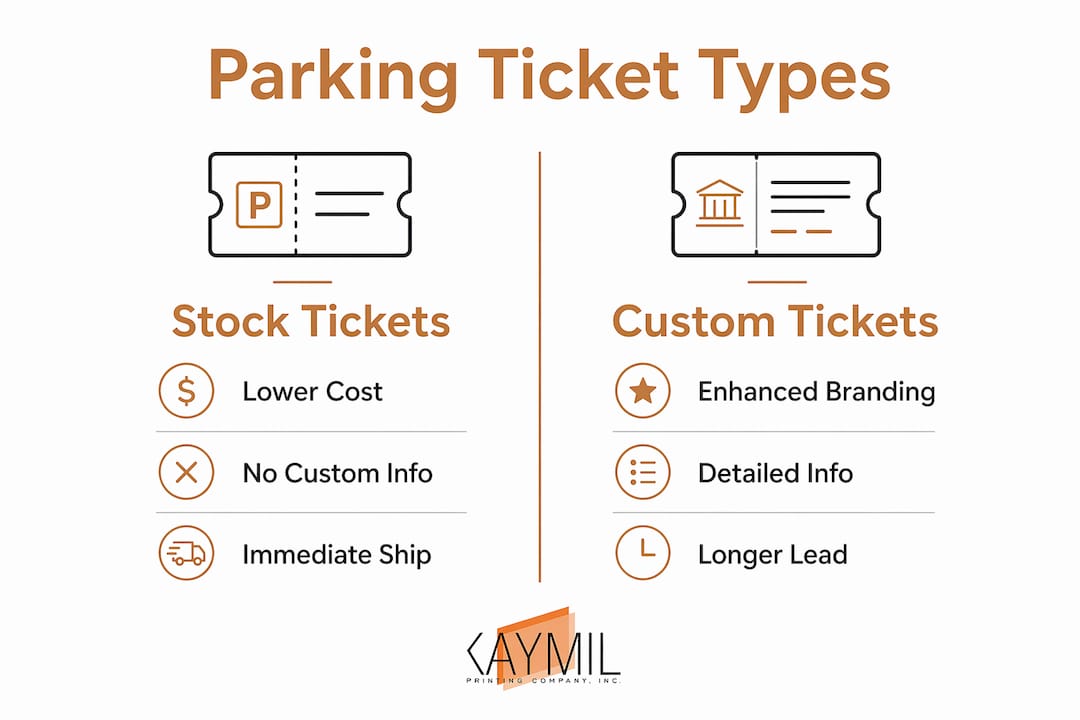
Large-scale municipal and commercial parking operators use custom tickets for branding and enhanced communication as a standard practice. That adoption reflects the operational reality that generic media cannot carry the information load a professional parking program requires.
What are the key technical and hardware considerations?
Hardware compatibility is the most overlooked factor in the stock vs custom parking tickets decision. Incorrect media specifications cause printer jams, sensor failures, and “out of paper” errors that shut down unattended kiosks. A single incompatible roll can trigger service calls that cost far more than the ticket order itself.
The critical specifications operators must confirm before ordering any ticket media include:
- Paper width. Kiosk printers, handheld enforcement units, and in-vehicle printers each use different roll widths. Confirm the exact millimeter spec from your printer’s manual.
- Sensor type. Black mark sensors and notch sensors read different physical cues on the roll. Mismatched sensor markings are the leading cause of feed errors in automated dispensers.
- Roll diameter and core size. Oversized rolls will not fit the media compartment. Undersized cores slip on the spindle.
- Thermal coating side. Thermal paper prints on one side only. Loading a roll backward produces blank tickets.
Parking kiosks from systems like Amano, TIBA, and SKIDATA have specific hardware requirements that must be matched at the media level. Handheld enforcement printers and in-vehicle units add another layer of variation. System integrators emphasize validating hardware-to-media compatibility before ordering to prevent costly downtime.
Pro Tip: Send your printer’s make, model, and a photo of the media compartment to your ticket supplier before placing any custom order. Caymil’s team uses that information to verify specs and prevent production errors.
Durable ticket stock supports 99.9% uptime in unattended kiosk deployments. That figure reflects what happens when the right media meets the right hardware. Operators who skip the compatibility check rarely achieve that reliability.
How to decide between stock and custom parking tickets for your lot
The right ticket type follows directly from your operation’s profile. Work through these four criteria to reach a clear answer.
-
Volume and budget. Stock tickets cost less per order at low volumes. Custom tickets reach cost parity and then become more economical at higher volumes because the per-unit price drops with scale. If your lot issues more than a few hundred tickets per month, custom pricing typically wins.
-
Branding and communication requirements. A surface lot with a single attendant can function on generic media. A branded garage, hotel valet program, or hospital campus parking operation needs a ticket that carries the facility name, payment instructions, and a contact number. Custom logo tickets directly improve compliance and reduce payment disputes.
-
Environmental exposure. Outdoor dispensers and enforcement units face direct sunlight, rain, and temperature swings. Outdoor ticket dispensers require UV-stable paper because standard thermal paper fades quickly in direct sunlight. Both stock and custom tickets are available in UV-stable thermal stock, but operators must confirm that specification when ordering.
-
Hardware configuration. If your lot runs an automated kiosk or a specific enforcement printer, media compatibility is non-negotiable. Custom tickets ordered to your printer’s exact specs eliminate the guesswork. Stock tickets work when the roll dimensions match your hardware’s standard configuration.
A practical decision matrix looks like this:
| Scenario | Recommended ticket type |
|---|---|
| One-time event, under 500 tickets | Stock |
| Low-traffic surface lot, no branding | Stock |
| Branded garage or hotel parking | Custom |
| Municipal enforcement program | Custom |
| Automated kiosk with specific sensor type | Custom (spec-matched) |
| Emergency backup supply | Stock |
Operators managing multiple locations benefit most from custom tickets because a single approved design reorders quickly once specs are on file. The practical guide to printed tickets from Caymil covers how to structure reorder cycles so facilities never run short.
Why I stopped treating parking tickets as a commodity
The first time I watched a parking operation lose a week of citation revenue because a generic ticket had no payment instructions on it, I changed how I think about ticket selection. Drivers who receive a blank, unbranded citation with no phone number and no website simply do not pay. The ticket looks unofficial. The dispute rate climbs. The operator absorbs the loss and blames the enforcement process when the real problem was the media.
Custom tickets are not a luxury for large operations. They are a communication standard. A ticket that carries your facility name, a QR code to your payment portal, and a clear deadline for payment does more enforcement work than any follow-up notice. I have seen branded ticket designs cut dispute rates significantly at mid-size garages simply because drivers had all the information they needed on the citation itself.
The hardware compatibility issue is where I see operators make the most expensive mistakes. Ordering 10,000 custom tickets with the wrong sensor marking is not a minor inconvenience. It is a production loss, a reorder delay, and a kiosk outage happening at the same time. Confirming printer specs before ordering takes 10 minutes. Recovering from a bad order takes weeks.
My recommendation: treat the ticket as part of your operation’s infrastructure, not a consumable you buy on price alone. The cost difference between stock and custom at volume is smaller than most operators expect. The operational difference is significant.
— Richard
Caymil’s stock and custom parking ticket solutions
Caymil has manufactured parking tickets since 1937, and that depth of experience shows up in the details that matter to operators: correct sensor markings, verified roll dimensions, and print quality that holds up in outdoor kiosks and enforcement printers alike.
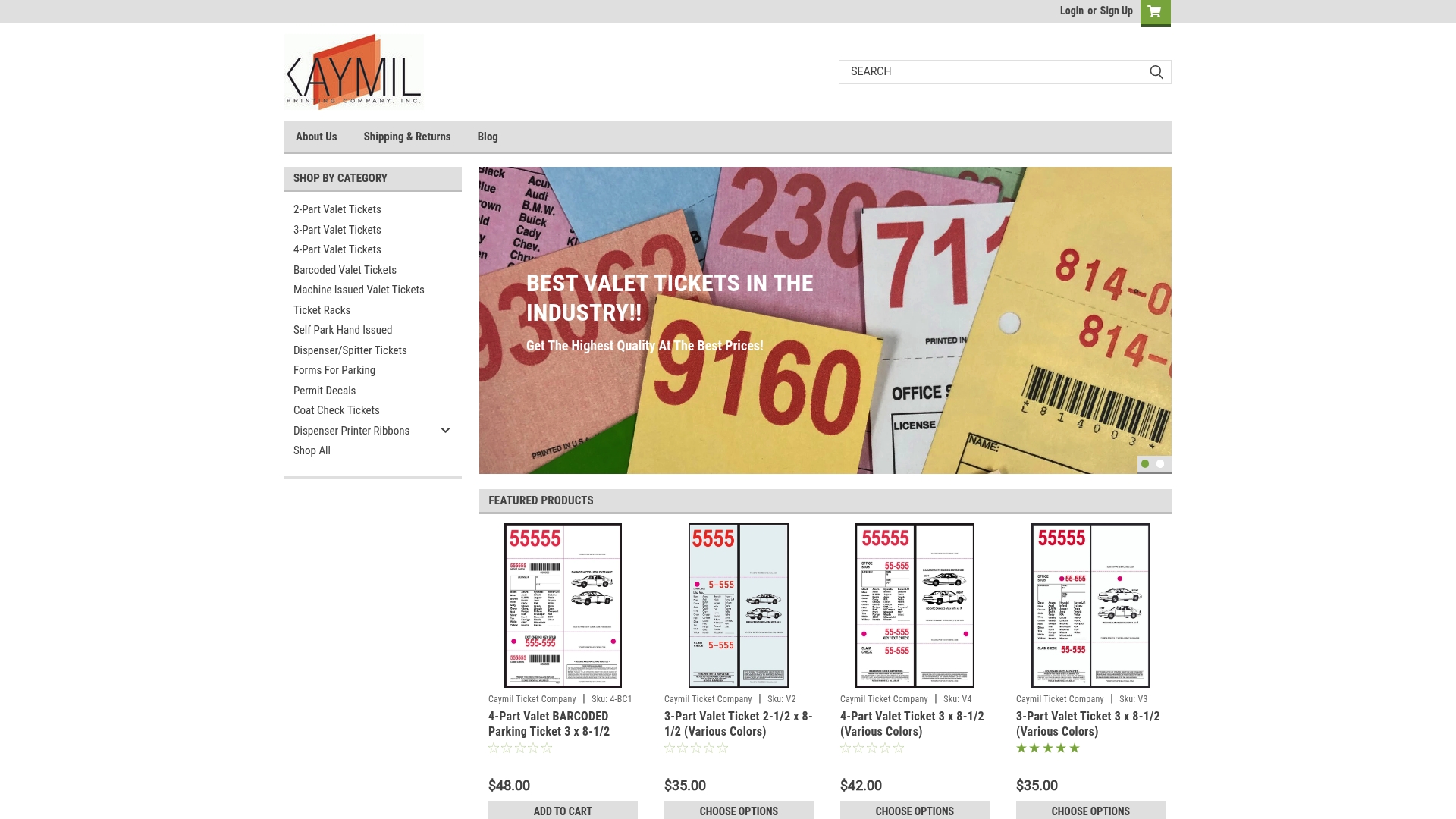
Caymil offers a full range of parking forms and tickets covering both stock and custom formats, including thermal rolls, carbonless multi-part pads, barcode tickets, and dispenser-ready spitter tickets for automated systems. Every custom order includes a digital proof and hardware compatibility review before production begins. Operators can reach Caymil’s team directly to confirm printer specs, request samples, or get a quote on a custom design that fits their facility’s exact requirements.
Key takeaways
Custom parking tickets deliver better communication, compliance, and revenue tracking than stock tickets for any operation issuing tickets at volume or running branded facilities.
| Point | Details |
|---|---|
| Stock tickets suit low-volume needs | Use stock for events, backup supply, or low-traffic lots where branding is not required. |
| Custom tickets improve compliance | Logos, QR codes, and payment instructions on custom tickets reduce disputes and speed up collections. |
| Hardware compatibility is critical | Confirm paper width, sensor type, and core size before ordering any ticket media to prevent kiosk downtime. |
| UV-stable stock is required outdoors | Standard thermal paper fades in direct sunlight; always specify UV-stable media for outdoor dispensers. |
| Custom reorders are fast once specs are filed | Suppliers provide digital proofs within 24–48 hours and reorder quickly when printer specs are already on file. |
FAQ
What is the main difference between stock and custom parking tickets?
Stock parking tickets are generic, pre-manufactured media that ship immediately with no customization. Custom parking tickets are produced to a facility’s exact specifications, including logos, barcodes, legal text, and sequential numbering.
Are custom parking tickets compatible with automated kiosk systems?
Yes, when ordered with the correct specifications. Operators must confirm paper width, sensor type (black mark or notch), and roll dimensions to match their kiosk’s printer requirements before placing a custom order.
How long does it take to receive custom parking tickets?
Modern parking ticket printing services provide digital proofs within 24–48 hours of receiving printer specs and layout approval. Reorders with specs already on file ship at turnaround times comparable to stock orders.
Do outdoor parking dispensers need special ticket stock?
Outdoor dispensers require UV-stable, moisture-resistant thermal paper. Standard thermal stock fades quickly in direct sunlight, making tickets illegible and creating enforcement and compliance problems.
When should a parking operator choose stock tickets over custom?
Stock tickets are the right choice for one-time events, emergency backup inventory, or low-traffic lots where branding and detailed payment instructions are not operationally necessary.
Recommended
- Custom Logo Parking Ticket Options for Operators - Caymil Printing Co., Inc.
- Carbonless Parking Tickets: A Manager’s Complete Guide - Caymil Printing Co., Inc.
- Sequential Numbering Parking Tickets: A Practical Guide - Caymil Printing Co., Inc.
- What Is a Stock Parking Ticket? A Clear Guide - Caymil Printing Co., Inc.