Custom Logo Parking Ticket Options for Operators
Custom logo parking ticket options are printed ticketing products that carry your brand identity, including logos, colors, slogans, and contact information, directly on the ticket stock used in daily parking operations. For parking lot operators, venue managers, and business owners, these tickets do more than track vehicles. They reinforce brand recognition at every customer touchpoint. Caymil has manufactured branded ticketing solutions since 1937, producing products compatible with major parking systems including Amano, TIBA, SKIDATA, FLASH Parking, and Flowbird. The right personalized parking tickets combine operational features like sequential numbering, barcodes, and multi-part carbonless formats with design flexibility that puts your logo front and center.
1. custom logo parking ticket options by ticket type
The first decision in any custom ticket order is choosing the right ticket format for your operation. Each type serves a distinct function, and the format you choose determines what branding and operational features are possible.
- Multi-part valet tickets: Two-part, three-part, and four-part valet tickets use carbonless paper to create simultaneous copies. One part stays with the vehicle, one goes to the driver, and additional parts support internal recordkeeping. These are the most common format for hotels, casinos, and upscale venues.
- Roll tickets for machine use: Dispenser and spitter tickets are wound on rolls sized to fit handheld or gate-mounted printers. They work in high-volume garages and transit facilities where speed matters.
- Hang tags and permit passes: Laminated hang tags function as logo parking pass options for long-term permits, employee parking, or event access. They resist weather and fading far better than standard paper stock.
- Barcode and QR code tickets: These carry machine-readable data for automated payment, access control, and validation. They are the standard format for facilities running SKIDATA, TIBA, or Amano equipment.
Ticket materials vary from cardstock to laminated and synthetic materials to suit different weather and usage environments. Outdoor lots and garages with humidity exposure need synthetic or laminated stock. Indoor valet operations can use standard cardstock without sacrificing print quality.
| Material | Best Use | Durability |
|---|---|---|
| Standard cardstock | Indoor valet, short-term lots | Moderate |
| Laminated stock | Outdoor permits, hang tags | High |
| Synthetic/weatherproof | Exposed lots, all-weather garages | Very high |
| Thermal paper rolls | Machine-issued gate tickets | Moderate |

Pro Tip: Request a sample of each material before committing to a large print run. A ticket that looks sharp on screen may feel flimsy in a valet’s hand or fade after one rain.
2. how to incorporate logos and branding effectively
Branded parking ticket designs work best when branding and function share equal priority. A ticket crowded with graphics that obscures the ticket number or barcode creates operational problems. The goal is a clean layout where your logo, colors, and contact information appear clearly without interfering with the data fields your staff and systems depend on.
Key design decisions for personalized parking tickets include:
- Color printing: Full-color logo printing delivers the strongest brand impact. One-color or two-color printing costs less and still produces professional results for operators with simpler brand marks.
- Front and back printing: The back of a ticket is prime real estate. Use it for legal disclaimers, payment instructions, maps, or promotional messaging.
- QR codes and barcodes: Barcode and QR code integration enables automated payment and validation, which improves customer experience and reduces manual errors at the exit lane.
- Brand colors and slogans: Matching your ticket stock color to your brand palette creates a cohesive look across physical touchpoints.
- Contact information: Phone numbers, website URLs, and social handles on the ticket give customers a direct line back to your business.
Spacing matters as much as design. Ticket printers require clear margins around barcodes and numbering fields to read correctly. Work with your printer to confirm that your logo placement does not crowd these zones. You can see real-world branded ticket examples to understand how operators balance design and function in practice.
Pro Tip: Always request a digital proof before approving any print run. Digital proofing prevents costly reprints by confirming the exact placement of branding elements and numbering sequences before mass production.
3. compatibility with parking management systems
Many operators assume parking tickets are generic products that fit any printer. That assumption leads to jammed machines, misread barcodes, and wasted inventory. Custom tickets can be designed to avoid printer jams and maintain clarity when they are built to match your specific equipment.
The most widely used parking management systems in the United States each have specific ticket size, roll diameter, and barcode format requirements:
- Amano systems: Require precise roll widths and thermal paper grades. Ticket size and core diameter must match the machine model.
- TIBA systems: Use barcode tickets with specific symbology requirements. Sequential numbering must align with TIBA’s software database.
- SKIDATA systems: Demand tight tolerances on magnetic stripe placement and barcode positioning for gate access to function reliably.
- FLASH Parking and Flowbird: Both platforms support custom ticket formats but require vendor confirmation of roll specs before ordering.
Confirm your printer model and software version with your ticket vendor before placing any custom order. A mismatch between ticket stock and printer specifications is the most common cause of operational failures after a new ticket delivery.
Typical valet ticket sizes run approximately 3.5" x 8.5" with multi-part configurations. That is a standard starting point, but your equipment may require a different dimension. Caymil’s team reviews printer model specifications before production to confirm fit. You can read a detailed breakdown of system-specific ticket requirements for Amano, TIBA, SKIDATA, and FLASH to prepare before you order.
4. ordering logistics: costs, lead times, and proofs
Understanding the ordering process helps you plan inventory without surprises. Custom ticket printing services follow a predictable workflow once you know what to expect at each stage.
- Starting costs: Custom valet parking tickets start at approximately $64 for basic sets. Price per ticket drops significantly as quantity increases, so operators with consistent volume benefit from larger print runs.
- Lead times: Production runs take 2–10 business days depending on order complexity, number of colors, and whether proofing revisions are needed. Rush orders are available from some vendors but carry a premium.
- Minimum quantities: Most custom ticket printing services set minimums between 250 and 500 tickets per order. High-volume operators often order in the thousands to reduce per-unit cost.
- Digital proofs: Always request a proof before approving production. A proof catches errors in logo placement, numbering sequences, and barcode positioning before they become a reprinting expense.
- Vendor communication: Provide your printer model, software system name, and any existing ticket samples when placing an order. This gives the vendor everything needed to match specifications on the first attempt.
Pro Tip: Order a 30-day buffer supply above your typical monthly usage. Custom tickets take time to produce, and running out mid-operation forces you into generic stock that carries no branding value.
5. sequential numbering and recordkeeping features
Sequential numbering is one of the most operationally valuable features on any branded parking ticket. Multi-part tickets with sequential numbering create duplicate copies for recordkeeping and give every transaction a unique identifier that ties physical tickets to digital records.
For valet operations, sequential numbers allow staff to match a ticket stub to a vehicle without relying on memory or handwritten notes. For parking enforcement, numbered tickets create an auditable trail that supports dispute resolution and revenue reconciliation. The number sequence can be configured to start at any point, which is useful when integrating with existing software databases that already have a numbering convention.
Two-part and three-part valet tickets are the most common formats for operations that need simultaneous copies. The customer keeps one part, the attendant retains another, and a third copy may go to a cashier or dispatcher. Each part carries the same sequential number, making reconciliation fast and accurate.
6. barcode and QR code integration
Barcode integration transforms a printed ticket into a functional access and payment credential. Barcodes and QR codes on custom tickets enable automated payment systems, gate access control, and validation workflows that reduce labor and speed up customer throughput.
QR codes add a layer of customer-facing utility. A guest can scan the QR code on their valet ticket to check wait times, pay in advance, or access a digital receipt. That functionality turns a simple branded parking ticket design into a customer experience tool. Barcode symbology must match your parking management software. Code 39, Code 128, and PDF417 are the most common formats used in Amano, TIBA, and SKIDATA environments. Confirm the required symbology with your software vendor before specifying it on your ticket artwork.
7. additional features that improve operations
Beyond logos and barcodes, several optional features add real operational value to customized parking enforcement tickets and valet passes.
- Adhesive parking permits: Sticker-style permits with your logo work for temporary access programs, construction site parking, or event credentials. They adhere to windshields and are difficult to transfer, which reduces fraud.
- Legal disclaimers and liability language: The back of a ticket is the right place for terms of service, liability limitations, and payment instructions. Pre-printing this text saves staff time and keeps your operation legally consistent.
- Ticket racks and dispensers: A ticket rack keeps your branded tickets organized at the valet stand or booth. Dispensers for roll tickets mount directly to machines or countertops and reduce handling errors.
- Custom packaging: Some operators order tickets pre-sorted in labeled bundles by shift or location. This reduces setup time and keeps inventory organized across multiple lots or facilities.
| Feature | Operational Benefit |
|---|---|
| Sequential numbering | Ties physical tickets to digital records for auditing |
| Barcode/QR code | Enables automated payment and gate access |
| Multi-part carbonless | Creates simultaneous copies for all parties |
| Adhesive permits | Reduces fraud on temporary access credentials |
| Pre-printed disclaimers | Standardizes legal language across all transactions |
8. design your own parking tickets: the proofing process
The proofing process is where most ordering mistakes are caught or missed. Operators who skip proofing to save time routinely end up reprinting entire runs because a logo was placed too close to a barcode or a numbering sequence started at the wrong value.
A standard proofing workflow for how to create custom parking tickets looks like this. First, submit your logo file in a vector format such as an EPS or AI file. Vector files scale without losing quality, which matters when your logo appears on a 3.5-inch-wide ticket. Second, specify your brand colors using Pantone or CMYK values rather than describing them in words. Third, review the digital proof at 100% scale to check spacing, readability, and barcode placement. Fourth, confirm the numbering sequence, starting number, and total quantity before approving. Fifth, sign off only after every element has been verified. This process adds one to two business days to your lead time and saves far more time than it costs.
Key takeaways
Custom logo parking ticket options deliver the most value when compatibility, material selection, and digital proofing are treated as non-negotiable steps before production begins.
| Point | Details |
|---|---|
| Match tickets to your equipment | Confirm printer model and system specs before ordering to avoid jams and misreads. |
| Proof before you print | A digital proof catches logo placement and numbering errors before mass production. |
| Choose material for your environment | Outdoor and high-humidity locations require laminated or synthetic stock for durability. |
| Use sequential numbering | Numbered multi-part tickets create an auditable record that supports reconciliation and dispute resolution. |
| Barcode integration adds function | QR codes and barcodes turn branded tickets into payment and access credentials. |
What i’ve learned after years of watching operators order wrong
The most common mistake I see from operators ordering custom tickets for the first time is treating the design as the primary decision. They spend hours on logo placement and color matching, then submit an order without confirming whether the ticket dimensions match their printer. The result is a beautiful ticket that jams every machine it touches.
My recommendation is to start with your equipment, not your artwork. Pull the model number off your printer, check your parking management software version, and hand that information to your ticket vendor before you open a design file. Caymil’s team has been doing this since 1937 and can cross-reference your equipment against known specifications immediately. That step alone eliminates the most expensive category of ordering errors.
On the cost-versus-durability question, I lean toward spending more on material for outdoor and high-traffic environments. A laminated hang tag that lasts a full season costs less over time than three rounds of paper permits that fade and tear. For indoor valet operations with controlled conditions, standard cardstock performs well and keeps costs reasonable.
The one development worth paying close attention to is QR code integration. Operators who have added QR codes to their branded valet tickets report faster exit lane throughput and fewer payment disputes. The technology is mature, the cost premium is small, and the customer experience improvement is measurable. If you are designing new tickets, build the QR code in from the start.
— Richard
Caymil’s custom parking ticket solutions
Caymil has manufactured custom parking tickets for parking garages, hotels, casinos, hospitals, and event venues across the United States for nearly 90 years. The full product line covers forms for parking including multi-part valet tickets, barcode tickets, machine-issued roll tickets, hang tags, and adhesive permits, all available with full logo customization, sequential numbering, and digital proofing before production.
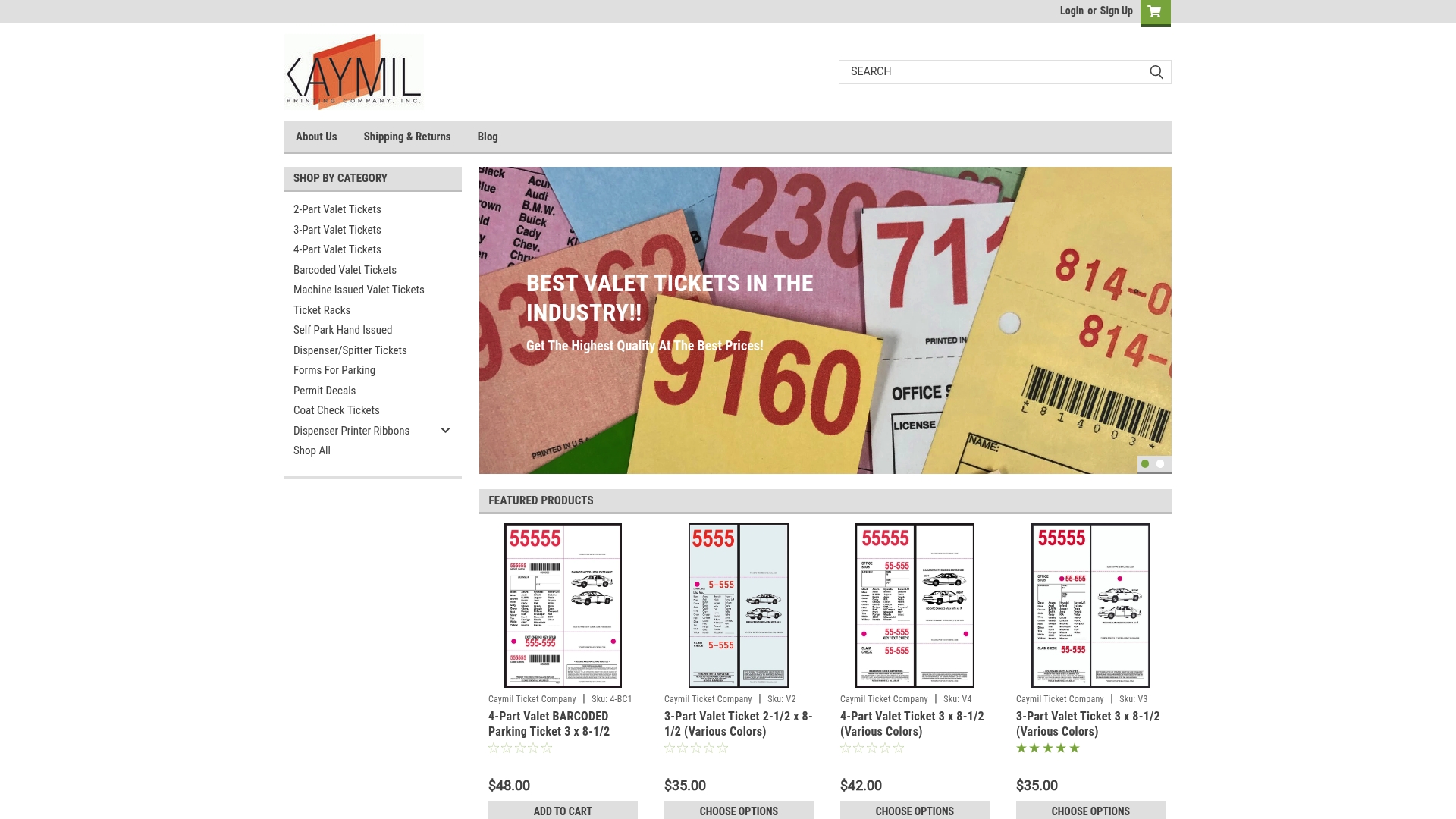
Caymil offers fast nationwide shipping with millions of tickets in stock and a team that reviews your printer specifications before every custom order. Whether you need 2-part valet tickets for a hotel valet program or barcode roll tickets for an automated garage, Caymil builds to your exact requirements. Request a quote or sample pack directly through the Caymil website to get started.
FAQ
What is the standard size for custom valet parking tickets?
The standard valet ticket size is approximately 3.5" x 8.5" in a multi-part configuration. Custom sizes are available to match specific printer requirements for Amano, TIBA, SKIDATA, and other systems.
How much do custom logo parking tickets cost?
Custom valet parking tickets start at approximately $64 for basic sets, with the price per ticket decreasing as order quantity increases. Lead times run 2–10 business days depending on complexity.
Can i add barcodes and QR codes to my branded parking tickets?
Yes. Barcodes and QR codes can be integrated into custom ticket designs to support automated payment, gate access, and validation workflows. The barcode symbology must match your parking management software.
Do custom tickets work with all parking management systems?
Operators can customize tickets to be compatible with systems including Amano, TIBA, and SKIDATA, but ticket dimensions, roll specs, and barcode formats must be confirmed against your specific equipment before ordering.
Why is digital proofing required before printing?
Requesting a digital proof confirms that branding, barcode placement, and numbering sequences are correct before bulk production begins. Skipping this step is the leading cause of costly reprints in custom ticket orders.
Recommended
- Branded Parking Ticket Examples for Lot Managers - Caymil Printing Co., Inc.
- Printed Parking Tickets: A Practical Guide for Operators - Caymil Printing Co., Inc.
- Parking Ticket Material Options: Top 10 for 2026 - Caymil Printing Co., Inc.
- Garage Parking Ticket Durability Tips for Operators - Caymil Printing Co., Inc.