

Garage Parking Ticket Durability Tips for Operators

Garage parking ticket durability is defined as a ticket’s ability to maintain print clarity, structural integrity, and scan reliability throughout its full operational lifecycle, from dispenser to exit gate. For parking facility managers, a ticket that fades, tears, or jams is not just a minor inconvenience. It triggers rescans, customer disputes, and revenue tracking failures that compound across thousands of daily transactions. The right combination of material selection, print technology, and environmental protection determines whether your tickets perform for hours or for days. This guide covers the most effective ticket durability practices available to operators today.
1. Garage parking ticket durability tips: start with material selection
The single most impactful garage parking ticket durability decision is material choice. Thermal paper, coated paper, and synthetic film each perform differently under heat, humidity, and physical handling, and selecting the wrong substrate costs you in reprints, jams, and failed scans.

| Material | Best for | Key weakness |
|---|---|---|
| Standard thermal paper | Indoor, climate-controlled garages | Fades in heat and UV light within 1 to 3 years |
| Top-coated thermal paper | Outdoor kiosks and high-humidity environments | Slightly higher cost per roll |
| Synthetic film (polypropylene) | High-abrasion, wet environments | Less compatible with some older printers |
| 14pt coated cardstock | Valet and multi-part tickets | Not compatible with thermal dispensers |
Top-coated thermal paper resists UV exposure, moisture, and abrasion by protecting the leuco dye layer that forms the printed image. Without that coating, outdoor kiosk tickets can begin darkening or fading within weeks. For valet and multi-part formats, 14pt cover stock enhances ticket stability and signals facility professionalism to customers. In fact, 65% of users associate ticket material quality with overall facility professionalism, which means your ticket stock is also a brand statement.
- Choose top-coated thermal rolls for any ticket exposed to sunlight, rain, or temperature swings
- Use synthetic film substrates in car wash facilities or open-air decks with standing water risk
- Match paper weight to your dispenser’s feed mechanism to avoid jams and misfeeds
Pro Tip: Request a material sample kit from your ticket supplier before committing to a full order. Test each substrate in your actual dispenser and exit gate scanner to confirm compatibility before purchase.
2. How does printer selection and maintenance affect ticket longevity?
Printer hardware and ticket material are interdependent. A high-quality thermal roll run through a poorly maintained printer produces tickets with patchy print, weak barcodes, and shortened image life. The printer is not a passive component in ticket durability.
Abrasive, non-standard paper accelerates printhead wear and increases residue buildup, leading to costly maintenance cycles and unplanned downtime. This means using OEM-approved or supplier-certified thermal rolls is not just a quality preference. It is a hardware protection decision with direct cost implications.
- Clean printheads weekly using lint-free swabs and isopropyl alcohol to prevent residue buildup that causes patchy print quality
- Replace printheads on a schedule based on manufacturer mileage ratings, not just when print quality visibly degrades
- Use only thermal rolls specified for your printer model, whether that is an Amano, TIBA, SKIDATA, or Flowbird system
- Calibrate paper tension and feed settings after every roll change to maintain consistent print registration
Pro Tip: Keep a printhead cleaning log at each dispenser station. Operators who track cleaning intervals catch degradation patterns early and avoid the far higher cost of printhead replacement.
Weekly printhead cleaning mitigates abrasive residue buildup that otherwise decreases print clarity and increases hardware failure rates. For high-volume garages processing thousands of tickets per day, this single maintenance habit extends printhead life significantly and keeps ticket image quality consistent across every transaction.
3. What design and printing techniques enhance ticket usability?
Ticket design is a durability factor that most operators overlook. A well-printed ticket on premium stock still fails if the barcode quiet zone is too narrow, the contrast is insufficient, or the perforation tears unevenly.
Matte-finish tickets improve scanning reliability by reducing glare interference in optical scanners. Poor scan consistency is more often caused by glare and damaged barcode areas than by scanner failure itself. This means a finish change alone can reduce rescan rates without any hardware investment.
- Print barcodes at a minimum of 300 DPI to maintain readability after handling and minor abrasion
- Maintain a quiet zone of at least 10 times the narrowest barcode element on all four sides of the code
- Use Code 128 or QR formats for compatibility with Scheidt & Bachmann, FLASH Parking, and most modern access control systems
- Apply sequential numbering with check digits to catch data entry errors and prevent duplicate ticket fraud
- Specify micro-perforation spacing at 1/16 inch tooth spacing with a tear force of 12 to 18 lbs for clean separation without kiosk jams
Tamper-evident features such as void patterns, security printing, and serialized numbering add a layer of protection that discourages ticket swapping and unauthorized reuse. These features also support fraud reduction strategies without requiring system-level changes. High-contrast black printing on white or light-colored stock consistently outperforms colored backgrounds for scanner read rates, particularly in low-light garage environments.
4. What environmental factors damage tickets and how to prevent them?
Heat, humidity, UV light, and physical abrasion are the four primary threats to parking ticket integrity after printing. Each requires a specific mitigation strategy.
Thermal paper tickets are susceptible to fading within one to three years without protective measures. Heat and light accelerate this process significantly. For garages with outdoor kiosks or rooftop levels, this is not a long-term archival concern. It is an active operational risk affecting tickets issued that same day.
| Threat | Impact on ticket | Mitigation |
|---|---|---|
| UV light | Premature darkening and image fade | Top-coated thermal paper, covered dispensers |
| High humidity | Paper curl, ink smear, feed jams | Sealed roll storage, dehumidified dispenser cabinets |
| Physical abrasion | Barcode damage, surface scratching | Matte finish, protective sleeves for issued tickets |
| Heat (above 140°F) | Thermal activation, full blackening | Climate-controlled storage, shaded kiosk placement |
- Store unused ticket rolls in sealed polyethylene bags away from direct sunlight and heat sources
- Keep storage areas below 77°F and at relative humidity under 65% to prevent premature thermal activation
- Use acid-free, chemically inert packaging such as polyester or Mylar sleeves for any tickets requiring long-term retention
- Install ticket racks that keep issued tickets vertical and protected from surface contact
- Train staff to handle tickets by the edges, not the printed face, to avoid transferring oils and heat from hands
Pro Tip: In open-air or rooftop garages, specify a dispenser cabinet with a UV-blocking polycarbonate window. This one hardware upgrade extends ticket image life without changing your ticket stock or print settings.
Adhesive selection also affects durability in facilities using label-style tickets. Permanent adhesives provide security but can leave residue on surfaces and damage ticket faces during removal. Removable adhesives are better suited for facilities where tickets must be cleanly detached and retained by customers.
5. How barcode ticket formats improve long-term scan performance
Barcode ticket formats directly determine how well a ticket performs across its full lifespan in a garage environment. A ticket that scans reliably on day one but fails after exposure to humidity or handling is operationally equivalent to a ticket that never worked. The format and print quality of the barcode must account for the full range of conditions the ticket will encounter.
Barcode tickets improve garage efficiency by reducing gate processing time and eliminating manual entry errors. The format choice between 1D linear barcodes and 2D QR codes affects both scanner compatibility and damage tolerance. QR codes carry redundant data and can be read even when up to 30% of the code is obscured or damaged, making them more resilient in high-wear environments.
For facilities using legacy systems like Amano or older TIBA configurations, Code 39 or Code 128 linear formats remain the standard. For newer installations using SKIDATA or Flowbird, QR and DataMatrix formats offer higher data density and better damage tolerance. Matching barcode format to your specific access control system is not optional. It is the baseline requirement for consistent scan performance.
Print contrast ratio is the most underrated barcode durability factor. A ratio of at least 70% between the dark bars and the light background is the minimum for reliable scanning. On thermal paper, this ratio degrades as the paper ages or is exposed to heat. Top-coated stock slows this degradation and keeps contrast within readable range longer than uncoated alternatives.
6. Best storage practices for unused ticket rolls
Proper storage of unused ticket rolls is one of the most overlooked tips for ticket durability. Rolls stored incorrectly before they ever reach a dispenser arrive pre-degraded, producing poor print quality from the first ticket issued.
Thermal paper is one of the least stable document formats available, and standard storage materials accelerate its degradation. Cardboard boxes, rubber bands, and PVC wrapping all introduce chemical reactions that compromise the thermal coating. Only chemically inert packaging preserves roll integrity over time.
- Store rolls standing upright on their core, never flat, to prevent core deformation that causes feed jams
- Avoid storing rolls near photocopiers, HVAC vents, or any heat-generating equipment
- Rotate stock using first-in, first-out inventory practices to prevent older rolls from sitting unused past their optimal print window
- Label storage bins with receipt dates so staff can identify and prioritize older stock
- Keep bulk storage in a dedicated, climate-controlled room separate from vehicle exhaust areas in the garage
For facilities ordering in large quantities, Caymil recommends requesting rolls with a minimum shelf life rating of 7 to 10 years under standard storage conditions. This specification is available on most top-coated thermal products and gives operators a reliable benchmark for inventory planning.
Key takeaways
Garage parking ticket durability requires top-coated materials, weekly printer maintenance, high-contrast barcode design, and controlled storage conditions to deliver consistent scan performance across the full ticket lifecycle.
| Point | Details |
|---|---|
| Material choice is foundational | Top-coated thermal paper resists UV, moisture, and abrasion better than standard thermal stock. |
| Printer maintenance protects print quality | Weekly printhead cleaning with isopropyl alcohol prevents residue buildup and patchy output. |
| Barcode design affects scan reliability | Matte finishes, quiet zones, and 300 DPI minimum print reduce rescan rates and gate delays. |
| Environmental controls extend ticket life | Store rolls below 77°F in sealed, chemically inert packaging away from heat and UV sources. |
| Format compatibility is non-negotiable | Match barcode format to your specific system, whether Amano, SKIDATA, Flowbird, or TIBA. |
What operators actually get wrong about ticket durability
Most parking operators focus on ticket cost per unit and miss the far larger cost of ticket failure. A roll of premium top-coated thermal stock might cost 15% more than standard thermal. A single gate jam during peak exit hours, requiring staff intervention and causing a queue backup, costs more in labor and customer friction than the entire price difference on that roll.
The other mistake I see consistently is treating printer maintenance as a reactive task. Operators wait until print quality visibly degrades before cleaning printheads or checking calibration. By that point, the printhead has already accumulated residue that shortens its remaining lifespan. The tickets issued during that degradation window have weaker barcodes that fail at higher rates, creating a downstream problem that outlasts the maintenance fix.
The third pattern worth calling out is the disconnect between procurement and operations. Purchasing teams select ticket stock based on price. Operations teams deal with the jams, rescans, and customer complaints that follow. Bridging that gap requires a simple policy: any ticket stock change must be tested in the actual dispenser and scanner before a full order is placed. This one step eliminates most compatibility failures before they reach the facility floor.
Quality tickets also carry a perception value that operators underestimate. A crisp, well-printed ticket on substantial stock signals to customers that the facility is professionally managed. A flimsy, faded ticket signals the opposite, regardless of how well the rest of the operation runs.
— Richard
Durable parking ticket solutions from Caymil
Caymil has manufactured high-quality parking tickets since 1937, supplying operators with thermal rolls, barcode tickets, multi-part valet formats, and custom-printed stock built for the demands of real garage environments.
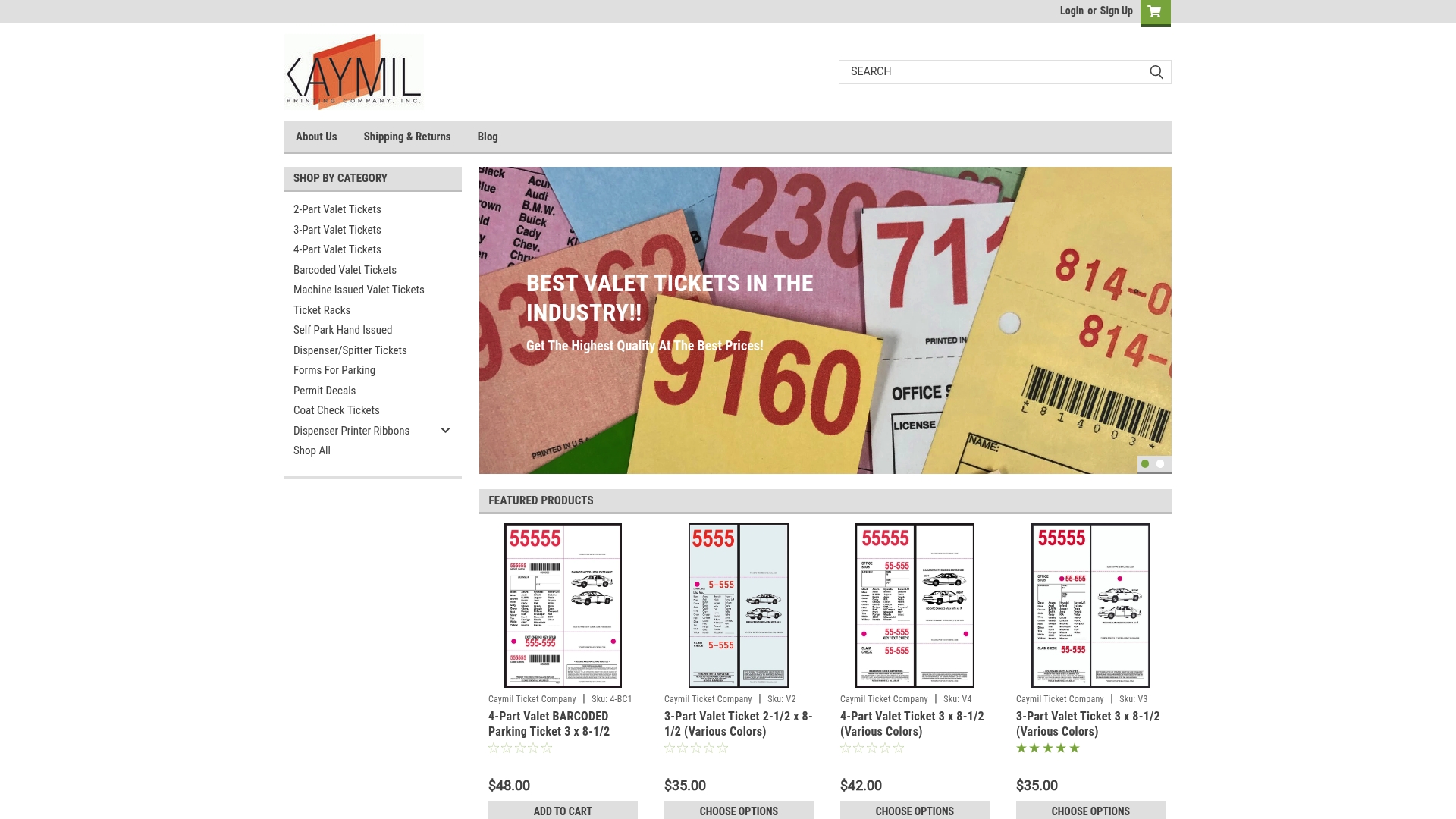
Whether you need barcode valet parking tickets with scan-optimized print specifications, 4-part valet formats for complex operations, or a full catalog of parking forms and tickets compatible with Amano, SKIDATA, TIBA, Flowbird, and Scheidt & Bachmann systems, Caymil delivers stock and custom solutions with fast nationwide shipping. Every product is manufactured to meet the material, print, and durability standards covered in this guide. Contact Caymil to request samples or discuss a custom ticket specification for your facility.
FAQ
What type of paper is most durable for garage parking tickets?
Top-coated thermal paper is the most durable option for garage environments. It protects the leuco dye layer from UV exposure, moisture, and abrasion, preserving image integrity longer than standard thermal stock.
How often should parking ticket printer heads be cleaned?
Printhead cleaning with lint-free swabs and isopropyl alcohol is recommended weekly for high-volume dispensers. Regular cleaning prevents residue buildup that causes patchy print quality and accelerates printhead wear.
What causes parking ticket barcodes to fail at the scanner?
Glare from glossy finishes, damaged quiet zones, and low print contrast are the leading causes of barcode scan failure. Switching to matte-finish tickets and maintaining a minimum 300 DPI print resolution resolves most scan reliability issues.
How should unused thermal ticket rolls be stored?
Store unused rolls upright in sealed polyethylene bags, below 77°F, away from heat sources and UV light. Only chemically inert packaging such as polyester or Mylar prevents premature thermal activation and coating degradation.
Do barcode format choices affect ticket durability?
Yes. QR codes tolerate up to 30% surface damage while remaining scannable, making them more resilient than linear barcodes in high-wear environments. Match the format to your specific access control system for consistent performance.
Recommended
- Parking Garage Lost Ticket Fee Policy: Operator’s Guide - Caymil Printing Co., Inc.
- Parking ticket security: How to prevent fraud and protect revenue - Caymil Printing Co., Inc.
- Why barcode tickets make parking garages more efficient - Caymil Printing Co., Inc.
- Parking Machine Ticket: What Every Driver Should Know - Caymil Printing Co., Inc.