

Parking Garage Lost Ticket Fee Policy: Operator’s Guide

Every parking garage operator has dealt with the frustrated driver who can’t find their ticket at exit. It’s a routine scenario with real financial stakes. A well-structured parking garage lost ticket fee policy determines whether that moment becomes a revenue recovery win or a customer service breakdown. Known formally as a “lost ticket procedure” in parking management, these policies dictate how your facility charges when entry time cannot be verified, how staff should respond, and how disputes get resolved. This guide walks through the full picture: fee structures, operational workflows, technology tools, and the balance between protecting revenue and keeping customers coming back.
Key Takeaways
| Point | Details |
|---|---|
| Max daily rate is standard | Most facilities charge the maximum daily rate per day parked when entry time cannot be confirmed. |
| Fixed fees add deterrence | A flat lost ticket fee on top of the daily rate, typically $5 to $50, reduces disputes and simplifies billing. |
| Technology reduces occurrences | Barcode tickets, LPR systems, and gate logs help verify entry and minimize reliance on the lost ticket fallback. |
| Staff training matters | Exit lane staff need clear procedures and data access to resolve lost ticket situations quickly and professionally. |
| Signage prevents friction | Posting lost ticket policies at entry and exit points reduces surprise, arguments, and refund requests. |
Understanding parking garage lost ticket fee policy structures
The phrase “lost ticket fee” sounds simple, but the actual policy behind it can vary significantly between facilities. At its core, a lost ticket fee policy tells your staff what to charge when a customer cannot produce the ticket that was issued at entry. Without that ticket, the system has no record of when the vehicle arrived, which means the parking duration cannot be calculated in the standard way.
Most operators use a two-part charge structure. The first component is the maximum daily rate, applied for each full day or portion of a day the vehicle may have been parked. The second is a fixed administrative fee that covers processing and deters fraudulent claims. For example, Boston Logan Airport charges the maximum daily rate per day plus a non-refundable $5 lost ticket fee. At Terminal Parking, that daily rate is $46. At Economy Parking, it drops to $37. The math is transparent, which is part of what makes the policy defensible.
Atlanta’s airport facilities take a similar approach. When entry time cannot be confirmed due to a lost ticket, Atlanta charges the maximum daily rate multiplied by the number of days parked, with rates ranging from $15 to $30 per day in standard lots and up to $75 per day in premium hourly decks.
Here is how the most common fee structures break down across facility types:
| Policy Type | Typical Charge Structure | Best Suited For |
|---|---|---|
| Max daily rate only | Full daily max × days parked | High-volume transient facilities |
| Max daily rate + fixed fee | Daily max + $5 to $50 flat charge | Airport and city garages with audit needs |
| Prorated estimate | Best-guess rate based on traffic data | Low-volume lots with attendant oversight |
| Replacement card fee | Flat $10 to $25 replacement charge | Monthly permit and access card programs |
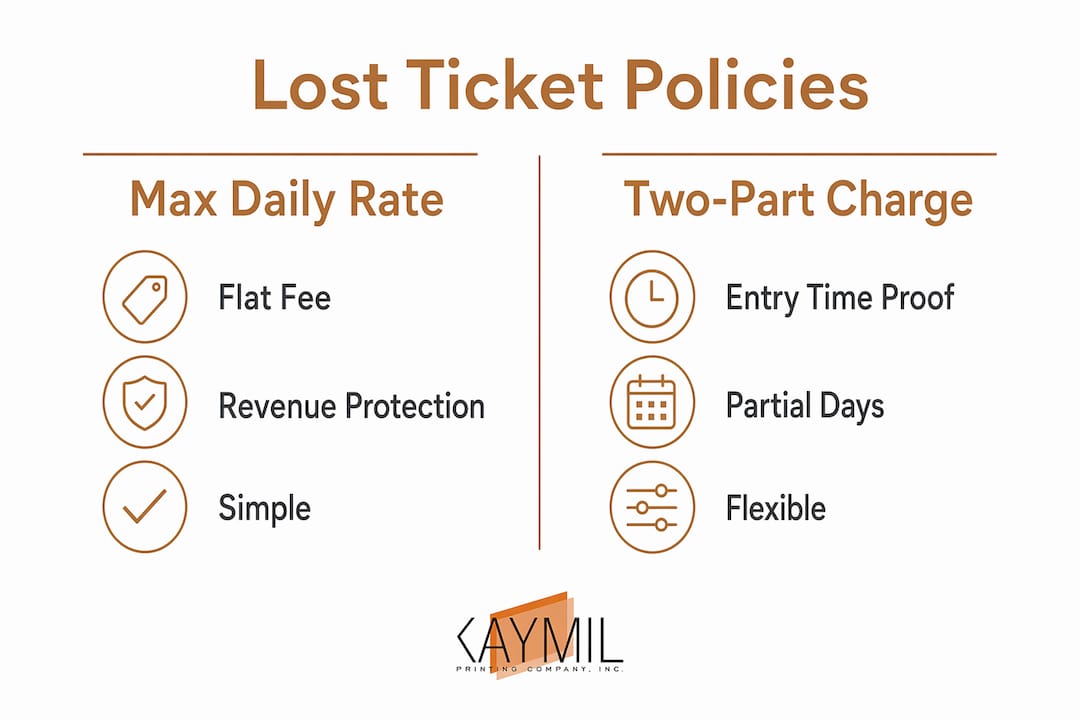
The rationale behind maximum rate billing is straightforward: without proof of entry time, operators cannot offer a discounted rate. Doing so would create an obvious workaround for customers trying to avoid paying for extended stays. The maximum daily rate acts as both a revenue safeguard and a deterrent against abuse. Facilities that allow staff to negotiate without data-backed verification create an opening for fraud and inconsistent customer treatment.
Monthly permit holders require a separate policy framework entirely. Cities like Tampa specify a $10 replacement charge for lost or damaged access cards, with lost ticket fees applying in select overstay scenarios. The distinction between hourly and monthly customers matters operationally because the documentation requirements and fee justifications differ.
Key components every lost ticket fee policy document should address:
- The default charge method when entry cannot be verified
- Whether a flat administrative fee applies on top of the daily rate
- How monthly permit holders are handled differently from transient parkers
- The process for documenting and auditing each lost ticket transaction
- Refund eligibility if entry time is later confirmed
Operational setup for handling lost ticket incidents
A policy written on paper only works if your physical setup and staffing support it. Before a lost ticket scenario reaches an exit attendant, the facility needs three things in place: reliable ticketing infrastructure, clear customer-facing communication, and trained staff.
On the infrastructure side, barcode tickets create an audit trail that can often recover entry data even when the physical ticket is gone. Gate logs, license plate recognition (LPR) cameras, and parking management system records can confirm when a vehicle entered, which allows staff to apply a standard rate rather than the maximum daily fallback. The more data your system captures at entry, the less often you need to apply the lost ticket charge at all.
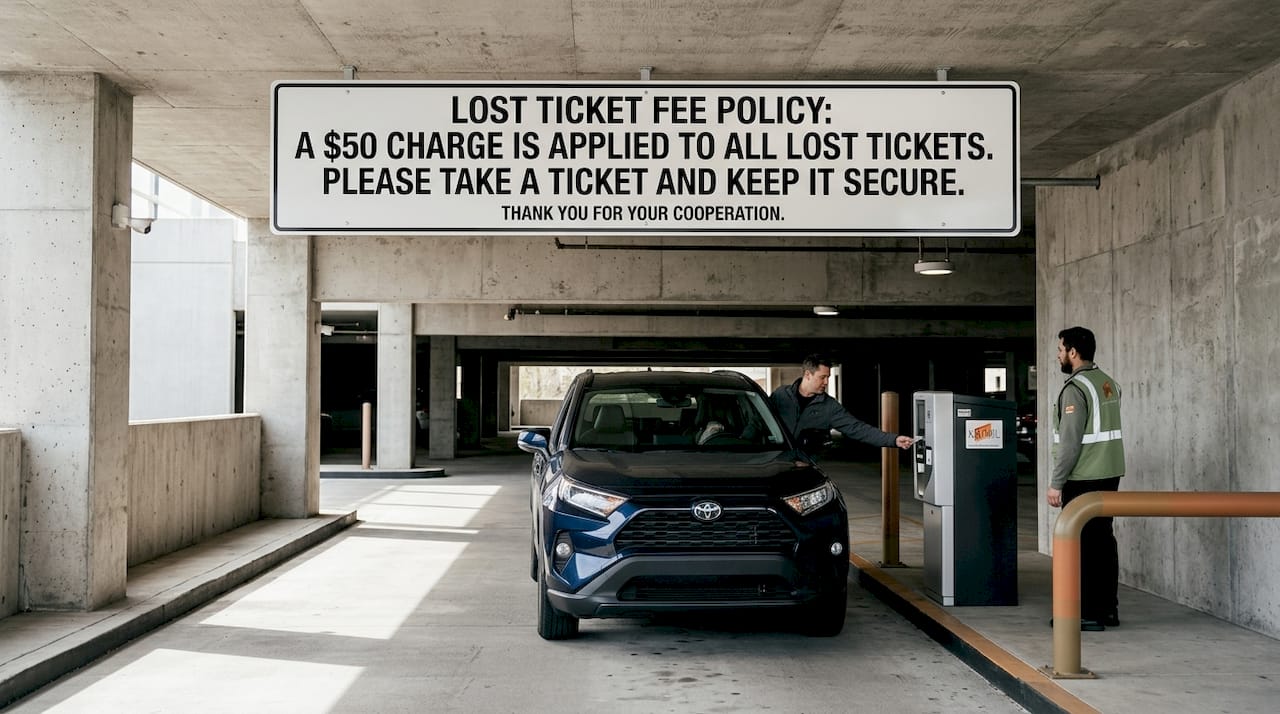
Signage is a tool that many operators underinvest in. Posting your lost ticket policy at the entry point, on ticket dispensers, and at the exit cashier station sets clear expectations before a problem occurs. When customers know in advance what a lost ticket costs, they are more careful with their ticket, and they are less likely to argue at the exit gate.
Pro Tip: Add a brief lost ticket fee notice directly on your parking receipt or ticket envelope. Customers are most receptive to terms when they are reading the ticket they just received, not when they are stuck at an exit gate trying to leave.
Staff preparation is the third pillar. Your exit lane personnel should have access to the parking management system, know how to search by license plate, and understand exactly when to escalate to a supervisor. Giving staff a clear decision tree, rather than relying on judgment calls, produces consistent outcomes and reduces the risk of disputes turning into extended arguments.
For monthly access card programs, the replacement and lost ticket procedures should be documented separately from transient parking policies and communicated to permit holders at the time of enrollment.
Step-by-step process for resolving a lost ticket at exit
When a driver arrives at the exit gate without a ticket, your staff response should follow a defined sequence. Inconsistency at this point is where most disputes originate.
-
Greet the customer and confirm the vehicle. Ask for the license plate number and, if applicable, the parking level or approximate entry time. This information starts the verification process before any fees are discussed.
-
Search system records. Use the parking management system or gate log to look up the license plate. Many modern systems can retrieve entry data from LPR cameras or barcode scan history. If a match is found, apply standard time-based pricing.
-
Apply the lost ticket charge if entry cannot be confirmed. When no entry record exists, charge the maximum daily rate for the number of days the vehicle may have been parked, plus any fixed administrative fee your policy specifies. State the charge clearly and explain the policy briefly.
-
Document the transaction. Record the license plate, transaction time, charge applied, and whether any system lookup was performed. This documentation protects your operation in the event of a dispute or chargeback.
-
Issue a receipt. Always give the customer written confirmation of what was charged and the reason. The Philadelphia Parking Authority, for instance, allows customers to submit a lost ticket balance request online after the fact, paired with phone support during business hours. Offering a similar dispute pathway reduces pressure on exit lane staff.
-
Escalate when appropriate. If a customer is agitated or claims they can prove their entry time through a credit card receipt or parking confirmation email, route them to a supervisor or customer service desk. Do not hold up the exit lane while resolving complex disputes.
Pro Tip: Create a one-page laminated reference card for every cashier booth listing the exact lost ticket charges, the system lookup steps, and the escalation contact. Staff turnover in parking operations is high. A reference card at the point of need removes the dependency on memory.
Common mistakes in lost ticket fee management
Even well-intentioned policies break down in practice. These are the problems that surface most often and how to address them.
-
Charging without verification. Applying the maximum daily rate before checking system records frustrates customers who could have been charged a standard rate. Always attempt a license plate lookup first.
-
Inconsistent application. When different staff members charge different amounts for the same situation, it creates the perception of arbitrary billing. Written policy and a clear decision tree solve this.
-
No receipt process. Customers who receive no documentation for a lost ticket charge have no paper trail if they want to dispute the fee. Always issue a receipt, even for cash transactions.
-
Ignoring technology to reduce ticket loss. If your facility consistently handles a high volume of lost ticket situations, the root cause may be ticket design or dispenser reliability rather than customer carelessness. Switching to durable machine-issued tickets with clear print and sequential numbering reduces misread or misplaced tickets.
-
No refund pathway. Customers who later find proof of their entry time should have a clear process to request a refund of the difference between what they paid and what they owed. This policy, combined with a receipt, reduces chargebacks and builds trust.
-
Treating all lost tickets the same. A monthly permit holder who lost their access card and a transient customer who drove in four days ago are not the same situation. Applying identical procedures creates confusion and potential billing errors.
Operators who reduce ticket fraud and loss proactively spend less time resolving disputes reactively. Investing in ticket quality, system integration, and staff training is cheaper per incident than handling the volume of disputes that poor processes generate.
Evaluating policy impact on revenue and customer experience
Lost ticket policies do not just protect revenue. They shape how customers remember their experience in your facility. A policy that is technically correct but poorly communicated can generate negative reviews even when the charge is entirely justified.
| Policy Element | Revenue Impact | Customer Experience Impact |
|---|---|---|
| Max daily rate fallback | Predictable revenue recovery | Can feel punitive without clear explanation |
| Fixed administrative fee | Covers processing cost | Low impact when disclosed upfront |
| LPR-assisted verification | Reduces maximum rate applications | Improves satisfaction when standard rate is applied |
| Clear signage at entry/exit | Minimal direct revenue effect | Significantly reduces disputes and complaints |
| Online dispute form | No direct revenue impact | Improves resolution experience for customers |
Facilities that use LPR and gate data to verify entry find that the number of maximum rate charges drops considerably because most entry events can be reconstructed digitally. That means more customers pay the rate they actually owe, which reduces disputes, refund requests, and online complaints.
The facilities with the best outcomes combine a firm maximum rate policy with clear pre-entry signage, a data-first verification step at exit, and a documented dispute resolution pathway. Transparent signage at entry points and exit lanes sets expectations before a charge is ever applied, which is the single most cost-effective customer experience improvement an operator can make.
Data from your parking management system should also inform periodic policy reviews. If lost ticket incidents exceed two to three percent of daily transactions, that signals a system or operational issue worth investigating, not just a customer behavior problem.
My take on designing policies that actually work
I’ve reviewed lost ticket scenarios across dozens of parking operations, and the same issue comes up repeatedly. Operators design a technically sound policy and then fail to communicate it anywhere a customer can see it before the exit gate. By then, the conversation is already defensive.
The maximum daily rate fallback is operationally sound. It protects revenue when entry data is genuinely unavailable, and it deters the small percentage of drivers who would otherwise exploit a lenient policy. But charging maximum rates without attempting a system lookup first, and without explaining the policy clearly, turns a legitimate charge into a perceived injustice.
What I’ve found consistently is that the best-performing facilities give their exit staff two things: a reliable lookup tool and the authority to escalate without delaying other vehicles. Staff who feel confident in the process handle disputes calmly. Staff who feel like they are making judgment calls under pressure tend to either overcharge or undercharge, and both outcomes cost the operation something.
Technology reduces the frequency of maximum rate charges, but it does not eliminate the need for good process design. A well-designed parking ticket that is legible, durable, and clearly printed reduces misread exits before the system ever needs to reconstruct entry data. That is where I would start if I were evaluating a facility’s lost ticket problem: the quality of what gets issued at entry, not just the policy for what happens at exit.
— Richard
Upgrade your lost ticket management with Caymil
Lost ticket incidents are a predictable part of garage operations. The right ticketing products reduce how often they happen and make resolution easier when they do. Caymil Printing Co., Inc. has been manufacturing high-quality parking tickets since 1937, offering durable thermal tickets, barcode tickets, and multi-part formats built for systems like Amano, TIBA, SKIDATA, and Flowbird. Clear printing, sequential numbering, and barcoded entry data make it easier for your system to reconstruct entry time, so your staff applies the right charge, not the maximum one by default. Explore Caymil’s parking forms and documents for operational support materials, or browse valet ticket options designed to improve tracking and reduce lost ticket incidents across your operation.
FAQ
What is a lost ticket fee in parking?
A lost ticket fee is a charge applied when a driver cannot produce the ticket issued at garage entry, preventing the system from calculating the actual parking duration. Most facilities charge the maximum daily rate plus a fixed administrative fee as the standard fallback.
How much does a lost parking ticket typically cost?
Lost parking ticket fees commonly range from $10 to $50 in administrative charges, on top of the maximum daily rate for each day the vehicle may have been parked. Airport facilities like Boston Logan add a $5 non-refundable fee on top of their daily maximum.
Can a parking garage verify entry without the original ticket?
Yes. Many garages use license plate recognition cameras, gate logs, and barcode scan records to reconstruct entry time. When entry can be confirmed through these systems, the standard time-based rate applies instead of the maximum daily rate fallback.
How should operators handle lost ticket disputes?
Operators should first perform a system lookup by license plate before applying any fee. If a dispute cannot be resolved at the exit lane, direct the customer to a supervisor or a documented dispute pathway, such as an online balance request form, rather than delaying other vehicles.
Do monthly permit holders face the same lost ticket charges?
No. Monthly permit and access card programs typically have separate replacement procedures. For example, Tampa’s monthly parking rules specify a $10 replacement fee for lost access cards, which differs from the maximum daily rate applied to transient hourly parkers.