

Carbonless Parking Tickets: A Manager’s Complete Guide

A carbonless parking ticket is a multi-part paper form that creates instant duplicate copies through pressure transfer, without carbon sheets or electronic systems. When an officer writes on the top sheet, microcapsules in the paper coating react to the pressure and reproduce the same information on every layer beneath it. For parking facility managers, this technology is the foundation of accurate violation records, dispute resolution, and audit readiness. Caymil has manufactured these forms since 1937, and the demand from garages, municipalities, hospitals, and valet operators has never slowed. Understanding how carbonless tickets work, and which configuration fits your operation, is the first step toward tighter record control.
What is a carbonless parking ticket and how does it work?
A carbonless parking ticket is defined as a pressure-sensitive, multi-layer paper form that transfers written information to underlying copies without any separate carbon sheet. The technology relies on a microcapsule coating on the back of each sheet. When pressure from a pen or stylus breaks those capsules, the released dye reacts with a coating on the sheet below to form a legible impression.
The industry term for this paper is NCR paper, which stands for No Carbon Required. NCR paper was developed as a cleaner, faster alternative to traditional carbon copy sheets. Parking operators use the term “carbonless ticket” interchangeably with NCR ticket in day-to-day operations.

Each set of sheets is collated and bound at the top or side. The top sheet is the original, and the copies beneath it are color-coded for easy distribution. White, yellow, pink, and blue sheets are the standard colors across most multi-part configurations. This color coding removes any guesswork about which copy goes to the vehicle owner, which stays in the booth, and which goes to accounting.
What are the benefits of carbonless tickets vs. thermal and single-part tickets?
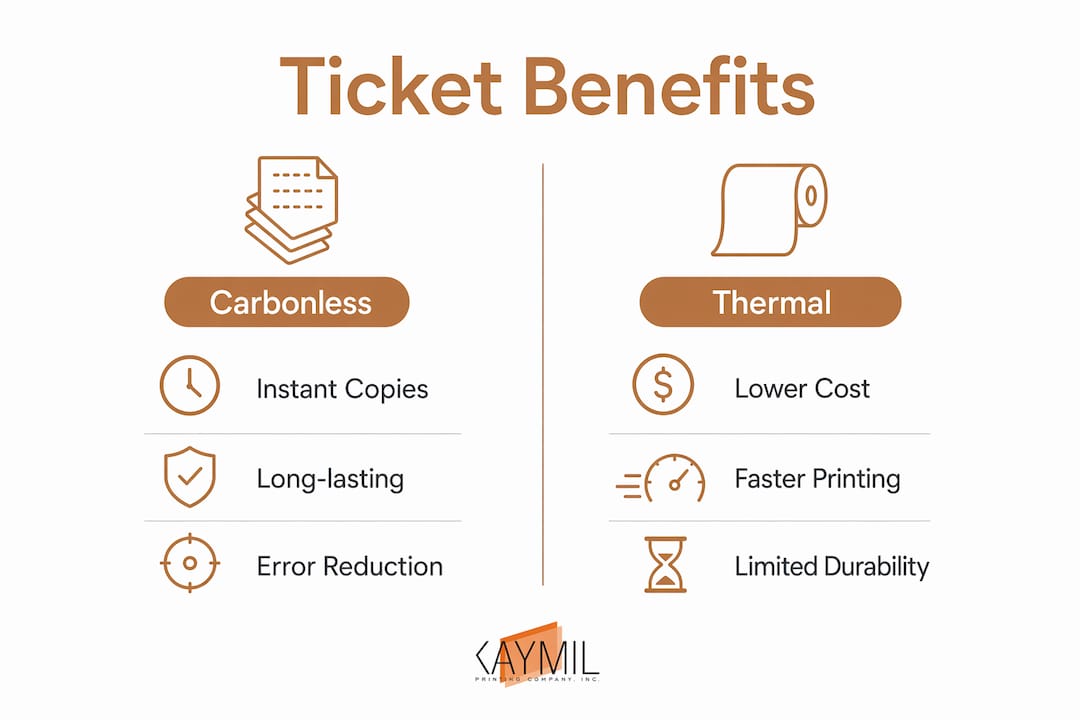
Carbonless tickets offer a clear advantage over thermal paper in one critical area: permanence. Thermal tickets fade within months when exposed to heat, sunlight, or friction. Carbonless impressions remain legible for years, making them the preferred choice for legal records and violation tracking that require long-term storage.
Single-part tickets require manual transcription to create a second record. That step introduces errors. Multi-part carbonless forms eliminate that risk entirely by duplicating the information the moment the officer writes it. One action creates every copy simultaneously.
The tradeoff is cost. Carbonless forms carry a higher per-set cost than thermal paper. Thermal paper wins on speed and unit price, but carbonless wins on audit trail reliability. For parking managers who face disputes, regulatory reviews, or legal proceedings, that audit trail is not optional.
| Feature | Carbonless | Thermal | Single-Part |
|---|---|---|---|
| Duplicate copies | Yes, instant | No | No |
| Fade resistance | High, years of legibility | Low, fades in months | High |
| Transcription errors | Eliminated | N/A | Common |
| Audit trail quality | Excellent | Poor | Poor |
| Cost per set | Higher | Lower | Lowest |
| Best use case | Violations, valet, audits | Entry/exit gates | Low-volume lots |
Pro Tip: If your facility stores violation records for more than six months, carbonless is the only paper type that holds up without lamination or digital backup.
What types of carbonless parking tickets are available?
Multi-part carbonless forms range from 2 to 4 parts, and each configuration serves a different operational need. The part count determines how many stakeholders receive a copy at the moment of issuance. Choosing the wrong part count means either wasting paper or leaving someone without a record.
Here is how each type breaks down:
- Single-part tickets. One sheet, no copies. Used in low-volume lots where records are kept digitally or not required. No duplicate is created at the point of issuance.
- 2-part tickets. The most common configuration for parking violations. Two-part carbonless tickets with consecutive numbering simplify tracking and give one copy to the vehicle owner and one to the enforcement officer or office. White and yellow sheets are the standard pairing.
- 3-part tickets. Used when a third stakeholder needs a copy. Common in valet operations where the attendant, the booth, and the customer each need a record. White, yellow, and pink are the typical sheet colors.
- 4-part tickets. The most complete configuration. White, yellow, pink, and blue sheets cover the customer, the enforcement officer, the office, and accounting or a third-party management company. Ideal for facilities with multiple reporting layers.
| Ticket type | Parts | Typical colors | Primary use case |
|---|---|---|---|
| Single-part | 1 | White | Low-volume, digital-first lots |
| 2-part | 2 | White, yellow | Parking violations, warnings |
| 3-part | 3 | White, yellow, pink | Valet, hotel parking, events |
| 4-part | 4 | White, yellow, pink, blue | Multi-department facilities, audits |
Different collation options, including straight and reverse collation, support varied workflow requirements. Straight collation keeps the original on top; reverse collation places it on the bottom for tear-off workflows. Caymil produces all standard configurations with options for both collation styles.
How do carbonless tickets improve operations and record-keeping?
Carbonless tickets create an immediate, synchronized paper record across every copy in the set. Multi-part forms support complex workflows where multiple departments need the same data at the same time, without relying on electronic systems. That matters in facilities where connectivity is limited or where paper records are legally required.
The operational benefits extend directly to dispute resolution. When a vehicle owner contests a violation, a legible, numbered carbonless copy provides an objective reference. Carbonless tickets support efficient audit processes and help managers comply with regulatory and legal frameworks in parking enforcement. A faded thermal receipt does not hold up in the same way.
Preventing errors in the field requires more than good paper. The following practices protect the integrity of every copy:
- Always write on a hard, flat surface. Soft surfaces allow uneven pressure, which produces inconsistent impressions on lower copies.
- Keep unused ticket sets away from heat and direct sunlight before issuance.
- Store completed ticket sets flat to prevent accidental pressure marks on adjacent forms.
- Use ballpoint pens rather than felt-tip markers. Felt-tip ink does not create the pressure needed to activate the microcapsule coating reliably.
Pro Tip: Use a protective backboard between the last copy and the next set in the book. This prevents ghost prints from transferring to the set below.
What should managers consider when selecting carbonless parking tickets?
Ticket size, part count, and sequential numbering are the three variables that define whether a carbonless ticket fits your operation. Size affects how much information the officer can record in the field. Part count determines your distribution chain. Sequential numbering is non-negotiable for any facility that conducts audits or tracks revenue.
Customization adds another layer of control. Consecutive numbering, custom branding, and security features reduce fraud and protect revenue. A ticket printed with your facility’s logo, a unique serial number, and a security pattern is significantly harder to counterfeit than a generic stock form. For municipalities and commercial operators, this level of control is standard practice.
Selecting a supplier requires evaluating four practical factors:
- Paper quality and coating consistency. Request samples and test them in field conditions. Write on the ticket outdoors, in direct sunlight, and on an uneven surface. Check all copies for legibility.
- Customization capability. Confirm the supplier can produce your required size, part count, color scheme, and numbering sequence. Ask for a proof before placing a full order.
- Minimum order quantities and lead times. High-volume facilities need a supplier with stock on hand and fast shipping. Caymil maintains millions of tickets in stock with nationwide shipping to meet urgent operational needs.
- Compatibility with existing systems. If your facility uses valet management software or parking enforcement platforms, confirm the ticket format integrates with your workflow before ordering.
Cost per set is a real consideration, but it should never override legibility and durability. A ticket that fades before a dispute is resolved costs far more than the price difference between paper grades. For a detailed look at how paper stock affects long-term performance, Caymil’s guide on parking ticket paper durability covers the key variables operators face.
Key takeaways
Carbonless parking tickets are the most reliable paper-based record tool available to parking facility managers, combining instant duplication, permanent legibility, and fraud resistance in a single form.
| Point | Details |
|---|---|
| Core technology | NCR paper uses microcapsule coatings to create instant copies under writing pressure. |
| Durability advantage | Carbonless impressions last years; thermal prints fade within months under heat or light. |
| Part count selection | Match 2-part, 3-part, or 4-part tickets to the number of stakeholders who need a copy. |
| Fraud prevention | Sequential numbering and custom branding reduce ticket counterfeiting and revenue loss. |
| Field handling | Use a hard writing surface and a protective backboard to prevent ghost prints on lower copies. |
Why carbonless tickets still earn their place in 2026
After years of working with parking operators across garages, municipalities, and valet programs, I have watched facilities switch to fully digital systems and then quietly reintroduce carbonless forms for enforcement. The reason is always the same: paper creates a record that does not depend on a server, a battery, or a network connection.
The argument for going fully digital is real. Barcode tickets and automated parking systems offer speed and data integration that paper cannot match. But digital records are only as reliable as the infrastructure behind them. Carbonless tickets fill the gap when systems go down, when officers work in areas without signal, or when a legal dispute requires a physical document that was created at the moment of issuance.
What I have also seen is that facilities underestimate the training component. Ghost prints are the most common complaint I hear about carbonless tickets, and almost every case traces back to writing on a soft surface or stacking ticket books without a backboard. The paper is not the problem. The handling is. Investing thirty minutes in staff training eliminates the issue entirely.
My honest view is that carbonless tickets and digital systems are not competing choices. They are complementary tools. The facilities that perform best in audits use both, with carbonless forms as the physical backup and digital records as the primary database. That combination is harder to challenge in a dispute and easier to manage during a regulatory review.
— Richard
Caymil’s carbonless parking tickets for facility operators
Caymil manufactures a full range of carbonless parking forms designed specifically for parking facility operators, including 2-part, 3-part, and 4-part configurations for violations, valet, and multi-department workflows.
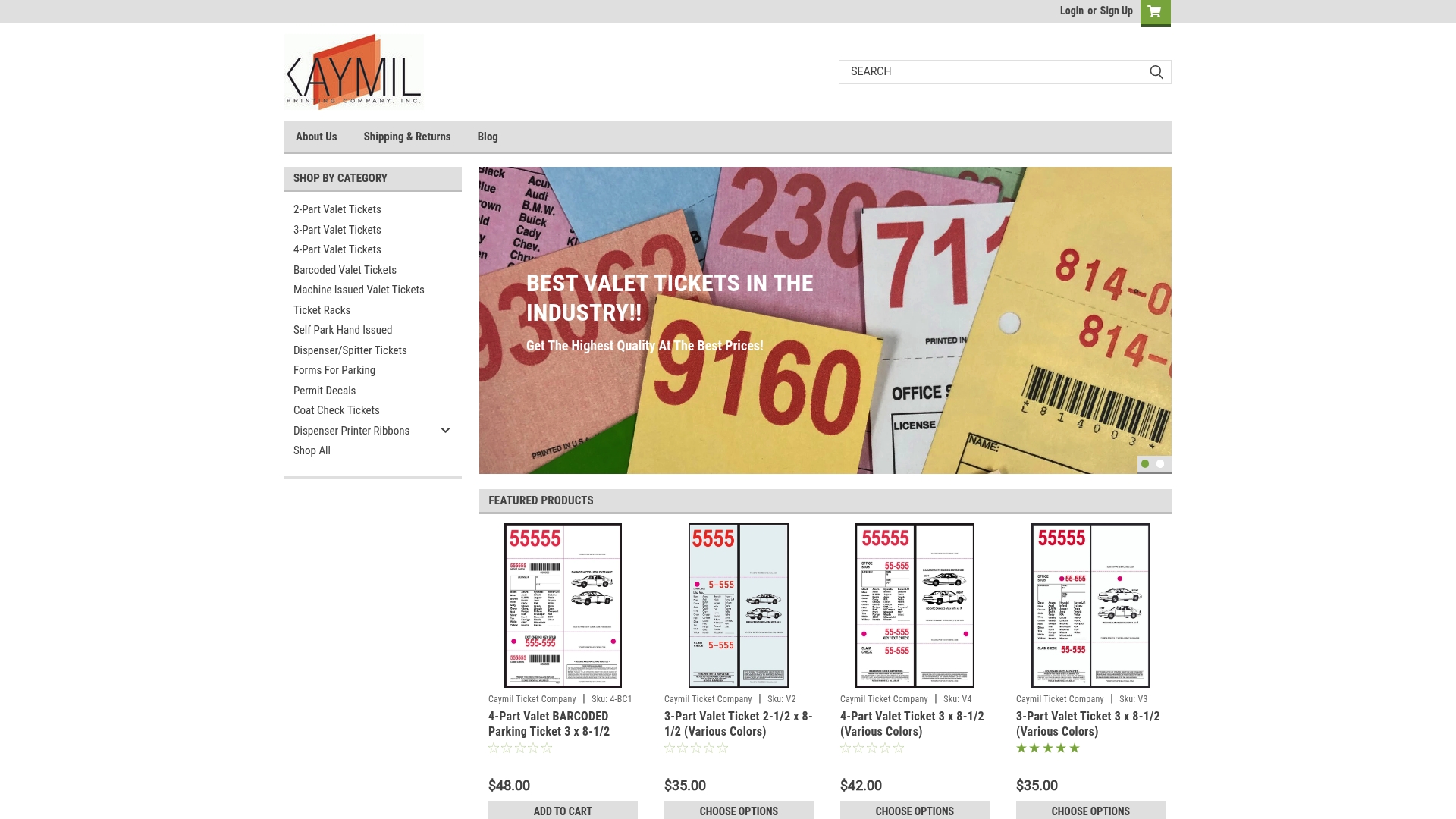
Every ticket is available with custom options including sequential numbering, facility branding, security features, and color-coded sheets. Caymil’s 2-part valet tickets and 4-part valet configurations are stocked and ready for fast nationwide shipping. For facilities that need a tailored solution, Caymil’s team works directly with operators to specify size, part count, and print options that match existing workflows. With decades of manufacturing experience and millions of tickets in stock, Caymil delivers the quality and reliability that parking professionals depend on.
FAQ
What is a carbonless parking ticket?
A carbonless parking ticket is a multi-part NCR paper form that creates duplicate copies through pressure transfer when written on. No carbon sheets are required.
How many parts does a carbonless parking ticket come in?
Carbonless parking tickets are available in 2-part, 3-part, and 4-part configurations, with each part color-coded for distribution to different stakeholders such as the vehicle owner, officer, and office.
Why do carbonless tickets last longer than thermal tickets?
Carbonless impressions resist fading for years, while thermal prints degrade within months when exposed to heat or light. This makes carbonless the preferred choice for legal records and long-term storage.
What causes ghost prints on carbonless ticket copies?
Incidental pressure on the top sheet transfers marks to all underlying copies. Writing on a hard surface and using a protective backboard between sets prevents this problem.
Can carbonless parking tickets be customized?
Yes. Options include sequential numbering, facility logos, security patterns, custom colors, and specific sizes. Customization reduces fraud and supports revenue tracking across parking operations.
Recommended
- Printed Parking Tickets: A Practical Guide for Operators - Caymil Printing Co., Inc.
- Sequential Numbering Parking Tickets: A Practical Guide - Caymil Printing Co., Inc.
- What Is a Single-Use Parking Ticket? A Manager’s Guide - Caymil Printing Co., Inc.
- Parking Ticket Dispenser Rolls: A Manager’s Guide - Caymil Printing Co., Inc.