

Parking Management System Examples for Operators in 2026

A parking management system is an integrated solution combining access control, payment processing, and real-time analytics to automate vehicle entry, exit, revenue collection, and enforcement. The best parking management system examples in 2026 share one defining trait: they replace disconnected manual processes with unified digital workflows. Platforms from Kulsys Technologies, OperationsCommander, PSH, and System TV each demonstrate how license plate recognition, contactless payments, and centralized dashboards translate directly into measurable gains for operators and facility managers. Understanding how these systems work in practice is the fastest way to identify which architecture fits your operation.
1. Free-flow, ticketless entry systems using ANPR/LPR
Free-flow parking systems use Automatic Number Plate Recognition (ANPR), also called License Plate Recognition (LPR), to identify vehicles at entry and exit without issuing a physical ticket. PSH deployed this model at Vaihinger Markt and Königsplatz, where cameras capture plate data and drivers pay at a terminal or via a mobile app before leaving. The result is a frictionless experience: no ticket to lose, no barrier delay, and no queue at the entry lane.
The operational benefits are concrete:
- Entry and exit times drop because vehicles do not stop to collect or insert tickets
- Payment options expand to include pay-at-terminal, QR code, and online pre-payment
- Equipment maintenance costs fall because barrier arms and ticket dispensers are removed or reduced
- Data accuracy improves because every transaction is tied to a verified plate number
The transition from traditional gated systems to free-flow is not simply a hardware swap. Staged installation planning protects revenue streams and keeps users informed of payment methods throughout the rollout. Operators who skip this step risk confusion at pay stations and revenue gaps during the changeover period.
Pro Tip: Before going live with a ticketless system, post clear signage at every pay terminal explaining the plate-based payment process. Drivers unfamiliar with ANPR systems will abandon payment if the path is not obvious, and that lost revenue is difficult to recover after the fact.
2. Cloud-based platforms with centralized dashboards and stakeholder apps
Cloud-based parking platforms like Kulsys Technologies deliver a single back-end that connects operators, attendants, and drivers through role-specific apps. The operator dashboard shows live occupancy, revenue by zone, and transaction history. Attendant apps handle manual overrides and gate control from a mobile device. Driver apps provide real-time space availability and contactless QR or RFID entry.

This architecture solves a problem that affects most mid-size and large facilities: data fragmentation. When revenue data, occupancy counts, and enforcement records live in separate systems, managers make decisions based on incomplete information. A unified cloud platform eliminates that gap.
Key features that define best-in-class cloud parking solutions include:
- Real-time occupancy monitoring across multiple lots or levels
- Revenue reporting segmented by time period, payment method, and zone
- Contactless entry via QR code or RFID credential
- Automated alerts for equipment faults, capacity thresholds, and payment failures
- Multi-site management from a single login
Use cases span malls, airports, residential complexes, and corporate campuses. For hotel operators, the integration between parking and valet workflows is particularly valuable. Caymil’s guide on hotel valet integration outlines how centralized dashboards reduce handoff errors between parking and front-desk teams.
Pro Tip: Request a live demo of the reporting module before committing to any cloud platform. The quality of the analytics interface varies significantly between vendors, and a dashboard you cannot read quickly during a busy shift is a dashboard you will stop using.
3. Unified systems of record connecting permits, enforcement, and payments
Modern parking management systems function as a system of record when they connect permit management, enforcement workflows, payment processing, and analytics within one continuous data flow. OperationsCommander defines this as the key differentiator between platforms that improve operations and those that simply digitize existing paperwork.
The practical advantages of a unified system of record are:
- Permit issuance automatically updates enforcement rules, so officers see current authorizations without manual list updates
- Payment records link directly to enforcement events, eliminating disputes about whether a citation was paid
- Analytics draw from all modules simultaneously, giving managers accurate occupancy, revenue, and compliance data in one view
- Workflow errors from re-entering data across separate systems are eliminated
For operators managing parking garage permit programs, this connectivity means a permit hang tag issued in the morning is enforceable by the afternoon patrol without any manual synchronization step. That speed matters in high-turnover facilities where unauthorized vehicles can occupy revenue-generating spaces for hours before enforcement catches up.
4. Access control and payment processing as separate, integrated modules
Access control and payment processing serve different functions and should be designed as distinct modules that communicate with each other rather than as a single combined system. Parcsafe’s Captura system manages vehicle authorization and audit trails at the gate level, including license plate verification and gate management, without processing payments. A separate billing system handles transactions and receipts.
This separation matters for three specific reasons. First, combining both functions in one module creates duplicated scan events when a vehicle triggers both an access check and a payment query simultaneously. Second, audit trails become unreliable when access events and payment events are logged in the same record without clear separation. Third, troubleshooting becomes significantly harder when a single system failure affects both entry control and revenue collection at the same time.
The comparison below illustrates how these two modules differ in scope:
| Module | Primary function | Key outputs |
|---|---|---|
| Access control (e.g., Captura) | Vehicle authorization and gate management | Entry/exit logs, plate verification records, audit trails |
| Payment processing | Transaction handling and revenue collection | Receipts, revenue reports, refund records |
Proper integration means the access control module queries the payment system to confirm a transaction before releasing the exit gate. The two systems communicate, but each maintains its own clean data record. Operators evaluating parking system tickets for systems like Amano, TIBA, or SKIDATA should verify that the ticket format supports this handoff without creating duplicate scan events.
5. Plate-based virtual permits replacing physical credentials
Virtual permit systems use LPR to authorize vehicles by plate number rather than by a physical hang tag or decal. Reliant Parking’s revo platinum case study demonstrates how shifting to virtual permit models changes the operational model from staff-conducted visual checks to automatic plate-based authorization at every entry point.
The operational change is significant. Staff no longer need to verify physical credentials, which reduces labor costs and eliminates the risk of forged or transferred hang tags. However, the system requires defined exception handling for unregistered vehicles, guest vehicles, and plate mismatches before going live. Without those rules in place, the system will either block legitimate vehicles or allow unauthorized ones through without generating an enforcement alert.
For facilities that still use physical permits alongside virtual ones, Caymil’s temporary parking permit examples provide practical guidance on designing credentials that work alongside LPR systems rather than against them.
6. Measurable results from integrated parking system deployments
The performance data from real deployments makes the ROI case for integrated systems concrete. Cloud-based parking solutions from System TV report revenue increases of 15 to 25 percent and operational cost reductions of 20 to 30 percent for facilities in the US and Canada. Those figures reflect the combined effect of eliminating revenue leakage, reducing labor overhead, and improving occupancy utilization.
The US Tech Automations case study is more specific. Automated enforcement and guest parking digitization reduced violations by 50 percent and recovered $156,000 in additional revenue within eight months. That recovery came from two sources: monetized visitor parking that was previously untracked and EV charging sessions that were not being billed consistently.
“Successful airport parking modernization depends on digitizing entry and exit and centralizing monitoring to avoid revenue leakage and queues.” — Interswitch deployment at Asaba International Airport
The Interswitch platform at Asaba International Airport replaced manual entry and exit processes with a digital system that reduced congestion and gave management a real-time view of all parking activity. The result was not just faster throughput. It was the elimination of the blind spots that allowed revenue to disappear between manual handoffs.
ROI evaluation must account for occupancy gains, labor savings, and driver convenience alongside direct revenue impact. Operators who measure only ticket revenue will undercount the full return from a modern integrated system.
Key takeaways
The most effective parking management systems are those that unify access control, payments, enforcement, and analytics within a single data flow rather than connecting separate point solutions after the fact.
| Point | Details |
|---|---|
| Free-flow entry requires full transaction design | Removing gates without planning payment paths and staged rollout creates revenue gaps and user confusion. |
| Cloud platforms eliminate data fragmentation | Unified dashboards connecting occupancy, revenue, and enforcement give managers accurate, real-time decisions. |
| System of record architecture drives ROI | Linking permits, enforcement, and payments in one platform reduces errors and speeds enforcement response. |
| Separate access and payment modules | Keeping these functions distinct prevents duplicated scans, audit failures, and troubleshooting complexity. |
| Integrated systems deliver measurable gains | Deployments show 15 to 25 percent revenue increases and up to 50 percent violation reductions within months. |
What I have learned from watching operators deploy these systems
The operators who get the most out of modern parking systems are the ones who treat the technology selection as a workflow redesign project, not a hardware purchase. Every system I have seen fail in the first six months failed for the same reason: the operator bought the platform but did not redesign the processes around it.
Free-flow entry is the clearest example. Removing the ticket dispenser and barrier arm looks simple on paper. In practice, it requires every driver to understand a new payment process, every staff member to handle exception cases they have never encountered before, and every piece of back-end software to communicate without gaps. The PSH deployments at Vaihinger Markt and Königsplatz worked because the implementation team planned the transaction path before the cameras went up, not after.
The same principle applies to virtual permits. Shifting from a physical hang tag to a plate-based authorization system sounds like a pure upgrade. It is, once the exception rules are defined. But if you go live without a clear protocol for guest vehicles, delivery trucks, and plate mismatches, your enforcement team will spend more time on manual overrides than they did with the old system.
My honest advice: before you evaluate any platform, map every exception case in your current operation. Unregistered plates, lost tickets, payment disputes, and equipment failures all need a defined resolution path inside the new system. The platforms that handle exceptions cleanly are the ones worth paying for. The ones that leave exception handling to your staff are the ones that will cost you more in labor than you save in automation.
— Richard
Upgrade your parking operation with the right ticketing supplies
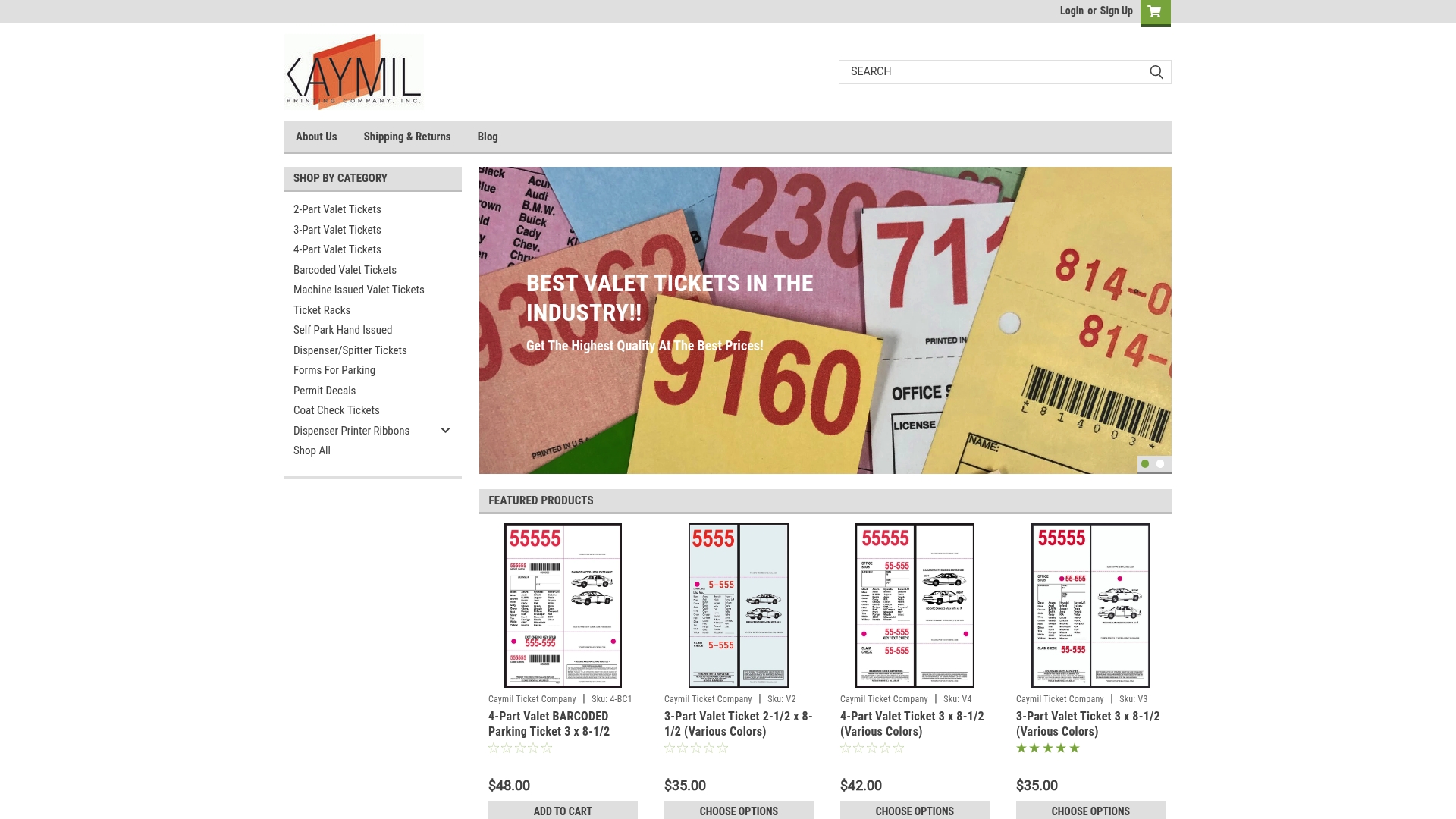
Modern parking management systems depend on physical ticketing products that match the platform’s specifications exactly. Caymil has supplied custom parking tickets, valet tickets, and permit products to operators across the United States since 1937, with products compatible with Amano, TIBA, SKIDATA, FLASH Parking, Scheidt & Bachmann, and Flowbird systems. Whether your facility uses automated dispensers, valet lanes, or permit-based access, Caymil’s barcode valet parking tickets and multi-part carbonless formats are built to work with the systems you already run. Explore Caymil’s full range of parking forms and supplies to find stock and custom options that support your operation’s specific workflow requirements.
FAQ
What is a parking management system?
A parking management system is an integrated platform combining access control, payment processing, and analytics to automate vehicle entry, exit, revenue collection, and enforcement. Modern systems use technologies like ANPR/LPR, contactless payments, and cloud dashboards to replace manual processes.
What are the main types of parking management systems?
The main types include free-flow ticketless systems using LPR, gated systems with ticket dispensers, cloud-based unified platforms, and permit-based virtual authorization systems. Each type suits different facility sizes, volumes, and operational models.
How much revenue improvement can operators expect?
Cloud-based integrated systems report revenue increases of 15 to 25 percent and operational cost reductions of 20 to 30 percent. One US Tech Automations case study recovered $156,000 in eight months through automated enforcement and digitized guest parking.
What is the difference between access control and payment processing in parking systems?
Access control manages vehicle authorization and gate operations, while payment processing handles transactions and receipts. Keeping these as separate but integrated modules prevents duplicated scan events and maintains clean audit trails for both functions.
How do I choose the right parking management system for my facility?
Map your current exception cases first, including guest vehicles, lost tickets, and payment disputes, then evaluate platforms based on how cleanly they handle those scenarios. Prioritize systems that act as a unified record connecting permits, enforcement, payments, and analytics in one data flow.
Recommended
- Hotel Parking Permit System Explained for Managers - Caymil Printing Co., Inc.
- The role of ticket dispensers in parking: A manager’s guide - Caymil Printing Co., Inc.
- Parking System Tickets – Amano, TIBA, SKIDATA, FLASH & More | Caymil Printing - Caymil Printing Co., Inc.
- Forms For Parking - Caymil Printing Co., Inc.