

Sequential Numbering Parking Tickets: A Practical Guide

Missing a ticket stub at the end of a busy Saturday shift, discovering a gap in your records mid-audit, or realizing a customer received a duplicate claim number — these are not minor inconveniences. They are revenue leaks and liability risks that compound over time. Sequential numbering parking tickets is the foundation of any credible parking operation, whether you’re managing a 200-car garage or a 5,000-vehicle event lot. This guide covers exactly how to implement, produce, and manage sequentially numbered parking tickets so your operation stays organized, auditable, and protected.
Table of Contents
- Key Takeaways
- Sequential numbering parking tickets: what it is and why it matters
- How production workflows protect sequence integrity
- Variable data printing and machine-readable codes
- Best practices for managing sequence parking citations
- Avoiding common sequence errors and ticket fraud
- My take on sequential numbering after years in parking operations
- How Caymil makes sequential numbering work for your operation
- FAQ
Key Takeaways
| Point | Details |
|---|---|
| Sequence integrity starts at production | Verifying first and last serial numbers in every batch prevents costly errors before tickets reach the field. |
| Technology multiplies the benefit | Combining sequential numbers with barcodes or QR codes enables scan-verified entry and automated reconciliation. |
| Gaps equal lost revenue | Any break in your ticket number sequence signals a missing ticket, a potential fraud event, or an operational failure. |
| System alignment matters | Printed ticket sequences must match your enforcement or adjudication software’s lookup keys to avoid mismatches. |
| Pilot before you scale | Testing a small batch physically before full production runs catches sequence breaks that digital proofs miss. |
Sequential numbering parking tickets: what it is and why it matters
Sequential numbering means each parking ticket receives a unique, incrementally ordered number printed directly on the stock. Ticket one reads 000001. Ticket two reads 000002. No two tickets in a given series share the same number, and no numbers are skipped without documentation.
The placement matters as much as the number itself. Citation numbers are positioned prominently, often near the top or on a detachable stub, labeled as “Citation No.,” “Ticket No.,” or “Violation No.” so enforcement staff and customers can locate the tracking number instantly. For valet operations, that stub serial becomes the key that reunites a driver with their car.
The practical benefits of a proper ticket number sequence go well beyond simple organization:
- Fraud prevention: Duplicate or counterfeit tickets are easy to spot when every number in a run is accounted for and verified against an issuance log.
- Audit simplicity: A parking ticket management system that cross-references issued versus returned tickets only works when the numbers form a complete, unbroken series.
- Dispute resolution: When a customer contests a citation, the ticket number is the first lookup key. A clear, sequential numbering system ties the printed ticket to the time stamp, officer ID, and violation photo in your records.
- Revenue protection: Missing tickets in a sequence immediately flag potential losses, whether from theft, misfiling, or issuance errors.
- Regulatory compliance: Many municipalities and state parking authorities require sequential citation records for public accountability.
Think of a ticket number sequence as the transaction ID of your parking operation. Without it, reconciling a busy event night becomes a manual, error-prone process. With it, you have a searchable, auditable record for every vehicle interaction.
How production workflows protect sequence integrity
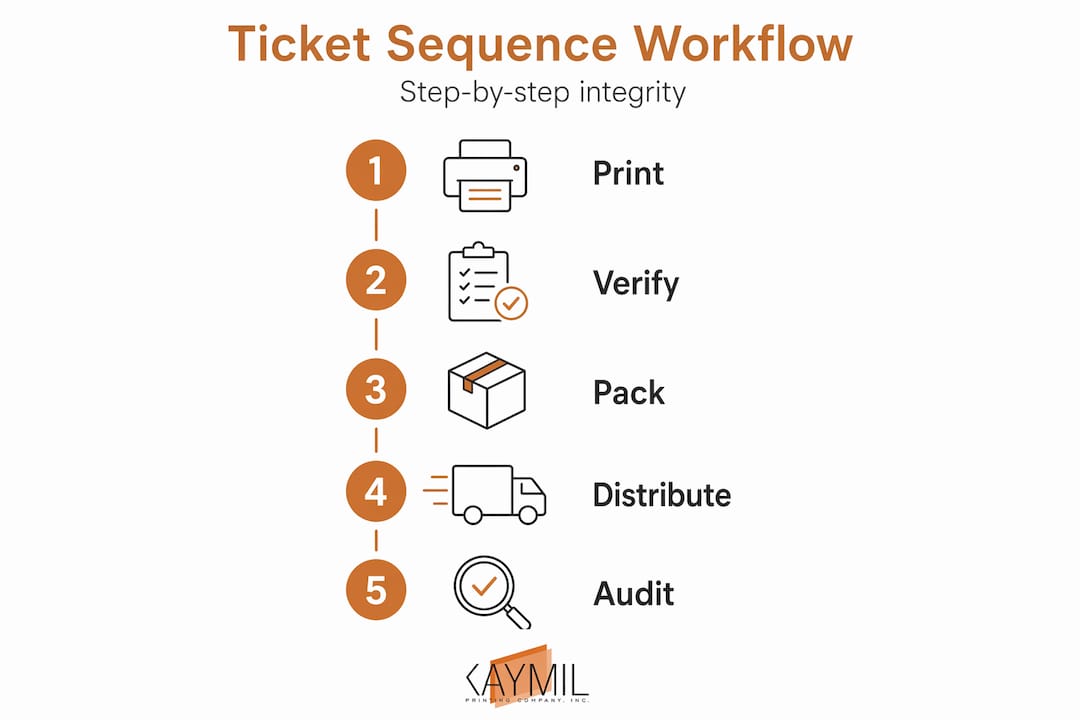
Printing sequential numbers is straightforward. Keeping those numbers in order through every step of production is where most problems originate.
The standard production method for high-volume parking tickets is cut-and-stack printing. The press prints multiple tickets per sheet, stacks the sheets, then cuts them into individual ticket pads or rolls. If the sheets aren’t stacked and cut in the exact right order, the resulting pads will have tickets numbered out of sequence. That is not immediately obvious to the person opening the box.
Here is a reliable production workflow that protects sequence integrity from start to finish:
- Define the serial range upfront. Specify starting and ending numbers before the job enters production. Share this with your printer as a controlled variable, not an afterthought.
- Model the cut-and-stack imposition. The sheet layout must account for how tickets will physically land after cutting. Serial-to-sheet mapping is the controlled invariant that must never be modified without re-validating the entire sequence model.
- Pilot a small physical run first. Print a short test run, cut it, and physically count from ticket one to the last ticket in the stack. Skipping pilot verification is one of the most common causes of shipping rework and sequence errors in professional print operations.
- Verify first and last serials at every stage. After cutting, after padding, after packaging — spot-check that the first and last ticket number in each bundle matches the production spec. Verification of first and last serial numbers in every stack is the quality control step that catches problems before they reach your operation.
- Document batch ranges. Each packaged bundle should carry a label noting its serial range. When you receive a shipment of 10,000 tickets in 10 packs of 1,000, each pack should be clearly marked with its starting and ending number.
- Store and distribute in sequence order. Pulling pack three before pack one from your supply closet defeats the system before a single ticket is issued.
Pro Tip: When you receive a new ticket shipment, open one pack from the middle of the shipment and physically verify the serial range on the label matches the actual first and last ticket inside. Printers can miss packing errors that documentation alone won’t catch.
Perforation and splitting operations introduce additional risk. Reimposition or splitting during cut-and-stack printing can silently break serial order if the serial-to-sheet mapping is not controlled and validated at that specific finishing step. Your printer should confirm that every finishing operation is treated as a potential sequence disruption point and managed accordingly.
Variable data printing and machine-readable codes
Traditional sequential numbering handles the physical tracking side of parking ticket control. Variable data printing (VDP) takes it further by printing unique barcodes and QR codes tied directly to each ticket’s serial number, at full production speed.
Inkjet VDP systems can print unique serial numbers and QR codes at speeds up to 1,000 feet per minute, making automated ticket numbering practical even for very large runs. For parking lot operators, this changes how entry, enforcement, and reconciliation work.
Here is what scan-enabled sequential parking tickets unlock:
- Automated entry verification: A scanner at the gate reads the barcode, checks the serial against a live database, and confirms or denies entry in under a second. No manual lookup required.
- Real-time issuance tracking: Every time a ticket is scanned at a kiosk or payment station, the event logs against that serial number in your parking ticket management system, giving you a live audit trail.
- Faster event reconciliation: At the end of a sold-out event, comparing issued serials against scanned serials tells you exactly how many vehicles entered, how many paid, and whether any serials were used more than once.
- Reduced manual errors: Sequential numbered tickets combined with barcode scanning greatly reduce the reconciliation work that otherwise falls on parking staff after each shift.
The technology choice between 1D barcodes and QR codes depends on your scanning infrastructure. 1D barcodes work with most standard parking gate systems. QR codes carry more data per scan and work with smartphone-based verification, which is practical for valet operations and smaller event venues without fixed readers.
| Feature | 1D Barcode | QR Code |
|---|---|---|
| Scanner compatibility | Most gate systems | Smartphones and 2D scanners |
| Data capacity | Serial number only | Serial, lot ID, date, price tier |
| Printing cost | Lower | Slightly higher |
| Best use case | Garage entry/exit | Valet and event verification |
Pro Tip: Before ordering barcode parking tickets, map your entire scanning workflow from ticket issuance to final payment. Scan workflow planning must happen before production, not after. A misaligned serial format between the printed ticket and your database lookup logic creates duplicated or missing records that are harder to fix retroactively.
Barcoded valet parking tickets combine the reliability of a physical sequential number with the speed of automated scanning, which is where most modern parking operations are heading.
Best practices for managing sequence parking citations
Getting sequentially numbered tickets printed correctly is half the work. Managing them through storage, issuance, and enforcement is the other half.

Strong operational controls across the full ticket lifecycle make the difference between a system that protects revenue and one that just looks like it does.
Batch management during storage and distribution starts with treating each numbered bundle as an accountable unit. Log each bundle’s serial range when it arrives, note where it’s stored, and record who checked it out. For enforcement operations, the officer’s name, badge number, and the serial range of the tickets issued to them each shift should all be on record.
Preventing gaps and duplicates requires a simple rule: no ticket gets issued out of numeric order without documented justification. Gaps in a ticket number sequence don’t fix themselves. Each one represents either a ticket that was voided, lost, or stolen, and each scenario requires a different response. Sequence continuity should be tracked per batch as a key performance indicator for your operation.
Aligning printed serials with your enforcement system is a step many operations overlook until they face a dispute. Operational citation IDs can differ from the printed sequence if your adjudication system assigns its own internal IDs. When those two numbering systems don’t match, a customer appealing a citation by referencing their printed ticket number may not match any record in your system. Sync your serial schemes with your case system’s lookup keys from day one.
Here is a comparison of manual versus integrated tracking approaches:
| Approach | Manual Tracking | Integrated Software |
|---|---|---|
| Audit trail | Paper logs, prone to gaps | Automatic, real-time |
| Dispute resolution | Manual lookup by officer | Instant serial search |
| Sequence gap detection | End-of-shift count | Flagged automatically |
| Revenue reconciliation | Labor-intensive | Automated reporting |
Unified enforcement platforms that tie evidence capture, ticket issuance, payments, and appeals into a single system improve auditability far beyond what sequential numbering alone can provide. The ticket number becomes the thread connecting every event in a citation’s lifecycle.
Avoiding common sequence errors and ticket fraud
Even well-designed sequential systems fail when operational habits break down. These are the risks that cost parking operations the most money and cause the most administrative headaches.
- Sequence breaks from improper cutting or packing: A vendor that doesn’t validate serial ranges at every finishing step will ship pads with tickets out of order. You won’t notice until an audit reveals gap clusters in a specific serial range.
- Mismatched stub and ticket serials: Multi-part tickets have a stub that stays with the attendant and a claim check that goes to the customer. If the printing doesn’t guarantee that stub and ticket share the same serial, your reconciliation is meaningless.
- Counterfeit and duplicate tickets: Parking ticket security measures including sequential numbering make counterfeiting significantly harder because a fraudulent ticket either duplicates an existing number or uses a number outside the issued range, both of which flag immediately in an audit.
- Gaps exploited by bad actors: In valet operations especially, a missing ticket number can indicate a vehicle was taken without a claim check being issued, which is a serious liability exposure.
Pro Tip: Run a weekly serial reconciliation during your first month with any new ticket stock. Count issued tickets against the starting inventory for each bundle. This catches printing or distribution errors early, while the vendor relationship is fresh enough to address them without delay.
Routine audits don’t have to be complex. A simple spreadsheet tracking bundle serial ranges, issuance dates, and the officer or attendant assigned to each bundle will surface most sequence integrity problems before they become financial or legal issues.
My take on sequential numbering after years in parking operations
I’ve reviewed a lot of parking operations that had sequential tickets printed correctly and still ended up with unusable audit trails. The printing was fine. The habits weren’t.
What I’ve found consistently is that the value of sequential numbering is almost entirely determined by what happens after the tickets arrive. Operations that treat ticket bundles as interchangeable consumables, pulling from whatever pack is closest to the door, destroy their own sequence integrity before a single ticket hits the windshield. The printed numbers are only as good as the discipline around how they’re issued and tracked.
The other thing I’d push back on is the assumption that adding barcodes automatically solves the problem. I’ve seen operations invest in barcode parking tickets and then run their scanning workflow on a database schema that doesn’t match the serial format on the ticket. The scans collect, the database errors out, and someone spends three days manually reconciling what was supposed to be automated. Plan the whole system before you order a single roll.
The operations that do this well treat sequential numbering as an operational discipline, not a printing feature. They pilot their batches, audit their gaps, sync their serials with their software, and assign every ticket bundle to an accountable person. That’s the difference between having numbers and having control.
— Richard
How Caymil makes sequential numbering work for your operation
Caymil has been manufacturing parking tickets since 1937, and sequential numbering has been part of every product line from the start. Whether you need custom-numbered parking forms for enforcement, multi-part valet tickets with matched stub and claim check serials, or machine-issued valet tickets with inline variable data printing, Caymil builds them with the serial range, format, and packaging your operation requires. Every order includes documented serial ranges, and Caymil’s production team validates first and last serials at every finishing step. With millions of tickets in stock and fast nationwide shipping, Caymil serves parking garages, municipalities, valet operators, event venues, and commercial parking management companies throughout the United States. Contact Caymil to discuss your serial range, format, and volume requirements.
FAQ
What is sequential numbering on a parking ticket?
Sequential numbering means each ticket in a print run carries a unique, incrementally ordered number such as 000001, 000002, and so on, with no duplicates or gaps. This number serves as the primary tracking key for issuance, payment, enforcement, and audit purposes.
Why do parking operators use numbered tickets?
Numbered parking tickets allow operators to detect missing, duplicate, or counterfeit tickets by comparing issued serial ranges against collected or scanned records. They also simplify dispute resolution and revenue reconciliation at the end of each shift or event.
How do you number parking tickets in high-volume production?
High-volume parking tickets are numbered using cut-and-stack printing workflows where serial-to-sheet mapping is controlled through every finishing step, including cutting, padding, and packaging. Verifying the first and last serial in each bundle before shipment is the standard quality check.
Can sequential numbers work with barcode scanning systems?
Yes. Variable data printing allows inkjet systems to print unique serial numbers and barcodes on the same ticket at production speed, enabling scan-based verification at parking gates and event entries. The serial format must be aligned with your scanning and database lookup logic before production begins.
What causes gaps in a parking ticket sequence?
Gaps result from voided tickets, improper cutting during production, storage or distribution errors, or deliberate removal of tickets. Each gap should be documented and investigated, as unexplained gaps in a sequence can indicate theft, fraud, or an operational control failure.
Recommended
- Parking ticket security: How to prevent fraud and protect revenue - Caymil Printing Co., Inc.
- Valet Tickets 101: The Simple System That Keeps Your Lot Moving - Caymil Printing Co., Inc.
- Blog - Caymil Printing Co., Inc.
- The role of ticket dispensers in parking: A manager’s guide - Caymil Printing Co., Inc.