
What Is a Temporary Parking Permit? A Practical Guide
Many people assume a temporary parking permit is something you can grab the morning you need it. That assumption is wrong, and it costs people fines they never saw coming. A temporary parking permit is an official short-term authorization issued by a municipal authority, granting a vehicle the right to park in a restricted zone for a defined period. Understanding how these permits work, who qualifies, and how to apply correctly can save you from expensive tickets and last-minute scrambling. This guide covers everything you need to know.
Table of Contents
- Key takeaways
- What a temporary parking permit actually is
- How to get a temporary parking permit
- Temporary parking rules, restrictions, and enforcement
- Real-world examples and how cities handle them differently
- Best practices for using temporary permits without incident
- My take on temporary permits after years in the industry
- Reliable parking permit forms from Caymil
- FAQ
Key takeaways
| Point | Details |
|---|---|
| Permits are time-limited authorizations | Temporary parking permits cover durations from 1 to 60 days, depending on the city. |
| Applications require advance notice | Most municipalities require 48 hours to one week of lead time before the permit start date. |
| Permits are vehicle-specific | Each permit is tied to a license plate and cannot be transferred to another vehicle. |
| Display rules are strictly enforced | A valid permit placed incorrectly on the dashboard can still result in a fine. |
| Annual caps prevent misuse | Many cities limit how many temporary permits a residence can receive per calendar year. |
What a temporary parking permit actually is
A temporary parking permit is a short-term parking authorization issued by a local government or municipality. It allows a vehicle to park in a zone that would otherwise be restricted, permit-only, or subject to time limits. These permits are not a workaround for standard parking rules. They are a regulated tool that cities use to manage limited curb space while accommodating legitimate short-term needs.

Permit durations vary widely: some cities offer single-day passes, while others grant permits lasting up to 60 days. Costs follow a similar range, running from free for special event zones to around $300 for longer-duration permits. The specific rules governing each permit type come directly from local ordinances, which means what applies in one city may not apply in the next.
Common situations that call for a temporary parking pass include:
- Out-of-town guests staying for several days in a permit-only residential zone
- Contractors, movers, or utility crews parking service vehicles near a job site
- Residents whose regular vehicles are in the shop and using a loaner or rental
- Attendees or residents near large-scale special events or festivals
- Construction crews requiring temporary vehicle parking adjacent to a work zone
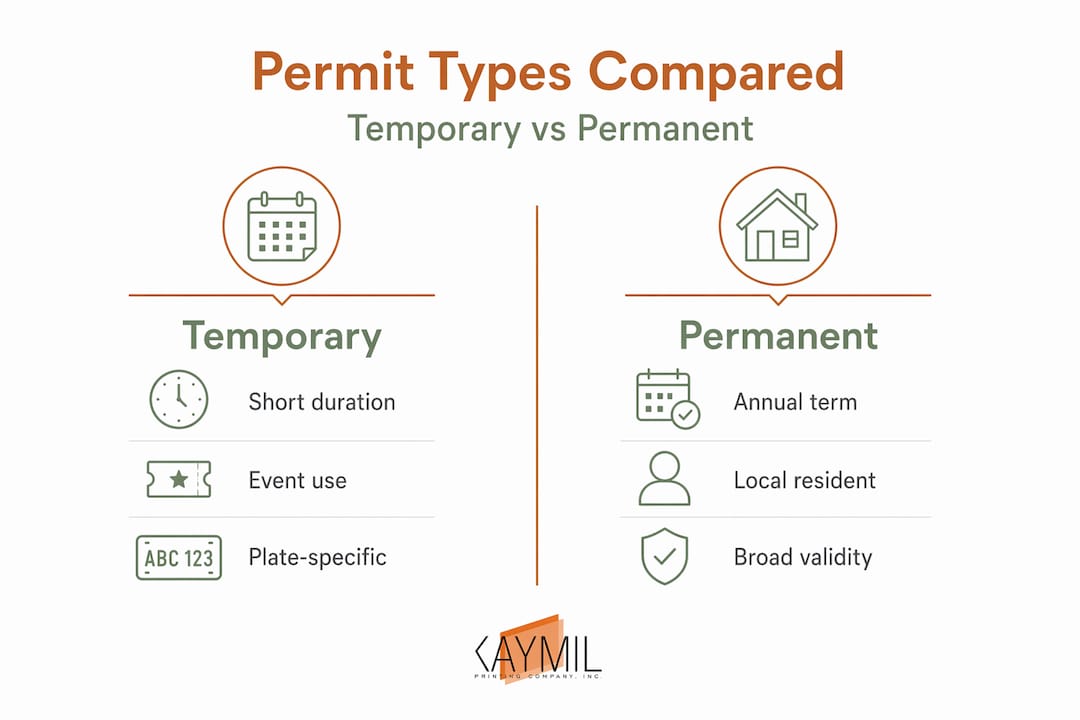
The key distinction between a temporary and a permanent permit is simple. A permanent permit is issued for an extended period to a qualifying resident or entity, typically renewed annually. A temporary permit covers a specific, time-bounded need and expires automatically when that period ends.
How to get a temporary parking permit
The application process varies by municipality, but the core requirements follow a consistent pattern. Most cities ask for proof that you are a resident of or have a legitimate service connection to the area where the permit will apply.
Here is what a typical temporary parking permit application process looks like:
-
Confirm eligibility. Most programs require the applicant to be a resident of the affected zone, a verified contractor, or an authorized event organizer. Proof of residency commonly means a utility bill or signed lease dated within the past 30 days.
-
Gather your documents. Prepare vehicle registration, proof of residency or business authorization, and any supporting details such as event dates, contractor license numbers, or a description of the work being performed.
-
Submit your application with enough lead time. Same-day applications are typically not allowed because municipalities must post signage at least 24 hours in advance. Many cities require one full week of advance notice for complex situations.
-
Choose your submission method. Online portals have become the standard in most major cities. Some smaller municipalities still process applications in person at a city clerk’s office or parking authority. Check your city’s website for the accepted method.
-
Receive and review your permit. Once approved, confirm that the vehicle’s license plate number, permit start and end dates, and the designated zone are all accurate before accepting the permit.
Pro Tip: Double-check the license plate number on every permit before submission. Digital enforcement systems perform database lookups against the plate on file. One transposed digit means your car gets ticketed even if you paid and applied correctly.
A common mistake is assuming that because you live on a street, you automatically qualify for any permit attached to that address. Cities often require that the applicant be a registered resident at that specific property, not just a frequent visitor or nearby neighbor.
Temporary parking rules, restrictions, and enforcement
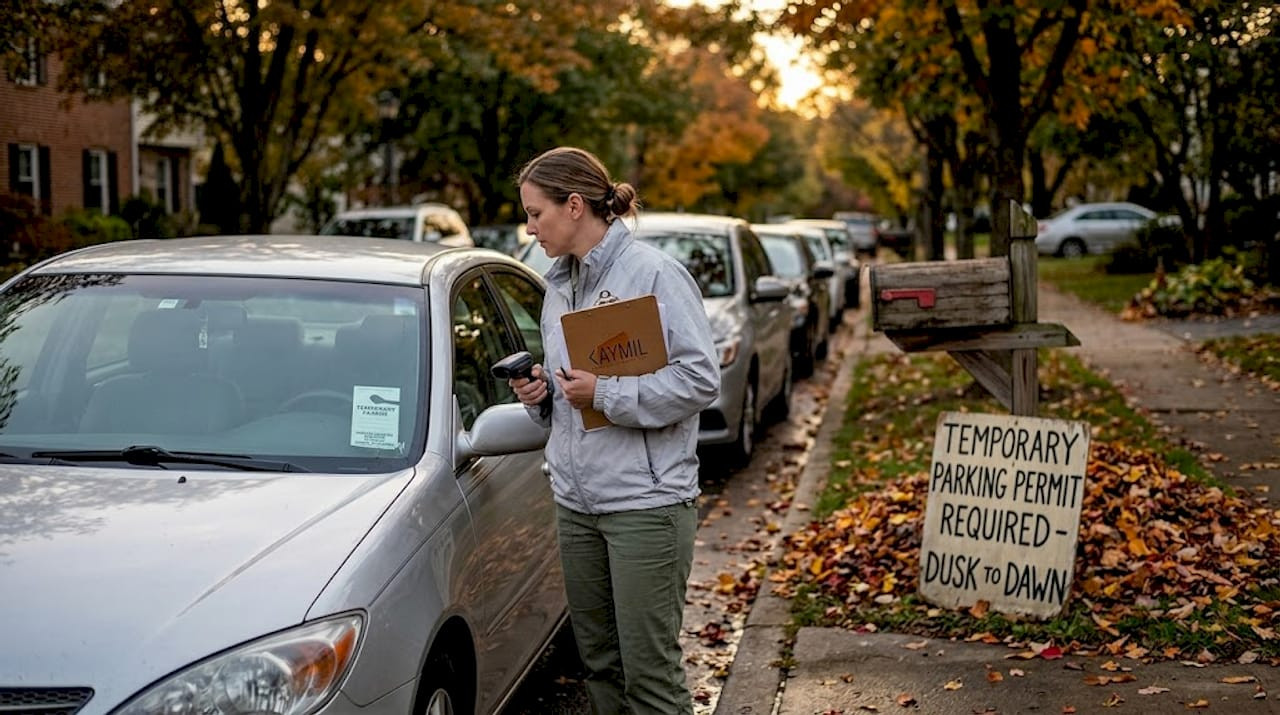
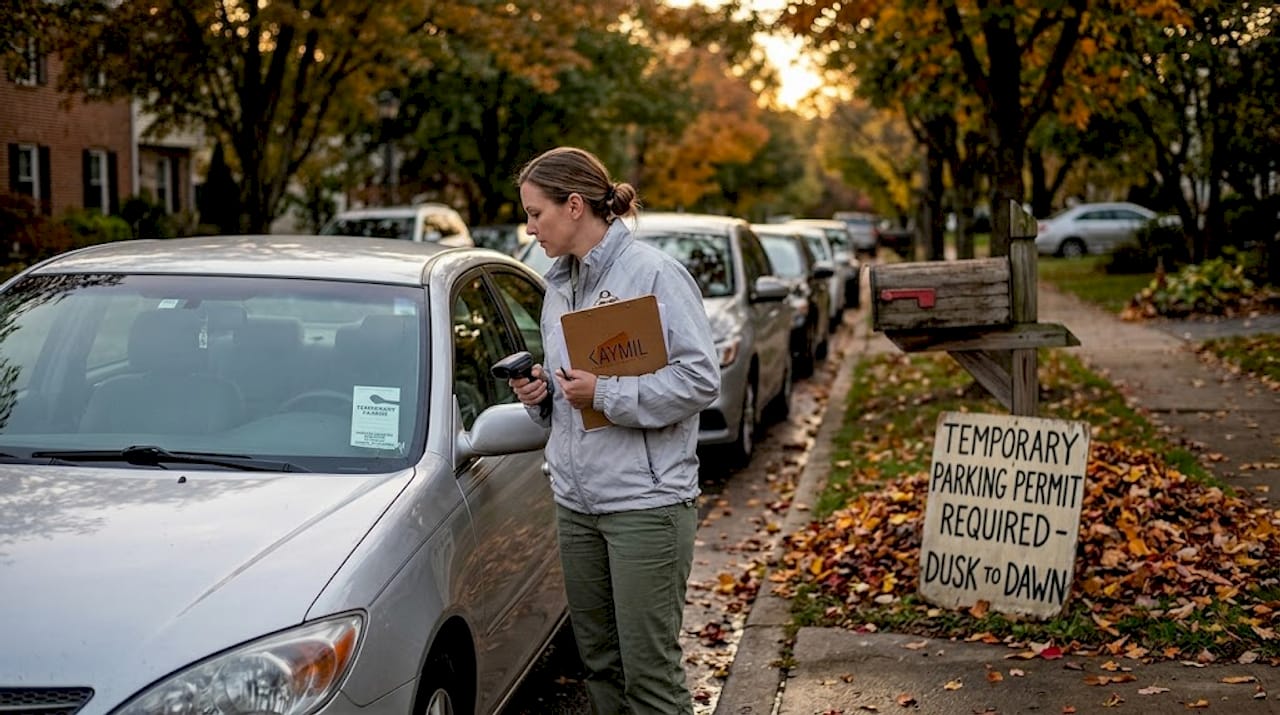
Once you have a permit, following the rules around its use is just as critical as obtaining it correctly. Enforcement officers are not checking paperwork by hand anymore. Most modern systems use mobile license plate readers that cross-reference a real-time database. If your plate is not in the system or the permit is not displayed properly, the ticket process is automatic.
Key rules to understand before parking under a temporary permit:
- Display requirements are strict. Permits must be placed face-up on the driver’s side dashboard, fully visible through the windshield. Tinted windows, cluttered dashboards, or upside-down permits all result in fines, even when the permit itself is valid.
- Permits are non-transferable. Each permit is tied to a specific license plate. A loaner or replacement vehicle requires its own separate permit to stay compliant.
- Annual caps are real. Cities like Mississauga enforce a limit of 14 temporary permits per calendar year per residence. The city sends an automatic notification when a household approaches that cap.
- Other parking restrictions still apply. A temporary permit does not override no-parking zones, fire hydrant clearances, or handicapped-only spaces. The permit authorizes parking in the specific zone listed, nothing more.
- Digital inaccuracies have zero tolerance. Errors in license plate entry or incomplete online applications result in immediate ticketing because enforcement relies entirely on database lookups, not visual inspection.
Treating a temporary parking permit as a privilege subject to clear regulatory boundaries is the most practical mindset. Cities issue these permits to manage a limited public resource. Those who misuse or abuse the system face not just fines but potential loss of permit privileges entirely.
Real-world examples and how cities handle them differently
The best way to understand temporary parking permits in practice is to look at how specific cities apply them. Policies differ considerably, and knowing the variation helps you ask the right questions when you apply in your own city.
Philadelphia implemented a temporary permit program for residents in neighborhoods adjacent to the 2026 FIFA World Cup Fan Festival at Lemon Hill. Permits were required from June 11 through July 19, 2026 for qualifying residents, and they were issued at no cost. The program was time-limited and zone-specific, meaning residents outside the designated boundaries did not qualify even if they lived nearby.
For large-scale event planning, coordinating parking logistics in advance matters as much as the permits themselves. Resources like event transportation planning guides can help organizers understand how parking authorization fits into broader logistics when managing crowds at major venues.
Here is how temporary permits compare across a sample of cities:
| City | Duration options | Cost | Application method | Annual cap |
|---|---|---|---|---|
| Champaign, IL | 1 to 60 days | Free to ~$300 | Online | Not specified |
| Mississauga, ON | Short-term, varies | Varies | Online portal | 14 per year |
| Philadelphia, PA | Event-specific | Free (event zone) | Online | Event period only |
| Bloomington, IN | Event-specific | Varies | Online | Varies by event |
Pro Tip: When applying for a permit near a major event or festival zone, apply at least two weeks early. Event-adjacent programs often have limited allocations, and cities can close applications once capacity is reached.
Construction projects and residential visitor permits follow a similar structure across most cities but come with additional documentation requirements, such as contractor license numbers or verified project timelines. Knowing the specific category your situation falls into before you apply prevents delays.
Best practices for using temporary permits without incident
Getting the permit is only half the job. Using it correctly is what keeps the ticket off your windshield.
- Apply well in advance. Most city systems require 48 hours to one week for processing, and same-day permits are rarely available.
- Verify all permit details before the start date, especially the license plate number, zone designation, and effective dates.
- Place the permit on the dashboard immediately and check its visibility from outside the vehicle before walking away.
- If your vehicle changes due to a repair or rental situation, apply for a replacement permit right away rather than assuming the original will cover the new plate.
- Know the expiration date and apply for a renewal or extension before the permit lapses, not after you receive a ticket.
- Keep a copy of your application confirmation in the vehicle as a backup in case of a system error or database lag.
Following these practices removes most of the risk from temporary permit use. The people who get fined are almost always those who cut corners on timing, skipped the display step, or assumed one permit covered a different vehicle.
My take on temporary permits after years in the industry
I have worked alongside parking operators, municipalities, and venue managers long enough to say this plainly: most permit problems are self-inflicted. The rules are not complicated. The real issue is that people treat the permit as the finish line when it is actually the starting point.
I have seen contractors lose entire job-site access windows because they submitted an application two days before they needed it, not realizing their city required five business days for signage posting. I have seen event organizers issue paper permits without checking local display requirements, only to find their attendees ticketed en masse on opening night.
The shift to digital enforcement has been the biggest change I have watched unfold. Automated permit systems are faster and more accurate, but they are far less forgiving. An officer with a clipboard might notice a permit tucked under a sun visor and use judgment. A license plate reader does not. It logs the plate, checks the database, and issues the citation in seconds.
My advice: treat a temporary parking permit the same way you would treat a legal document. Read every field before you submit. Confirm approval before you park. Display it correctly every single time. The permit system exists because curb space is a finite public resource, and municipalities are right to protect it. Compliance is not just about avoiding fines. It is about respecting a system that keeps parking functional for everyone.
— Richard
Reliable parking permit forms from Caymil
Managing temporary parking for your organization requires forms and materials that are accurate, durable, and easy to issue. Caymil Printing Co. has supplied parking operators, municipalities, event venues, hospitals, and universities with high-quality parking permit forms and ticketing products since 1937.
Whether you need custom-printed parking permit forms with sequential numbering, barcoding, or logo branding, or you need valet tickets for large-scale event management, Caymil delivers. Products are available in stock quantities with fast nationwide shipping, or fully customized to your organization’s specifications. For event-specific temporary parking needs, machine-issued valet tickets offer a reliable, professional solution that integrates with major parking management systems. Contact Caymil to discuss your permit printing requirements.
FAQ
What is a temporary parking permit?
A temporary parking permit is a short-term authorization issued by a municipality allowing a vehicle to park in a restricted zone for a defined period. Durations range from 1 to 60 days depending on the city and the specific use case.
Who needs a temporary parking permit?
Anyone parking a vehicle in a permit-only residential zone without a permanent permit typically needs a temporary pass. Common applicants include out-of-town visitors, contractors, movers, and residents using a loaner vehicle.
How far in advance do I need to apply?
Most cities require at least 48 hours to one week of advance notice. Same-day applications are generally not accepted because municipalities must post required signage at least 24 hours before the permit takes effect.
Can I use one permit for multiple vehicles?
No. Temporary permits are vehicle-specific and tied to a single license plate. If your vehicle changes, you must apply for a new permit for the replacement vehicle.
Are there limits on how many temporary permits I can get per year?
Yes, in many cities. Mississauga, for example, caps temporary permits at 14 per calendar year per residence and notifies residents automatically when they approach the limit.