

What Is a Valet Parking Envelope? A Pro Guide

A valet parking envelope is a purpose-designed security sleeve that stores vehicle keys and guest information to support safe, organized valet operations. Known formally as a valet key envelope or valet security envelope, this tool is the physical backbone of any professional valet parking system. Hotels, event venues, luxury resorts, and high-volume parking operations rely on these envelopes to maintain a clear chain of custody for every vehicle handled. Without them, key management becomes guesswork, and liability exposure grows fast.
What is a valet parking envelope and why does it matter?
A valet parking envelope is a specialized security container designed to safely house vehicle keys and guest information during valet operations, particularly in luxury hospitality and high-security event settings. The envelope serves three core functions: it protects keys from unauthorized access, it records critical vehicle and guest data, and it synchronizes with the broader valet parking system to speed retrieval.
The distinction between a valet envelope and a simple paper ticket is significant. A ticket records a transaction. An envelope secures a physical asset, the key, while simultaneously documenting the vehicle’s condition, ownership, and location in the lot. That combination of physical security and paper documentation is what makes the envelope indispensable in professional valet operations.

For hotel managers and event planners, the valet envelope purpose extends beyond convenience. It creates a defensible record that protects the operator if a guest disputes damage or a key goes missing. For valet service providers, it is the primary tool for maintaining order across dozens or hundreds of simultaneous vehicle handoffs.
Physical design and construction
Valet envelopes are typically constructed from durable card stock or coated paper, sized to hold a standard key fob or key ring without tearing. The exterior carries printed fields for vehicle data, and the interior holds the key securely until retrieval. High-quality envelopes use materials that resist moisture and tearing under the physical demands of a busy valet stand.
What features make valet envelopes essential for secure operations?
The security and documentation features built into a professional valet envelope are what separate a well-run valet parking system from one that creates liability. These features work together to protect guests, operators, and vehicles throughout the entire service cycle.
Key security and documentation features include:
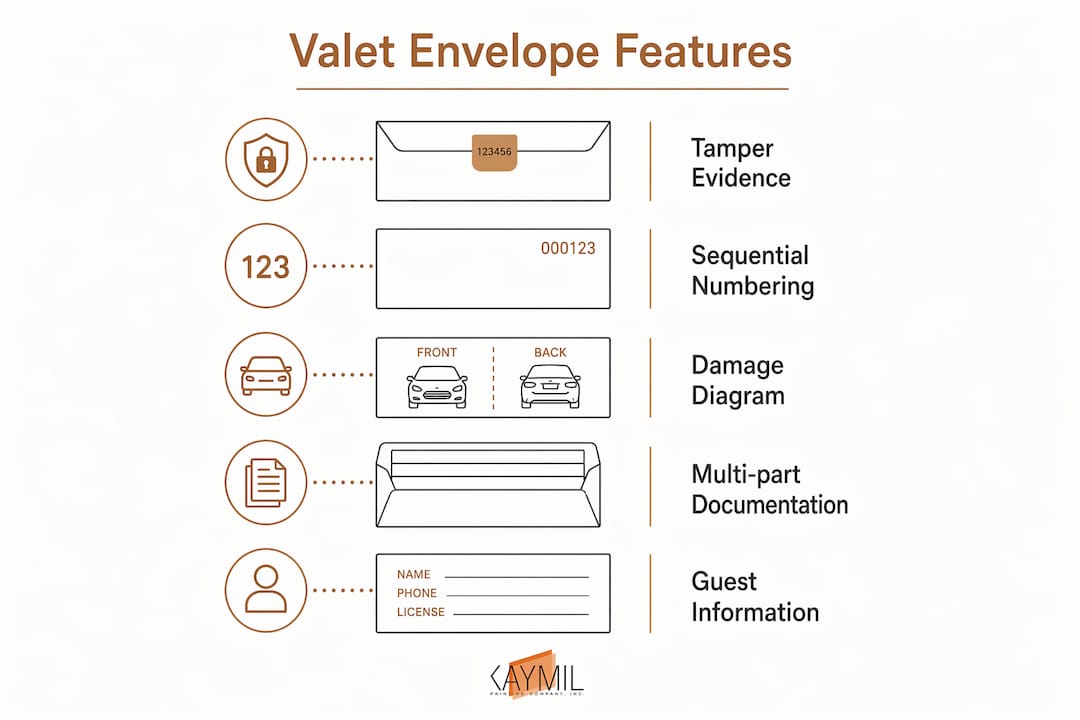
- Tamper-evident seals: Tamper-evident envelopes leave visible evidence if opened, creating an audit trail that proves whether keys were accessed between drop-off and retrieval. This is critical for mitigating theft liability in luxury and high-value vehicle situations.
- Sequential numbering: Sequential numbering systems align each envelope with a specific key hook on the valet podium, reducing vehicle retrieval time to under 30 seconds in well-organized operations. That speed directly affects guest satisfaction scores.
- Multi-part documentation: Valet envelopes come in 3-part, 4-part, or 5-part configurations, providing separate detachable sections for the guest claim check, the valet’s working copy, and a dashboard stub placed inside the vehicle. Each part serves a different stakeholder in the handoff chain.
- Vehicle condition fields: Printed fields for vehicle make, model, color, license plate, and pre-existing damage documentation protect operators from liability and provide a factual basis for resolving disputes. A guest cannot credibly claim a scratch was caused by the valet if the envelope documents it at intake.
- Custom branding options: Hotels and event venues can print logos, color schemes, and contact information directly on the envelope, reinforcing brand identity at every guest touchpoint.
Pro Tip: Always use envelopes with pre-printed damage diagrams showing a vehicle outline. Attendants can circle affected areas at intake, creating a visual record that is far more defensible than written descriptions alone.
The combination of tamper evidence, sequential numbering, and multi-part documentation is what makes the valet envelope a genuine operational tool rather than a simple storage sleeve. Each feature addresses a specific failure point in the valet workflow.
How do valet envelopes integrate into the valet parking workflow?
Understanding how valet parking works at the operational level reveals why the envelope is the central coordination tool in any professional system. The workflow follows a clear sequence, and the envelope is present at every step.
- Vehicle intake: The attendant greets the guest, opens a new sequentially numbered envelope, and records the vehicle’s make, model, color, license plate, and any visible damage. The guest signs or initials the condition record. This step establishes the legal and operational baseline for the entire transaction.
- Key placement: The keys go inside the sealed envelope, which is then placed on the key hook matching the envelope number on the valet podium. This one-to-one correspondence between ticket number and hook position is the foundation of fast retrieval. Strict discipline in maintaining this sequence dramatically reduces retrieval delays, which is critical during large events and busy hotel checkouts.
- Claim check issuance: The guest receives the detachable claim stub from the envelope. This stub carries the matching number and serves as the guest’s proof of ownership during retrieval. For luxury transportation events, the claim check also reinforces the professional image of the service.
- Vehicle retrieval request: When the guest presents the claim stub, the attendant matches the number to the corresponding hook, retrieves the envelope, confirms the vehicle details, and dispatches a runner to bring the vehicle forward. Well-run systems complete this process in 3 to 5 minutes.
- Vehicle handoff and close-out: The attendant verifies the vehicle with the guest, collects any parking fee, and retains the valet copy of the envelope for record-keeping. The documentation copy remains on file for a defined period, providing a retrievable record if any dispute arises later.
The valet ticket or envelope acts as the main synchronization tool, ensuring the sequence of tickets aligns with the physical key placement on the valet podium. This synchronization is what separates a professional operation from one that loses vehicles or keeps guests waiting.
Common mistakes and best practices for event planners and hotel managers
A well-defined valet ticketing system is the most effective way to eliminate confusion and prevent vehicle misplacement. Yet many operations, particularly those run by event planners or hotel managers who are new to valet logistics, make avoidable errors that undermine the system’s effectiveness.
Common mistakes to avoid:
- Misaligning ticket numbers and key hooks: When an attendant places an envelope on the wrong hook, the retrieval process breaks down entirely. This single error can cause cascading delays during peak periods.
- Skipping the damage documentation step: Operators who fail to document pre-existing vehicle condition at intake are exposed to fraudulent damage claims. The envelope’s condition fields exist precisely to prevent this.
- Using inconsistent envelope formats across a team: When some attendants use 3-part envelopes and others use 4-part versions without a clear protocol, the documentation chain breaks. Standardize the format before the event or shift begins.
- Neglecting to retain completed envelopes: Discarding used envelopes at the end of a shift eliminates the audit trail. Retain all completed envelopes for a minimum of 30 days, or longer if your operation handles high-value vehicles.
Pro Tip: Pair your physical envelope system with a digital log at the end of each shift. Photograph the completed envelope or enter the key data points into a spreadsheet. This creates a redundant record that protects your operation if a paper envelope is lost or damaged.
Valet ticketing systems contribute directly to revenue protection by accurately tracking vehicle flow and parking durations. New valet operators often underestimate the importance of consistent communication using the ticket system, which is the single most common source of mix-ups in high-volume operations. You can explore valet parking log practices to build documentation habits that complement your envelope system.
Valet envelopes vs. other key management tools: which is right for your operation?
Valet operators today have several options for key management, from simple paper tickets to RFID tracking systems. The right choice depends on the volume, security requirements, and budget of the operation.
| Tool | Security level | Documentation | Cost | Best for |
|---|---|---|---|---|
| Valet key envelope | High (tamper-evident) | Full multi-part record | Low to moderate | Hotels, events, luxury venues |
| Simple paper ticket | Low (no tamper evidence) | Minimal | Very low | Low-volume, low-risk lots |
| RFID key tag | High (electronic tracking) | Digital log only | High | Large garages, tech-forward operations |
| Digital-only system | Moderate (app-dependent) | Cloud-based | Moderate to high | High-tech venues with reliable connectivity |
| Key tag without envelope | Low | None | Very low | Internal staff parking only |
The valet envelope occupies a practical middle ground. It delivers tamper-evident security and full paper documentation at a fraction of the cost of RFID or digital systems. For most hotels, event venues, and valet operators, this combination represents the best balance of security, usability, and cost.
RFID and digital systems offer advantages in large-scale garage operations where hundreds of vehicles move simultaneously. But they depend on technology infrastructure, battery life, and connectivity. A physical envelope never loses signal, never needs charging, and never requires a software update. For operations where reliability and simplicity are priorities, the envelope remains the preferred tool.
Hotel valet and parking integration works most smoothly when the physical envelope system and digital records complement each other rather than compete. The envelope handles the physical key and the immediate documentation. Digital tools handle long-term record storage and reporting.
Key takeaways
A valet parking envelope is the single most cost-effective tool for securing vehicle keys, documenting condition, and maintaining operational order across any professional valet parking system.
| Point | Details |
|---|---|
| Core function | Envelopes secure keys and document vehicle condition, creating a defensible chain of custody. |
| Sequential numbering | Matching envelope numbers to key hooks reduces retrieval time to under 30 seconds. |
| Multi-part documentation | 3-part, 4-part, and 5-part formats provide separate records for guests, attendants, and vehicles. |
| Tamper-evident security | Visible seals create an audit trail that protects operators from theft and damage liability. |
| Best use case | Envelopes outperform digital-only systems in reliability, cost, and simplicity for most hotel and event operations. |
Why the envelope is still the most underrated tool in valet operations
After years of working with valet operators across hotels, convention centers, and private events, one pattern stands out clearly: the operations that run smoothest are not the ones with the most sophisticated technology. They are the ones with the most disciplined paper systems.
I have seen RFID setups fail during a power outage at a major hotel, leaving attendants scrambling with no record of which key belonged to which vehicle. I have also seen a three-person valet team at a boutique resort handle 200 vehicles during a wedding reception without a single retrieval error, using nothing more than sequentially numbered envelopes and a well-organized key board.
The valet envelope is underrated because it looks simple. It is a piece of paper. But the discipline it enforces, the documentation it creates, and the security it provides are genuinely difficult to replicate with more expensive alternatives. The tamper-evident seal alone has resolved more guest disputes than any digital log I have encountered.
My honest recommendation for hotel managers and event planners is this: invest in quality envelopes with proper tamper-evident seals, pre-printed damage diagrams, and sequential numbering. Train your team to treat the numbering sequence as non-negotiable. Then layer digital logging on top as a backup, not a replacement. That combination delivers the security of a high-tech system at a fraction of the cost, and it works every time, regardless of connectivity or battery life.
— Richard
Upgrade your valet system with Caymil’s professional envelope solutions
Caymil has manufactured professional valet parking tickets and envelopes since 1937, and the product line reflects decades of real-world operational feedback from hotels, event venues, and valet operators nationwide.
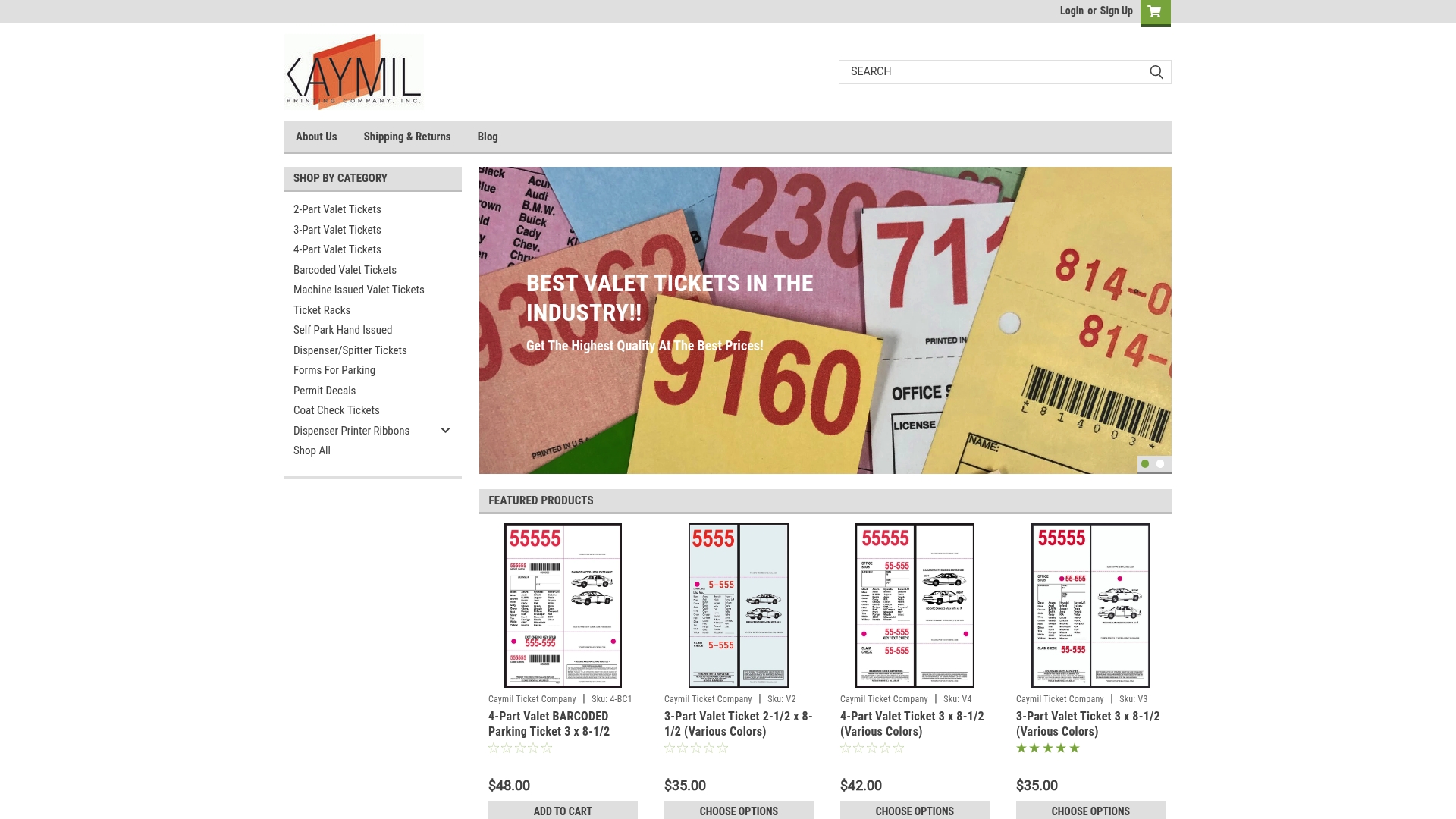
Caymil’s valet parking forms and envelopes are available in stock and custom formats, with options for sequential numbering, tamper-evident seals, multi-part carbonless copies, and full custom branding. For operations that need multi-part documentation, Caymil’s 3-part valet tickets and 4-part valet tickets provide the complete documentation chain that protects operators and guests alike. Fast nationwide shipping and competitive pricing make it straightforward to stock up before your next event or busy season.
FAQ
What is a valet parking envelope used for?
A valet parking envelope is used to securely store vehicle keys and record guest and vehicle information during valet operations. It maintains a chain of custody for keys and provides documentation that protects operators from liability.
How does a valet envelope differ from a regular parking ticket?
A parking ticket records a transaction, while a valet envelope physically secures the vehicle key and documents the vehicle’s condition at intake. Valet envelopes typically include tamper-evident seals and multi-part documentation that standard tickets do not provide.
What information is recorded on a valet parking envelope?
Standard fields include vehicle make, model, color, license plate number, pre-existing damage notes, date and time of intake, and the attendant’s identifier. Multi-part envelopes provide separate copies for the guest, the valet team, and the vehicle dashboard.
How does sequential numbering improve valet operations?
Sequential numbering aligns each envelope with a specific key hook on the valet podium, so attendants can locate any key in under 30 seconds. This system eliminates guesswork during peak periods and is the foundation of fast, accurate vehicle retrieval.
When should an operation use envelopes instead of a digital key system?
Valet envelopes are the better choice when reliability, low cost, and simplicity are priorities, particularly for hotels, event venues, and operations without consistent connectivity. Digital systems add value as a complementary record-keeping layer but should not replace physical envelopes in most valet environments.