

Coat Check Tickets for Events: Stock vs Custom Guide

For most events, order sequentially numbered 2-part or 3-part stock tickets on 67# Vellum Bristol or heavier card stock. Choose custom printing when you need a logo, specific colors, or barcode scanning capability.
Two terms every buyer should know before placing an order:
- Stub (claim ticket): The portion given to the patron at drop-off. This is what they present to retrieve their item.
- Hanger stub: The matching portion that stays attached to the item or hanger throughout storage. Sequential numbering on both parts is the core security feature, linking patron to item without any additional system.
Coat check tickets are typically sold in packs of 500 or 1,000, which covers most single-event needs. For larger events, order larger pack sizes as needed, since a substantial share of attendees often use the check service.
Table of Contents
- What is a coat check ticket and how does it work?
- Comparing 2-part, 3-part, and 4-part coat check formats
- What materials and print specs should you confirm before ordering?
- Which security features actually reduce lost-item risk?
- How do you choose the right ticket quantity, color, and customization level?
- What should you expect for ordering lead times and shipping?
- When does a digital or hybrid coat check system make sense?
- What are the best operational practices for running coat check at events?
- Why Caymil is a reliable source for coat check tickets
- Key Takeaways
- A supplier’s perspective on what buyers get wrong
- Order coat check tickets from Caymil
- Useful sources and supplier pages
- FAQ
What is a coat check ticket and how does it work?
A coat check ticket, also called a claim check or claim ticket, is a sequentially numbered multi-part form used to match a patron to a stored item. Each part separates at a perforation: one goes to the guest, one stays with the item, and a third (in 3-part formats) goes to the operator for recordkeeping.
The standard workflow runs in five steps:
- Guest arrives and hands over coat, bag, or other item.
- Staff tears the ticket at the perforation, handing the claim stub to the guest.
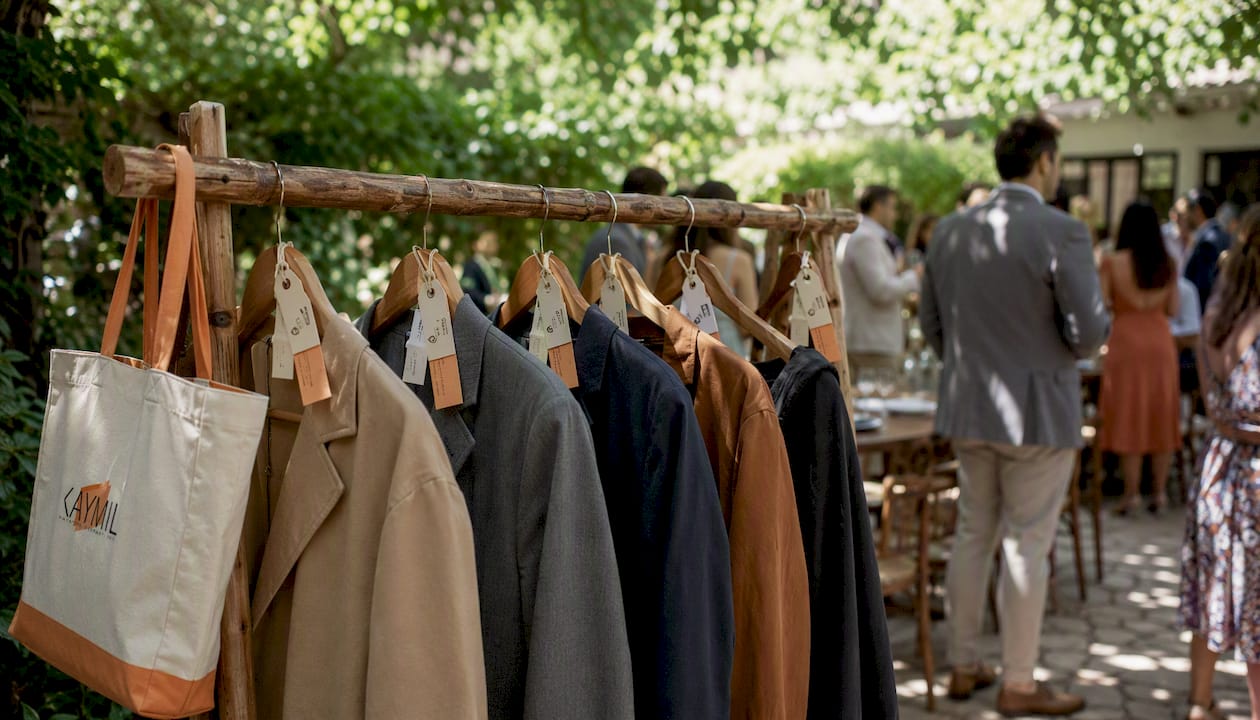
- The hanger stub is attached to the item or looped through the hanger hole.
- The item is stored in numbered sequence on a rack or shelf.
- At retrieval, the guest presents the claim stub; staff matches the number and returns the item.
The 2-part format covers single-item checks cleanly. The 3-part adds a third copy for the operator, which is useful when venues need an internal record for reconciliation, lost-item disputes, or end-of-night audits. Larger venues with multiple storage rooms or multi-department tracking sometimes use 4-part formats, though that level of complexity is rarely needed outside high-volume hospitality operations.
Comparing 2-part, 3-part, and 4-part coat check formats

| Format | Typical material | Security features | Pack sizes | Customization options | Lead time |
|---|---|---|---|---|---|
| 2-part | 67# Vellum Bristol or 110lb Index | Sequential numbering, hang hole, perforation | 500 / 1,000 | Color, logo, custom number start | Stock: 1–2 days; Custom: 5+ business days |
| 3-part | 67# Vellum Bristol or 110lb Index | Sequential numbering, hang hole, disclaimer printing | 500 / 1,000 | Color, logo, disclaimer text, barcode | Stock: 1–2 days; Custom: 5+ business days |
| 4-part | Heavier card stock or carbonless | Sequential numbering, carbonless copies, barcode option | 500+ (custom minimums apply) | Full custom: logo, color, barcode, carbonless | Custom only: 10+ business days |
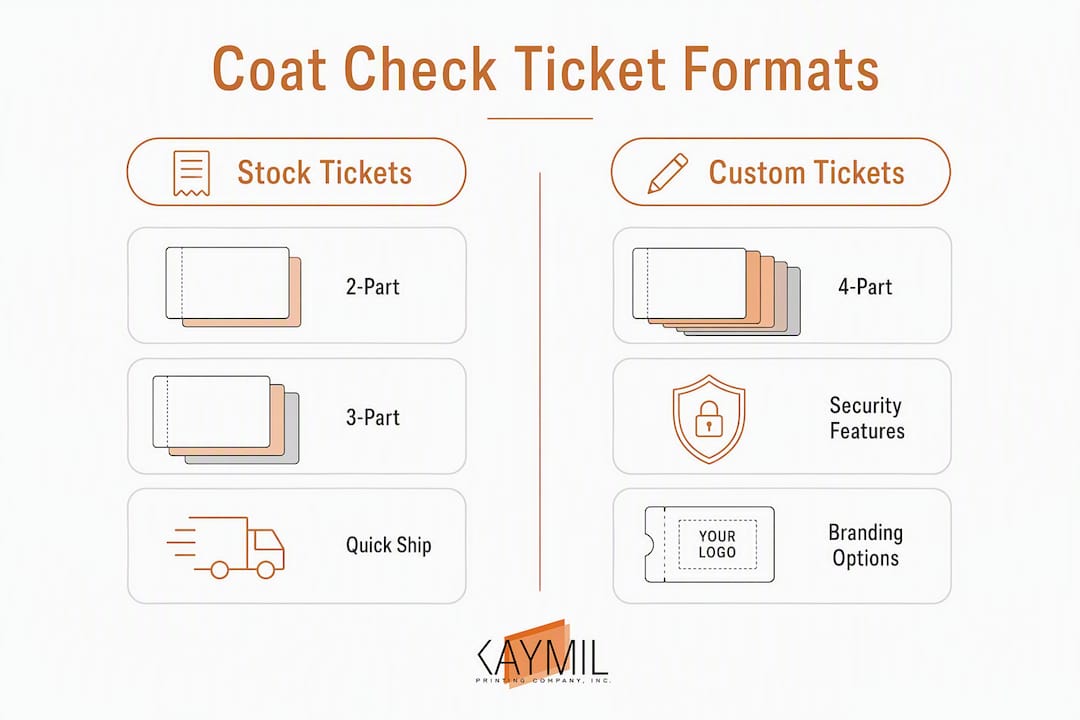
2-part tickets suit small events, private coat closets, and any operation where a single item per guest is the norm. They are the most affordable per-unit option and are widely available in stock.
3-part tickets are the format most mid-to-large venues rely on. The third copy gives operators a paper trail without adding meaningful cost. Many retail product listings also include a printed liability disclaimer on each ticket, which is a low-cost legal safeguard worth keeping in your print proof.
4-part tickets make sense when a venue needs detailed accounting copies, multi-department distribution, or carbonless duplication for internal auditing. The added cost and longer lead time are justified only when that paper trail has a clear operational purpose.
What materials and print specs should you confirm before ordering?
Paper weight determines how well a ticket survives a busy coat room. The industry standard is 67# Vellum Bristol, a card-weight stock that resists tearing and holds up through repeated handling. Heavier 110lb Index stock is common for single-part or custom-printed tickets where durability is a priority.
Before placing any order, confirm these specs against the product page:
- Paper weight: 67# Vellum Bristol minimum for multi-part; 110lb Index for single-part or premium custom
- Dimensions: A common stock size is 2.5" x 3.25"; larger formats (1-5/8" x 5-1/4") suit venues that need more writing space
- Hang hole: A 3/8" punched hole is standard, allowing the stub to loop over a hanger or hook without tearing
- Perforation: Clean, consistent perforations reduce tear-off errors at the counter during high-traffic moments
- Numbering: Large, readable sequential numbers on both parts; confirm the starting number if ordering a continuation run
- Ink and color: Confirm color accuracy against a printed proof, not a screen preview
- Disclaimer text: Verify that any liability language fits within the printed area and is legible at the ticket’s size
Consulting Caymil’s ticket material options guide is a practical step when you are deciding between paper weights or finishes for a custom run.
Which security features actually reduce lost-item risk?
Sequential numbering is the single most effective security feature for most coat check operations. When every ticket carries a unique, pre-printed number, staff can locate items by number sequence rather than searching by description, and any gap in the number run flags a potential discrepancy.
Beyond numbering, consider these features based on your venue’s volume and workflow:
- Barcodes and QR codes: Worth the added cost for high-throughput venues where staff scan tickets rather than read numbers manually. Caymil’s barcode ticket capabilities extend to coat check formats, enabling scanning at drop-off and retrieval.
- Carbonless multi-part copies: Automatically produce an internal record without a separate logging step, useful for venues that need an audit trail.
- Hang hole placement: A correctly positioned hole keeps the stub visible on the hanger throughout storage, reducing retrieval errors.
- Readable large-format numbers: Product specs commonly list large numbering as a deliberate design choice; at a busy counter, a number that is easy to read at a glance cuts retrieval time noticeably.
Pro Tip: Pair sequential numbering with a simple paper log at the counter. Record the number range issued each hour. If a lost-ticket dispute arises, you can cross-reference the log against remaining stubs and close the gap quickly without holding up the line.
How do you choose the right ticket quantity, color, and customization level?
Start with attendance. A rough rule: plan for 60–80% of expected guests at formal events (galas, award dinners, theater performances) and 30–50% at casual events (cocktail parties, trade shows). Round up to the nearest pack size (500 or 1,000) and keep a reserve.
Color strategy matters more than most buyers anticipate:
- Assign a different ticket color to each coat room or storage zone.
- Use a second color for a second event day to prevent mix-ups during multi-day conferences.
- Stock colors typically include white, canary, green, salmon, cherry, blue, and manila, giving most venues enough range without custom printing.
On customization, the decision usually comes down to three questions:
- Do you need a logo or branded design? If yes, custom printing is required.
- Do you need barcodes or QR codes? Custom print run with barcode capability.
- Do you need a specific disclaimer or legal language? Confirm it fits the ticket dimensions in a proof before approving.
Custom orders typically carry minimums that affect per-unit cost. Stock tickets in packs of 500 or 1,000 offer the lowest per-unit price and the fastest availability. For a one-time event, stock is almost always the right call unless branding is a firm requirement.
What should you expect for ordering lead times and shipping?
| Order type | Typical lead time | Shipping options | Notes |
|---|---|---|---|
| Stock tickets | Same day to 2 business days | Standard and expedited | Most common colors and pack sizes ship immediately |
| Custom print | 5 business days (standard) | Standard and expedited | Includes proof review stage |
| Expedited custom | 3–5 business days | Expedited shipping | Confirm availability at time of order |
Stock tickets are the right choice when an event is within two weeks and branding is not a requirement. Custom print runs require a proof review stage, which adds at least one business day to the timeline. Build in time for proof approval, especially if multiple departments need to sign off on the design.
Caymil’s 1,000-count stock coat check tickets ship fast and cover most single-event volume needs without a custom minimum.
When does a digital or hybrid coat check system make sense?
Paper tickets remain the right choice for the majority of venues: low setup cost, no hardware dependency, and no training curve for staff or guests. For high-volume operations, though, digital and hybrid options address the main failure mode of paper systems: queue congestion caused by lost tickets and slow manual reconciliation.
Hybrid systems, such as barcoded paper tickets paired with a scanner, preserve the familiar paper workflow while enabling fast digital reconciliation. Some QR-based platforms report drop-off times under 10 seconds per guest and work alongside existing numbering processes without requiring new hardware.
Fully digital systems replace the physical ticket with an SMS message or mobile wallet pass. These platforms can capture guest contact details at check-in, support pre-pay and tipping integrations, and convert coat check from a cost center into a marketing data asset.
- Choose paper when your venue is low-tech, your budget is tight, or your guests skew older and prefer a physical stub.
- Choose barcoded paper when you need speed and auditability but want to keep the paper workflow intact.
- Choose fully digital when throughput is very high, lost-ticket disputes are a recurring problem, or you want to capture guest data.
Pro Tip: Pilot a hybrid system at a single event before committing to a full rollout. Run barcoded paper tickets alongside your existing process, measure retrieval speed, and assess staff comfort before investing in scanning hardware or software subscriptions.
What are the best operational practices for running coat check at events?
A well-run coat check operation depends on process consistency as much as ticket quality. Follow this sequence at every station:
- Greet the guest and take the item.
- Tear the ticket cleanly at the perforation; hand the claim stub to the guest immediately.
- Loop or attach the hanger stub to the item before setting it down.
- Hang or store the item in strict numerical order.
- At retrieval, take the claim stub, locate the item by number, confirm the match visually, and return the item.
Station layout affects throughput significantly. Position drop-off and pickup at separate windows or sides of the counter when volume allows. Keep a ticket rack organized in numerical runs so staff can locate items without scanning the entire rack.
For lost tickets, establish a clear protocol before the event opens. A reasonable approach: ask the guest for a description of the item, check the number range from the log, and hold the item until the end of the event if the description cannot be confirmed. A printed disclaimer on the ticket supports this process legally.
Pro Tip: Brief staff on a two-sentence script for lost-ticket situations: “We’ll hold your item securely. Please see the manager at the end of the event with a photo ID.” This keeps the line moving and sets clear expectations without confrontation.
Why Caymil is a reliable source for coat check tickets
Caymil has manufactured and supplied ticketing products since 1937, giving procurement teams a supplier with deep production experience across stock and custom formats. For coat check specifically, Caymil offers:
- Stock coat check tickets in common pack sizes (500 / 1,000) with fast nationwide shipping
- Multi-part formats (2-part, 3-part, and custom multi-copy) with sequential numbering standard
- Barcode and QR code printing capability for venues moving toward hybrid systems
- Custom color, logo, and disclaimer printing with proof review before production
- Compatibility with common venue workflows and coat rack hardware (hang hole standard on all formats)
For small events, Caymil’s stock 2-part tickets ship quickly and require no minimum beyond the standard pack. For larger venues or branded operations, custom 3-part tickets with sequential numbering and a printed disclaimer cover the full operational and legal checklist.
Browse Caymil’s coat check ticket options to confirm current pack sizes, specs, and pricing before placing your order.
Key Takeaways
Stock 2-part or 3-part sequentially numbered coat check tickets cover most event needs; choose custom printing only when branding, barcodes, or specific legal language are required.
| Point | Details |
|---|---|
| Format selection | Use 2-part for simple single-item checks; use 3-part when an operator copy for recordkeeping is needed. |
| Pack sizes | Standard packs of 500 or 1,000 cover most single-event volumes; order 1,000 for larger events. |
| Security standard | Sequential numbering on both parts is the core security feature; add barcodes only when scanning is part of your workflow. |
| Lead time planning | Stock tickets ship in 1–2 business days; custom print runs require 5 business days plus proof review. |
| Caymil recommendation | Caymil supplies stock and custom coat check tickets with sequential numbering, barcode capability, and fast nationwide shipping. |
A supplier’s perspective on what buyers get wrong
Most ordering mistakes happen at the proof stage, or because buyers skip it entirely. The sequential number range is the detail that causes the most friction: if you are ordering a continuation run and the starting number is wrong, you end up with duplicate numbers across events, which defeats the entire purpose of the system. Always confirm the starting number in writing before approving a proof.
Hang hole placement is the second most common issue. A hole that is punched too close to the edge tears under the weight of a heavy coat. Standard placement is centered at the top with enough margin to hold cleanly on a wire hanger. Request that your proof explicitly shows the hole position relative to the ticket edge, not just the printed design.
One suggestion that only a manufacturer typically gives: if you are adding a liability disclaimer, treat it as a required print element, not an afterthought. Confirm it is legible at the ticket’s actual printed size, not just on screen. A disclaimer that is too small to read provides no practical protection and no operational value.
Order coat check tickets from Caymil
Caymil gives procurement teams a direct path from spec to delivery, with stock tickets available for immediate shipment and custom print runs backed by decades of manufacturing experience. For a small event, the stock 2-part or 3-part options ship fast with no custom minimum. For a branded venue operation, Caymil’s custom printing covers sequential numbering, barcodes, logos, and disclaimer text, all confirmed through a production proof before the run begins.
Browse current stock options and custom configurations on the coat check ticket product page, or contact Caymil directly for a quote on bulk or custom orders. Procurement teams with specific volume or turnaround requirements can also explore the full Caymil ticket product catalog to confirm compatibility with existing venue workflows before ordering.
Useful sources and supplier pages
Use these pages to validate specs, compare formats, and place orders:
- Caymil coat check tickets: stock and custom options — primary product page with pack sizes, numbering, and customization details
- Caymil 1,000-count stock coat check tickets — large-pack stock option with fast shipping
- Caymil barcode ticket capabilities — relevant for venues adding scanning to their coat check workflow
Cross-check paper weight, part count, sequential numbering, and hang hole dimensions on any supplier’s product page before finalizing your order.
FAQ
What is a coat check ticket?
A coat check ticket is a sequentially numbered multi-part claim ticket used to match a patron to a stored item at a venue. One part goes to the guest as a claim stub; the other stays with the item for retrieval.
How do coat check tickets work?
Staff attach the hanger stub to the stored item and hand the matching claim stub to the guest. At pickup, the guest presents the stub, staff match the number, and return the item.
Do you have to pay for a coat check?
Coat check fees vary by venue. Some venues charge a per-item fee (typically $1–$5), while others offer the service complimentary as part of the guest experience.
Do coat checks still exist?
Yes. Coat check services remain standard at theaters, hotels, restaurants, galas, and event venues across the United States, particularly during fall and winter seasons.
What is the best ticket format for a small event?
A stock 2-part sequentially numbered ticket on 67# Vellum Bristol or 110lb Index stock covers most small-event needs and ships within 1–2 business days without a custom minimum.