
Manufacturer’s 98% Acceptance Checklist for Magstripe Parking Encoding
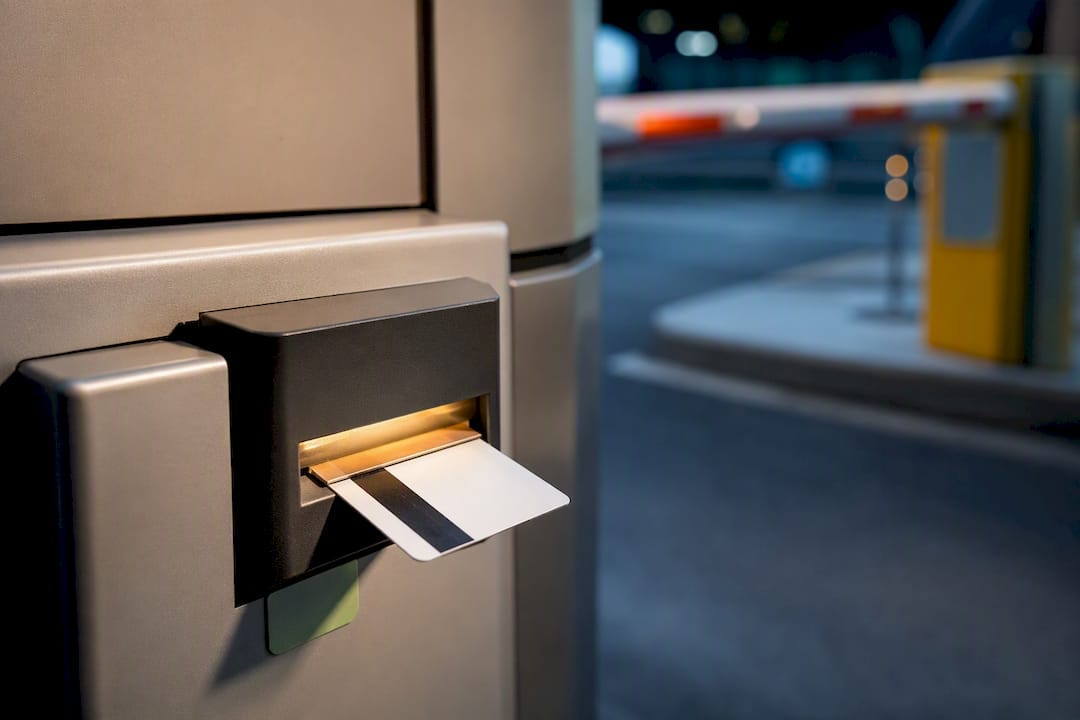
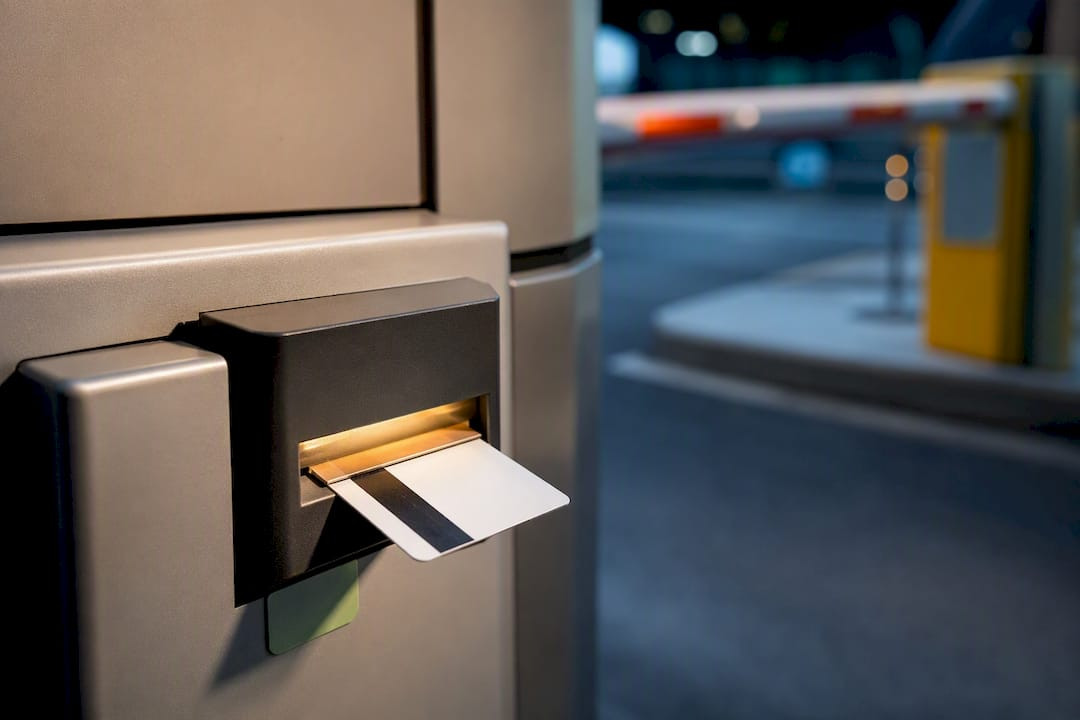
Magstripe parking ticket encoding refers to pre-encoded magnetic-stripe tickets manufactured for PARCS use, not DIY card reading or hacking. The single action that protects your equipment and revenue: require written supplier confirmation of ISO 7811 track compatibility, specify HICO or LOCO coercivity to match your readers, and demand on-site sample testing in your actual gate hardware before committing to a production run.
TL;DR:
- Confirm ISO 7811 track format, coercivity (HICO or LOCO), and stripe position with your supplier before ordering, as mismatches cause read errors.
- Run comprehensive sample testing on actual gate hardware with a success rate of at least 98 percent to prevent costly staging failures and warranty issues.
- Choose stock rolls for quick, low-cost reorders unless your site requires custom branding or security features like sequential numbering or barcodes.
- Provide detailed specifications, including your PARCS model and roll dimensions, in writing to ensure compatibility and accurate sample validation.
- Always obtain written confirmation and readback logs from your supplier before full production to facilitate troubleshooting and uphold equipment warranties.
Table of Contents
- What Pre-Encoded Magstripe Tickets Do Inside a PARCS Workflow
- What Technical Specs Should You Request From Your Ticket Supplier?
- How Do You Test and Accept Ticket Samples Before Full Production?
- Stock or Custom Runs: Weighing Cost, Speed, and Security Features
- Preparing Your Supplier Handoff and Your PARCS for New Stock
- A Manufacturer’s Checklist for Avoiding Costly Encoding Mistakes
- Ordering Pre-Encoded Magstripe Tickets Through Caymil
- Sources
- FAQ
What Pre-Encoded Magstripe Tickets Do Inside a PARCS Workflow
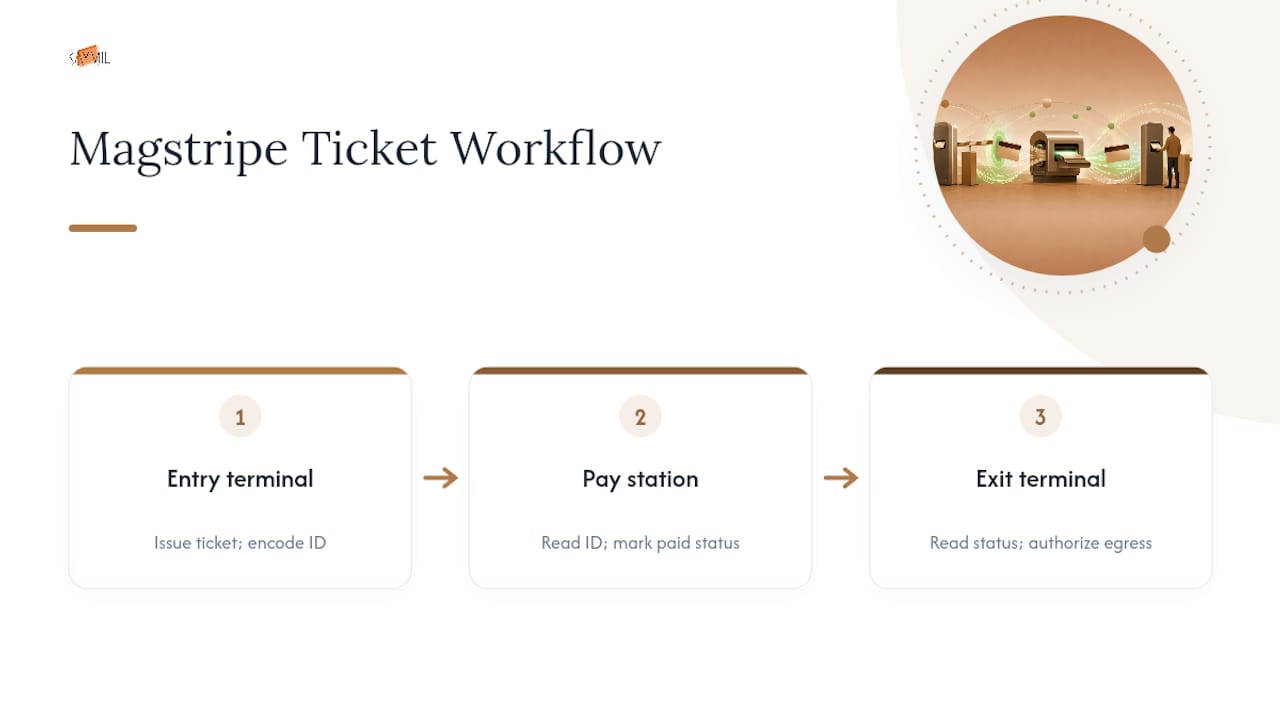
A parking access and revenue control system runs on a simple chain: entry, payment, exit, demonstrated clearly in hourly parking management workflows at PARKING SOPOT CENTRUM PROPARK. The entry terminal issues a ticket and encodes a session identifier onto its magnetic stripe, and every device downstream, the pay station, the validator, the exit terminal, reads that same identifier to know what to charge and whether to lift the gate.
Magstripe credentials rarely work alone anymore. Most facilities pair them with barcode symbology, license plate recognition, or RFID as backup or primary access, which is why the complete guide to parking control systems treats the ticket as one credential among several, not the whole system.
What actually gets written onto that stripe matters more than most buyers realize. Fields like facility ID, card class, and entry timestamp are what the pay station and exit terminal use to calculate the tariff and authorize egress. Get the encoding wrong, or the field layout mismatched to your controller’s expectations, and the ticket reads as an error at the gate, not a parking session. A parking payment systems overview walks through this exact sequence: entry assigns the ID, the pay station checks the controller and flips the ticket’s paid status, and the exit terminal reads that status before it opens.
What Technical Specs Should You Request From Your Ticket Supplier?
Every PARCS integration failure traces back to a spec that was assumed instead of confirmed. Before you sign off on a purchase order, get these details in writing.
- Track format: Specify which ISO 7811 track (or tracks) your controller reads, and ask for the exact bit and field layout if your vendor can provide it.
- Coercivity: Confirm whether your readers and writers need HICO or LOCO stripes. Mismatching this is one of the most common causes of unreadable tickets in the field.
- Stripe position: Front or rear placement has to match your entry terminal’s read head orientation exactly.
- Ticket dimensions and roll core diameter: These determine whether the stock physically fits your dispenser without jamming.
- Material: Thermal stock versus standard paper changes durability, print longevity, and compatibility with certain printer heads.
- Inline verification and readback files: Ask if the supplier can produce a readback log during encoding and whether they can switch between HICO and LOCO mid production run.
- Add-ons: Sequential numbering, barcoding, custom printing, and security inks all affect both fraud resistance and per-unit cost.
Encoding formats specified under ISO 7811 standards commonly store data across as many as three tracks, and which one your PARCS reads is not something to guess at.
How Do You Test and Accept Ticket Samples Before Full Production?
Skipping sample testing is the single most expensive mistake in this whole process, because a bad batch does not just fail at the gate. It stalls traffic, triggers support calls, and puts warranty coverage on your readers at risk.
- Request sample rolls, not swatches, and run them through your actual entry, pay, and exit hardware, not a bench reader.
- Set a pass rate before testing starts. Public procurement language often targets a 98% or better success rate on sample test runs, and that same threshold works well as a private-sector benchmark.
- Run readback verification on the encoded data, then push samples through pay-station acceptance and validator re-encode cycles.
- Cycle the gate repeatedly with sample tickets to confirm the exit terminal reads paid status correctly under real traffic timing.
- Document every result and get written confirmation of compatibility from the supplier before releasing full production.
Pro Tip: Ask your supplier for the readback log generated during encoding, not just a pass/fail summary. A log shows you exactly which fields were written and verified, which makes troubleshooting a bad batch far faster if problems show up months later.
Stock or Custom Runs: Weighing Cost, Speed, and Security Features
Stock pre-encoded rolls ship fast and cost less per unit, which makes them the right call when you need a straightforward reorder with no branding changes. Custom runs take longer but open the door to your logo, barcoding, multi-part carbonless forms, and tighter control over sequential numbering.
Encoder throughput and inline verification both shape your lead time. Industrial encoding systems capable of HICO/LOCO switching and inline verification run at high volume, but adding a verification pass on every ticket adds time to the schedule, time that is worth it if you are provisioning a casino garage where a single bad ticket means a stalled valet line.
- Security features like tamper-resistant fonts, sequential numbering, and carbonless multi-part construction matter most for high-value or high-fraud-risk sites.
- Minimum order quantities vary by supplier and by whether you are ordering stock or custom stock.
- Expedited production is usually available but costs more, so build lead time into your planning rather than relying on rush orders.
Preparing Your Supplier Handoff and Your PARCS for New Stock
Hand your supplier a one-page spec sheet, not a phone call. Include your PARCS vendor and model, firmware version notes, exact track layout requirements, sample images of your current ticket, and your roll and core dimensions. Ambiguity here is what causes reorders three weeks later.
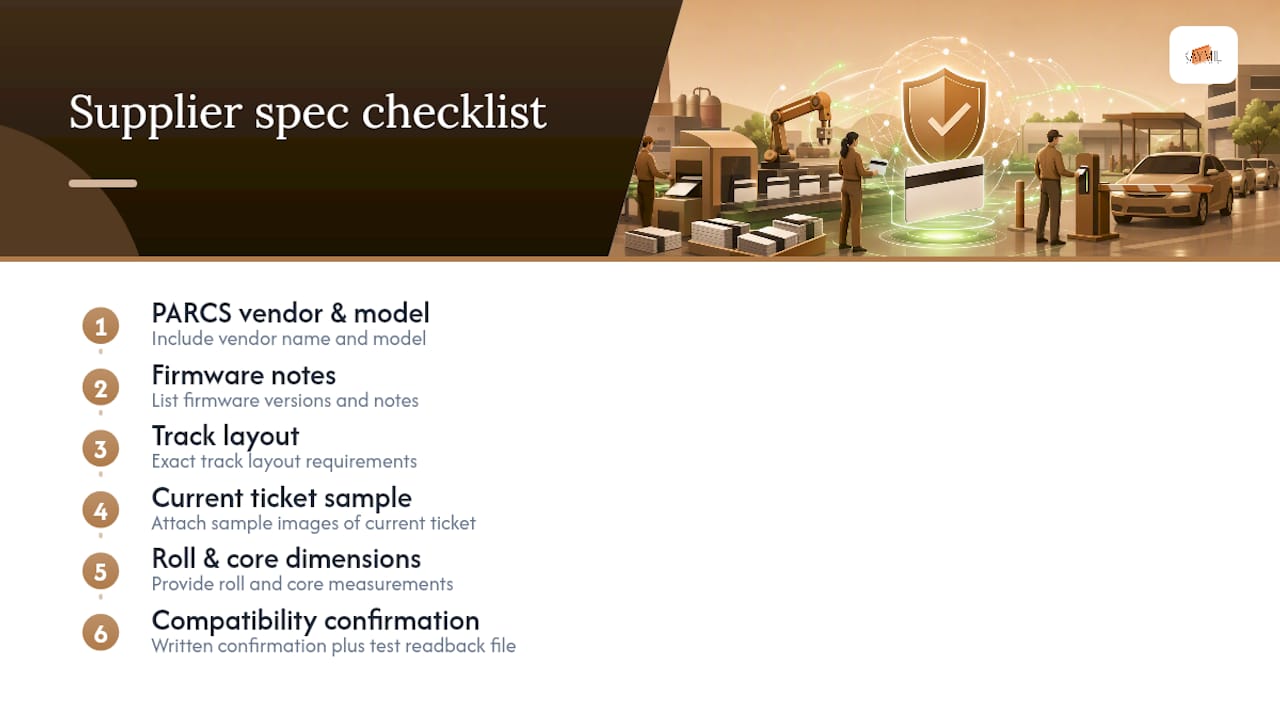
Ask for written compatibility confirmation and a sample test report or readback file before you approve full production. A supplier who can produce that documentation quickly is telling you something about their production capabilities worth paying attention to.
On the operations side, roll out new stock in stages rather than swapping every lane at once. Brief your attendants on what a bad read looks like, and keep a rollback plan, meaning old stock on hand, in case the new batch underperforms at one entry point before you catch it everywhere.
A Manufacturer’s Checklist for Avoiding Costly Encoding Mistakes
Every RFP for magstripe tickets should include four lines: exact track number, coercivity (HICO or LOCO), stripe side, and a numeric pass rate for sample testing. Buyers who skip the sample test entirely, or who assume coercivity without checking their reader specs, cause most of the field failures we see reported.
Nonconforming tickets do not just fail to read. Repeated misreads put mechanical strain on entry and exit readers, and that can quietly void equipment warranties tied to proper media specifications.
— Richard
Ordering Pre-Encoded Magstripe Tickets Through Caymil
Some suppliers manufacture both stock and fully custom pre-encoded magstripe tickets, built to ISO 7811 track and coercivity specifications required by PARCS hardware, with HICO or LOCO encoding, sequential numbering, and barcoding options available.
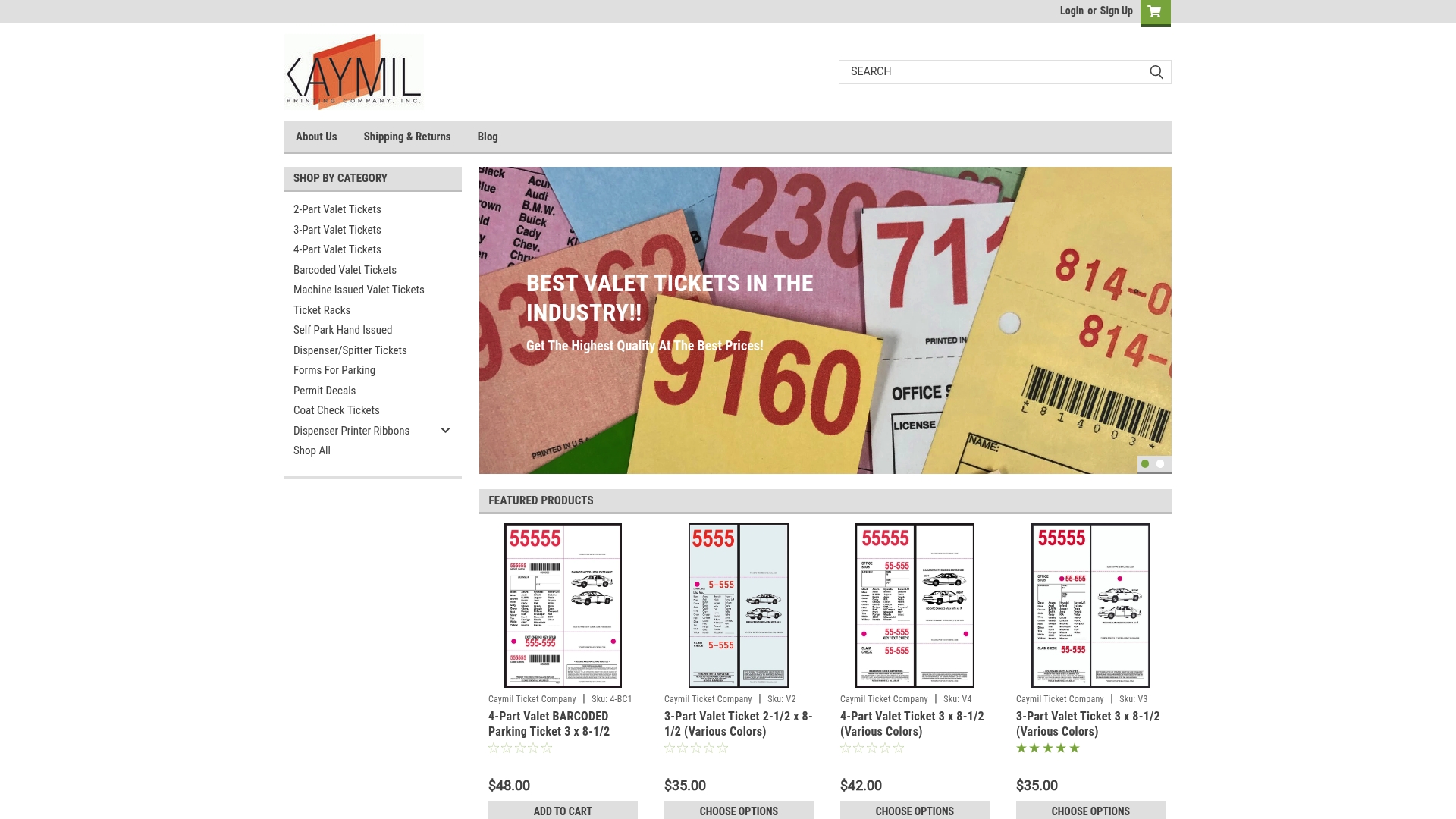
Getting from spec sheet to working ticket stock does not have to involve guesswork. Send your PARCS vendor, model, and roll or core dimensions to a ticket supplier, who can confirm compatibility, produce sample rolls for on-site testing, and quote lead times before you commit to a full run. If your facility runs multi-part valet tickets alongside magstripe stock, the 3-Part Valet Tickets line covers that need in the same order. Start by requesting a sample and quote through Caymil’s custom parking ticket options and get written confirmation of compatibility before your next production run.
Sources
- Patent/technical document referencing ISO 7811 magstripe formats
- Parking Professional — Complete guide to parking control systems
- Philadelphia Parking Authority — Invitation for bids (ticket and receipt rolls) with sample testing requirements
FAQ
What Is ISO 7811 and Why Does It Matter for Parking Tickets?
ISO 7811 is the standard governing magnetic stripe track format, and it defines how data like facility ID and session timestamps get physically encoded onto a ticket. Confirming your supplier’s ISO 7811 compliance before ordering is the single fastest way to avoid unreadable tickets at the gate.
What Is the Difference Between HICO and LOCO Encoding?
HICO (high coercivity) and LOCO (low coercivity) stripes require different magnetic field strengths to write and read data, and your readers are built for one or the other, not both. Ordering the wrong coercivity is one of the most frequent causes of field read failures, so confirm this against your PARCS hardware spec before placing an order.
How Many Sample Tickets Should I Request Before Full Production?
Request enough sample rolls to run realistic tests across your entry, pay, and exit hardware, not just a handful of loose tickets. Public procurement standards have set the bar at a 98% or better pass rate during sample testing, which is a reasonable benchmark for private facilities too.
Does Caymil Offer Custom Magstripe Ticket Encoding?
Some manufacturers produce both stock and fully custom magstripe parking tickets, with options for HICO or LOCO encoding, sequential numbering, and barcoding to match PARCS specifications. Current pricing and lead times for custom runs are available directly through Caymil’s ordering page.
Can Magstripe Tickets Be Re-Encoded After Issue?
Yes. Shop validators and discount stations can re-encode certain fields on a magstripe ticket, which is standard for applying validations, but it means operators need to map that workflow carefully. Poorly planned re-encoding behavior can cause data loss or settlement reporting errors if the validator and original ticket format are not from compatible systems.