

Parking Managers: Shop Ready Mirror Hang Tag Sizes From a Manufacturer

Most suppliers sell mirror hang tags in five finished sizes: 2.75"×4.75" for standard daily permits, 3.5"×8.5" or 3.75"×8.5" for valet and tall-format tags, 4.25"×11" and 5.5"×11.75" for high-visibility event parking, and 8.5"×11.5" as the large-format ceiling. Pick 2.75"×4.75" for routine dealership or lot use, move up to the 3.5" or 3.75" widths for valet operations that need room for a claim number, and reserve the largest formats for multi-day events where visibility from a distance matters more than pocket-size convenience.
TL;DR:
- Most standard mirror hang tags are 2.75"×4.75" for daily permits or dealership use, with larger formats like 3.5"×8.5" for valet and multi-day events.
- Attaching tags with a punch hole or die-cut hook depends on mirror type and intended use, requiring compatibility checks before ordering.
- Plastic materials (.020" gauge) are best for long-term tags, while coated paper suits short-term or single-event needs; climate impacts material choice.
- Standard sizing is flexible since regulations are local or industry-based, making template review and proofing essential to avoid costly reprints.
- Accurate attachment style, reading distance, and information fields determine the optimal tag size, not just industry average dimensions.
Table of Contents
- What Are the Standard Mirror Hang Tag Sizes?
- Hang Tag Dimensions: Hooks, Bleed, and Sheet Layouts
- How Do I Choose the Right Hang Tag Size?
- Which Materials Hold Up Best for Hang Tags?
- What Does It Cost to Order Custom Hang Tags?
- Caymil’s Templates and Production Support
- Environmental Durability: Weather Resistance and UV Coating
- Are There Standards for Parking Hang Tags?
- Do Hang Tags Fit Every Mirror Type?
- Why Most Size Guides Miss the Real Decision
- Order Production-Ready Mirror Hang Tags From Caymil
- Sources
- FAQ
What Are the Standard Mirror Hang Tag Sizes?
Buyers rarely need a custom die when a stock size already fits the job. The industry has settled on a small handful of finished dimensions, each based on how much information a tag needs to carry and how far away someone has to read it.
- Mini (approximately 3"×2.875"): Used for basic identification, such as employee or resident parking, where only a number or short code needs to display.
- Standard (2.75"×4.75"): The most common finished size for daily parking permits and dealership plates, offering enough room for a logo, dates, and a permit number without crowding the mirror.
- Tall/valet (3.5"×8.5" or 3.75"×8.5"): Popular for valet claim tags and dealership loaner tags because the extra length accommodates a tear-off stub or a larger barcode.
- Large/event (4.25"×11" and 5.5"×11.75"): Built for construction sites, hospital campuses, and multi-day events where a tag has to be readable from 10 to 15 feet, often by a security guard scanning a lot from a golf cart.
- 1-up sheet size (8.5"×11.5"): The largest common format, typically used when a single tag needs to carry extensive text, such as terms and conditions or multiple date ranges for an event pass.
Orientation matters as much as size. Portrait layouts work best for tags read at close range through a windshield, while landscape layouts suit tags meant to be spotted quickly from a passing vehicle or a lot attendant’s station. If a tag needs to carry a barcode alongside printed text, the larger formats, 4.25"×11" and up, give the scanner more surface area and reduce misreads, a detail that matters more than most buyers expect until a barcode fails at the gate.
Hang Tag Dimensions: Hooks, Bleed, and Sheet Layouts
Getting the finished size right is only half the job. The hole, slit, or die-cut hook determines whether the tag actually stays on the mirror, and the artwork setup determines whether the print comes out clean.
- Choose the attachment style first. A round punched hole (commonly 3/8" to 1/2" diameter) works for simple string or elastic loops, while a die-cut hook slot suits tags meant to slide directly over a mirror stem without any extra hardware.
- Set bleed at 1/8" on every side. This keeps background color or artwork from showing a white edge after the tag is trimmed to its finished die line.
- Keep text and barcodes inside a safety margin, generally 1/4" from any cut edge, so nothing critical gets clipped during finishing.
- Confirm the sheet layout before sending files. Standard production runs use 8.5"×11" sheets in 1-up, 2-up, or 4-up configurations depending on the finished tag size, and production estimators typically display these safety and bleed zones directly in the proofing tool.
- Request a vector template or press-ready PDF rather than designing from scratch, since a template already accounts for the die line, hole placement, and bleed.
Pro Tip: Ask your printer whether their die-cut hook matches both older circular mirror stems and the flatter integrated mirror housings on newer vehicles. A hook cut for one style can leave the tag dangling loosely on the other.
How Do I Choose the Right Hang Tag Size?
The right size comes down to four questions, and skipping any one of them tends to produce a tag that either wastes money or fails at the point of use.
- How far away does this tag need to be read? A tag checked at arm’s length by a driver needs far less real estate than one scanned by a security officer walking a row of cars.
- What fields must appear on the tag? A logo, date range, permit number, and barcode together need more surface area than a single ID number.
- What kind of vehicle mirror will hold it? Compact sedans, trucks, and SUVs have different mirror stem widths and housing shapes, which affects how a large tag hangs and whether it swings into the driver’s sightline.
- How will the tag attach? A hole-and-string setup tolerates a slightly larger tag than a rigid die-cut hook, which needs a cleaner fit to avoid slipping off.
A few common scenarios illustrate the trade-offs. A parking garage issuing daily resident passes usually does best with the 2.75"×4.75" standard size, since drivers glance at it briefly and don’t need much text. A valet operation handing out claim tags benefits from the 3.5"×8.5" tall format, which leaves room for a tear-off stub and a bold claim number readers can find fast. A multi-day construction site or festival, where a tag has to survive several days on the mirror and be spotted from a distance, calls for the 4.25"×11" or larger event formats. Going bigger always costs more per unit and risks partially blocking the driver’s view, so match the size to the actual reading distance rather than defaulting to the largest option out of caution.
Which Materials Hold Up Best for Hang Tags?
Material choice affects how long a tag survives on a mirror and how much it costs per unit, and the right pick depends entirely on how long the tag needs to last.
- Uncoated cardstock: The most economical option for single-visit or short-term use, such as a one-day event pass that gets discarded after checkout.
- Coated cardstock with UV coating: Adds a layer of scuff and moisture resistance, suitable for week-long event runs or seasonal parking permits.
- Plastic, typically .015" to .020" gauge: A common choice for standard permit hang tags, offering enough rigidity to survive glovebox storage and repeated mirror use; .020" deluxe plastic is a frequently listed thickness for standard permit tags.
- Heavier plastic, .030" to .040" gauge: Reserved for multi-season or annual permits expected to survive a full year of temperature swings and handling.
- Reinforced rings or grommets around the hole: Extend the life of any material by preventing the hole from tearing after repeated removal and reattachment.
What Does It Cost to Order Custom Hang Tags?
Minimum order quantities and unit pricing shift depending on substrate and print process. Digital full-color printing generally allows smaller minimum runs than screen printing or foil stamping, since digital presses don’t require the same setup investment. Standard plastic permit tags, for example, commonly ship with minimums around 125 units on a 4-color process.
- Sequential numbering and barcoding add setup cost but make audit trails and revenue tracking far easier for parking operators managing high volume.
- Custom die-cut hooks cost more than a stock punched hole because they require a dedicated die, though the fit improvement is often worth it for valet and dealership programs.
- Spot color runs are cheaper than full 4-color process printing but limit design flexibility, a reasonable trade for simple ID tags.
- Turnaround time shortens considerably when artwork arrives preflight-ready, using an existing stock template rather than a fully custom layout that needs a new die and proofing round.
Caymil’s Templates and Production Support
Caymil has manufactured parking, valet, and hospitality ticketing products since 1937, and that history shows up in the level of detail available to buyers before they ever place an order.
- Caymil’s blog walks through the five decisions that fix parking hang tag design, covering sizing, hole placement, and artwork setup for facility managers.
- Technical guidance on Flash Parking ticket media specs explains how barcode placement and substrate choice affect scan reliability for system-integrated lots.
- Buyers can request preflight review before a job goes to press, catching bleed or safety-margin errors before they become a reprint.
- Anyone unsure whether to go stock or fully custom can contact Caymil directly for sample tags and layout recommendations before committing to a production run.
Environmental Durability: Weather Resistance and UV Coating
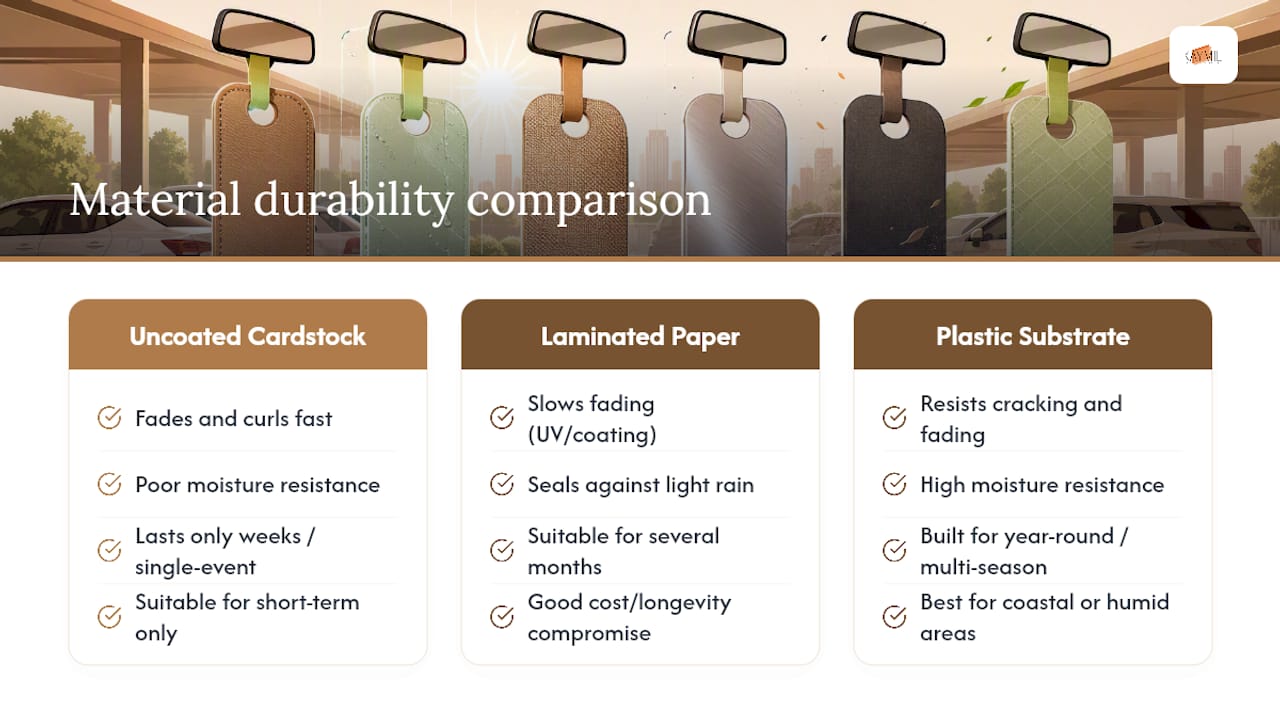
A hang tag baking on a dashboard through a Phoenix summer faces a different challenge than one hanging in a parking garage in Seattle, and material choice needs to reflect that. Uncoated cardstock fades and curls fast under direct sun exposure, often within a matter of weeks, which makes it a poor fit for any permit expected to last more than a single event.
UV coating slows fading and adds a light moisture barrier, extending a paper tag’s usable life for seasonal programs running several months. For year-round or multi-season permits, plastic substrates outperform paper by a wide margin, resisting cracking, fading, and moisture damage far longer under the same conditions.
Lamination offers a middle ground for buyers who want paper’s lower cost without paper’s short lifespan, sealing the print against light rain and routine handling. Parking operators in coastal or high-humidity climates should lean toward plastic or laminated stock regardless of how long the permit is meant to last, since moisture damage tends to show up faster than sun fading in those environments. Matching material to climate, not just to budget, prevents the common mistake of reordering tags twice in one season because the first batch degraded faster than expected.
Are There Standards for Parking Hang Tags?
No federal regulation dictates a specific finished size or hole diameter for mirror hang tags. Requirements that do exist tend to come from state or municipal disability parking programs, which set their own specifications for placards distinct from the general-purpose permit tags dealerships and parking operators use.
Because no universal standard governs commercial hang tag dimensions, the sizes described throughout this guide function as industry norms rather than mandated specifications. That gives buyers real flexibility, but it also means the responsibility for choosing a compatible, legible format falls entirely on the operator. Municipalities running metered or permit parking programs sometimes set their own local rules for what a valid permit must display, so it’s worth checking local ordinances before finalizing artwork, particularly for ADA-related placards or municipally issued residential permits, where a mismatched format can render a tag unenforceable at the point of ticketing.
Do Hang Tags Fit Every Mirror Type?
Attachment compatibility depends more on the mirror stem and housing than on the vehicle’s make or model. Older vehicles typically use a thin, circular mirror stem that accepts a simple die-cut hook slot or a hole-and-string loop without issue. Many newer vehicles integrate the mirror housing into a bulkier assembly that includes cameras or sensors, which can change how much clearance a hang tag has before it brushes against the windshield or dash.
Elastic bands and adjustable straps solve most fit problems across both styles, since they stretch to accommodate a range of stem thicknesses rather than relying on an exact hook measurement. A basic string loop works fine for short-term tags but can slip loose on rougher roads, which is why permanent or multi-day permits often benefit from a reinforced hole with a grommet.
Buyers ordering for a mixed fleet, one that includes both older sedans and newer SUVs, should test a sample tag on a few vehicle types before committing to a full print run. A hook cut too tightly for a thick modern mirror stem will either refuse to hang properly or damage the tag on installation, and that’s a cheap problem to catch early and an expensive one to discover after 5,000 tags arrive.

Why Most Size Guides Miss the Real Decision
Most advice on hang tag sizing treats the finished dimension as the whole story, when the real decision point is almost always the reading distance and the attachment method, not the size chart itself. A 2.75"×4.75" tag and an 8.5"×11.5" tag can carry the exact same information; the difference is whether that information needs to be read by the driver at arm’s length or by a security officer from across a lot.
The conventional advice to “just pick a standard size” also glosses over how much the hole or hook style affects real-world performance. A tag can be perfectly sized and still fail if the hook doesn’t match the mirror stem it’s meant to hang from, something that only shows up after a batch is already printed. Buyers should settle attachment compatibility before finalizing dimensions, not after.
If there’s one priority worth putting ahead of everything else, it’s requesting a template or proof before committing to a full print run. The gap between a spec sheet and an actual finished tag in hand is where most reorders and wasted budget come from, and it’s the cheapest problem in this entire process to avoid.
— Richard
Order Production-Ready Mirror Hang Tags From Caymil
Some manufacturers produce mirror hang tags to exact sizes, hole specs, and materials suited to parking operators’ needs, often backed by long-term ticketing production experience. Whether you’re outfitting a dealership lot, a valet stand, or a multi-day event, Caymil’s catalog covers the finished sizes and attachment styles this guide walks through, with stock and custom options ready to match your system.
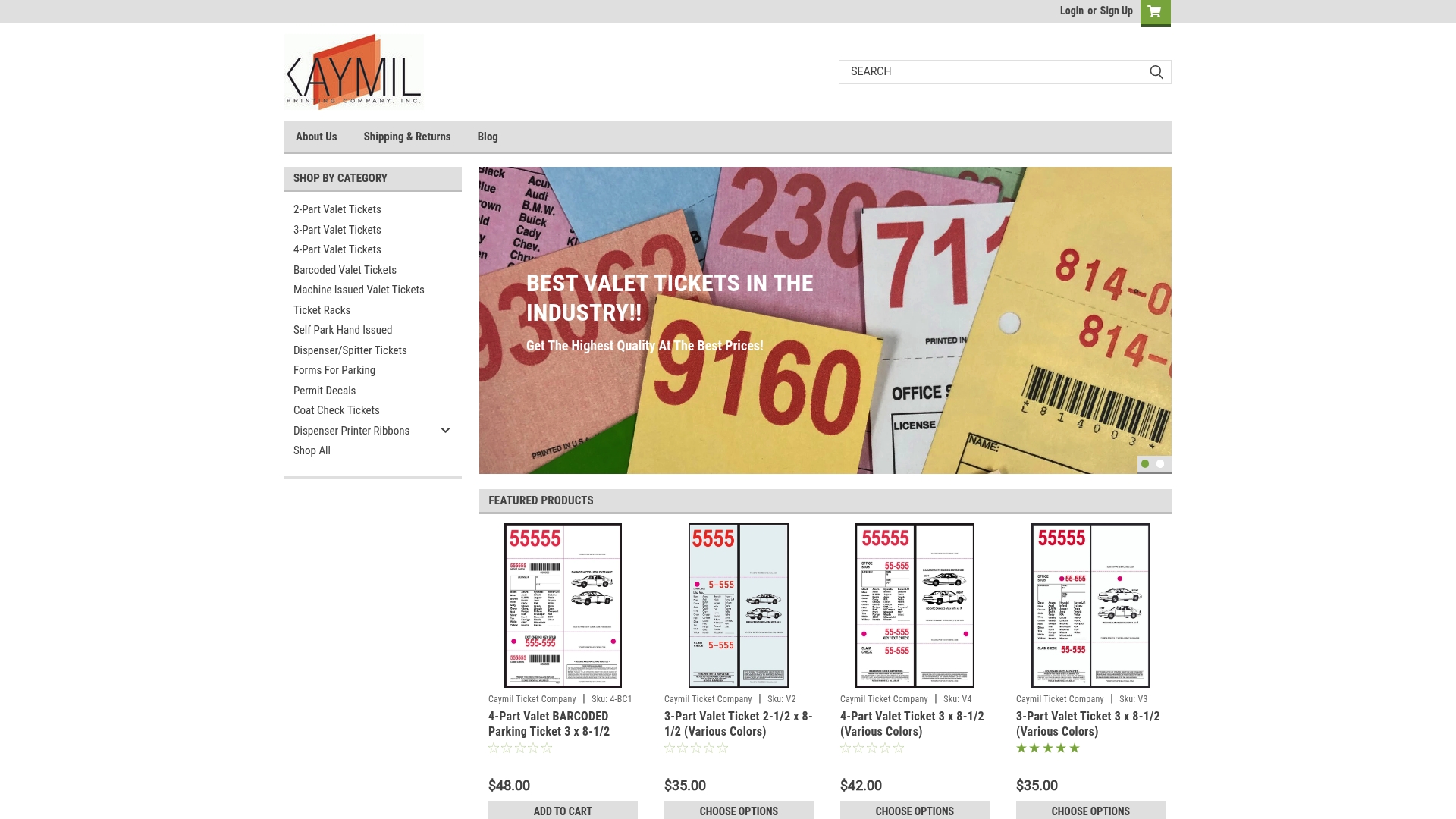
Valet operators handling claim tags alongside tickets can pair mirror hang tags with Caymil’s 2-Part Valet Tickets for a complete front-desk workflow, while operations needing tear-off stubs or sequential tracking should look at the Barcoded Valet Tickets line. Buyers managing high-volume programs that also require decals as a backup identification method can review Parking Permit Decals as a complementary product. Ready to move forward? Request a template or spec sheet through Caymil’s site and get a production-ready proof before committing to a full print run.
Sources
FAQ
What Size Should a Mirror Hang Tag Be?
Most mirror hang tags measure 2.75"×4.75" for standard use, which fits a logo, permit number, and dates without crowding the mirror. Valet and dealership programs often step up to 3.5"×8.5" or 3.75"×8.5" for extra text or a tear-off stub.
What Are the Standard Dimensions for Hang Tags?
The most common finished dimensions are 2.75"×4.75" for daily permits, 3.5"×8.5" or 3.75"×8.5" for valet and tall formats, and 4.25"×11" up to 8.5"×11.5" for large-format event and high-visibility tags. Mini tags around 3"×2.875" cover simple identification needs.
What Hole or Hook Size Do Mirror Hang Tags Use?
Punched holes typically run 3/8" to 1/2" in diameter for string or elastic loops, while die-cut hook slots are custom sized to slide over a mirror stem without additional hardware. The right choice depends on whether the tag needs to hang loosely or attach securely for multi-day use.
How Thick Should Hang Tag Material Be?
Plastic hang tags commonly use .020" gauge for standard permits, with thicker plastic reserved for annual or multi-season programs, as seen in common .020" deluxe plastic permit specs. Paper and cardstock options work fine for short-term or single-event tags where longevity matters less than cost.
Does Caymil Offer Custom Mirror Hang Tag Sizes?
Yes, Caymil produces both stock and fully custom mirror hang tags, including sequential numbering, barcoding, and custom die-cut hooks to match specific parking systems. Current pricing and size options are available directly on the Caymil site.