
Standard Parking Ticket Dimensions: Sizes and Specs Guide
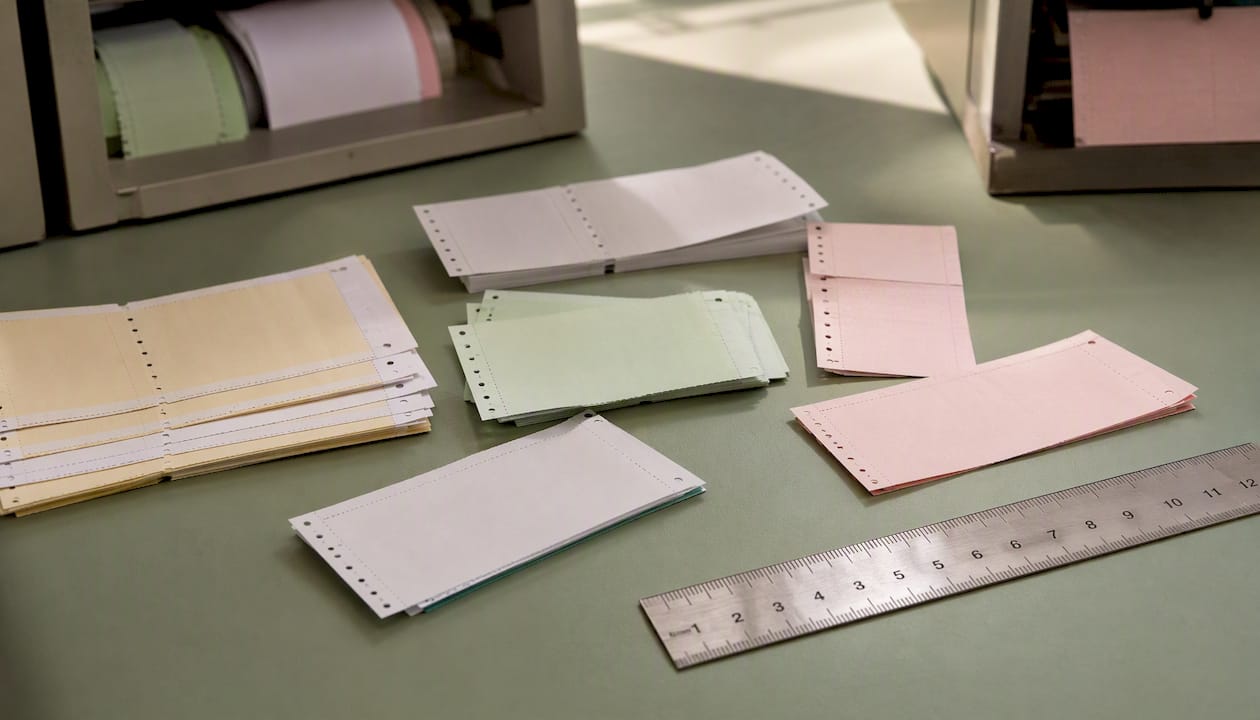
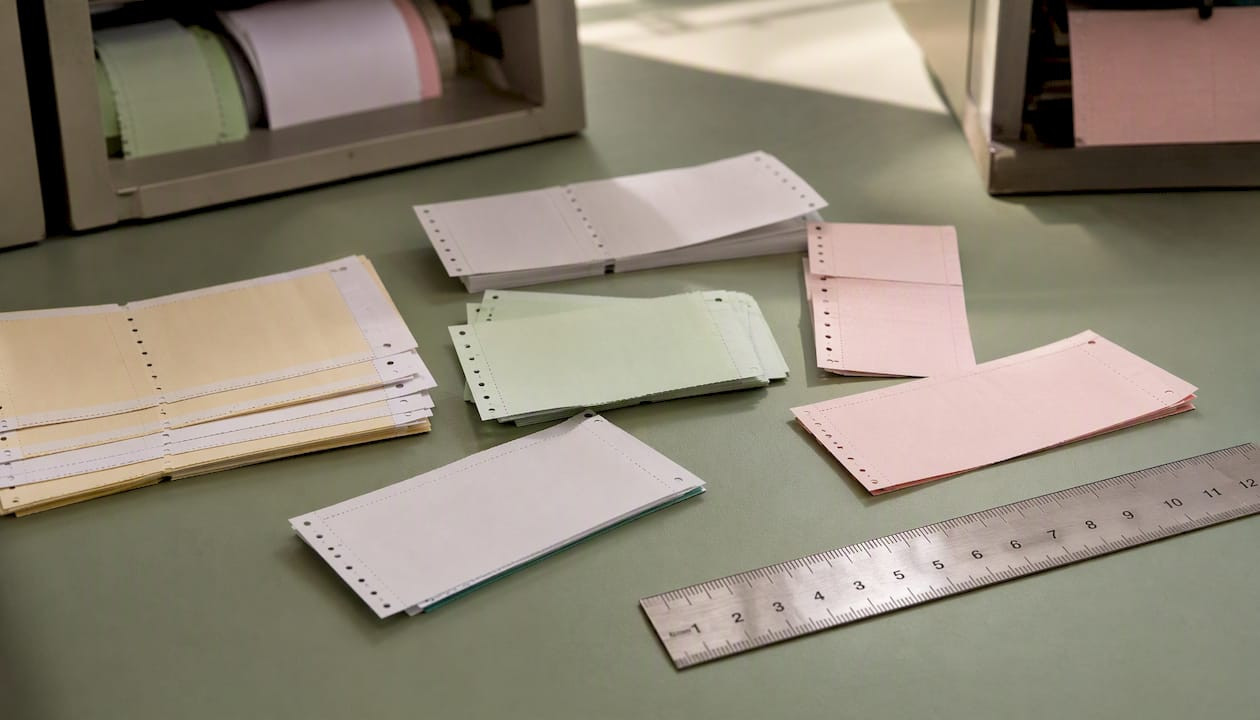
The most common parking ticket dimensions used by U.S. operators are 4" × 8", 4" × 6", 3.5" × 5.5", and 3" × 5" for hand-issued book and pad formats. Machine blanks run narrower: 2.125" × 3.375" for center-feed spitter systems and 2.5" × 6" for longer dispenser formats. For a general-purpose multipart violation or valet ticket that fits most pad-style dispensers and book workflows, a multipage form measuring approximately 4.25" × 8.5" with a 0.5" top binding stub covers the widest range of operational needs. Caymil stocks and custom-prints all of these sizes with sequential numbering, barcoding, and carbonless multipart options ready to ship nationwide.
Common stock sizes at a glance:
- 4" × 8" (101.6mm × 203.2mm): standard book-style cardstock violation ticket
- 4.25" × 8.5" with 0.5" stub: municipal-grade multipart form, three or more parts
- 4" × 6" (101.6mm × 152.4mm): compact valet receipt or validation stub
- 3.5" × 5.5" (88.9mm × 139.7mm): mid-size valet or event ticket
- 3" × 5" (76.2mm × 127mm): postcard-size receipt-style citation slip
- 2.125" × 3.375": center-feed machine blank (spitter/kiosk)
- 2.5" × 6": longer dispenser blank for booth or gate systems
Key Takeaways
Standard parking ticket dimensions range from 3" × 5" receipt slips to 4.25" × 8.5" multipart municipal forms, and matching the correct size to your dispenser feed direction and part count is the single most important step before placing an order.
| Point | Details |
|---|---|
| Most common stock sizes | 4" × 8" and 4.25" × 8.5" cover the majority of book-style violation and valet ticket needs. |
| Machine blank dimensions | Center-feed spitter systems typically use 2.125" × 3.375"; booth dispensers often use 2.5" × 6". |
| Bleed and safe area | Add 0.125" bleed on all sides; keep text and barcodes at least 0.125" inside the trim line. |
| Multipart stub allowance | Reserve a 0.5" binding stub across the top of any multipart book form before designing content. |
| Lead time planning | Stock sizes ship in 1–2 business days; custom multipart carbonless jobs typically need 10 business days. |
| Caymil ordering | Caymil stocks and custom-prints all standard sizes with preflight support and nationwide shipping. |
Table of Contents
- What are the standard parking ticket dimensions operators use?
- Which ticket format fits your dispenser or printer?
- What materials and security features should you specify?
- How do you prepare print-ready artwork for parking tickets?
- What should you expect for lead times, minimums, and pricing?
- How Caymil covers every size and spec in this guide
- A manufacturer’s perspective on what buyers get wrong
- Ready to order the right ticket for your operation?
- Sources
- FAQ
What are the standard parking ticket dimensions operators use?
Parking ticket sizes in the U.S. are not governed by a single federal standard. Sizes vary by jurisdiction, dispenser type, and whether the ticket is hand-issued or machine-generated. That said, the industry has converged on a short list of practical dimensions that work across most workflows.
The 4" × 8" format is the workhorse of book-style violation tickets. Brady’s cardstock parking ticket (8 in H × 4 in W) confirms this as a widely stocked size. It provides enough surface area for violation codes, officer badge numbers, vehicle descriptions, and a signature line without becoming unwieldy to tuck under a windshield wiper.
Multipage book formats typically measure approximately 4.25" × 8.5" with a 0.5" binding stub across the top, leaving a usable print area of 4.25" × 8". This matches the municipal specification that New York’s regulations describe for multipart ticket packets of at least three parts. Perforated pad formats often run slightly larger at 4" × 8.5" or 4.5" × 9.25" to accommodate a tear-off stub at the bottom.
Pro Tip: If your operation issues tickets both by hand and through a pad-style dispenser, the 4" × 8" format fits both workflows without a custom die. Operators who need the extra field space for violation codes can step up to 4.25" × 8.5" without changing their dispenser tray.
Which ticket format fits your dispenser or printer?
Format matters as much as size. A ticket printed to the right dimensions on the wrong stock or in the wrong feed orientation will jam a dispenser or fail a barcode scan. Three primary formats cover nearly every U.S. parking operation.
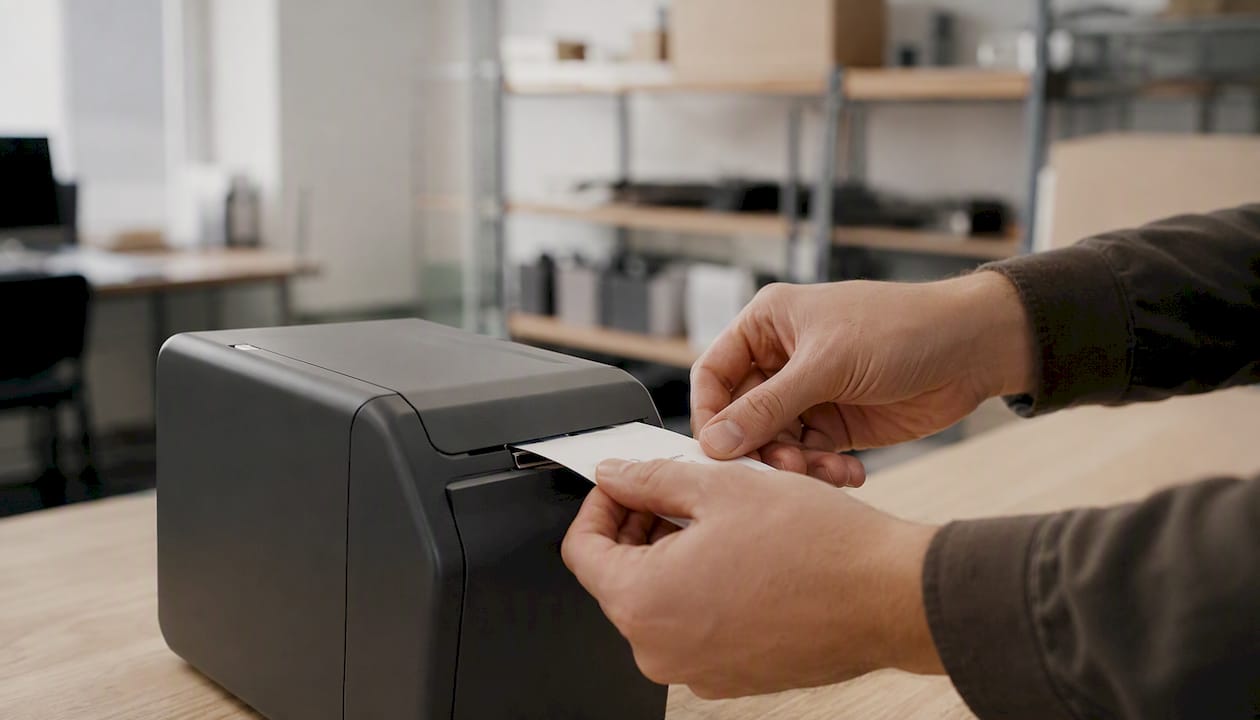
Machine blanks (center-feed / spitter) are the narrowest format, designed to feed through automated dispensers and gate systems. Common widths are 2.125" and 2.5"; lengths vary by the system’s feed path. These are typically single-ply, printed on thermal or bond stock, and ejected one at a time. Systems from Amano, SKIDATA, FAPD, and Secom use machine-blank formats, though exact dimensions differ by model.
Multi-part carbonless books are the standard for hand-issued violation tickets and valet receipts. A 3-part book gives the issuing officer a copy, the vehicle owner a copy, and the agency a file copy. Four-part books add a court or processing copy. These run in the 4" × 8" to 4.25" × 8.5" range and are bound at the top with a 0.5" stub.
Thermal and roll tickets serve automated kiosks, POS-style parking terminals, and handheld ticketwriters. Roll widths are specified in millimeters. A 79mm (≈3.125") roll is a common POS-style parking roll width. Other common widths include 57mm and 80mm depending on the printer model. Caymil’s parking ticket rolls cover custom barcode and automated parking system compatibility.
Before ordering, verify these four parameters for your dispenser:
- Feed direction: Does the ticket feed portrait (narrow edge first) or landscape (wide edge first)?
- Roll width or sheet width: Measure the feed slot in millimeters or inches.
- Core size: For roll tickets, confirm the inner core diameter (typically 0.5" or 1").
- Cutter or perforation placement: Determine whether the machine cuts the ticket or relies on a pre-perforated tear line, and at what distance from the leading edge.
Pro Tip: Handheld ticketwriters used by parking enforcement officers typically accept 2.25" or 2.5" wide rolls. Confirm the model number before ordering — the same officer may carry a unit that uses a different width than the booth printer at the same facility.
What materials and security features should you specify?
Stock selection directly affects how long a ticket survives on a windshield in rain, heat, or direct sun. The wrong paper degrades before the vehicle owner reads it; the right stock holds ink and stays legible through a full enforcement cycle.
Paper categories and weights:
- Cardstock (60–80 lb cover): Durable, holds offset printing well, standard for book-style violation tickets.
- Bond paper (20–24 lb): Lighter, used in multipart carbonless sets where multiple plies must feed cleanly.
- Thermal paper: No ink required; the printer’s heat element creates the image. Suitable for roll-fed kiosks and handheld units. Thermal images can fade with prolonged UV exposure, so outdoor windshield use warrants a UV-resistant thermal grade.
- Carbonless NCR (No Carbon Required): Used in 2-, 3-, and 4-part forms. Each ply is coated so pressure from writing or printing transfers the image without carbon paper.
For outdoor durability, an aqueous coating or UV varnish on the face of a cardstock ticket significantly extends legibility. Caymil’s guidance on parking ticket paper covers the tradeoffs between thermal rolls and sheet stock for operators concerned about longevity.
Security and operational features to specify:
- Sequential numbering: Printed in a fixed location, typically the top-right corner or a dedicated number field. Enables chain-of-custody tracking and prevents duplication.
- Barcodes and QR codes: Placed in a quiet-zone-compliant area (minimum 0.25" clear margin on all sides). Code 128 and QR are the most common formats for parking enforcement.
- Tamper-evident perforations: A perforation pattern that shows visible distortion if the ticket is removed and reattached.
- Microtext and watermarks: Printed in the background to deter counterfeiting; effective on municipal violation tickets.
- Holographic labels: Applied as a separate element for high-security permit or citation applications.
Carbonless multipart forms are the right choice when the operation needs simultaneous copies at the point of issue. Separate receipts work when copies are generated later through a system print queue. For windshield placement in uncovered lots, a UV-coated cardstock or a UV-resistant thermal grade outperforms standard bond in direct sun.
How do you prepare print-ready artwork for parking tickets?
Submitting a print-ready file the first time eliminates the most common source of production delays. These specifications apply to offset and digital printing of sheet-format tickets; roll-format thermal tickets follow the same bleed and safe-area rules but are supplied as a repeating tile at the roll width.
Artwork checklist:
- Final trimmed size: State the finished ticket dimensions in inches (e.g., 4" × 8"). Confirm this matches your dispenser or pad specification before sending files.
- Bleed: Add 0.125" (3mm) on all sides beyond the trim line. Any background color or image that runs to the edge must extend into the bleed zone.
- Safe area: Keep all critical text, barcodes, and numbering at least 0.125"–0.1875" inside the trim line. Elements outside this zone risk being clipped during cutting.
- File format: PDF/X-1a is the preferred format. Supply at 300 dpi minimum, CMYK color mode. Convert all fonts to outlines.
- Sequential numbering: Supply a variable-data file (CSV or delimited text) with the full number sequence, or specify the start and end numbers and the zero-padding format (e.g., 000001–010000). Numbering typically appears in the top-right corner or a dedicated field at 8pt minimum.
- Barcode placement: Position barcodes in a quiet zone with at least 0.25" clear on all sides. Minimum bar height for Code 128 is 0.75". Confirm the symbology (Code 128, QR, Code 39) with your scanning system before finalizing artwork.
- Hole/punch location: If the ticket requires a hole for a hanger or rack, specify the center point in inches from the nearest corner (e.g., 0.375" from top, centered on width).
- Top binding stub: For multipart books, reserve a 0.5" stub across the top. The perforation line sits at the 0.5" mark; all print content falls below it.
- Dielines and registration marks: Supply a separate dieline layer in the PDF for any non-rectangular cuts. Registration marks must fall outside the bleed zone.
- Spot vs. process color: Specify Pantone numbers for spot colors. If the printer converts to CMYK, request a proof before the full run.
- Artwork templates (dielines) are available from Caymil’s preflight team; requesting one before building the file prevents dimension errors.
- For custom logo tickets, supply vector logos (AI or EPS) to avoid pixelation at small sizes.
- Carbonless multipart files require a separate art layer for each ply if the content differs between copies.
What should you expect for lead times, minimums, and pricing?
Planning a ticket order without understanding production timelines leads to operational gaps. Stock sizes ship faster; custom jobs require more runway.
Lead time by job type:
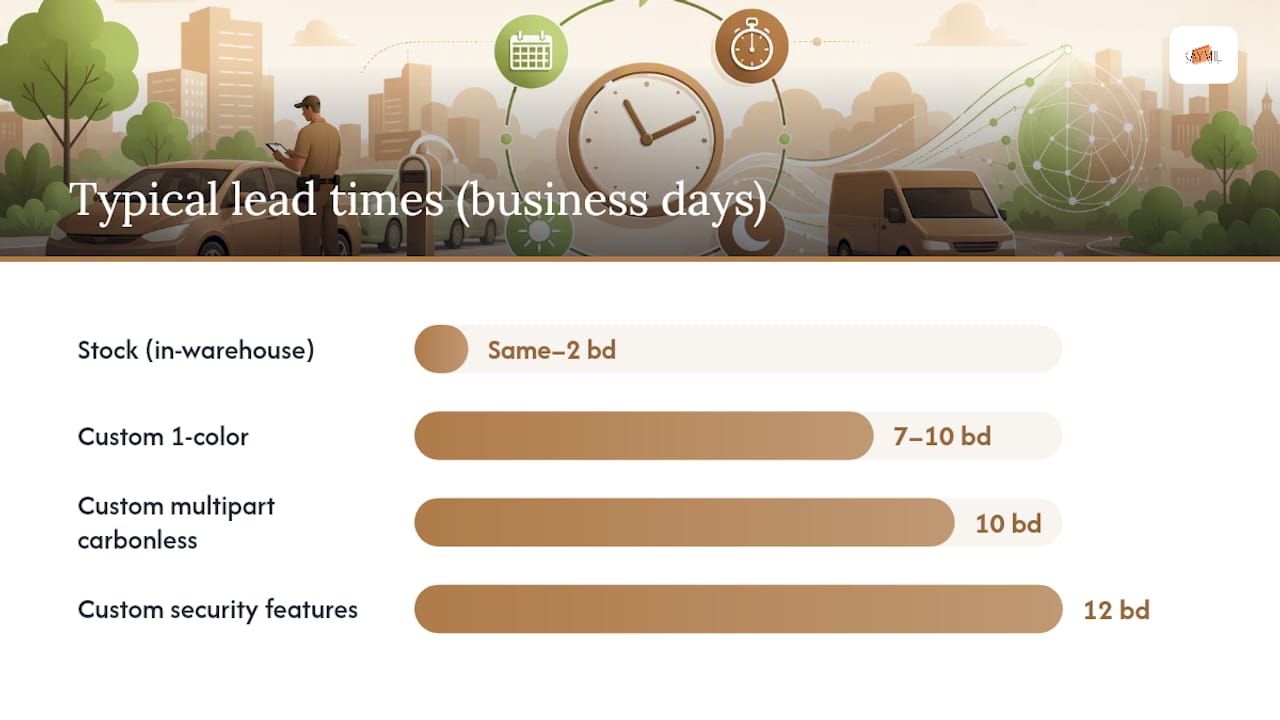
| Job Type | Typical Lead Time |
|---|---|
| Stock size, in-warehouse | Same day to 2 business days |
| Custom size, simple 1-color | 7–10 business days |
| Custom multipart carbonless | 10 business days |
| Custom with security features | 12 business days |
| Rush production (when available) | Add surcharge; confirm availability |
Minimum order quantities vary by format. Roll tickets typically have higher minimums because of setup costs on roll-winding equipment. Custom die-cut jobs and special coatings raise minimums further because the die itself is a fixed cost amortized across the run. For bulk parking ticket orders, larger quantities reduce the per-unit cost significantly.
Primary cost drivers:
- Quantity: The single largest lever. Per-unit cost drops sharply as quantity increases.
- Colors: Each additional ink color adds plate or setup cost. One- and two-color jobs are the most economical.
- Sequential numbering and barcoding: Variable-data printing adds setup time and may require a digital press run.
- Paper stock: Carbonless NCR costs more per ply than bond; thermal stock pricing varies by grade and coating.
- Multipart layers: A 4-part form costs more than a 2-part form in both material and collating time.
- Security features: Microtext, watermarks, and holographic elements each add cost; budget for them explicitly.
- Rush production: Available from some suppliers at a surcharge; not always possible for complex jobs.
A realistic example: a midsize operation ordering 5,000 custom 3-part carbonless violation tickets at 4.25" × 8.5" with sequential numbering and a 2-color print typically needs 10–12 business days from approved artwork to shipment.
How Caymil covers every size and spec in this guide
Caymil has manufactured parking and valet tickets since 1937, giving the company a production depth that covers the full range of formats described here. Caymil’s parking forms include stock and custom options across book-style, multipart carbonless, thermal roll, and machine-issued blank formats.
What Caymil stocks and produces:
- Book-style violation tickets in 4" × 8" and 4.25" × 8.5" with 0.5" binding stubs
- 2-part, 3-part, and 4-part carbonless valet tickets in standard and custom sizes
- Dispenser/spitter tickets compatible with Amano, TIBA, SKIDATA, FLASH Parking, Scheidt & Bachmann, and Flowbird systems
- Barcoded tickets with variable-data sequential numbering and QR or Code 128 symbology
- Thermal roll tickets in 57mm, 79mm, 80mm, and custom widths
- Permit hang tags, validation stubs, and valet receipts in compact formats
Caymil’s production team provides artwork templates, preflight support, and dieline files before the press run, which eliminates the back-and-forth that delays most custom orders. Nationwide shipping and millions of tickets in stock mean most standard orders ship within two business days.
A manufacturer’s perspective on what buyers get wrong
The most common ordering mistake is specifying the ticket size without confirming the feed orientation. A 4" × 8" ticket fed landscape into a dispenser designed for portrait orientation will jam on the first cycle. The second most common error is forgetting the 0.5" binding stub when ordering multipart books, which leaves the top 0.5" of the usable print area blank on the finished ticket.
Barcode quiet zones are the third consistent problem. Operators specify a barcode but place it too close to the ticket edge, and the scanner fails to read it because the quiet zone is clipped during cutting. A 0.25" minimum clear margin on all four sides of a barcode is not optional.
Practical next steps for operators ready to order:
- Measure your dispenser’s feed slot width and length in inches and millimeters.
- Confirm feed direction (portrait or landscape) and whether the machine cuts or relies on a perforation.
- Identify the number of parts needed (2, 3, or 4) and whether carbonless or separate receipts fit your workflow.
- Gather your artwork file or request a template from Caymil’s preflight team.
- Confirm your sequential number range and barcode symbology before submitting the order.
Ready to order the right ticket for your operation?
Caymil makes it straightforward to move from spec to finished ticket. Whether you need stock 4" × 8" violation books shipping this week or a fully custom 3-part carbonless form with sequential numbering and barcoding, the process starts with a single conversation.
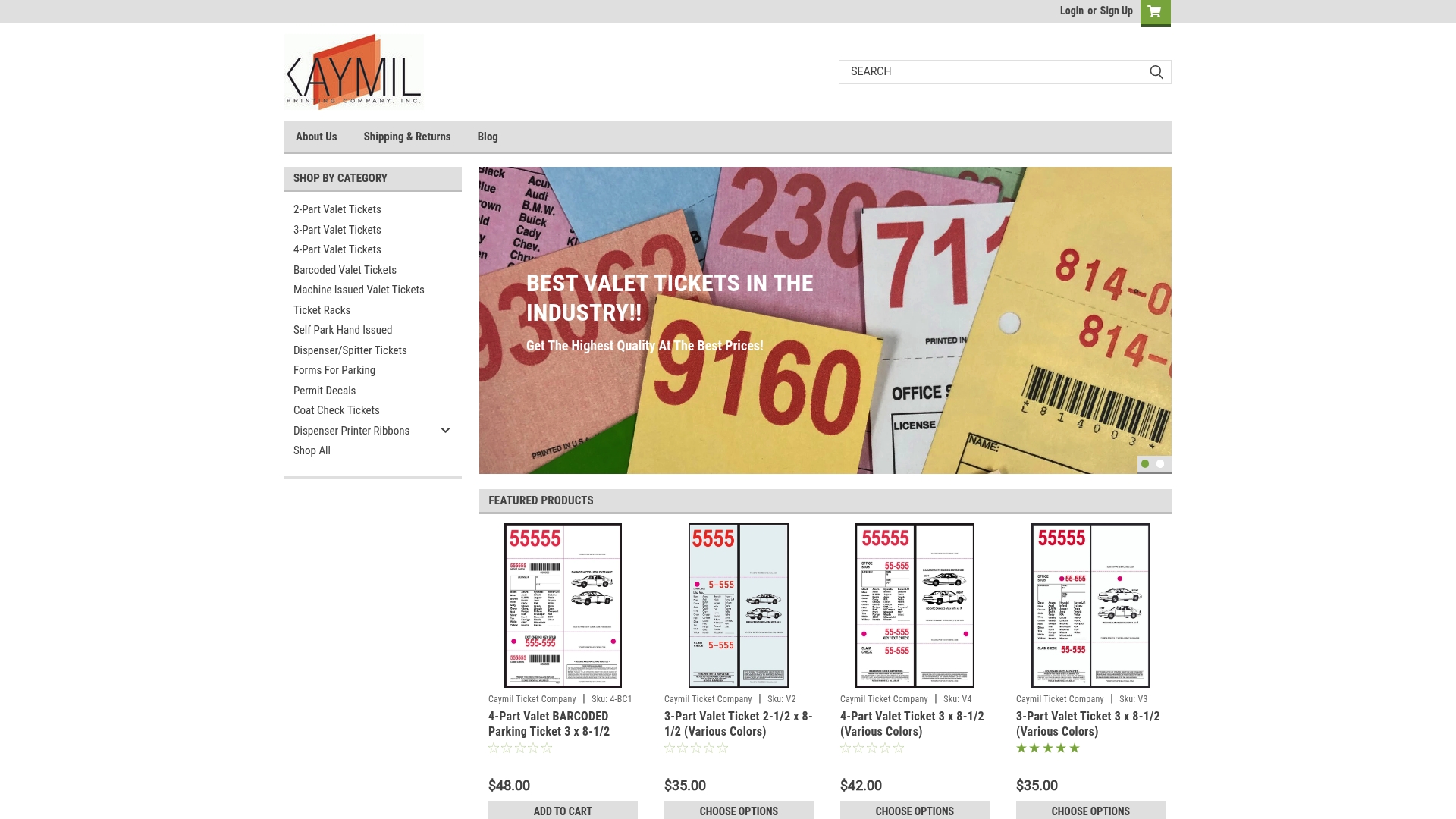
Submit your dispenser model, ticket dimensions, and part count through Caymil’s parking forms ordering page, and the team will confirm compatibility, provide a dieline template if needed, and return a quote. For machine-issued and center-feed formats, the dispenser spitter tickets page lists compatible systems and size options directly. Artwork upload, preflight review, and production scheduling all happen through one point of contact, with nationwide delivery on every order.
Sources
Reference these pages when verifying sizes, downloading templates, or checking regulatory formats:
- View Document - Unofficial New York Codes, Rules and Regulations
- Brady® 103649 Parking Ticket, 8 in H x 4 in W, Black on White, Cardstock
- What Do Parking Tickets Look Like and How Can You Identify Them?
- FED-FEDERAL APD POS, GENERIC, BLANK, HEAVYWEIGHT, ROLL, 79MM X 79.248METERS (3.125" X 260’)
FAQ
What is the standard size for a parking ticket in the U.S.?
There is no single federal standard. The most widely used sizes are 4" × 8" for book-style violation tickets and approximately 4.25" × 8.5" for multipart municipal forms, with machine blanks running as narrow as 2.125" × 3.375" for automated dispensers.
How big is a typical parking citation compared to a postcard?
Many hand-issued parking citations are roughly postcard size, around 3" × 5", though full violation books commonly run 4" × 8" or larger to accommodate all required fields.
What roll width do most parking kiosks and POS printers use?
The most common thermal roll width for POS-style parking printers is 79mm (approximately 3.125"), though 57mm and 80mm rolls are also widely used depending on the printer model.
How many parts does a standard parking ticket book have?
Most parking violation books use 2-part or 3-part carbonless forms. Municipal operations often require at least 3 parts to provide copies for the vehicle owner, the issuing officer, and the agency’s records.
Can Caymil print custom sizes outside the standard dimensions?
Yes. Caymil produces fully custom ticket sizes, part counts, and formats alongside its stock offerings, with preflight support and artwork templates available to confirm dimensions before production begins.