
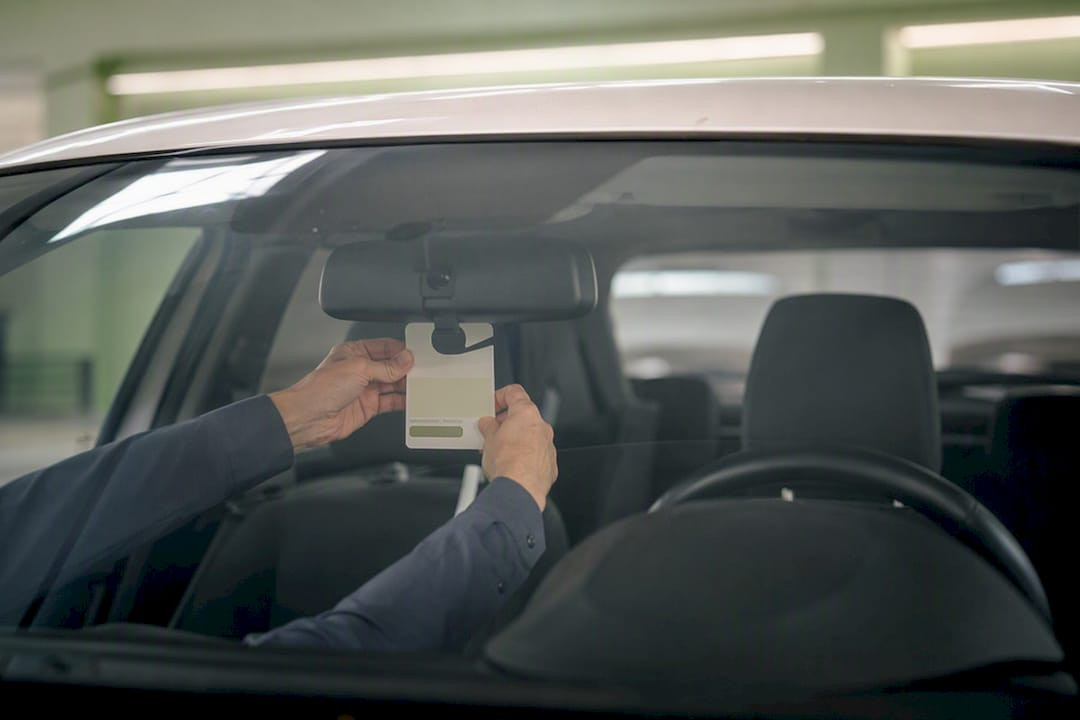
5 Decisions That Fix Parking Hang Tag Design for Facility Managers
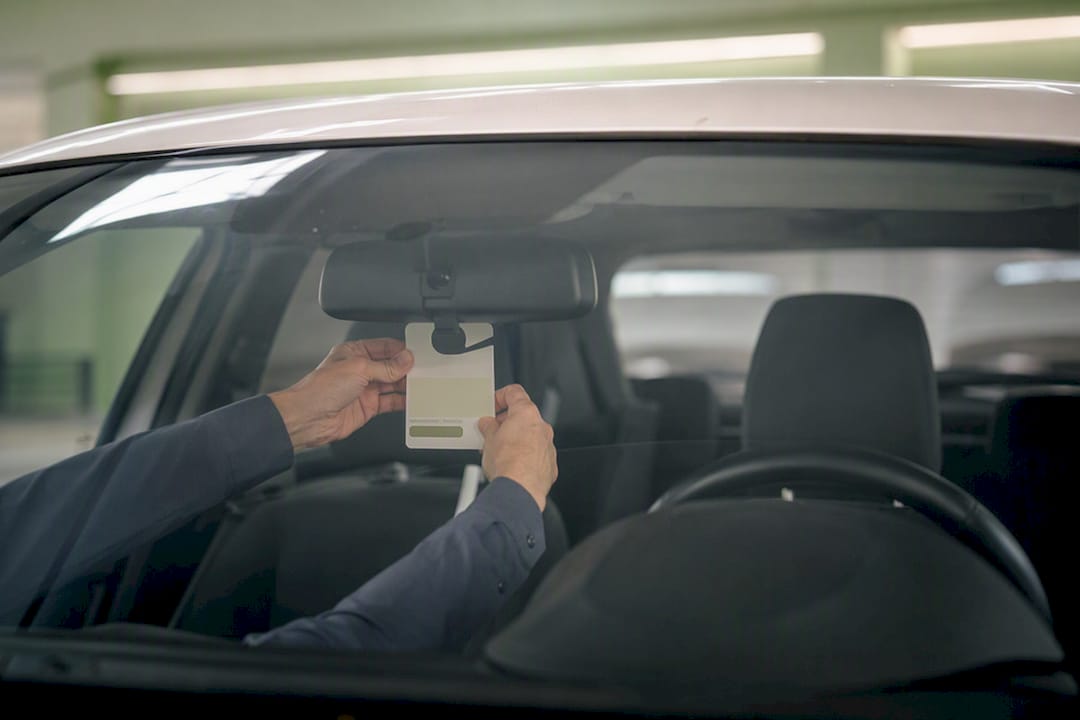
Five decisions determine whether a hang tag program runs smoothly or generates a stream of enforcement disputes: material and thickness, size and shape, the identification method (numbering, barcode, or both), the attachment style, and the lead time and quantity you order. Get those right before artwork goes to production. Caymil qualifies as a supplier that can execute all five, but every manufacturer will need print-ready files and, for variable data, a clean CSV of your numbering or barcode sequence.
TL;DR:
- Using 30 mil polystyrene with UV-stable inks and lamination offers the best durability for multi-year outdoor parking tags.
- Sequential numbering suffices for small lots, but barcodes and unique IDs become necessary for database management or gate system integration.
- Submit artwork as a high-resolution PDF/X in CMYK, with a 0.125-inch bleed and a CSV file for variable data to avoid production delays.
- Ordering a sample or proof before full production is essential to verify color, material, and legibility, preventing costly reprints.
- Caymil can produce compliant hang tags with appropriate materials, variable data, and security features for major access control systems nationwide.
Table of Contents
- Choosing Materials That Survive Real-World Handling
- How Should a Parking Tag Be Designed for Fast Enforcement?
- Do You Need Barcodes, Holograms, or Just Sequential Numbers?
- Matching Tag Shape and Attachment to Your Fleet
- What File Format and Resolution Do Printers Need?
- Planning Lead Time, Quantities, and Budget
- Why Manufacturer Track Record Matters for Hang Tags
- Staying Inside ADA and Local Parking Rules
- Sustainable Material and Ink Choices for Parking Tags
- Designing Tags People With Color Blindness Can Read
- Handling Lost, Damaged, and Replacement Tags
- Getting Sign-Off Before Artwork Goes to Print
- A Working Checklist From the Field
- How Caymil Can Produce the Hang Tags in This Guide
- Sources
- FAQ
Choosing Materials That Survive Real-World Handling
The material decision drives everything else, from cost to how often you reorder. Thin stock might save money upfront, but it fails fast once tags start swinging from mirrors in stop-and-go traffic or getting handled at valet stands.
- 20 mil PVC or polystyrene works well for annual permits and moderate exposure, balancing cost against a one-year lifespan.
- 30 mil polystyrene holds up to daily handling, sun exposure, and temperature swings, making it the standard choice for multi-year employee or resident permits.
- Reflective or UV-stable inks keep colors and numbers legible after months of dashboard heat and sunlight, which matters most in southern climates or open-air garages.
- Lamination adds scratch resistance for tags that get handled during transfers between vehicles or valet stations.
Weatherproof, UV-resistant plastic construction with reinforced attachment points cuts down on the replacement cycle that eats into a facility’s ticketing budget. A tag that fades or cracks within six months costs more over three years than a thicker one bought once.
How Should a Parking Tag Be Designed for Fast Enforcement?
Enforcement officers scan hundreds of vehicles per shift, often at a walking pace or from a slow-moving cart. A design built for enforcement puts identification information where an officer’s eye lands first, not where it looks best on a designer’s mockup.
- Use color bands tied to specific zones or permit types. A blue band for visitor parking and a green band for staff, for instance, lets an officer clear a lot without reading a single number.
- Print ID numbers at a minimum of 1 inch tall in a bold sans-serif font, since anything smaller becomes unreadable through a windshield from outside the vehicle.
- Keep supporting text, like expiration month or building name, large enough for legibility at a few feet.
- Position the logo and facility name at the top, the ID number in the center where it dominates the tag, and the expiration date in a fixed bottom corner every officer learns to check first.
Designing around access control this way, rather than around brand aesthetics, is what actually cuts down on unauthorized parking and speeds up enforcement during daily sweeps.
Pro Tip: Test your final design at 15 feet under parking lot lighting, not on a monitor. Colors and fonts that look sharp on screen often blur together under sodium-vapor lights at night.
Do You Need Barcodes, Holograms, or Just Sequential Numbers?
Not every facility needs the same level of security. A 200-space employee garage with a staffed gate has different exposure than a 3,000-space municipal structure processing thousands of daily transactions.
- Sequential numbering alone is enough for small lots with visual enforcement and low counterfeiting risk.
- Unique alphanumeric IDs or barcodes make sense once you need to cross-reference a tag against a database, revoke lost permits remotely, or integrate with gate hardware.
- Holograms, foil stamping, or UV-reactive ink deter tampering in high-value programs, such as reserved executive parking or paid monthly permits where resale is a real risk.
- Barcode or QR placement should sit flat, away from folds or perforations, so handheld scanners and gate-mounted readers get a clean read on the first pass.
If your facility runs Amano, TIBA, SKIDATA, FLASH Parking, Scheidt & Bachmann, or Flowbird equipment, confirm barcode symbology and placement with your printer before finalizing artwork, since scanner tolerances vary by system.
Matching Tag Shape and Attachment to Your Fleet
Standard hang tags run roughly 3 by 4.5 inches for long vertical mirror tags, the most common format because they stay visible regardless of how a vehicle is parked. Shorter, wider formats around 2.5 by 4 inches fit compact cars and motorcycles where mirror space is limited.
- U-shape mirror slips work for permanent or annual permits that stay in place for months.
- Slits or hook-style perforations suit valet and short-term visitor tags that need quick removal.
- Elastic loops hold up better in high-wind areas where rigid tags can crack at the hanging point.
- Perforated tear-off stubs give temporary passes a built-in expiration mechanism, useful for construction sites or event parking.
Die-cut, custom-shaped tags add tooling cost and lead time compared to standard rectangles, so reserve them for programs where brand recognition genuinely offsets the added expense, like hospitality or resort parking.
What File Format and Resolution Do Printers Need?
Handing off clean, print-ready files is the single fastest way to avoid a delayed order. Vendors work from a short list of technical requirements, and missing any one of them means a proof cycle you didn’t need.
- Submit artwork as PDF/X with all fonts outlined or embedded, in CMYK color mode, since RGB files shift color unpredictably on press.
- Provide images at a minimum of 300 DPI, or at least 1,000 pixels on the shorter side of the finished tag.
- Build in a 0.125 inch bleed beyond the trim line, and keep all text and logos inside a 0.125 inch safe area to avoid getting cut off.
- For variable data, deliver a clean CSV file listing every sequential number, unique ID, or barcode value in the exact order they should print.
- If barcodes are involved, include one sample code in your proof request so the printer and your scanning hardware can confirm compatibility before the full run prints.
Planning Lead Time, Quantities, and Budget
Ordering hang tags is not a same-day purchase, and treating it like one is how facilities end up with expired permits still hanging from mirrors.
- Request a free sample or short proof run before committing to full production. It’s the cheapest insurance against a color, size, or material mismatch discovered after 5,000 units print.
- Quantity breaks matter: unit costs drop meaningfully at higher volumes, but so does flexibility if your numbering plan changes mid-year.
- Specialty finishes (holograms, die cuts, foil stamping) add both cost and days to turnaround, so build them into your timeline early rather than as a rush add-on.
- Store unissued tags in a locked cabinet with an issuance log, since unsecured stacks of numbered permits are a common source of both waste and fraud.
Lost, damaged, and mid-cycle new-hire tags add up faster than most facilities budget for.*
Why Manufacturer Track Record Matters for Hang Tags
A supplier’s production history tells you what to expect when your order hits the queue. Caymil has manufactured parking, valet, and ticketing products since 1937, which covers stock and fully customized hang tags with sequential numbering, barcoding, logos, and security features.
- Product compatibility spans major gate and access systems, including Amano, TIBA, SKIDATA, FLASH Parking, Scheidt & Bachmann, and Flowbird.
- Variable-data jobs run from a submitted CSV, with proofs issued before full production to confirm numbering and barcode accuracy.
- Nationwide shipping from stock inventory shortens turnaround for facilities that need tags fast, not just facilities placing large custom orders.
— Richard
Staying Inside ADA and Local Parking Rules
Hang tag design has to account for accessible parking regulations even though the tags themselves aren’t the primary compliance mechanism. The Americans with Disabilities Act governs accessible parking space design, signage height, and van-accessible aisle widths, but permit hang tags used for general enforcement operate alongside, not instead of, state-issued disability placards and plates.
If your lot includes reserved accessible spaces enforced by facility staff, your hang tag design should include a clearly marked accessible zone code that matches your signage, but the tag itself should never claim to substitute for a legally required placard.
Local parking ordinances add another layer. Many municipalities regulate maximum permit fees, require specific wording for visitor or temporary permits, and mandate that residential permit programs post clear signage explaining enforcement hours. Some cities also require permits to display an expiration date in a fixed, consistent location so parking enforcement officers can verify validity without handling the vehicle.
Before finalizing your design, check with your city’s parking or transportation department for any local labeling requirements, particularly around accessible space enforcement and visitor permit disclosures. A quick call during the design phase avoids a reprint after your first enforcement audit flags a compliance gap.
Sustainable Material and Ink Choices for Parking Tags
Facility managers increasingly field questions from sustainability committees and procurement departments about the environmental footprint of ticketing supplies, and hang tags are a reasonable place to make incremental improvements.

Polystyrene and PVC remain the most durable substrates for outdoor exposure, but both come from petroleum-based plastics that don’t biodegrade. If your program issues large volumes of temporary or event-based tags with short lifespans, consider a lighter-weight, recyclable paperboard or coated stock rather than heavy-duty plastic, since durability matters far less for a tag that expires in a week.
For permanent programs, the sustainability tradeoff runs the other direction. A thicker, longer-lasting plastic tag that survives three years without replacement generates less total waste than three consecutive years of thinner tags that crack and get reordered annually. Total cost of ownership and environmental footprint often point to the same answer: buy once, buy durable, for anything issued for a full year or longer.
Ink choice matters too. UV-cured inks used for outdoor durability tend to produce fewer volatile organic compound emissions during printing compared to older solvent-based inks, though exact formulations vary by printer. If sustainability reporting matters to your organization, ask your vendor directly about ink composition and whether recycled-content substrates are available for your material and thickness requirements. Not every printer offers recycled stock in the mil thickness needed for outdoor durability, so confirm availability before specifying it in a request for quote.
Designing Tags People With Color Blindness Can Read
Color-coded zone systems are one of the most effective enforcement tools available, but they fail completely for the roughly 8% of men and a much smaller share of women who have some form of color vision deficiency. A red-versus-green zone system, the most common color-blind confusion pair, can render two entirely different permit types visually identical to a colorblind enforcement officer or a facility employee checking a windshield.
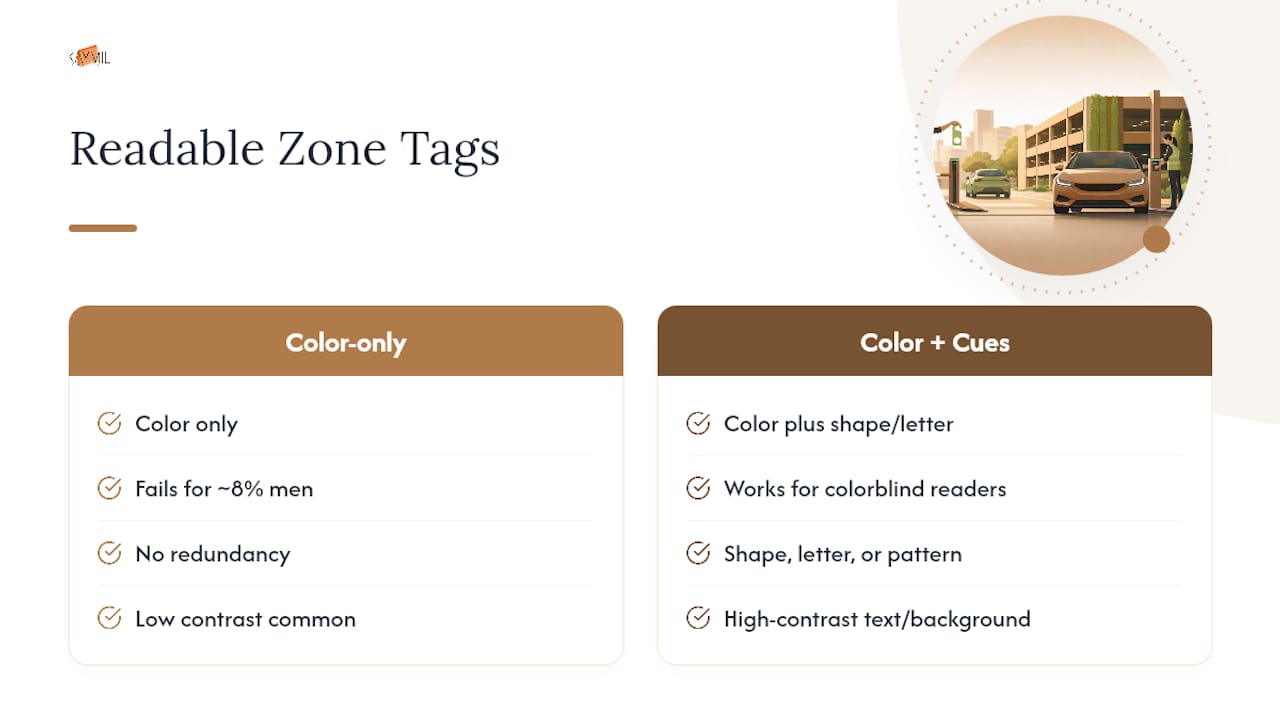
Build redundancy into every color-coded design. Pair every color band with a distinct shape, letter code, or pattern, so “Zone A” isn’t identified by blue alone but by blue plus a bold letter “A” printed at high contrast. High-contrast combinations, dark text on a light background or the reverse, help readers with low vision as well as colorblind readers, and they hold up better under low garage lighting regardless of anyone’s vision.
Avoid relying on subtle color gradients or pastel distinctions between zones. If two zone colors are close enough in hue that they photograph similarly in black and white, they’re too close for reliable color-blind differentiation. A quick test: convert your design mockup to grayscale and confirm each zone is still distinguishable by its letter code or pattern alone, not just its color.
Font choice affects accessibility too. Sans-serif fonts like Helvetica or Arial read more clearly at a distance and under motion blur than decorative or script fonts, which matters for both low-vision readers and anyone scanning tags quickly during a lot sweep. Numbers in particular should use a font where digits like 3, 8, and 0 stay visually distinct even when printed small on a supporting line of text.
Handling Lost, Damaged, and Replacement Tags
Every hang tag program eventually deals with a permit holder who lost their tag, a windshield tag that faded past legibility, or a valet operation where tags get damaged from daily handling. Building a replacement policy into your design phase, rather than improvising one after the first complaint, saves administrative time and closes a common fraud gap.
Set a clear replacement fee, even a modest one, for lost tags. A free replacement policy invites permit holders to “lose” a tag and sell or share the original rather than reporting it stolen, while a small fee (many facilities charge somewhere in the $10 to $25 range, though this varies by facility and market) discourages casual duplication requests without becoming punitive for a genuine loss.
Maintain a simple void list tied to your sequential numbering or unique ID system. When a tag is reported lost or a permit holder leaves the organization, that number should be flagged as invalid in whatever log or system your enforcement staff checks, whether that’s a paper roster at a small facility or an integrated database at a large garage. This is where sequential numbering or barcoding earns its cost: a numbered tag can be individually revoked, while an unnumbered generic tag cannot.
Set a physical replacement threshold too. Faded, cracked, or peeling tags should be swapped out proactively rather than waiting for an officer to reject one at the gate. A rough guideline: inspect and reissue any tag showing visible fading or cracking, typically after 12 to 18 months for tags exposed to full sun daily. Building a scheduled reissue cycle into your annual permit renewal, rather than a reactive one, keeps your enforcement staff working from tags they can actually read.
Getting Sign-Off Before Artwork Goes to Print
The single most common delay in a hang tag rollout has nothing to do with the printer. It’s the internal approval loop that starts after artwork is already finalized, when a stakeholder who wasn’t consulted early flags a problem too late to fix without a reprint.
Loop in every department that touches enforcement before finalizing color coding or zone assignments. Security, facilities, and whoever manages your gate or access control system all need to sign off on what each color and code means, since a mismatch between your hang tag legend and your gate system’s zone definitions creates confusion at the exact moment enforcement needs clarity.
Circulate a single proof, not a design brief, for approval. Stakeholders respond far more accurately to seeing the actual tag at actual size, with actual colors, than to a written description of the plan. Print one physical sample if your vendor offers it, since screen colors and printed colors don’t always match, and a stakeholder approving from a monitor may be surprised by the printed result.
Set a firm approval deadline tied to your ordering lead time, and communicate that deadline when you first circulate the proof. Open-ended approval requests are how design projects stall for weeks while every reviewer assumes someone else will respond first.
A Working Checklist From the Field
Order your first sample before committing to full production, always. Confirm material thickness matches your actual exposure conditions, not just your budget. Lock your numbering or barcode plan in a CSV before artwork is finalized, since retrofitting variable data into a completed design causes needless rework. Get every enforcement stakeholder to approve a physical proof, not a screen mockup. Build a replacement policy before your first lost tag, not after. Reorder before your current stock runs out, not when it does.
The three mistakes I see most often: artwork submitted at low resolution that looks fine on screen and pixelated on the tag, material chosen by price alone that fails within a season, and a numbering plan finalized after the first batch already printed. Each one is avoidable with a five-minute check before you send files to production.
How Caymil Can Produce the Hang Tags in This Guide
Every spec covered here, material thickness, numbering, barcoding, and attachment style, maps directly to what Caymil manufactures for parking facilities across the country. Caymil is the direct route to a finished tag rather than a design exercise that still needs a printer: one supplier handles material selection, variable-data setup, and production without you coordinating between a designer and a separate print shop.
Start your quote request with four things ready: your finished artwork or logo files, your total quantity, your numbering or barcode plan (even a rough draft), and any finish preferences like lamination or reflective ink. Caymil’s parking forms and hang tag options cover stock and custom orders, and facilities running barcode-based enforcement can review the barcode valet parking ticket line for compatible variable-data formats. Sample requests and proofs are part of the standard ordering process, so you see color, material, and sizing before committing to a full production run. Reach out with your specs and get a quote back before your next permit cycle starts.
Sources
For deeper detail on rolling out a facility-wide program, review Caymil’s guide to launching a parking garage permit hang tag program. If your enforcement plan leans on logos and color recognition, see custom logo parking ticket options. For material engineering details on outdoor durability, the commercial identification plate manufacturer guide covers reinforcement standards that apply directly to hang tags.
- Best material for outdoor asset tags: Weatherproof options — Signature Laser Designs
FAQ
What Material Lasts Longest for Outdoor Parking Tags?
30 mil polystyrene with UV-stable inks and lamination holds up best for multi-year permits exposed to daily sun and handling, while 20 mil PVC works fine for shorter annual cycles.
Do I Need Barcodes on Every Parking Hang Tag?
No. Sequential numbering is sufficient for small lots with visual enforcement, while barcodes make sense once you need database cross-referencing or gate-system integration.
What File Resolution Do Printers Require for Hang Tags?
Most vendors require artwork at a minimum of 300 DPI, submitted as a PDF/X file in CMYK color mode with a 0.125 inch bleed.
How Long Does It Take to Get Custom Parking Hang Tags Printed?
Turnaround depends on quantity, finishes, and whether variable data like numbering or barcodes is involved, so requesting a sample or proof early in your timeline is the safest way to protect your rollout date.
Should I Order a Sample Before Placing a Full Order?
Yes. A sample or short proof run confirms color, material, and legibility before you commit to full production, which is far cheaper than reprinting a large batch.
Can Caymil Produce Hang Tags Compatible With My Parking System?
Caymil manufactures hang tags compatible with major systems including Amano, TIBA, SKIDATA, FLASH Parking, Scheidt & Bachmann, and Flowbird, with sequential numbering and barcoding available for integration.