

Multi-Part Valet Ticket Benefits for Parking Operators

Multi-part valet tickets reliably reduce retrieval errors, strengthen chain-of-custody, and speed throughput for high-volume valet operations. For most operators, the recommended baseline is a sequentially numbered, 3-part carbonless ticket with a customer claim stub, a key chain tag, and a dashboard identification piece. Add barcodes when integrating with systems like Amano or FLASH Parking.
Quick decision checklist before you order:
- Parts needed: 2-part for simple short-stay; 3-part for standard valet; 4- or 5-part for hotel overnight or multi-location operations
- Sequential numbering: required for auditability and end-of-day reconciliation
- Barcode option: add when your parking-management system supports scanning (confirm symbology: Code 128, QR, or proprietary)
- Material: carbonless multi-part for hand-issued; thermal roll for machine-issued high-volume lanes
- Color coding: alternate ticket colors by day or event to prevent reuse of old stubs
Table of Contents
- How multi-part valet tickets work from arrival to retrieval
- What operators actually gain from multi-part valet ticket benefits
- Which ticket types and features fit your operation
- How to implement multi-part tickets from arrival through reconciliation
- What to specify when ordering tickets
- Industry evidence and system compatibility
- How to choose the right ticket and what to ask your supplier
- Common pitfalls when implementing multi-part valet ticket systems
- Training staff on ticket handling and security protocols
- Real-world operational improvements after adopting multi-part tickets
- Key Takeaways
- The case for getting the ticket right from day one
- Caymil makes it straightforward to order the right ticket
- Useful sources and next steps
- FAQ
How multi-part valet tickets work from arrival to retrieval
Understanding the physical anatomy of a ticket explains why each part exists and what breaks down when one is missing.
A standard 3-part ticket includes three connected sections printed simultaneously through carbonless transfer: a customer claim stub that the guest keeps, a key chain tag that travels with the vehicle’s keys, and a dashboard tag placed inside the car to identify it in the lot. Four- and five-part formats add an internal receipt for the cashier or a hang tag for the rearview mirror, which is common in hotel overnight operations where a vehicle may sit for multiple days.
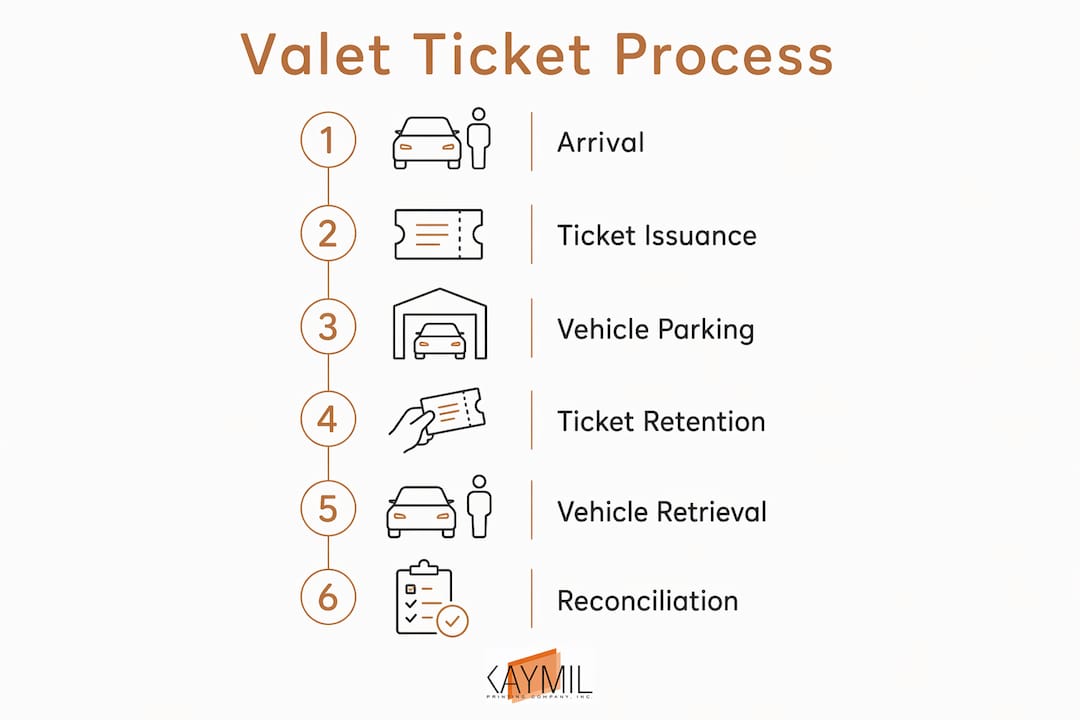
The chain of custody follows a clear sequence:
- Attendant greets the guest and collects keys.
- Ticket fields are filled: vehicle make, color, license plate, arrival time, and ticket number.
- The key tag is attached to the key ring; the dashboard tag goes on the dash.
- Keys are placed on the hook or in the envelope that matches the ticket number.
- The customer claim stub is handed to the guest.
- On retrieval, the guest presents the stub; the attendant matches it to the key tag and pulls the vehicle.
- The internal receipt (if present) is retained for end-of-day reconciliation.
Sequential numbering and barcodes add a timestamped, traceable layer to this process. When a ticket number is scanned at issue and again at retrieval, the system logs dwell time, attendant ID, and transaction sequence automatically. That data supports both operational reporting and liability documentation.
Sequential numbering and barcodes convert a paper ticket into an auditable record. Every number in the issued range accounts for a vehicle. A gap in the sequence is an immediate flag for a missing key or an unrecorded transaction — something a single-part ticket cannot surface at all.
Pro Tip: Number your ticket fields in the order attendants fill them out. Logical field sequencing cuts average ticket-fill time and reduces transcription errors, especially during peak arrival waves.
What operators actually gain from multi-part valet ticket benefits
The advantages span three categories: operational efficiency, security and liability, and commercial impact.
Operational efficiency
- Reduced retrieval times when ticket numbers map directly to key hook positions (more on this in the implementation section)
- Simplified staff training because standardized fields tell attendants exactly what to record
- Improved parking density: valet attendants can stack vehicles efficiently, with some analyses noting capacity improvements compared to self-park layouts
- Faster throughput at high-volume events when machine-issued roll tickets replace hand-written stubs
Security and liability
- Documented chain-of-custody via sequential numbers reduces disputes about vehicle condition at retrieval
- Barcodes enable automated, timestamped records that are far harder to manipulate than manual logs
- Daily reconciliation against issued ticket ranges surfaces missing or duplicated tickets before they become liability claims
- Tamper-evident tear patterns and single-use color coding deter fraudulent retrieval attempts
Commercial impact
Ticket quality signals service quality before a word is spoken. Operators who invest in premium branded tickets report that the physical presentation of the claim stub shapes guest perception at the moment of handoff. According to Open Door Valet data, average dining checks increase and return visit frequency rise when valet is offered, underscoring the revenue case for a well-run valet program.

Pro Tip: A crisp, branded ticket with clear print and a clean tear line tells the guest their car is in professional hands. Faded, smudged, or hand-torn stubs do the opposite — and that impression lands before the car even moves.
Which ticket types and features fit your operation
Choosing the right spec comes down to use case, volume, and system integration requirements.
| Ticket Type | Best Use Case | Key Trade-off |
|---|---|---|
| 2-part | Short-stay, low-volume valet | Minimal documentation; no internal receipt |
| 3-part | Standard hotel, restaurant, event valet | Balanced cost and auditability |
| 4-part | Hotel overnight, multi-location operations | Extra internal receipt; slightly higher cost |
| 5-part | High-security or casino environments | Maximum documentation; more parts to manage |
Materials
- Carbonless multi-part: the standard for hand-issued tickets; all parts print simultaneously without carbon paper, keeping hands clean and records legible
- Carbon copy: older format, still used in some legacy operations; messier and less durable than carbonless
- Thermal roll: used in machine-issued setups; fast and clean but single-part by nature, so it pairs with a digital system rather than a physical chain-of-custody chain
Security and traceability features
- Sequential numbering: the baseline requirement for any auditable operation
- Single-use color coding: rotate colors by day or event to prevent old stubs from being reused
- Barcodes and QR codes: enable scanning integration with parking-management platforms
- Unique job IDs: useful for multi-client or multi-event operations running concurrent ticket ranges
- Tamper-evident tear patterns: physical deterrent against stub duplication
Form factors
Hang tags loop over the rearview mirror and stay visible without touching the dash. Dashboard stubs sit flat and work well in tight interiors. Key chain tags are punched to attach directly to the key ring. Detachable customer receipts add a payment or validation record to the same ticket set.
Machine-issued vs. hand-issued
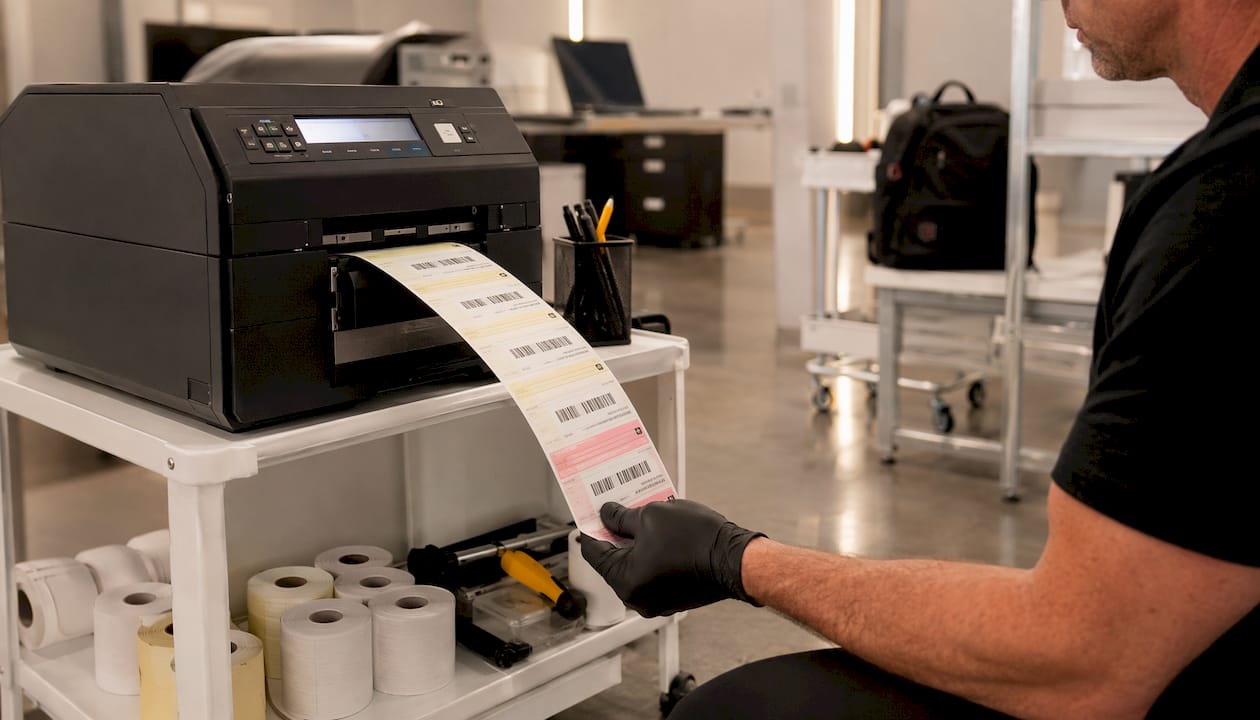
Machine-issued roll tickets accelerate throughput at high-volume events and simplify reconciliation when integrated with a parking-management system. They work best when the operation already uses a digital platform. Hand-issued carbonless tickets remain the right choice for operations where simplicity, portability, and no-power reliability matter more than scan speed.
How to implement multi-part tickets from arrival through reconciliation
A consistent workflow is what converts a good ticket design into an operational advantage.
- Greet and collect: Attendant meets the guest at the drop-off point, collects keys, and begins filling the ticket immediately.
- Fill all fields: Vehicle make, color, license plate, arrival time, and any visible pre-existing damage notes. Legibility matters — print clearly.
- Attach tags: Key chain tag goes on the key ring; dashboard tag is placed on the dash or hung from the mirror.
- Map to hook: Place keys on the hook or in the envelope that matches the ticket number exactly. Ticket #47 goes to hook #47. This one-to-one mapping is the single most effective way to cut retrieval time during peak periods.
- Hand off the stub: Give the customer claim stub to the guest and confirm they have it before they walk away.
- Log if digital: If using a parking-management system, scan or enter the ticket number to open a timestamped record.
- Retrieve on presentation: Match the guest’s stub to the key tag before pulling the vehicle. Never release a vehicle without a matching stub.
- Reconcile daily: At end of shift, count issued ticket stubs against the hook board. Every number in the issued range should be accounted for.
Pro Tip: Color-code tickets by day or event. When Monday’s tickets are blue and Tuesday’s are yellow, a blue stub presented on Tuesday is an immediate flag — no counting required.
Key storage and security
- Limit key-board access to on-duty attendants only
- Keep a supervisor key for lost-stub situations, with a documented release process
- Store the key board in a locked or supervised area, not an open attendant stand
- For sequential numbering best practices and reconciliation, maintain a log of issued ticket ranges per event and cross-reference daily
What to specify when ordering tickets
Getting the spec right before you order prevents costly reprints and operational gaps.
Minimum spec list to send to any supplier:
- Part count (2, 3, 4, or 5)
- Material: carbonless, carbon, or thermal
- Sequential numbering: starting number and range
- Barcode or plain: if barcode, specify symbology (Code 128, QR, or other)
- Ink colors: standard black, PMS match, or alternating colors by part
- Logo placement and file format
- Detachable elements: which parts perforate and in what direction
- Form factor: hang tag, dashboard stub, key chain tag, or combination
Quantity guidance
For ongoing operations, order at least a 90-day supply to avoid mid-season stockouts. For events, calculate peak daily volume, multiply by event days, and add 15% safety stock for spoilage and misprints. Roll tickets for machine-issued setups typically come in quantities of 2,100 per roll; sheet tickets for hand-issued operations are usually ordered in sets of 500 or 1,000.
Lead times
Stock ticket SKUs ship fast — often within one to two business days. Custom runs with logo placement, PMS color matching, or non-standard perforation patterns typically require a proof cycle and a production window. Request a sample proof before approving any custom run, particularly for barcodes, since barcode readability must be confirmed on your actual scanner hardware before volume printing.
What affects cost
Custom PMS color matching, barcode printing, machine-issued roll formats, and sequential numbering in non-standard ranges all add to unit cost. The offset is that these features reduce operational errors and dispute costs, which typically exceed the incremental print cost many times over.
Industry evidence and system compatibility
The operational case for multi-part tickets is well-documented across industry sources. The Valet Spot confirms that sequentially numbered, multi-part tickets create an auditable chain of custody that reduces liability disputes and supports tracking from arrival through retrieval. Admit One Products notes that custom ticket design with dedicated fields for vehicle details and logical numbering reduces training time and retrieval errors.
Parking system compatibility
| System | Barcode Integration | Machine-Issued Format | Notes |
|---|---|---|---|
| Amano | Yes | Yes | Confirm ticket width and roll core size |
| TIBA | Yes | Yes | Supports Code 128 and QR |
| SKIDATA | Yes | Yes | Verify symbology with SKIDATA rep |
| FLASH Parking | Yes | Yes | Cloud-based; confirm API ticket-scan workflow |
| Scheidt & Bachmann | Yes | Yes | Confirm paper spec for thermal rolls |
| Flowbird | Yes | Yes | Check barcode density requirements |
Compatibility checklist for IT and operations teams:
- Confirm barcode symbology supported by your parking-management platform
- Test scan on the intended phone or handheld scanner before volume printing
- Verify roll core diameter and ticket width for machine-issued setups
- Confirm whether the system requires a pre-printed ticket ID or generates one at issue
- Check whether the platform logs dwell time automatically on scan or requires manual entry
Pro Tip: Request a test print of your barcode spec and scan it on every device your team will use — phone cameras, dedicated scanners, and any kiosk hardware. A barcode that reads on one device and fails on another will cause retrieval delays at the worst possible moment.
For hotel and hospitality integrations, the hotel valet and parking integration guide covers advanced barcode and digital system workflows in detail.
How to choose the right ticket and what to ask your supplier
A structured decision process prevents the most common ordering mistakes.
Decision checklist:
- Match part count to your use case (see the comparison table above).
- Choose carbonless for hand-issued; thermal roll for machine-issued.
- Require sequential numbering on every order — no exceptions.
- Add barcodes if your system supports scanning; confirm symbology first.
- Plan your quantity and replenishment cadence before placing the first order.
- Request a physical sample or proof before approving a custom run.
Supplier questions to ask:
- What is your standard lead time for stock SKUs vs. custom runs?
- Do you provide a physical proof before production?
- Which barcode symbologies do you support (Code 128, QR, proprietary)?
- Are your tickets compatible with Amano, TIBA, SKIDATA, FLASH Parking, Scheidt & Bachmann, or Flowbird systems?
- What are your minimum order quantities for custom runs vs. stock items?
- What is your replacement or returns process for print defects?
- Do you offer rush production, and what is the lead time and cost?
Red flags when evaluating suppliers:
- No clear policy on sequential numbering ranges or starting numbers
- Inability or unwillingness to provide a physical proof before production
- No compatibility information for major parking-management systems
- Vague or absent returns and replacement process
- No sample inventory for stock SKUs
Sample RFQ items you can copy:
- “Please provide a proof of the barcode at the specified density before production approval.”
- “Confirm sequential numbering starting at [X] and ending at [Y], with no duplicates.”
- “Confirm compatibility with [system name] and the barcode symbology required.”
Common pitfalls when implementing multi-part valet ticket systems
The most frequent implementation failures are not design problems. They are process problems that a well-designed ticket cannot fix on its own.
Skipping the proof cycle is the costliest mistake. A barcode that looks correct on screen may not scan reliably in print, especially at small sizes or on carbonless stock. Always request a physical proof and scan it before approving production.
Ordering too few tickets creates mid-event stockouts. When a valet operation runs out of tickets during a busy Saturday night, attendants improvise — and improvised records are where disputes originate. Build safety stock into every order.
Inconsistent field completion undermines the chain of custody. If some attendants record license plates and others skip them, the ticket loses its value as a liability document. Standardize the required fields and enforce them in training.
Mismatched hook mapping is a retrieval bottleneck that compounds under pressure. If ticket numbers do not correspond to hook positions, attendants must search rather than go directly to the right hook. The fix is simple: assign hook numbers to match ticket numbers before the first vehicle arrives.
Reusing tickets across events is a security risk. Old stubs can be presented fraudulently if colors and number ranges are not rotated. Alternating colors by day or event, combined with a logged range per event, closes this gap.
Training staff on ticket handling and security protocols
Training is where the operational design of a multi-part ticket either delivers its benefits or falls apart.
Core training topics for every attendant:
- How to fill every required field legibly and in order
- How to attach the key tag and dashboard tag correctly
- Where to place keys and how hook mapping works
- How to handle a guest who has lost their claim stub
- What to do if a ticket is damaged, voided, or misprinted
Security protocol training:
Attendants should understand that the claim stub is the only authorized release document for a vehicle. A lost-stub release requires supervisor approval and a documented identity verification process — never a verbal override from a guest. Voided tickets should be marked clearly and retained, not discarded, so they appear in the reconciliation count.
Handwriting standards matter more than most operators expect. A license plate misread as a different number, or a ticket number that looks like another, creates retrieval confusion that slows the entire operation. Require block printing for all numeric fields.
Ongoing reinforcement is more effective than a single onboarding session. Brief daily pre-shift reviews of the previous day’s reconciliation results, with specific feedback on any gaps or errors, build consistent habits faster than annual training alone.
For operations managing executive arrivals or premium guest experiences, pairing solid ticket protocols with luxury car service etiquette standards gives attendants a fuller picture of guest expectations at the handoff moment.
Real-world operational improvements after adopting multi-part tickets
The pattern across operations that switch from single-part or informal ticketing to structured multi-part systems is consistent: retrieval times drop, disputes decrease, and end-of-day reconciliation becomes a routine rather than a scramble.
A restaurant valet operation that moves from a single-part claim check to a 3-part carbonless ticket with sequential numbering gains an immediate audit trail. When a guest disputes a scratch at retrieval, the attendant can pull the internal receipt showing the vehicle’s condition was noted at arrival. That documentation resolves the dispute without escalation.
A hotel overnight operation that adds a 4-part ticket with a hang tag gains the ability to locate vehicles in a multi-level structure without walking every floor. The hang tag is visible from the aisle; the internal receipt stays with the cashier; the key tag travels with the key. Three physical records, one transaction.
For high-volume event venues, machine-issued roll tickets integrated with a parking-management platform reduce the per-vehicle issue time significantly and generate a digital record that supports post-event revenue reporting. Operators using barcoded tickets with compatible systems can pull dwell-time data, peak arrival windows, and per-attendant transaction counts without manual tallying.
The commercial case is supported by data: Open Door Valet reports that venues offering valet see dining check averages rise by 18–24% compared to self-park alternatives. The ticket is the first physical touchpoint in that experience.
Key Takeaways
Multi-part valet tickets with sequential numbering and barcodes are the most reliable way to reduce retrieval errors, document chain-of-custody, and support revenue reporting in a valet operation.
| Point | Details |
|---|---|
| Recommended baseline spec | A sequentially numbered, 3-part carbonless ticket covers most standard valet operations. |
| Barcodes add measurable value | Barcoded tickets enable timestamped, traceable records and integrate with Amano, TIBA, SKIDATA, FLASH Parking, Scheidt & Bachmann, and Flowbird systems. |
| Hook mapping cuts retrieval time | Matching ticket numbers to key hook positions is the single most effective operational adjustment for high-volume periods. |
| Commercial uplift is documented | Venues offering valet report dining check increases of 18–24% and return visit frequency rises by 22% per Open Door Valet data. |
| Caymil for ordering | Caymil stocks and custom-prints 2-, 3-, and 4-part tickets with sequential numbering, barcoding, and machine-issued roll options, with fast nationwide shipping. |
The case for getting the ticket right from day one
Most operators underestimate how much operational drag comes from a poorly specified ticket. The ticket is not just a claim check. It is the primary record of every vehicle transaction your operation processes. When the fields are wrong, the numbering is inconsistent, or the barcode does not scan on your hardware, every downstream process suffers: retrieval slows, reconciliation takes longer, and disputes become harder to resolve.
The operators who get this right tend to share one habit: they treat the ticket spec as a workflow document, not a print job. They think through the arrival sequence, the hook board layout, the reconciliation process, and the parking-system integration before they place the first order. That upfront work pays off every shift.
The other thing experienced operators consistently flag is the value of ordering a sample run before committing to volume. A physical proof reveals color accuracy, barcode readability, perforation placement, and carbonless transfer quality in a way that a digital mockup never does. The cost of a sample run is trivial compared to the cost of reprinting 5,000 tickets because the barcode density was wrong.
Caymil makes it straightforward to order the right ticket
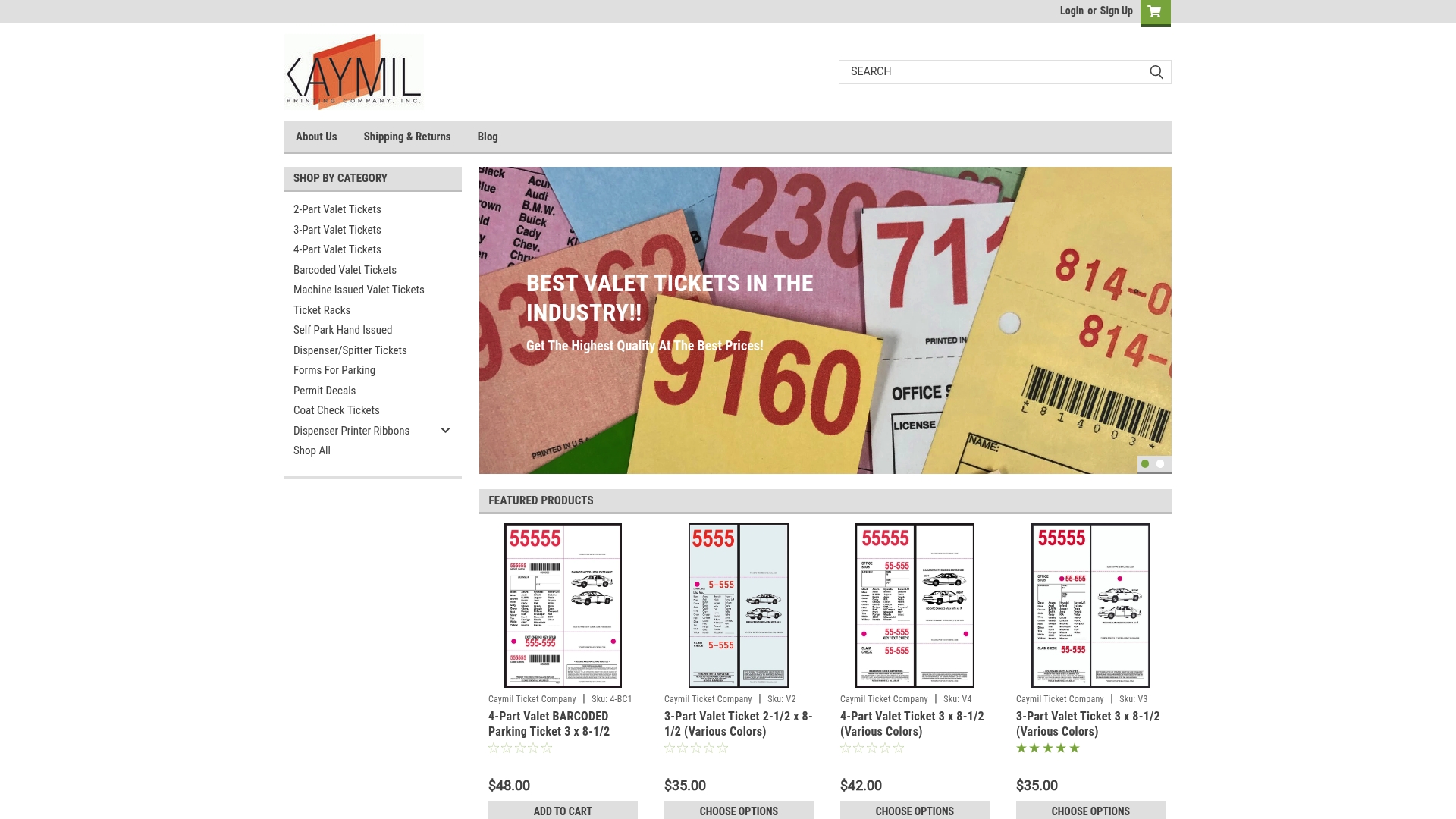
Since 1937, Caymil has manufactured and supplied custom and stock valet tickets to parking operators, hotels, event venues, and municipalities across the United States. The product range covers 2-part, 3-part, and 4-part valet tickets, barcoded options, and machine-issued roll formats for high-throughput operations. Every ticket is available with sequential numbering, custom logo placement, PMS color matching, and carbonless multi-part construction.
Caymil’s tickets are compatible with major parking-management systems including Amano, TIBA, SKIDATA, FLASH Parking, Scheidt & Bachmann, and Flowbird. With millions of tickets in stock and fast nationwide shipping, most standard orders ship within one to two business days. Custom runs include a proof cycle so operators can confirm barcode readability, color accuracy, and perforation placement before production.
Ready to specify your next order? Browse Caymil’s full parking and valet ticket range to find stock SKUs, request a custom quote, or order a sample run before committing to volume.
Useful sources and next steps
Caymil product pages:
- 3-part valet parking tickets — recommended baseline for most operations
- 4-part valet parking tickets — hotel overnight and multi-location use
- Barcoded valet parking tickets — system integration and traceability
- Machine-issued valet tickets — high-volume event throughput
- Full parking and valet ticket range — browse all formats and request samples
External resources for further reading:
- The Valet Spot: All About Valet Parking Tickets — practical operator guidance on ticket anatomy and workflow
- Open Door Valet: Valet vs. Self-Park Customer Data — commercial impact data for valet programs
Before you place a volume order:
- Request a physical proof and scan the barcode on your actual hardware
- Confirm sequential numbering range and starting number in writing
- Verify compatibility with your parking-management system
- Order a sample run to check carbonless transfer quality and perforation placement
FAQ
What are the main benefits of multi-part valet tickets?
Multi-part valet tickets create an auditable chain of custody by giving each vehicle transaction a customer claim stub, a key tag, and a dashboard identifier. Sequential numbering and optional barcodes add timestamped records that reduce retrieval errors and support liability documentation.
How many parts does a valet ticket need?
A 3-part carbonless ticket covers most standard valet operations. Four- or 5-part formats are better suited to hotel overnight stays or high-security environments where an additional internal receipt or hang tag is needed.
Do valet tickets work with parking management systems like Amano or SKIDATA?
Yes. Barcoded valet tickets can integrate with Amano, TIBA, SKIDATA, FLASH Parking, Scheidt & Bachmann, and Flowbird systems. Confirm the required barcode symbology (Code 128, QR, or proprietary) with your system vendor before ordering.
Does valet parking offer in-and-out privileges?
In-and-out privileges depend on the specific operation and venue policy. Some valet programs allow guests to retrieve and re-drop their vehicle multiple times within a session; others charge per retrieval. Operators should state the policy clearly on the ticket or at the point of handoff to avoid disputes.
Who is responsible if a valet damages a vehicle?
The valet operator is generally liable for damage that occurs while the vehicle is in their custody, which is one reason a documented chain-of-custody via multi-part tickets matters. A ticket that records vehicle condition at arrival provides the evidence needed to resolve damage disputes accurately.