
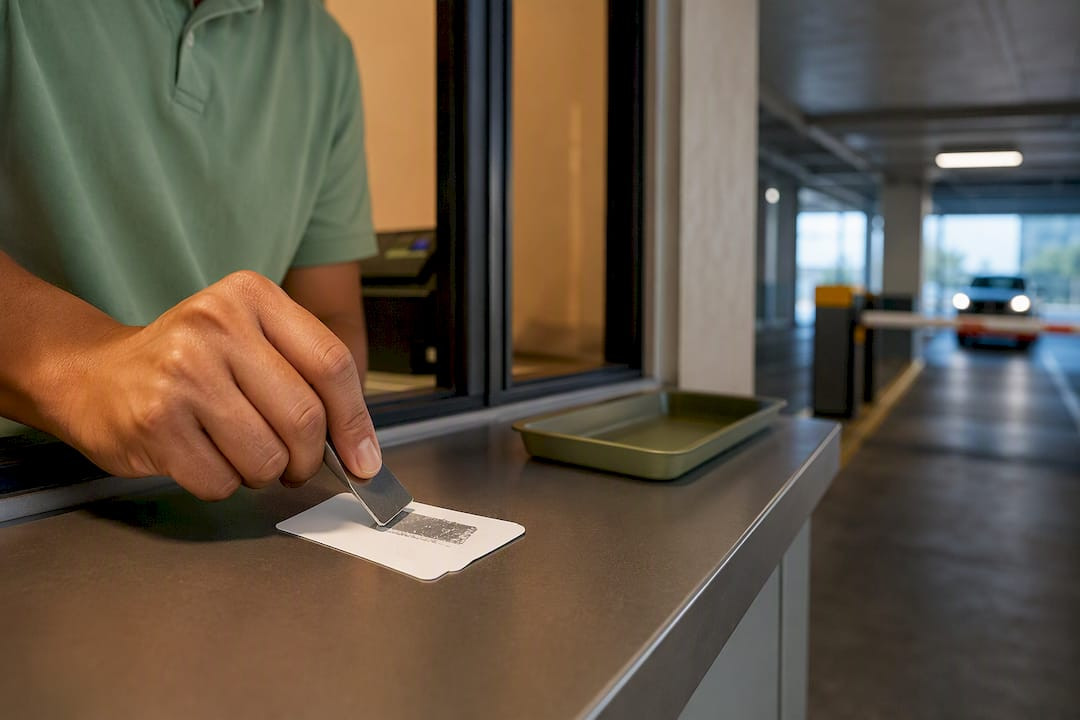
Recover 50%+ Revenue With Scratch Off Tickets for Parking Operators

In parking, valet, and hospitality operations, “scratch off tickets” refers to business-grade printed ticketing supplies, not consumer lottery products. These sequentially numbered, barcoded, and often multipart tickets are the physical control point for parking and valet revenue. A properly specified ticket, sourced from an experienced manufacturer, reduces lost revenue, terminal downtime, and disputed claims.
TL;DR:
- Using custom tickets with security features like scratch-off panels may add costs and lead time, but ensure they are tested against your terminal’s specifications beforehand.
- Matching ticket dimensions, coating, roll diameter, and print area to your PARCS system is crucial to prevent jams, head damage, or unreadable barcodes.
- Implementing disciplined issuance and reconciliation procedures, including daily audits and digital logging, significantly reduces revenue loss and dispute risks.
- Smaller operations should opt for 2-part or 3-part valet tickets, while high-volume venues often require 4-part tickets for comprehensive recordkeeping.
- When employing scratch-off features for validation or promotions, legal review is essential to avoid violations related to chance-based gambling or sweepstakes regulations.
Table of Contents
- Ticket types and formats buyers should know
- Technical specs checklist and PARCS compatibility
- Design elements that protect revenue and limit liability
- Ordering and customization: what affects cost and lead time
- Implementation and operational best practices
- What makes scratch off tickets different from standard parking tickets
- Where scratch off ticket features show up in business operations
- Legal and licensing considerations for scratch off panels
- Running a fair and effective scratch off promotion
- Handling redemption and disputes at the point of service
- Caymil’s perspective and proof points
- Where to start an order with confidence
- Sources
- FAQ
Ticket types and formats buyers should know
Choosing the right ticket format starts with matching the paper stock and structure to how the ticket will be issued, handled, and reconciled. Valet operations that rely on manual issuance typically need carbonless multipart stubs, while automated gate systems require machine-compatible rolls.
- 2-part valet tickets work for smaller lots where a single duplicate copy (guest stub and claim stub) is enough for basic accountability.
- 3-part valet tickets add a third copy, often used to separate guest, office, and valet runner copies for tighter reconciliation.
- 4-part valet tickets suit high-volume hotel or casino valet stands that need copies for the guest, the cashier, the runner, and a permanent office record.
- Dispenser or spitter roll tickets feed automated PARCS terminals and print on demand as vehicles enter, eliminating manual handling.
- Barcoded tickets support scanning at exit gates or with handheld readers, while magnetic stripe tickets integrate with terminals that read encoded data for access control and revenue tracking.
Fanfold and roll formats matter mainly for machine-issued systems, where the ticket must feed cleanly through a printer mechanism without jamming. Manual valet stands, by contrast, favor carbonless multipart stock because the copies never touch a machine at all.
Technical specs checklist and PARCS compatibility
Ticket stock that looks fine on a shelf can still fail inside a parking terminal. PARCS ticket supplies must match the terminal manufacturer’s specifications for paper type, size, roll diameter, core inner diameter, and print placement, and custom printing must not interfere with thermal sensitivity or the ticket’s physical dimensions.
Before ordering a full run, confirm these items against your terminal’s own spec sheet:
- Paper type and coating (thermal top-coated versus standard bond)
- Roll diameter and core inner diameter that match the dispenser housing
- Maximum print area so barcodes and logos don’t crowd sensor zones
- Perforation placement so tickets separate cleanly without jamming feed rollers
Noncompliant coatings or oversized print areas can scorch thermal print heads or cause paper jams that stop a gate lane cold. Caymil’s guidance on PARCS parking system tickets walks through dimension and paper-type requirements in more detail, and field-testing a sample before full production catches encoding or fit problems before they reach a live lane.
Pro Tip: Request a small test batch and run it through your actual terminal model before committing to a full production order.
Design elements that protect revenue and limit liability
Ticket design is not cosmetic. It is the mechanism that ties a vehicle to a transaction, a shift, and a reconciliation record.
- Sequential numbering and barcode linkage let shift reports match issued tickets against posted revenue, exposing gaps immediately.
- A printed vehicle damage diagram on the ticket back supports a consistent inspection workflow at drop-off and pickup, which is a critical loss-prevention step many operators overlook.
- Clear lost-ticket and liability language sets expectations before a dispute happens, reducing back-and-forth at the booth.
The financial upside of getting this right is not theoretical. Redesigning the valet ticket and adding issuance accountability and posting audits produced a case example where valet revenue improved by more than 50%, with self-parking revenue gains exceeding 100%. That kind of recovery comes from closing the small gaps, missing stubs, unposed folios, unrecorded lost tickets, that a well-designed ticket and disciplined process catch automatically.
Ordering and customization: what affects cost and lead time
Stock tickets ship faster and cost less per unit, making them a sensible choice for standard lots with no special branding needs. Custom tickets take longer to produce but let you add logos and security features and encoding tailored to your terminal.
- Stock versus custom: stock works for straightforward operations; custom suits properties needing branding, security features, or specific dimensions.
- Variable-data printing (sequential numbers, unique barcodes) adds a small production step but is essential for reconciliation.
- Barcoding and magnetic encoding extend lead time slightly since each roll or batch must be tested against terminal tolerances.
- Special inks or security features (tamper-evident coatings, UV elements) add cost but reduce fraud risk on high-value lots.
Ordering a sample run before committing to full production is worth the extra day or two it adds to the timeline. Encoding tolerances and print placement vary between vendors, and a field test on your actual terminal model catches most compatibility failures before they become a production-wide problem.
Pro Tip: Validate a proof copy against your terminal before approving a full print run, not after the shipment arrives.
Implementation and operational best practices
A well-specified ticket only pays off if the operation around it is disciplined.
- Assign shift-level accountability for ticket issuance and define a clear release procedure, including ID verification and a wait period, for lost-ticket claims.
- Store roll and carbonless stock properly to avoid heat or moisture damage that can ruin thermal coatings before they ever reach a dispenser.
- Reconcile ticket numbers and barcodes against shift reports daily, flagging any gap between tickets issued and revenue posted.
- Audit folio postings periodically so vehicle charges billed to hotel or event accounts match the tickets issued for those stays.
- Layer in digital capture where available: properties adopting hybrid valet platforms benefit when arrival time, vehicle condition, and location are logged digitally alongside the paper stub, since a paper ticket’s value depends on that data being usable for analytics and folio posting.
Caymil’s operational rundown on valet ticket systems covers issuance and reconciliation steps in more depth for operators building this workflow from scratch.
What makes scratch off tickets different from standard parking tickets
Within the ticketing supplies category, “scratch off” refers to a security feature, a coated panel that conceals a code, number, or validation mark until it is physically scratched away, rather than a distinct ticket type. Operators add it when a standard printed number or barcode isn’t enough to guarantee that a ticket hasn’t been duplicated, altered, or read in advance.
A standard valet or parking ticket exposes its sequence number and barcode openly, which works fine for routine claim-and-retrieve transactions. A scratch-off panel adds a layer that only becomes visible at the moment of use, which matters most for validation stamps, prepaid parking vouchers, or promotional codes tied to a specific redemption event. The panel itself sits on the same carbonless or roll stock used for other business tickets. It’s a printed feature, not a separate paper category, so it fits into the same ordering process as barcoded or sequentially numbered tickets.
Operators considering a scratch-off element should treat it as an added security layer on top of the fundamentals covered earlier: sequential numbering, barcode linkage, and clear liability language. Skipping those fundamentals to add a scratch-off panel misses the point. The panel protects against a narrow kind of tampering, while the numbering and reconciliation system protects the revenue itself.

Where scratch off ticket features show up in business operations
Scratch-off panels appear most often in situations where a ticket doubles as a promotional or validation instrument rather than a pure claim check. Parking validation programs are a common example: a retailer, hotel, or event venue issues a ticket with a concealed code that a guest reveals to confirm a discount or free-parking period, which prevents the code from being read or reused before the intended moment.
Event venues and hospitality properties sometimes extend the same concept to on-site contests or loyalty promotions bundled with parking or valet service, where a scratch-off panel reveals whether a guest has won a small perk tied to their visit. Municipalities running short-term parking promotions, such as a holiday shopping district validation program, use a similar structure to control how and when a discount code becomes visible.
In every one of these cases, the audience is the operator running the program, not a consumer buying a lottery product. The ticket still functions primarily as a parking or access record. The scratch-off feature is layered on to support a specific promotional or validation goal without compromising the numbering and barcode system that keeps the underlying operation reconciled.
Legal and licensing considerations for scratch off panels
Any ticket program that reveals a prize, discount, or benefit through a scratch-off mechanism can brush up against state gaming or promotional-contest rules, depending on how the reveal is structured and whether an element of chance is involved. A parking validation program with a guaranteed discount is a straightforward business promotion. A program where the scratch-off reveals a randomized prize is a different matter, since randomized giveaways can trigger sweepstakes or lottery regulations depending on the state and the value involved.
Because these rules vary by state and by the specific mechanics of a promotion, operators should confirm requirements with counsel or a state gaming or consumer-affairs authority before launching any scratch-off program that includes an element of chance or a prize of meaningful value. This is a compliance question, not a printing question, and no ticket vendor can substitute for that legal review. The safest starting point is treating any scratch-off promotion as a legal matter first and a design matter second.
Running a fair and effective scratch off promotion
A scratch-off promotion works best when the mechanics are transparent and consistent for every participant. Clear terms printed on the ticket itself, what the scratch-off reveals, how to redeem it, and any expiration, prevent the kind of confusion that turns into a customer complaint at the booth.
Consistency in odds or discount value across a printed batch matters as much as the design itself. If a batch of validation tickets is meant to offer the same guaranteed benefit to every guest, the production run needs the same quality control as any sequentially numbered ticket, since a misprint or missing panel undermines the whole promotion. Operators running a promotion with any randomized element should keep documentation of how winning tickets were distributed within the print run, both for internal recordkeeping and in case a participant disputes the outcome.
Staff training matters just as much as the ticket design. Front-line staff issuing or redeeming scratch-off tickets need a clear, simple explanation of what the promotion offers and how to handle an unusual request, since a guest who feels misled by a poorly explained promotion creates a service problem well beyond the ticket itself.
Handling redemption and disputes at the point of service
Redemption should be simple: a guest scratches the panel, staff verifies the revealed code or benefit against a reference list or scanner, and the transaction closes out on the spot. Complexity at this stage is usually a sign the ticket design or the staff process needs revisiting, not that the guest is doing something wrong.

Disputes typically arise from one of three causes: a damaged or unreadable panel, a misunderstanding about what the ticket entitles the guest to, or a genuine printing error in the batch. A damaged panel is best resolved by keeping a small reserve of backup vouchers or an alternate verification method (such as a manager override tied to the ticket’s visible sequence number) so a legitimate guest isn’t turned away over a physical printing flaw. Misunderstandings are reduced by printing the terms plainly on the ticket rather than relying on a verbal explanation at the counter.
For genuine batch errors, the same reconciliation discipline used for parking revenue applies here: sequential numbering lets staff verify whether a disputed ticket falls within the valid range for that promotion. Treating every scratch-off promotion with the same documentation rigor used for valet tickets, tracking issued ranges, redemption counts, and any voided or reissued tickets, keeps disputes rare and resolvable when they do happen.
Caymil’s perspective and proof points
Some manufacturers have produced parking, valet, and hospitality ticketing supplies for many years, with product lines spanning stock and custom valet tickets, dispenser rolls, and barcoded formats built for compatibility with major PARCS brands. A specialist focus means custom orders are approached with compatibility in mind first: confirming terminal specs, paper coating, and print placement before a production run begins, rather than after tickets fail in the field.
Decades of manufacturing experience inform how samples are validated against terminal requirements, a practice that matters as much as the ticket design itself.
— Richard
Where to start an order with confidence
Matching the right ticket family to your operation is most of the battle, and Caymil’s product lines map directly to the formats covered above. Properties running manual valet stands typically start with 2-part or 3-part valet tickets, while higher-volume hotel and casino operations often need the extra copy that 4-part valet tickets provide.
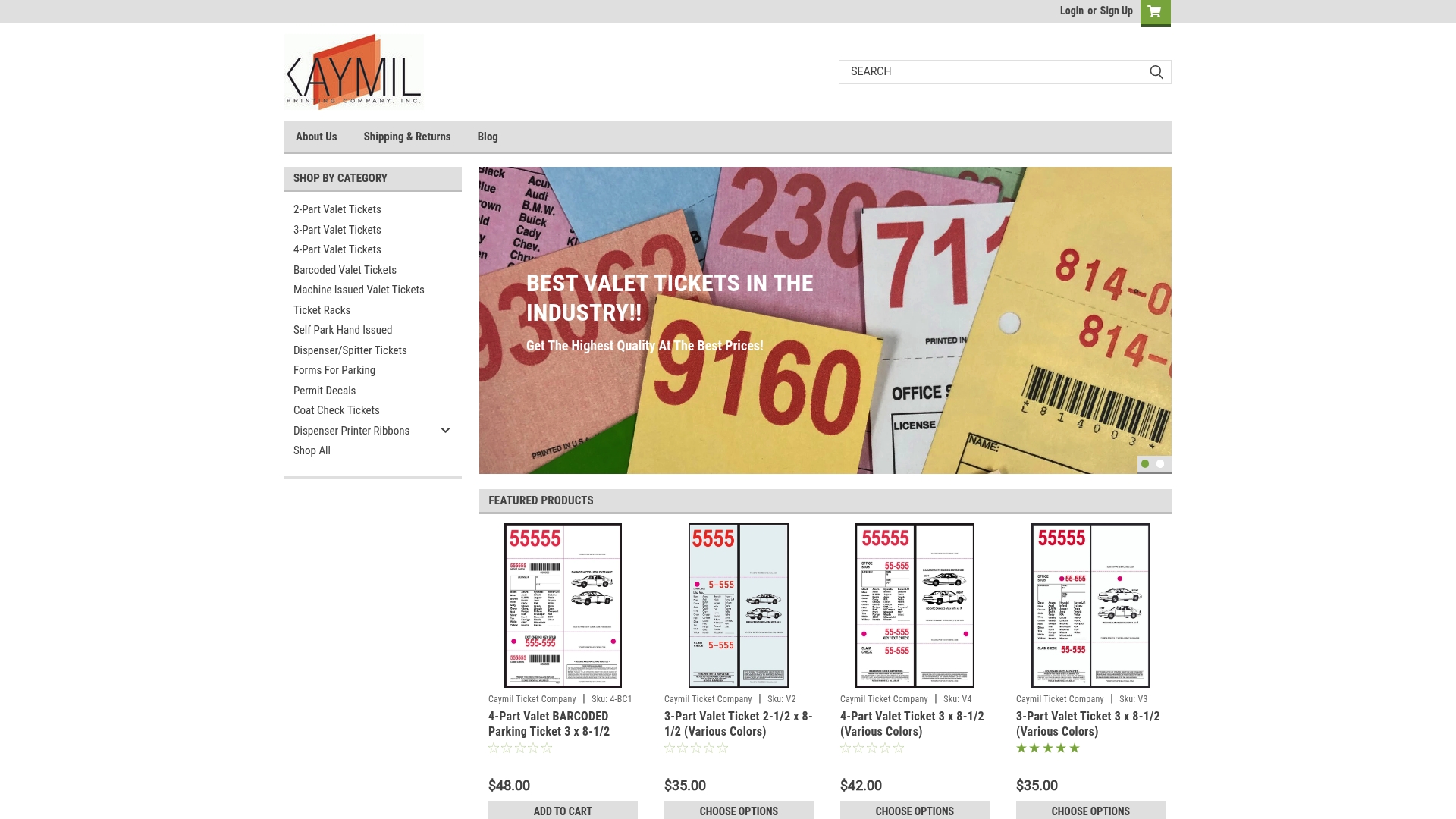
- Operations scanning at exit or syncing with a PMS should look at barcoded valet tickets for reconciliation-ready formats.
- Automated gate systems pair with dispenser or spitter tickets sized to the terminal’s roll housing.
- Lots needing supporting supplies, from ticket racks to general parking forms, can source everything from one supplier.
Before placing a full order, request a sample and confirm it against your terminal’s spec sheet. If your exact need isn’t listed above, the full catalog at Caymil covers permit decals, coat check tickets, and custom parking ticket options.
Sources
This article draws on public PARCS procurement specifications, parking asset management research, and valet operations manuals, including the City of Philadelphia’s PARCS ticket bid documentation and HVS parking asset management research.
- Bid No. 24-06 Ticket and Receipt Rolls for Parking Access Revenue Control Systems (PHL/Center City garages)
- Parking Asset Management - Part III | HVS
- Hotel valet parking operations: standards, technology, and guest experience in 2026 | Hotel Facility Guide
- Parking Valet Operations Manual | Parking Professional
FAQ
What are scratch off tickets in a parking or valet context?
They are business-grade printed tickets, often valet claim stubs or validation tickets, that include a coated panel concealing a code or benefit until scratched away. This differs from consumer lottery products and is used for validation programs, promotions, or added security on top of standard sequential numbering.
How do I know if a ticket will work with my PARCS terminal?
Check the terminal manufacturer’s spec sheet for paper type, roll diameter, core size, and print placement, since these must match exactly to avoid jams or unreadable prints. Requesting a sample and running it through your actual device before a full order is the safest way to confirm compatibility.
Can a scratch off ticket promotion trigger gambling regulations?
It can, depending on whether the reveal involves a randomized prize rather than a guaranteed discount or benefit. Operators should confirm the specific rules with counsel or a state gaming authority before launching any promotion involving chance.
What ticket format should a valet operation choose?
Smaller lots typically do fine with 2-part valet tickets, while higher-volume hotel or casino valet stands often need 3-part or 4-part formats for separate guest, office, and runner copies. The right choice depends on how many parties need a physical record of each transaction.