

Custom Event Parking Ticket Design for Event Planners

Custom event parking ticket design is the process of creating tailored parking passes that control vehicle access, communicate parking entitlements clearly, and reinforce event branding at every touchpoint. Done well, a personalized parking permit does more than mark a windshield. It speeds up gate transactions, reduces staff confusion, and tells attendees exactly what they paid for before they even reach the entrance. Caymil Printing Co. has manufactured custom event tickets and parking passes since 1937, and the difference between a well-designed ticket and a generic one shows up immediately in gate throughput and guest satisfaction.
What key design elements make custom event parking ticket design effective?
The foundation of any effective event parking ticket design is structure. A ticket that lacks clear sections, sequential numbering, or defined tear points creates confusion under pressure, and large events have no tolerance for that.
Multi-part ticket formats are the industry standard for good reason. A 3-part valet ticket measures 3.5 x 8.5 inches, includes two perforations, and divides into three functional sections: a claim tab for the guest, a station record for the attendant, and a vehicle copy that stays with the car. Each part carries the same sequential number, so any section can be matched to the others instantly. This structure eliminates the guesswork that slows down high-volume event parking.
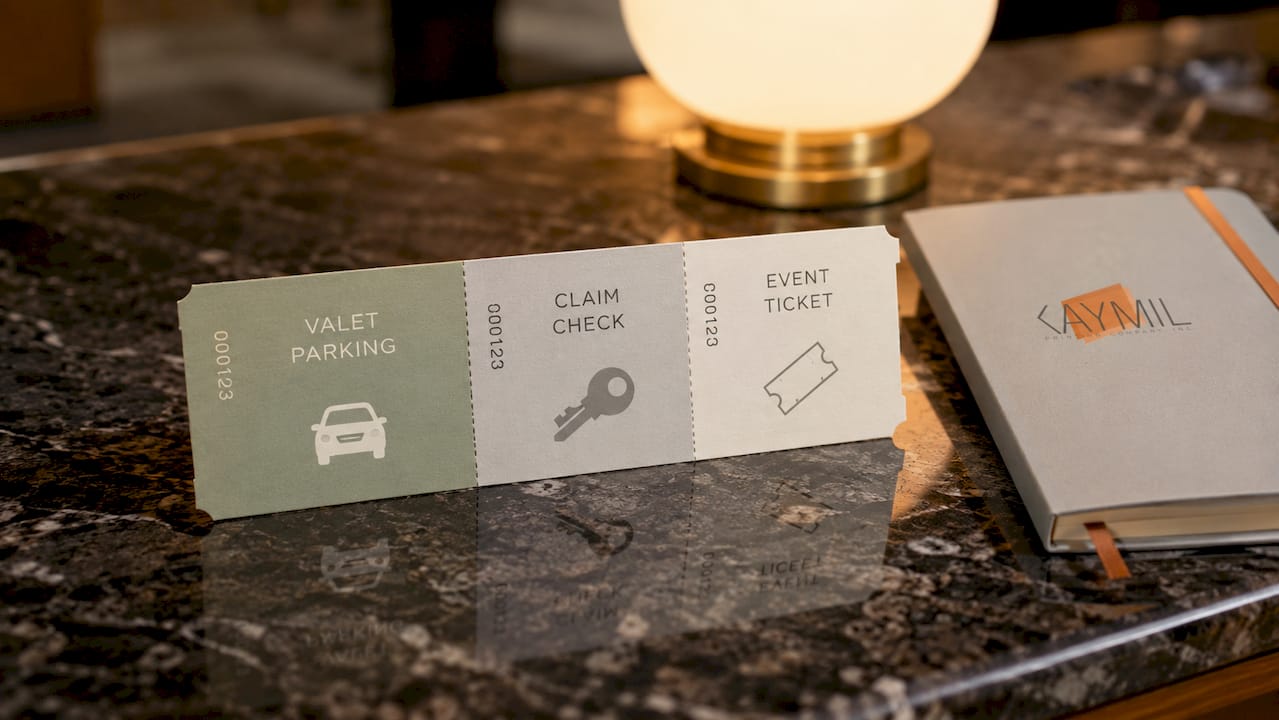
Sequential numbering is not optional. Numbers on every tear-away section act as a traceable financial asset and a fraud deterrent. Typically four to six digits, zero-padded, and printed on both the main body and the stub, these numbers give your team a reliable inventory count and a clear audit trail from the first car in to the last car out.
Beyond structure, the visual layout of the ticket itself matters. Consider these core design elements:
- Ticket orientation and size: Standard event parking passes run 3.5 x 8.5 inches in portrait orientation, though landscape formats work well for windshield hang tags and dashboard permits.
- Perforation placement: Tear lines should be positioned so the stub width falls between 1.5 and 2 inches, giving attendants a clean grip without tearing through printed information.
- Entitlement language: State clearly whether the ticket covers one vehicle, one day, or one event. Ambiguity at the gate costs time.
- Scan zones: Reserve a dedicated white space block for barcodes or QR codes, free of background color or logo overlap that would interfere with scanning.
- Font size and contrast: Gate staff read tickets under variable lighting. Use a minimum 10-point font for critical information and high-contrast color combinations.
Pro Tip: Order a short proof run of 25 to 50 tickets before committing to your full quantity. Check that perforations tear cleanly, numbers are legible on all three parts, and scan zones read accurately with your gate equipment.
How to integrate parking ticket design with event operations
Ticket design and parking operations are not separate decisions. Every layout choice you make either supports or undermines the speed of your entry workflow.
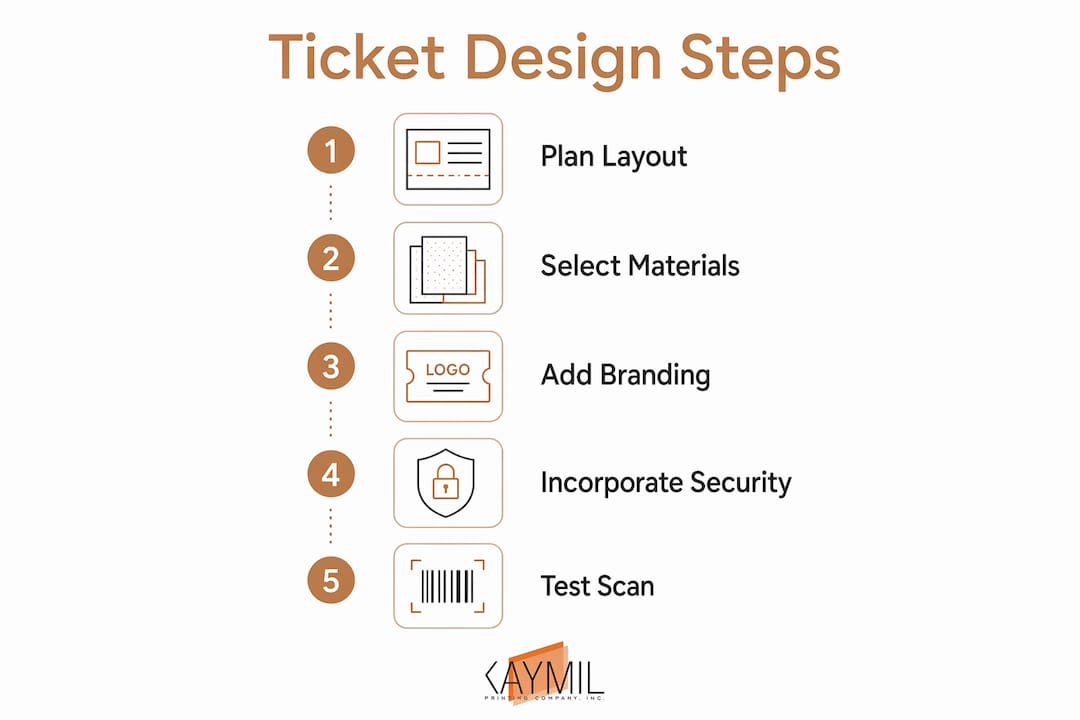
Transactions that exceed roughly one minute at a parking gate create backups that compound quickly at large events. QR codes and automated license plate recognition can separate parking validation from event admission scanning entirely, which means your parking gate staff are not waiting on the event ticketing system to clear before raising the arm. Design your parking ticket with this separation in mind from the start.
Here is a practical workflow that aligns ticket design with gate operations:
- Assign distinct scan zones. Place the parking barcode or QR code on a section of the ticket that remains with the vehicle or the attendant, not the portion the guest tears off and takes inside.
- Print entitlement terms prominently. Clear parking entitlement language on the ticket, such as “Valid: Saturday, June 14 only” or “One vehicle per ticket,” reduces gate disputes without requiring staff intervention.
- Use color coding by lot or zone. Assign a distinct background color to each parking area. Gate staff can direct vehicles visually without reading fine print.
- Design the vehicle copy for dash placement. The section that stays with the car should be sized and oriented to sit flat on a dashboard or hang from a mirror without obscuring the driver’s view.
- Align your scanning logic with ticket design. If your system uses SKIDATA, Amano, or FLASH Parking equipment, confirm that your barcode symbology and placement meet the scanner’s read distance and angle requirements before finalizing the layout.
Separating parking and event entry workflows reduces staffing burdens and produces measurably smoother throughput. The ticket design is the physical interface between your attendees and that workflow. Get it right on paper, and the operation runs itself.
Pro Tip: If your event uses a mobile parking platform like HONK Mobile, request a test scan of your ticket proof with the actual app before printing. Barcode placement that looks correct on screen can still fail at the gate if the quiet zone margins are too narrow.
What are the best print and production considerations for event parking tickets?
Production quality determines whether your design actually performs in the field. A ticket printed on thin stock tears at the wrong point, fades in sunlight, and jams in gate equipment. These are preventable problems.
| Production Factor | Recommended Specification | Why It Matters |
|---|---|---|
| Cardstock weight | 60 to 80 lb. text or 90 lb. index | Holds up in outdoor environments and feeds cleanly through dispensers |
| Perforation alignment | Aligned across all tickets on the sheet | Misaligned perforations cause ticket jams and slow gate processing |
| Sequential numbering method | Cut-and-stack imposition or pre-numbered PDF | Ensures number sequence is maintained across stubs and main tickets |
| Front-to-back registration | Within 1/16 inch tolerance | Prevents double-sided content from shifting out of alignment |
| Finish | Matte or uncoated for scan zones | Glossy finishes reflect light and reduce barcode scan reliability |
Cut-and-stack imposition and pre-numbered PDFs are the two standard production methods that guarantee sequential numbering stays accurate across every stub and main ticket in a run. Cut-and-stack means the printer imposes multiple ticket positions on a single sheet, cuts the stack, and the numbers fall in order automatically. Pre-numbered PDFs assign a unique number to each ticket position before the file goes to press. Both methods work. The choice depends on your printer’s equipment and your run quantity.
Digital proofs before a full print run catch panel spacing errors, misplaced tear lines, and number placement issues before they become a 5,000-ticket problem. A proof approval is not a formality. It is the last checkpoint between your design intent and the physical ticket your attendants will handle under pressure.
Pro Tip: Request a hard-copy proof, not just a PDF. Screen resolution hides perforation alignment issues and color shifts that only appear on the actual printed substrate.
How to customize parking tickets for branding and guest communication
A parking ticket is the first physical object many guests interact with at your event. Treating it as a branding surface costs nothing extra when you are already printing, and the payoff in perceived professionalism is immediate.
Caymil offers customization options that include high-definition logos, vibrant color schemes, sponsor advertisement panels, and event-specific information fields. The practical approach is to divide the ticket face into functional zones and assign branding to the areas that do not interfere with operational elements.
Consider these customization priorities:
- Logo placement: Position your event or venue logo in the header of the main ticket body, away from the scan zone and numbering field. A logo in the stub area gets torn off and discarded.
- Color by function: Use your brand palette for the background and headers, but reserve white or light gray for barcode zones and number fields to maintain scan reliability and legibility.
- Sponsor panels: The back of the ticket is underused real estate. A sponsor advertisement or event schedule on the reverse side adds value without cluttering the operational face.
- Parking rules in plain language: Print the three most important rules directly on the ticket. “No re-entry,” “Valid for one vehicle,” and “Display on dashboard” answer the questions your gate staff field most often.
- Validity period and lot identifier: These two fields reduce more gate disputes than any other design element. Make them large, bold, and impossible to miss.
For events that use barcode-enabled parking tickets, the scan zone discipline is non-negotiable. Keep a minimum 0.25-inch quiet zone on all four sides of the barcode, and never print background color or texture within that boundary. The rest of the ticket is yours to brand as aggressively as the event calls for.
What common mistakes to avoid when designing event parking tickets?
Most design and production errors are predictable. Knowing them in advance saves you from reprinting an entire run the week before your event.
- Misaligned perforations: This is the most common production failure. Perforations that do not align across the sheet cause tickets to tear unevenly, which slows attendants and frustrates guests. Confirm alignment specifications with your printer before approving the proof.
- Vague entitlement language: “Parking pass” tells a guest nothing useful. “Valid: Lot B, Saturday only, one vehicle” eliminates three common gate disputes in six words.
- Numbering gaps or duplicates: A numbering error in a 10,000-ticket run creates inventory reconciliation problems that persist long after the event ends. Verify the number range on your proof against your purchase order.
- Insufficient paper weight: Tickets printed on standard copy-weight paper (20 lb.) tear, curl, and fade in outdoor conditions. Specify a minimum 60 lb. text stock for any ticket exposed to weather.
- Glossy finish over scan zones: Gloss laminate and UV coating reflect scanner light and produce read failures. Specify matte or uncoated finish on any area containing a barcode or QR code.
Pro Tip: Build a one-page design checklist before submitting your final file. Confirm: sequential number range, perforation positions, scan zone dimensions, paper weight, and entitlement language. A five-minute review prevents a five-day reprint delay.
Key takeaways
Effective custom event parking ticket design combines clear entitlement language, sequential numbering on every section, precise perforation alignment, and brand-consistent visuals to produce tickets that work for both guests and gate staff.
| Point | Details |
|---|---|
| Use multi-part ticket structures | Three-part formats with dedicated guest, station, and vehicle sections reduce errors under time pressure. |
| Number every section sequentially | Sequential numbers on all tear-away parts prevent fraud and support accurate inventory reconciliation. |
| Align design with gate workflow | Separate scan zones for parking and event entry validation prevent bottlenecks at high-volume gates. |
| Specify correct paper weight and finish | Use 60 to 80 lb. stock with matte finish on scan zones to prevent tearing, fading, and read failures. |
| Approve a hard-copy proof first | A physical proof catches perforation misalignment and color shifts that PDF review misses entirely. |
Why ticket design details matter more than most planners expect
I have worked with event organizers who spent months on venue layout, catering logistics, and entertainment scheduling, then ordered generic parking tickets two weeks before the event. Every time, the parking operation was the first thing to break down on event day.
The detail that surprises most planners is how much a three-part ticket structure changes staff behavior under pressure. When an attendant has a dedicated vehicle copy, a station record, and a guest claim tab all numbered identically, they stop second-guessing themselves. The ticket tells them exactly what to do. I have seen that single design decision cut average transaction time by a third at busy valet lanes, without any additional training.
The other underestimated element is entitlement language. Planners often treat the text on a parking ticket as an afterthought. In practice, six words printed in 14-point bold type, stating the lot, the date, and the vehicle limit, eliminate the most common gate disputes before they start. That is not a design flourish. It is operational infrastructure printed on cardstock.
Invest the time in a proper proof review, specify the right paper weight, and treat your parking ticket as a functional document first and a branding surface second. The guest experience you protect at the parking gate sets the tone for everything that follows inside the venue.
— Richard
How Caymil supports your event parking ticket needs
Caymil Printing Co. has manufactured custom parking and valet tickets since 1937, and that depth of experience shows in every production detail. Whether you need 3-part valet parking tickets with sequential numbering and perforations, 4-part formats for more complex operations, or barcoded tickets compatible with Amano, SKIDATA, and FLASH Parking systems, Caymil produces them to specification with fast nationwide shipping. Every order includes proof approval before the full run goes to press. Explore Caymil’s full range of customizable parking forms and get your event parking operation built on tickets that actually perform.
FAQ
What is a custom event parking ticket?
A custom event parking ticket is a printed parking pass designed specifically for a single event or venue, incorporating sequential numbering, entitlement language, branding, and optional barcodes or QR codes. Unlike stock tickets, personalized parking permits are produced to match the operational and visual requirements of a specific event.
How many parts should an event parking ticket have?
Most event parking operations use a 3-part ticket format with two perforations, producing a guest claim tab, a station record, and a vehicle copy. Four-part formats suit more complex operations where an additional record is needed for revenue reconciliation or multi-lot management.
Why does sequential numbering matter on parking tickets?
Sequential numbers on every ticket section create a traceable financial record and prevent duplicate or fraudulent entries. Numbers printed on both the stub and the main body allow staff to match any section to its origin instantly, which is critical for inventory audits after large events.
What paper weight is best for outdoor event parking tickets?
A minimum of 60 lb. text stock is the standard for event parking tickets used in outdoor or high-traffic environments. Lighter paper curls, tears prematurely, and fades in direct sunlight, all of which create operational problems at the gate.
How do I prevent barcode scan failures on printed parking tickets?
Maintain a minimum 0.25-inch quiet zone on all four sides of the barcode and specify a matte or uncoated finish for the scan zone area. Glossy finishes reflect scanner light and produce read failures, particularly in outdoor lighting conditions where glare is unpredictable.