
Mail Fulfillment for Permits: A Decision Guide for Operators
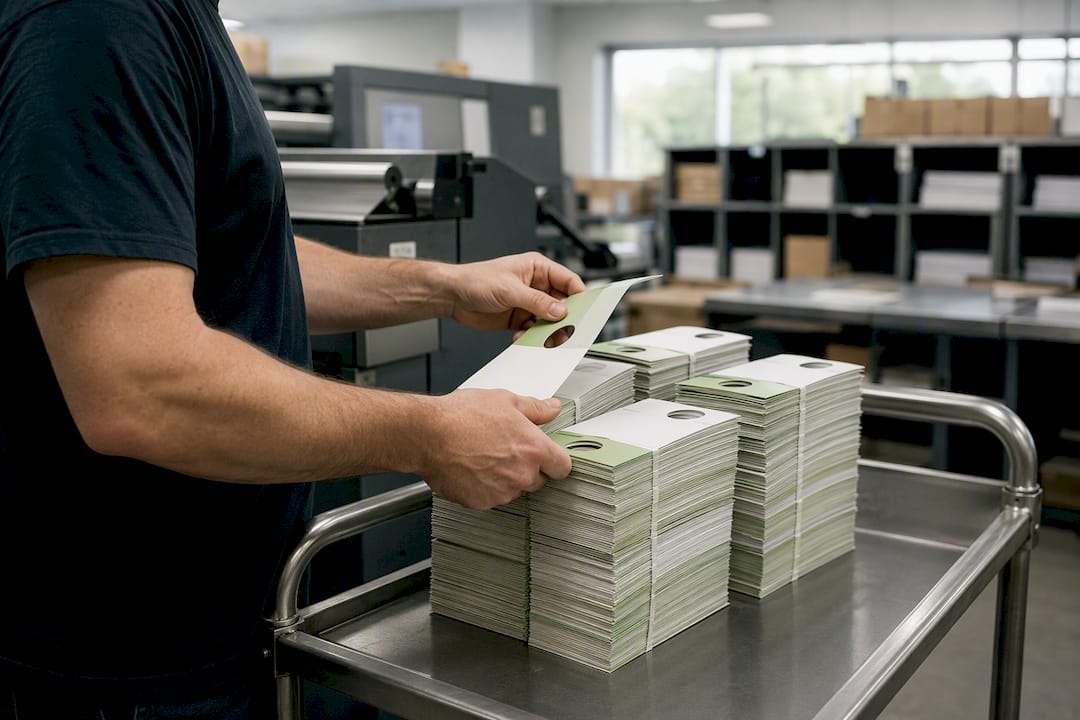
Outsource your permit mail fulfillment once your program moves beyond a few hundred pieces a season. Printing, collating, and mailing permits in-house eats staff hours during the exact weeks operations teams can least afford it, and postage costs climb fast without bulk-mail rates. Outsourcing to a dedicated fulfillment partner solves both problems at once: it reduces per-piece cost through discounted postage rates and frees your staff for enforcement and customer service instead of stuffing envelopes.
Keeping fulfillment in-house still makes sense at very low volumes, say a small residential lot issuing fewer than 200 permits a year, where the fixed setup costs of an outside vendor outweigh the labor saved. Everyone else, from universities to hospital campuses to municipal parking authorities, generally comes out ahead outsourcing the work.
- Cost: Bulk postage and eliminated manual labor typically beat in-house handling once volume passes a few hundred permits.
- Speed: A vendor with dedicated print and mail lines clears seasonal spikes faster than internal staff juggling other duties.
- Compatibility: Confirm the vendor’s numbering and barcoding scheme works with your existing system, whether that’s Amano, TIBA, or SKIDATA.
- Next step: Send a small sample data file to a fulfillment vendor like Caymil and ask for a proof and cost estimate before committing to a full run.
Key Takeaways
Outsourcing permit mail fulfillment cuts postage and labor costs while removing the seasonal bottleneck that overwhelms in-house teams during peak permit runs.
| Point | Details |
|---|---|
| Outsource above low volume | In-house handling only makes sense under a few hundred permits per year. |
| Plan 6 to 8 weeks ahead | Universities and municipalities need longer lead times than hotels or hospitals during peak season. |
| Break down cost line items | Separate print, postage, and labor costs to negotiate each one instead of a bundled rate. |
| Confirm system compatibility | Verify barcode and numbering formats match your Amano, TIBA, or SKIDATA setup before ordering. |
| Start with a trial run | Caymil’s forms for parking product line supports a 50 to 100 piece trial before a full commitment. |
Table of Contents
- What Does Mail Fulfillment for Permits Actually Involve?
- How Far Ahead Should You Plan Permit Mailings?
- What Drives the Cost of Permit Fulfillment?
- What Should You Budget for Total Cost of Ownership?
- What Contract Terms Should You Negotiate?
- What Legal Rules Apply to Permit Mailings?
- A Print Producer’s View on Permit Season
- How Caymil Fits Your Permit Fulfillment Checklist
- Sources
- FAQ
What Does Mail Fulfillment for Permits Actually Involve?
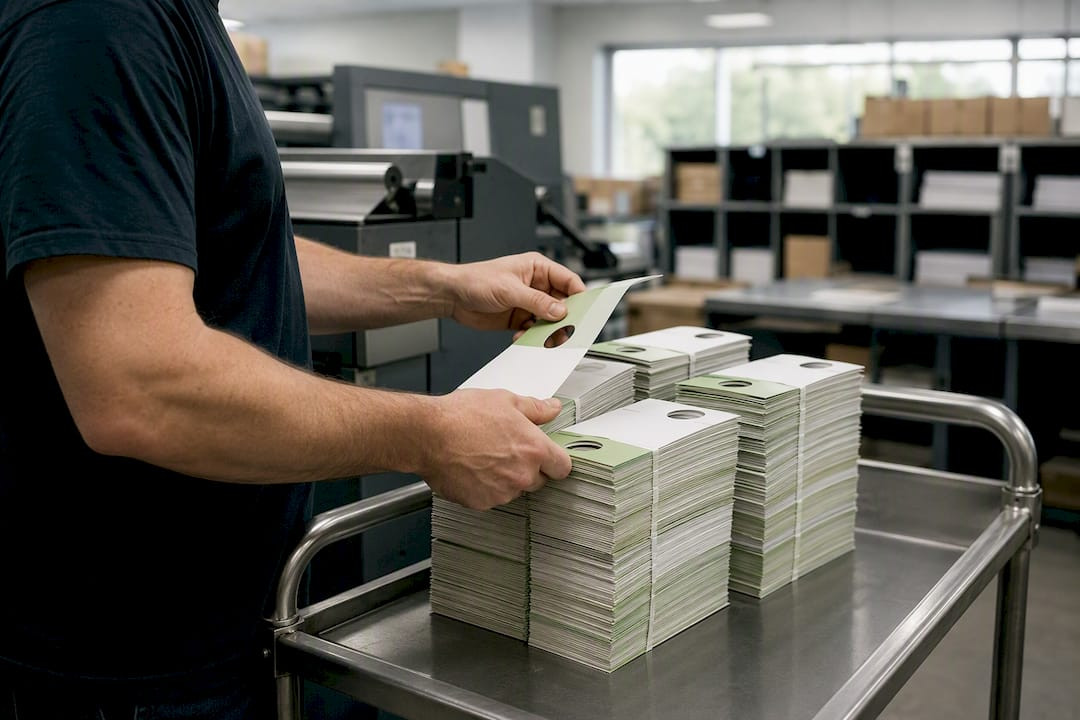
Mail fulfillment for permits covers the full chain from raw recipient data to a permit in someone’s mailbox: file upload, proofing, printing, packaging, and mailing. Most parking operators use the term loosely to mean “getting permits printed and out the door,” but the workflow behind it has five distinct stages, and skipping any one of them is where programs run into trouble.
It starts with a secure data upload. You send your vendor a recipient file, typically a spreadsheet with names, addresses, vehicle information, and permit numbers, through an encrypted portal or SFTP connection rather than email. The vendor then generates a proof, a visual mockup of the actual permit with your logo, sequential numbers, and barcodes populated from your data, for your approval before anything goes to press.
Printing follows once you sign off. This is where format choices matter: hang tags for garages, decals for windshields, or temporary paper permits for guests and short-term visitors. Collating and packaging come next, where permits get paired with any required inserts, parking rules, campus maps, welcome letters, before being sealed for mailing.
The final step, direct mailing, often gets treated as an afterthought, but it’s where address validation and mail class selection determine whether permits arrive on time or bounce back as undeliverable. A capable vendor closes the loop with a post-mailing data sync, updating your records to show exactly which permit number went to which address. That reporting matters more than most operators expect the first time a permit holder disputes receiving one.
How Far Ahead Should You Plan Permit Mailings?
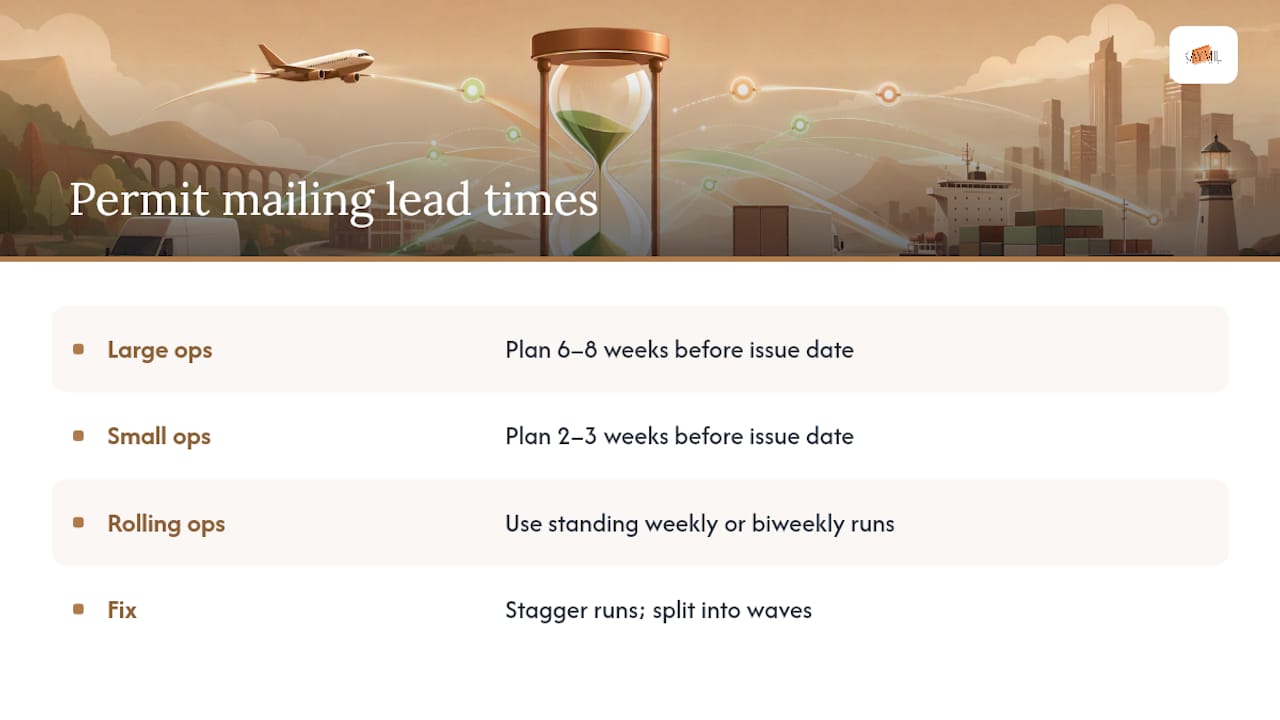
Plan your permit run 6 to 8 weeks before your issue date if you’re a university or municipality processing thousands of pieces. Smaller operations, hotels or hospitals issuing a few hundred permits, can usually work with a 2 to 3 week lead time. The gap exists because print capacity, proofing rounds, and mail transit time all stack up, and permit season compresses everyone’s timeline into the same narrow window.
Universities are the clearest example. Fall semester housing permits, faculty renewals, and event parking often land in the same six week stretch in August, and every other campus in the region is placing similar orders at the same time. Vendors that advertise 24 to 48 hour turnaround for in-stock items are describing processing time once your proof is approved, not the full cycle including design, proofing revisions, and postal transit.
Staggering your runs is the practical fix. Instead of mailing 5,000 permits in one batch, split the order into two or three waves, new registrants first, renewals second, so your vendor’s press and mail room aren’t bottlenecked on a single massive job. This also gives you a chance to catch address errors or barcode mismatches in the first wave before they repeat across the full volume.
Pro Tip: Ask your vendor for their peak-season cutoff dates in writing. Most fulfillment operations stop accepting new “rush” jobs two to three weeks before major academic or municipal permit deadlines, and finding that out after you’ve missed the window is a bad way to start the semester.
Hospitals and casinos with rolling permit issuance, new hires, contractor badges, don’t face the same seasonal spike, but they still benefit from a standing weekly or biweekly mail run rather than one-off orders, which usually cost more per piece.
What Drives the Cost of Permit Fulfillment?
Five variables set your per-piece cost: printing complexity, mail class, postage, insert materials, and fulfillment labor. Understanding which ones you control changes how you negotiate with a vendor.
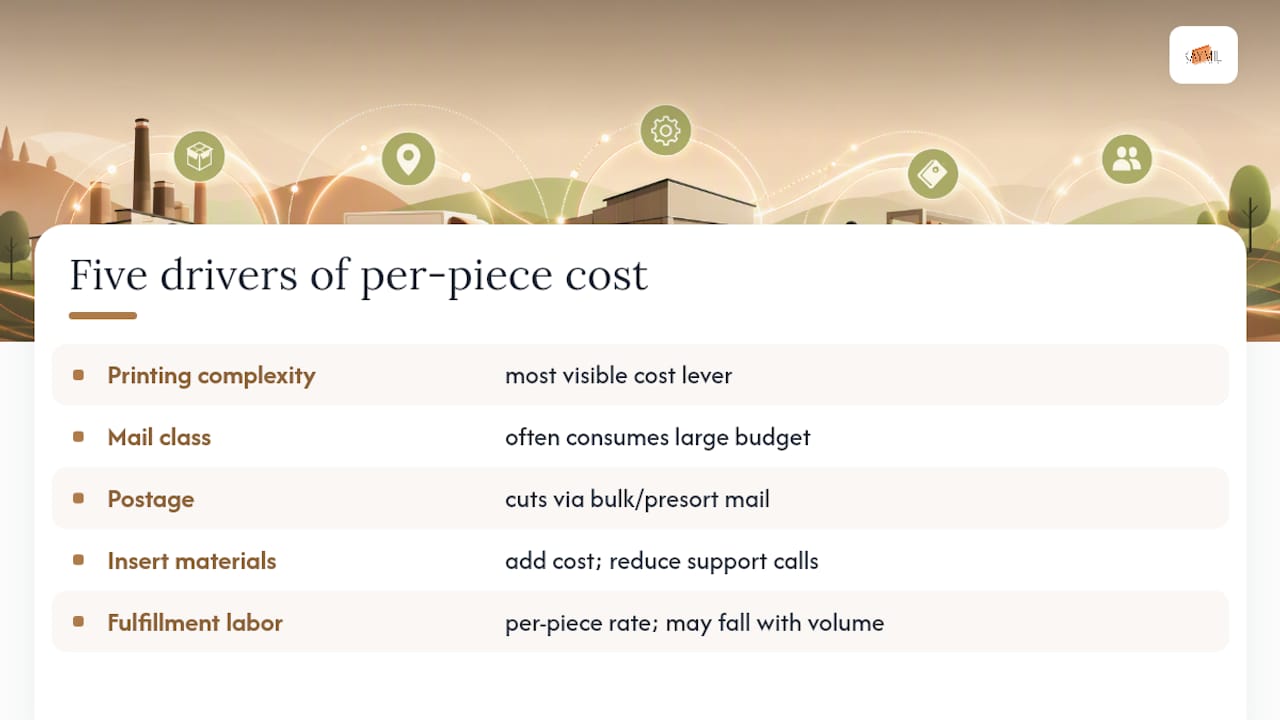
Printing complexity is the most visible lever. A basic single-color paper permit costs far less to produce than a multi-part carbonless hang tag with sequential numbering, a barcode, and security features like void pantographs or holographic foil. If your program doesn’t need barcoding for automated gate access, dropping it lowers your per-unit print cost meaningfully.
Mail class is where a lot of budget disappears without anyone noticing. First-Class mail delivers faster and forwards automatically, but bulk rates through USPS Marketing Mail or presorted First-Class can cut postage substantially on large runs, provided your vendor has the bulk mailing permit and volume to qualify for those discounts. This is one of the clearest reasons outsourcing beats in-house mailing at scale: individual stamps on 3,000 letters cost dramatically more than a presorted batch run through a fulfillment partner’s mail account.
Insert materials, welcome letters, parking maps, rule sheets, add incremental cost per piece but also reduce support calls, since permit holders who get clear instructions call the office less. Fulfillment labor, the actual collating and stuffing, is baked into most vendor quotes as a per-piece rate, but it’s worth asking whether that rate changes at higher volumes. It usually does.
What Should You Budget for Total Cost of Ownership?
Your true cost per permit includes far more than the printed piece. A realistic total cost of ownership calculation covers three categories: one-time setup fees, minimum order volumes, and the recurring variable costs per mailing.
Setup fees typically cover template creation, your logo and layout applied to the vendor’s permit stock, and initial proofing. Some vendors waive this for standard formats and charge only for custom multi-part designs or specialty security features. Ask specifically whether setup is a one-time charge or resets each time you make a design change, since permit programs often tweak wording or add a QR code mid-year.
Minimum volumes matter more than most first-time buyers expect. A vendor built for high-volume bulk parking ticket orders may set a minimum run that doesn’t make financial sense for a boutique hotel issuing 50 valet permits a month. Confirm the minimum before requesting a formal quote, or you’ll spend time evaluating a vendor you can’t actually use at your scale.
Variable costs, the per-piece charge that includes print, materials, collation, and postage, are where the real budget lives once setup is behind you. Get this broken into line items rather than a single bundled number. A vendor quoting “$1.10 per permit” without separating print cost from postage makes it hard to compare against a competitor’s structure or to negotiate down a single component, like switching to a lighter card stock to trim postage weight.
What Contract Terms Should You Negotiate?
Contract length, volume commitments, and rush-order pricing are the three terms that matter most when signing with a fulfillment vendor. Most permit programs sign 12-month agreements tied to a fiscal or academic year, which makes sense given the seasonal nature of the work, but the details inside that term are where flexibility gets won or lost.
Push for volume flexibility rather than a fixed annual commitment. Enrollment shifts, hospital staffing changes, and municipal permit demand all fluctuate year to year, and a contract locking you into a specific piece count penalizes you for under-ordering in a slow year. A better structure ties pricing to volume tiers, so your per-piece rate improves as you order more, without obligating you to a number you might not hit.
Rush-order terms deserve explicit negotiation, not an assumption. Ask what the vendor charges, and how much lead time they need, for an expedited run outside your normal schedule. This clause is the one you’ll actually use when a late registration wave or a printing error forces a reorder mid-season.
Data ownership and retention terms belong in the contract too. Confirm who owns the recipient database, how long the vendor retains your files after a job completes, and what happens to that data if you switch vendors. A short trial period before a full annual commitment, covered in more detail further in this guide, is the cleanest way to test these terms before they’re locked in for a year.
What Legal Rules Apply to Permit Mailings?
USPS mailing standards and your state’s data privacy rules are the two compliance areas that actually affect permit mailings. Neither is complicated, but both trip up operators who assume any printed piece can go in any envelope at any address.
Address accuracy matters legally, not just operationally. USPS requires accurate, deliverable addresses for any mail class, and using outdated or unverified addresses increases both cost, through returned mail, and the risk that a valid permit holder never receives their permit and disputes a citation as a result. A vendor running address validation as part of the mailing process catches most of these errors before a piece ever reaches a mailbox.
Data handling is the second compliance layer, particularly for universities and hospitals bound by FERPA or HIPAA-adjacent privacy expectations around student and employee information. Your fulfillment vendor should offer a secure upload portal rather than email attachments, a written retention and deletion policy for recipient files, and a clear answer on who can access your data during processing. If a vendor can’t describe their data-handling policy in specific terms, in writing, that’s a red flag worth treating as disqualifying.
Municipalities have an added layer: public records requests can sometimes apply to permit databases, so confirm with your legal counsel whether recipient lists sent to a third-party vendor fall under your jurisdiction’s disclosure rules before you sign a contract.
A Print Producer’s View on Permit Season
Every permit season looks the same from the print side: a burst of nearly identical orders in a six-week window, all wanting to be first in the queue. What actually separates a smooth rollout from a scramble is proofing discipline. Universities and hospitals that catch numbering errors at the proof stage, rather than after a full run ships, save themselves the worst kind of rework.
The detail clients underestimate is the return address. A white-labeled mailer with your organization’s name and address, not a printer’s, keeps recipients from assuming the envelope is junk mail. It’s a small choice with outsized effect on how many permits actually get opened.
Phase outsourcing in with one segment, guest permits or a single building, before moving your full volume. It surfaces data formatting issues while the stakes are still low.
How Caymil Fits Your Permit Fulfillment Checklist
Caymil builds permit hang tags, decals, and temporary permit formats with sequential numbering, barcoding, and multi-part construction, then handles the printing and nationwide packaging that gets them into your permit holders’ hands. That combination, product manufacturing plus fulfillment under one roof, is the piece most vendor checklists are built around, and it’s the reason parking operators searching for both a printer and a mail partner often end up narrowing their list to a single provider instead of coordinating two.
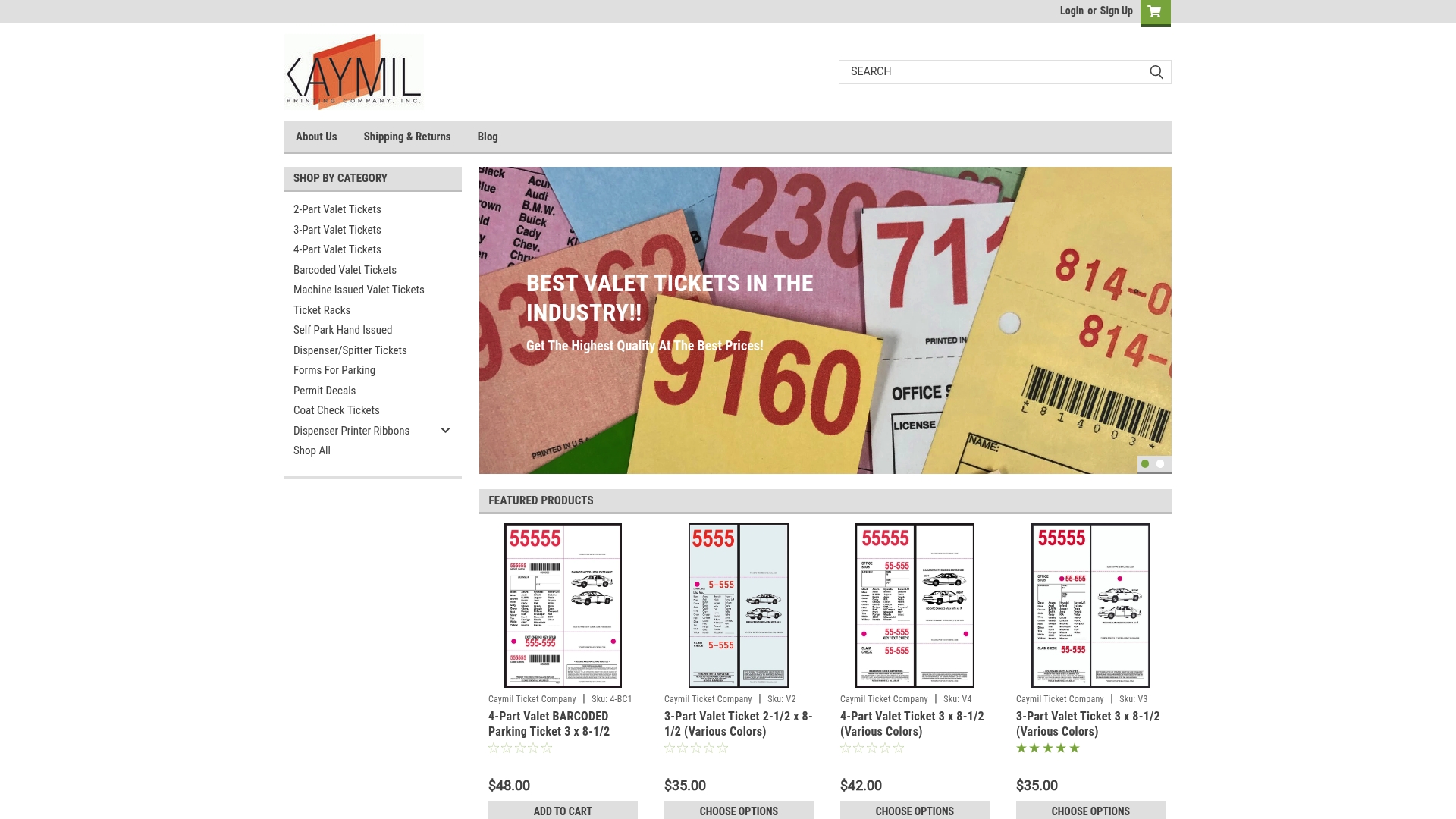
The checklist items covered earlier in this guide map directly to what Caymil offers: secure file submission for your recipient data, a proofing and approval step before anything prints, and product compatibility with the access-control systems most operators already run, including Amano, TIBA, SKIDATA, FLASH Parking, Scheidt & Bachmann, and Flowbird gate hardware. If your permits need to trigger a barcode scanner or match a specific numbering sequence tied to your existing system, that’s worth flagging in your first conversation.
The lowest-risk way to evaluate any fulfillment partner is a small trial before a full commitment. Send Caymil a sample data file, note which inserts you want included, and set a target mailing date, then request a trial run of 50 to 100 permits through the forms for parking product line to see proof turnaround and final quality firsthand before your full permit season order goes out.
Sources
- Pitney Bowes blog — postage discounts and outsourcing mail processing
FAQ
What Is Mail Fulfillment for Permits?
It’s the full process of printing, packaging, and mailing physical parking permits, hang tags, decals, or temporary permits, to permit holders, typically handled by a dedicated vendor rather than internal staff.
How Much Does Permit Mail Fulfillment Cost?
Cost depends on print complexity, mail class, and volume, but bulk postage rates through an outsourced vendor generally beat individual mailing costs handled in-house.
How Long Does Permit Fulfillment Take?
Plan 6 to 8 weeks ahead for large university or municipal runs, and 2 to 3 weeks for smaller hotel or hospital orders, accounting for proofing, printing, and mail transit.
Does Caymil Work With My Existing Parking System?
Caymil’s permit products are built with compatibility notes for major systems including Amano, TIBA, SKIDATA, FLASH Parking, Scheidt & Bachmann, and Flowbird, so confirm your specific numbering or barcode requirements during your initial inquiry.
Should I Request a Trial Before Committing to a Vendor?
Yes. A small trial run of 50 to 100 permits lets you evaluate proof accuracy, turnaround time, and packaging quality before signing a full annual contract.