

Day-of-Event Parking Permit: Guide for Parking Managers

A day-of-event parking permit is a short-term access credential valid only for the duration of a specific event or calendar day. Unlike monthly, seasonal, or assigned permits, it grants no ongoing access rights and typically expires when the event ends. For overflow lots, open-house events, and last-minute attendees, a first-come, first-served day-of permit is the right call. For capacity-critical or high-security events, prepaid or allocated permits provide operators far better control. Caymil Printing Co. has manufactured these credentials since 1937, and the format and security features you choose matter as much as the permit policy itself.
Table of Contents
- When do venues issue day-of-event permits?
- What formats and features should you specify?
- How does custom printing support day-of permit operations?
- Operational checklist: issuance, staffing, and timeline
- Best practices and common mistakes
- How do you design permits for different vehicle types?
- Environmental considerations in permit design
- Compliance with local regulations and accessibility standards
- Contingency planning for lost permits, fraud, and enforcement
- Post-event permit collection and reconciliation
- Key Takeaways
- A manufacturer’s perspective on day-of permit decisions
- Caymil’s printing solutions for day-of-event permits
- FAQ
When do venues issue day-of-event permits?
Day-of permits solve a specific operational problem: demand that is too variable or too infrequent to justify permanent permit infrastructure. Common use cases include overflow lots at stadiums and universities, community events with unpredictable attendance, shared-use facilities running simultaneous events, and last-minute attendees who missed prepayment windows.
The operational benefits are concrete, as detailed in how electric vehicles transform golf facility operations, where efficient fleet movement and staging support smoother event day logistics.
- Capacity management: Lots can be closed once capacity is reached, preventing the congestion that follows overselling.
- Dynamic pricing: Day-of rates are typically higher than prepaid rates. Penn State, for example, lists day-of event parking at a higher rate than discounted prepaid options, which run lower when purchased in advance.
- Simplified enforcement: A single-day credential is easy to verify visually or by scan, reducing gate disputes.
- Reduced pre-event administration: Staff issue permits at the gate rather than managing a permit database weeks in advance.
One misconception operators hear constantly: attendees assume a day-of permit reserves a specific spot. AT&T Stadium’s parking rules make the policy explicit — parking is managed live, and reserving or saving spots is prohibited. Day-of permits grant lot access, not a guaranteed space. When simultaneous events occur, the higher applicable rate applies automatically to anyone without a valid prepaid permit.
What formats and features should you specify?
The right format depends on throughput requirements, event duration, and your gate hardware. The four main options each carry distinct tradeoffs.
Roll/machine-issued tickets (thermal or impact-printed) are the fastest option at high-volume gates. Paired with a simple barcode scan, they process vehicles quickly and integrate directly with systems like Amano, TIBA, SKIDATA, FLASH Parking, Scheidt & Bachmann, and Flowbird. See the event parking ticket types guide for a format-by-format breakdown.
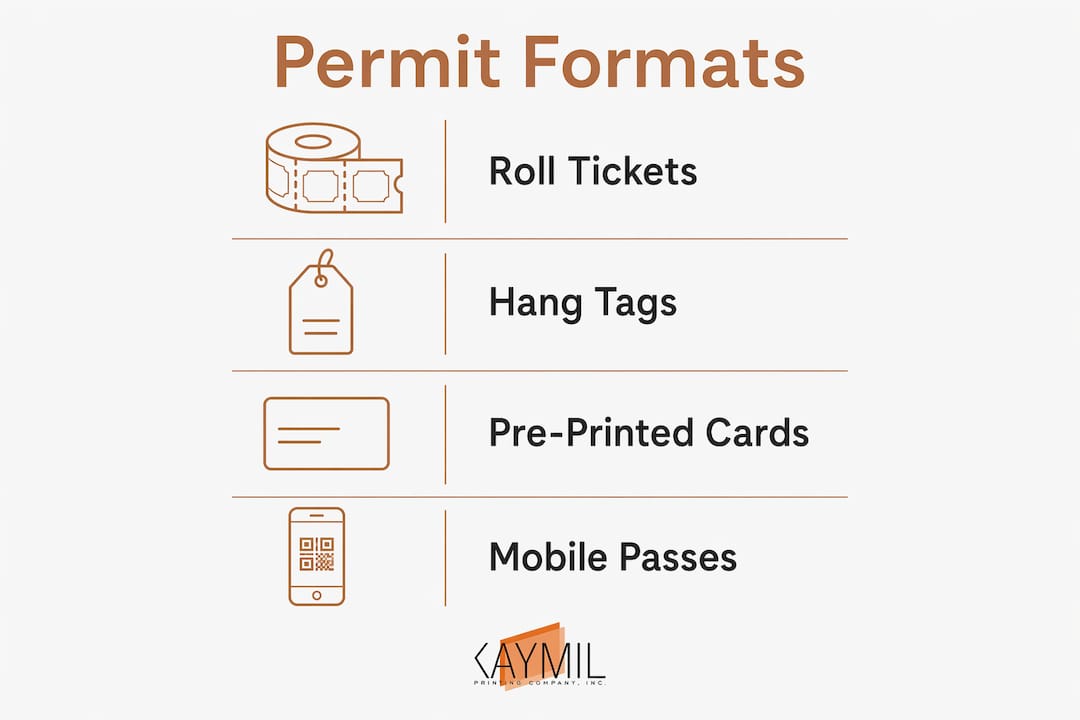
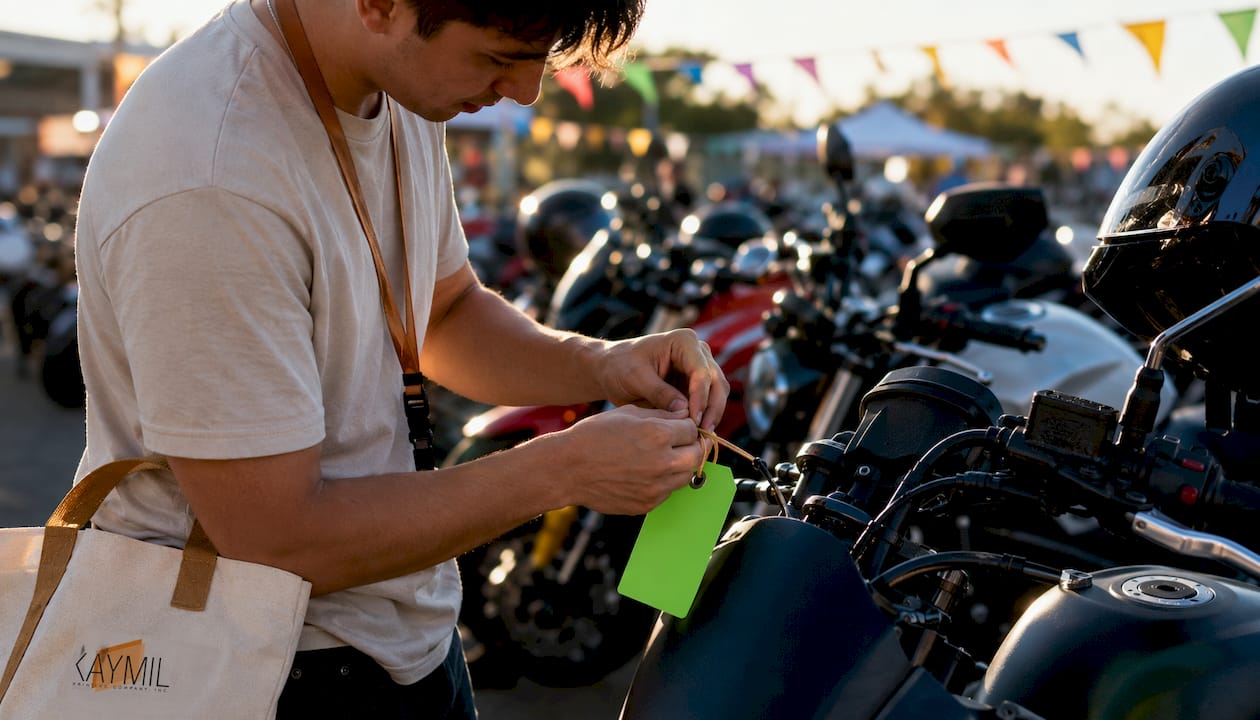
Hang tags suit longer-duration events where durability and re-entry control matter more than raw throughput. A weatherproof hang tag with a serialized barcode lets enforcement staff verify credentials without stopping vehicles.
Pre-printed card or paper passes work well for pre-distributed VIP or ADA allocations, where the permit is mailed or handed to attendees before arrival.
Mobile/QR passes are increasingly standard. Many venues now require prepayment through mobile apps or pay stations, and cashless payment is the norm at major facilities. The tradeoff: gate hardware must support the barcode or QR symbology the pass uses.
Feature checklist for any format:
- Sequential numbering for reconciliation
- Barcode or QR code tied to a manifest
- Color-coding by lot or zone
- Perforation or tear-off stubs for auditing
- Weather-resistant stock for outdoor lots
- Magnetic stripe or RFID where gate hardware requires it
Pro Tip: Before finalizing your ticket stock, confirm the barcode symbology (Code 39, Code 128, QR, PDF417) your gate scanner accepts. A mismatch between printed permit and reader is one of the most common causes of gate delays at high-volume events.
How does custom printing support day-of permit operations?
Every field on a day-of permit carries operational weight. A well-designed credential includes the event name and date, lot or zone designation, validity window, vehicle type, sequential number, barcode or QR, and a logo or color code for quick visual verification. Caymil’s custom event parking ticket design resource covers recommended field layouts and spec examples in detail.
Security features matter more than most operators expect. Tamper-evident hang tags, holographic foil, microprinting, and serialized barcodes tied to a manifest all reduce fraud risk at busy events. For high-value lots, spot UV or invisible ink adds another layer without slowing print production.
Key customization options:
- Stock vs. custom: Stock permits ship fast and suit recurring formats; fully custom permits accommodate unique dimensions, security features, or branding requirements.
- Rush printing: Caymil maintains millions of tickets in stock and offers fast nationwide shipping, which matters when an event is confirmed on short notice.
- Compatibility: Ticket stock dimensions and barcode symbology must match gate scanner specifications for Amano, TIBA, SKIDATA, and other systems before the print run is finalized.
Pro Tip: Order a small proof run and test it through your actual gate hardware before committing to a full quantity. Dimensional tolerances that look fine on paper can cause feed errors in high-speed dispensers.
Operational checklist: issuance, staffing, and timeline
A structured timeline prevents the most common day-of failures.
| Timeframe | Task |
|---|---|
| — | Confirm lot capacity, select permit format, place print order |
| 2–4 weeks out | Finalize staffing plan, order signage, set pricing tiers |
| — | Brief gate staff, test scanner/barcode compatibility |
| Day of event | Open lots on schedule, issue permits, monitor capacity |
| Post-event | Collect permits, reconcile manifest, audit revenue |
Staffing roles:
- Permit sales attendants — issue and collect payment at entry points
- Gate attendants — verify credentials and direct traffic flow
- Traffic control staff — manage ingress/egress queues and overflow routing
- Roving enforcement — check permits in the lot and address violations
- Reconciliation/accounting — match issued permits to revenue at close
Issuance method comparison:
- Preprinted handouts: Low cost, fast distribution, higher fraud risk without serialization
- Gate-printed machine tickets: High throughput, direct system integration, requires hardware
- Mobile/QR issuance: Cashless and auditable, but demands compatible gate readers
- Attendant-distributed hang tags: Durable, good for re-entry control, slower at peak arrival
Budget line items to plan for: printing cost, barcode or serialization add-ons, temporary staffing, signage, mobile-payment processing fees, and reconciliation labor.
Use serialized numbering or barcode manifests to reconcile cashless and cash sales. This prevents ticket reuse and simplifies post-event audits considerably.
Best practices and common mistakes
Clear lot maps, explicit validity windows printed directly on the permit, and color-coding by lot or vehicle type reduce attendee confusion before a single gate opens. Pre-event staff briefings — covering gate scripts, escalation procedures, and scanner operation — cut disputes at the busiest arrival windows.
“Lack of advance information causes congestion and gate delays. Coordinating staffing, traffic control, and accessible routing before the event is the difference between a smooth operation and a bottleneck that takes hours to clear.” — Cal State LA Event Parking Guidelines
Common pitfalls worth avoiding: relying on attendees to understand first-come, first-served rules without explicit signage; insufficient validation at busy gates; mismatched barcode symbology between printed permits and scanners; and confusing or absent lot maps. UW–Madison’s event parking help center notes that arrival time often determines access, so communicating capacity risk to attendees before they leave home reduces gate pressure.
Pro Tip: Publish a pre-event parking advisory at least 48 hours before the event. Include lot opening times, payment methods accepted, and a direct statement that permits do not guarantee a specific space.
How do you design permits for different vehicle types?
Standard passenger vehicles, motorcycles, oversized vehicles, VIP guests, and ADA-accessible parking each require distinct permit handling. A single undifferentiated permit format creates enforcement headaches.
Color-coding is the most practical solution at scale. Assign a distinct color per vehicle category: one for standard cars, another for motorcycles (which may share a designated zone), a premium color for VIP lots, and a clearly marked accessible permit for ADA spaces. ADA parking at major venues requires event-specific allocation. A state-issued placard alone does not guarantee access to event lots — operators must issue a valid event ADA parking permit alongside any placard requirement.
Oversized vehicles (typically those exceeding 18 feet in length or 9 feet in width) need a separate designation that triggers a rate adjustment and directs them to appropriate spaces. Print that designation prominently on the permit face.
Environmental considerations in permit design
Sustainability in permit printing is a practical concern, not just a policy checkbox. Single-use paper permits generate waste at scale, and operators increasingly look for ways to reduce that footprint.
Recycled or FSC-certified paper stock is available for most permit formats without sacrificing print quality or durability. Thermal printing eliminates the need for ink cartridges, reducing chemical waste per ticket. Mobile and QR-based passes eliminate physical media entirely for attendees who prefer digital credentials.
For events where physical permits are required, collecting permits at exit points and recycling them reduces landfill contribution. Multi-part carbonless tickets, where the top copy is collected and the carbon copy stays with the attendee, cut total paper consumption compared to issuing separate receipts.
Compliance with local regulations and accessibility standards
Day-of permits must satisfy both local parking ordinances and federal accessibility requirements. The Americans with Disabilities Act mandates a minimum number of accessible spaces based on total lot capacity, and those spaces must be clearly marked, properly dimensioned, and located on the shortest accessible route to the venue entrance.
Operators should verify local municipal permit requirements before issuing day-of credentials on public streets or in shared municipal lots. Some jurisdictions require a temporary use permit from the city or county transportation authority before a private operator can charge for parking in those areas. Confirm current requirements with your local authority having jurisdiction.
Contingency planning for lost permits, fraud, and enforcement
Lost permits happen at every large event. The standard response: require the attendee to show proof of purchase (a receipt, a mobile confirmation, or a credit card transaction) and issue a replacement with a clearly marked “duplicate” notation. Never issue a replacement without verification — that gap is where fraud enters.
Fraud prevention relies on serialization. A barcode manifest that logs every issued permit number makes it straightforward to identify duplicates or counterfeits at the gate. Short validity windows (time-stamped to the event day only) limit the window for reuse. Post-event permit collection, where staff retrieve hang tags or passes at exit points, closes the loop entirely.
Enforcement protocols should be documented before the event, not improvised during it. Define the escalation path: attendant identifies violation, contacts supervisor, supervisor contacts towing or citation authority. Gate staff should not make independent towing decisions.
Post-event permit collection and reconciliation
Reconciliation starts with the manifest. Every permit issued — whether printed, machine-dispensed, or mobile — should correspond to a revenue entry. Match sequential numbers or barcode scans against payment records to identify gaps. Gaps indicate either a collection failure or a revenue discrepancy worth investigating.
Collect physical permits at exit points when the format allows it. Hang tags are easy to retrieve; machine-issued tickets are typically retained at the gate scanner. Mobile passes reconcile automatically through the payment platform. Any uncollected physical permits should be voided in the manifest to prevent reuse at a future event.
Key Takeaways
A day-of-event parking permit is a single-day access credential that grants lot entry, not a reserved space, and the format you choose determines throughput, security, and reconciliation accuracy.
| Point | Details |
|---|---|
| Definition and scope | A day-of permit is valid for one event day only; it does not reserve a specific parking space. |
| Format selection | Match the format (hang tag, machine ticket, mobile/QR) to your gate hardware and event duration. |
| Barcode compatibility | Confirm barcode symbology with your gate system (Amano, TIBA, SKIDATA, Flowbird, etc.) before printing. |
| ADA compliance | A state-issued placard alone does not grant event lot access; issue a separate event ADA permit. |
| Caymil as print partner | Caymil manufactures stock and custom permits with sequential numbering, barcoding, and security features, with fast nationwide shipping for last-minute events. |
A manufacturer’s perspective on day-of permit decisions
The question operators ask most often is not “what format should I use?” It is “how fast can you get it to me?” Rush orders for day-of permits are the norm, not the exception. Events get confirmed late, capacities change, and permit quantities get revised the week before gates open.
What that experience reveals is a consistent gap between what operators plan and what they actually need at the gate. The most-requested security features are serialized barcodes and tamper-evident stock — not because operators have experienced fraud, but because they have seen what happens when permits are easy to copy. The compatibility check with gate systems is the step most often skipped under time pressure, and it is the one that causes the most visible problems on event day.
The practical advice from decades of manufacturing: order earlier than you think you need to, test a proof through your actual hardware, and treat the barcode manifest as a financial document, not just an operational one.
Caymil’s printing solutions for day-of-event permits
Caymil has manufactured parking permits and event tickets since 1937, and the product line covers every format an event operation requires. Stock hang tags, machine-issued roll tickets, barcoded valet tickets, and multi-part carbonless formats are available with fast nationwide shipping. Custom orders include sequential numbering, full-color logos, security features, and barcode symbologies confirmed for compatibility with Amano, TIBA, SKIDATA, FLASH Parking, Scheidt & Bachmann, and Flowbird systems.
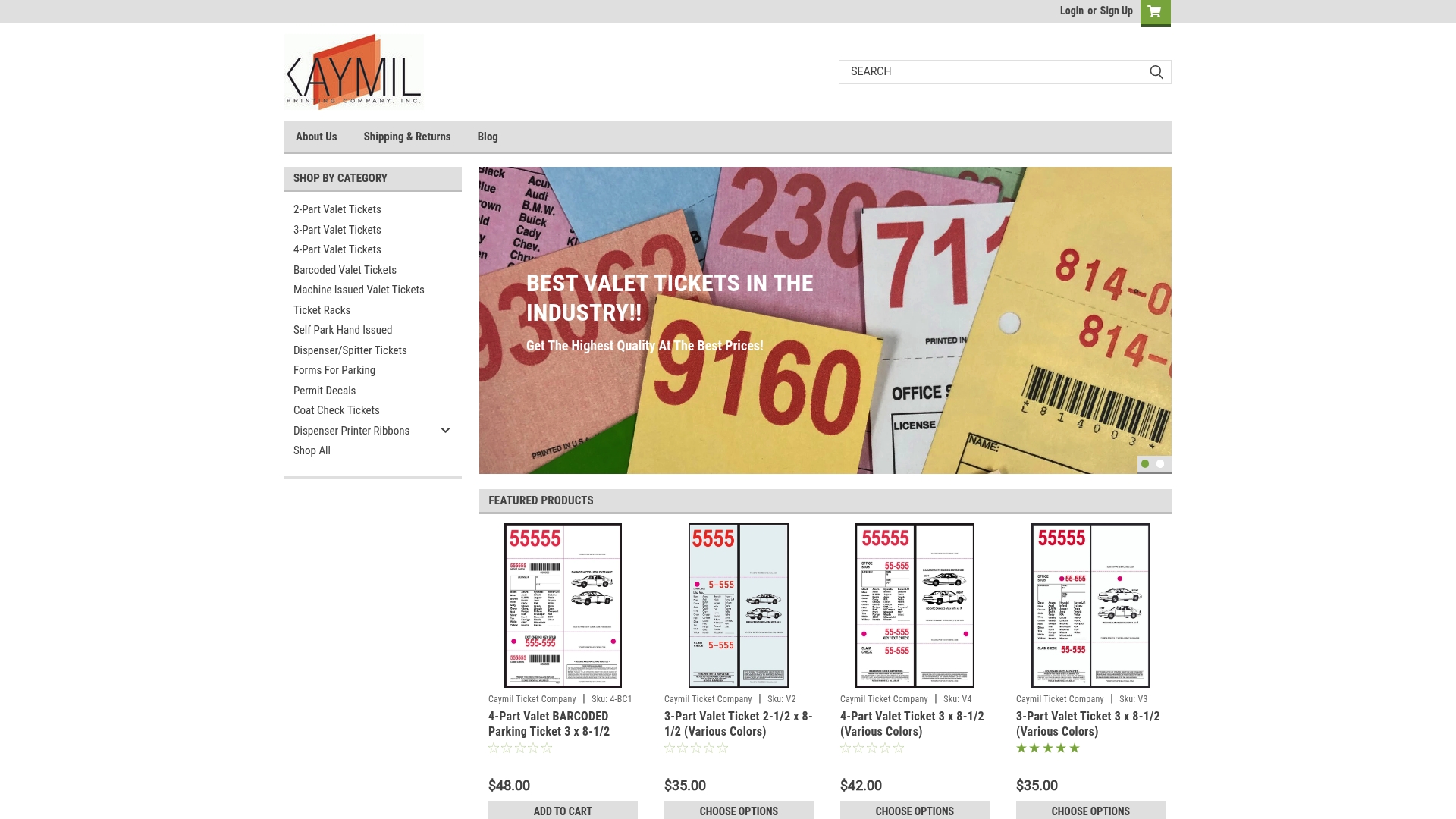
For operators who need a proven print partner with the inventory and manufacturing depth to handle last-minute event requirements, Caymil’s parking permit forms and templates are a practical starting point. Request a quote or browse stock options to find the format that fits your next event.
FAQ
What is a day-of-event parking permit?
A day-of-event parking permit is a short-term access credential valid only for the day of a specific event. It grants entry to a designated lot but does not reserve a specific parking space.
Does a day-of permit guarantee a parking spot?
No. Major venues explicitly state that parking is first-come, first-served and that saving or reserving spots is prohibited, even with a valid permit.
How much does day-of event parking typically cost?
Rates vary by venue and event. Penn State’s transportation office lists day-of event parking at $10, with discounted prepaid options available at a lower rate when purchased in advance.
Does an ADA placard cover event parking?
Not automatically. A state-issued ADA placard or license plate does not grant access to event lots without a purchased event ADA parking permit, as confirmed by major stadium parking policies.
What barcode format works best for day-of permits?
Code 128 and QR codes are the most widely supported across gate systems including Amano, TIBA, and SKIDATA. Confirm the accepted symbology with your specific hardware before placing a print order.
Recommended
- What is an event parking ticket? The pro’s guide - Caymil Printing Co., Inc.
- Hotel Parking Permit System Explained for Managers - Caymil Printing Co., Inc.
- How Event Parking Lot Management Works in 2026 - Caymil Printing Co., Inc.
- Event Parking Ticket Types: A Planner’s 2026 Guide - Caymil Printing Co., Inc.