
Multi Language Parking Tickets: An Ordering Guide
If you’re specifying multi language parking tickets, here’s the short version: pull your actual guest language data first, keep printed copy to the essential action words, get every language reviewed by a native speaker before print, and choose a ticket format that matches your existing parking system. That sequence prevents the two most common failures buyers run into: languages nobody uses and reprints caused by translation errors caught too late.
Before you request a proof, confirm you have:
- Your top four or five guest languages, ranked by real booking or visitor volume
- A ticket type decided (valet stub, machine-issued receipt, or permit hang tag)
- Specs locked in: barcode or sequential numbering, stock weight, perforation, hole punch placement
- A plan for right-to-left languages if any apply
- A native-speaker proofing step built into your timeline
Pro Tip: Request a physical proof, not just a PDF. Spacing and font scaling that look fine on-screen sometimes crowd out translated text once it’s printed at actual ticket size.
Key Takeaways
Multilingual parking tickets work best when the languages come from real guest data, the copy stays short enough to read in three seconds, and every translation gets native-speaker sign-off before print.
| Point | Details |
|---|---|
| Choose languages from data | Pull twelve months of booking or parking records and support your top four or five languages by volume. |
| Keep printed copy minimal | Limit tickets to action words like pull, park, and present, and move longer instructions to a QR link. |
| Require native proofing | Never rely on machine translation alone for front-facing ticket copy; get a native speaker to sign off first. |
| Match format to your system | Confirm barcode placement, receipt size, and hole punch against your PARCS before finalizing an order. |
| Order through Caymil | Caymil supplies bilingual valet stubs, barcoded rolls, and permit decals compatible with major PARCS, with proofs and nationwide shipping. |
Table of Contents
- Why Use Multilingual Parking and Valet Tickets
- How Do You Choose Which Languages to Print?
- What Makes Multilingual Ticket Copy Actually Readable?
- Which Ticket Format and Specs Should You Order?
- How Do You Proof and Sign Off on Translations?
- What Should You Know Before Placing an Order?
- How Do Printed Tickets Fit Into a Digital Translation Strategy?
- What’s the Fastest Path to Ordering Multilingual Tickets?
- How Caymil Supports Multilingual Ticket Orders
- Sources
- FAQ
Why Use Multilingual Parking and Valet Tickets
Multilingual tickets pay for themselves in fewer interruptions, not just goodwill. When a guest can read pickup instructions in their own language, your valet stand handles more cars per hour because attendants aren’t repeating the same explanation three times a shift. Multilingual signage and ticket text create a more inclusive, efficient service environment, and that efficiency shows up directly in reduced staff repetition during high-volume periods.
The guest-facing payoff is just as real. Confusion at a valet stand or garage exit reads as poor service even when the facility is running fine. Clear instructions in a guest’s own language lower that anxiety and cut down on rule violations, like guests parking in the wrong zone or losing their claim stub.
Where this shows up in practice:
- Hotels: fewer front-desk calls asking “which line is my car in?”
- Casinos: faster valet turnover during peak weekend volume
- Universities: clearer permit terms for international students and visiting faculty
- Hospitals: less confusion for stressed visitors trying to find validated parking
- Event venues and municipal garages: simpler instructions during one-off surges in foot traffic
How Do You Choose Which Languages to Print?
Guessing at languages wastes print budget on options nobody reads. Use your own data instead of assumptions about who visits your property.
- Pull twelve months of guest data. Your property management system, booking engine, or ticketing records usually show country of origin, language preference, or call center language requests. Parking scan data works too if your PARCS logs it.
- Rank by real volume. Support the top four or five languages that cover the bulk of your traffic first. This mirrors the operational pattern used across the hospitality industry: start with the languages that carry the most volume rather than trying to cover every possibility on day one.
- Decide where bilingual is enough. Short ticket labels (claim stub numbers, “keep this ticket”) often only need two languages. Longer instruction panels, like permit terms or lot rules, can carry three or four lines of text before legibility suffers.
- Plan for seasonal spikes. A ski resort garage or a convention center might need a temporary language add-on for a specific event or season.
Pro Tip: If your top two languages cover 90% of your guests, don’t dilute the ticket with a fifth language “just in case.” Put the rarer languages on a QR-linked page instead.
What Makes Multilingual Ticket Copy Actually Readable?
Printed tickets fail when they try to say too much. The goal is a stub a guest can understand in three seconds, not a translated paragraph.
- Cut copy to the action. “Pull forward,” “keep stub,” “present at exit” cover most valet and garage scenarios. Longer policy language belongs on a QR link, not the ticket face.
- Pair text with icons. A car icon, directional arrow, or phone symbol next to short text reduces reliance on any single language. Valet protocol standards recommend exactly this kind of simple, standardized wording paired with non-verbal retrieval cues like QR codes and SMS to cut down on verbal back-and-forth at the stand.
- Size and contrast matter more than people expect. Translated text often runs longer than English (German and French routinely add 20 to 30% more characters), so build in margin rather than shrinking the font to fit.
- Handle right-to-left languages separately. Arabic or Hebrew fields need their own layout zone rather than a mirrored English template, or the line breaks come out wrong.
- Keep barcodes and sequence numbers clear of fold lines and perforations so scanners read them cleanly at the exit gate.
A simple valet stub template might read: “PULL FORWARD / AVANCE” on one line, ticket number and barcode below it, and a QR code in the corner for extended instructions.
Which Ticket Format and Specs Should You Order?
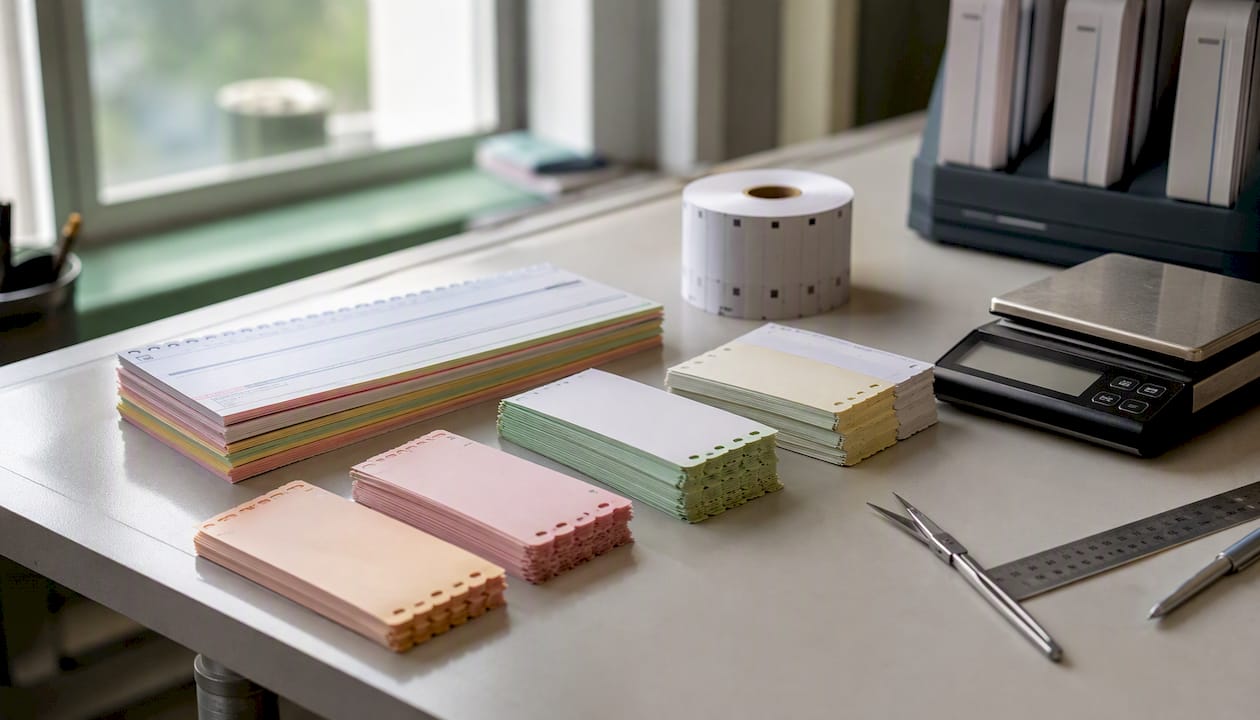
The right format depends on your workflow, not just your language count. A machine-issued receipt has different constraints than a hand-torn valet stub.
| Ticket type | Best for | Key spec to confirm |
|---|---|---|
| 2 or 3-part valet stub | Attendant-issued valet with office copy | Sequential numbering, perforation placement |
| 4-part carbonless | Multi-department tracking (valet, audit, customer, office) | Carbon transfer clarity across all four layers |
| Machine-issued barcode roll | PARCS-integrated garages and kiosks | Roll width, barcode placement, thermal vs. paper stock |
| Permit hang tag or decal | Universities, municipalities, seasonal programs | Weather resistance, adhesive strength, back-copy space |
Material choice matters as much as format. Coated stock resists valet-stand grime better than uncoated paper, and hang tags need weatherproof material if they’re going to survive a Midwest winter on a windshield.
Before you finalize any order, confirm compatibility with your actual equipment. Caymil manufactures parking system tickets built to work with major PARCS platforms, including Amano, TIBA, SKIDATA, FLASH Parking, Scheidt & Bachmann, and Flowbird. Confirm receipt dimensions, hole-punch location, and barcode zone against your specific machine model. That single check prevents the most common reorder cause: a ticket that prints fine but jams the reader.
How Do You Proof and Sign Off on Translations?
Skipping native review is the single most expensive mistake buyers make on multilingual tickets, because a translation error printed on ten thousand stubs means ten thousand reprints.
- Build a phrase glossary first. Lock the translation of property-specific terms, like “valet,” “claim stub,” or “exit lane,” before anyone starts translating full copy. Reusing an inconsistent term across languages confuses guests more than a missing translation does.
- Require native-speaker review, not machine translation alone. A fluent in-house staffer or a vetted reviewer should check every front-facing language before it goes to layout. Machine translation gets literal meaning right and idiom wrong, and idiom is where guests get confused.
- Run a layout proof. Confirm spacing, line breaks, and font scaling once real translated text sits inside the actual ticket dimensions.
- Get a physical or high-resolution PDF proof before final print approval, and have someone check it against the glossary one more time.
- Flag safety or legal wording for human review specifically. A liability disclaimer or towing policy statement is not where you want a machine translation guess.
Pro Tip: Keep your approved glossary on file. The next reorder, seasonal reprint, or new ticket format reuses the same terms without starting translation from scratch.
What Should You Know Before Placing an Order?
Lead time and cost both move with a handful of predictable factors, and knowing them ahead of time keeps a rush order from becoming a rush problem.
| Factor | Effect on order |
|---|---|
| Order quantity | Larger runs lower per-unit cost but extend production time |
| Full-color printing | Adds cost versus black-plus-one-Pantone-color |
| Multi-part carbonless | Longer setup than single-ply stock |
| Barcoding or sequential numbering | Minor cost add, but essential for PARCS tracking |
| Custom die-cut or foil | Longest lead time of any option |
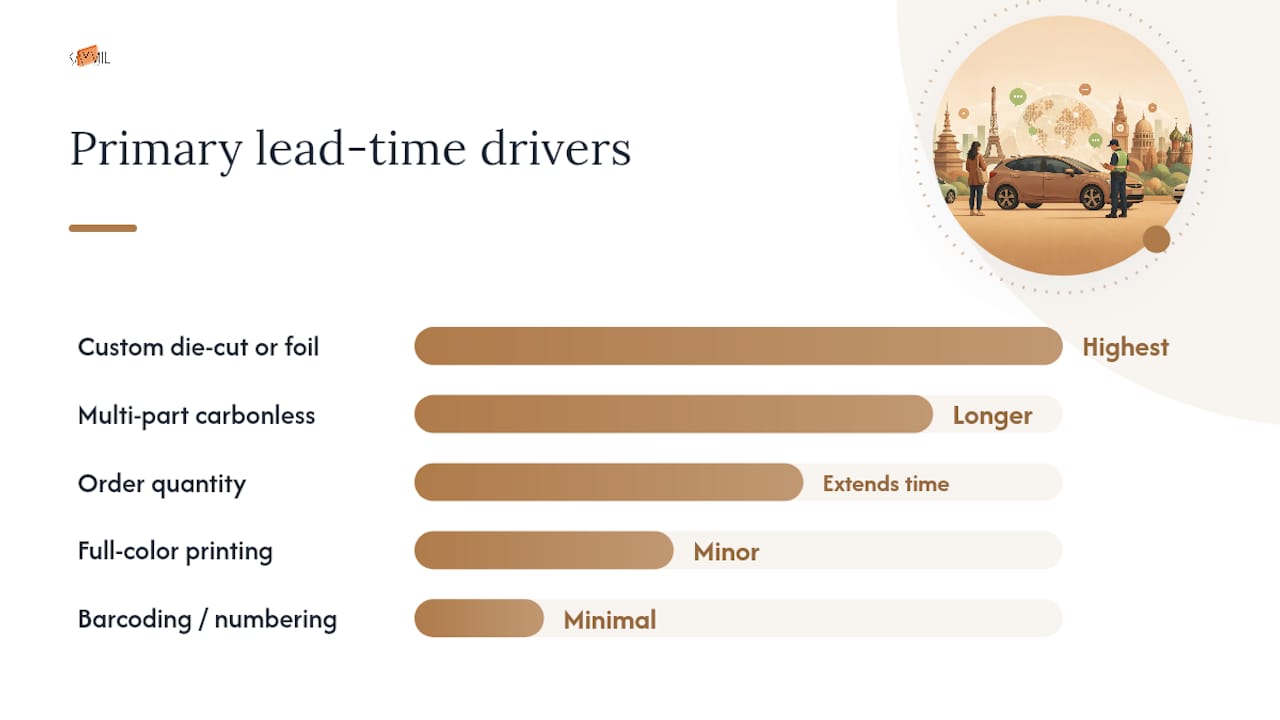
A few practical moves keep cost down without cutting corners on clarity: limit language lines on the front of the ticket and push longer translated policy text to the back copy or a QR link, and choose a single accent color over full photographic printing when brand color alone will do the job. Very large production runs generally need longer lead times, so build proof approval into your schedule rather than requesting it after your deadline is already tight.
For inventory, a staggered ordering approach works better than one giant annual run: keep a base stock of your standard bilingual template on hand for daily use, and place smaller supplemental runs ahead of known seasonal spikes or one-off events.
- Confirm machine compatibility before final approval, not after the shipment arrives
- Request a proof for every new language added, even if the format hasn’t changed
- Set a reorder threshold (a par level) so you’re never down to your last box during peak season
How Do Printed Tickets Fit Into a Digital Translation Strategy?
Think of your ticket as the first layer of a three-layer language system, not the whole system. The pattern gaining ground across hospitality in 2026 stacks static printed content, auto-translated digital guides, and on-demand live translation into one coordinated experience.
- Layer one: the printed ticket or hang tag, short and universal
- Layer two: a QR code linking to a translated landing page with expanded instructions, contact numbers, or payment links
- Layer three: live human or chat-based translation for anything that needs judgment, like a dispute or a special request
Practically, that means your ticket should say almost nothing beyond the essential action, then point to a QR code for anyone who needs more detail. Keep the same glossary across the printed ticket and the QR landing page so a guest sees consistent terminology whether they’re reading paper or a screen. Save anything sensitive, like billing disputes or towing questions, for a human channel rather than an auto-translated page, since consistent language support across every touchpoint is what actually drives guest retention, not just the print run itself.
Pro Tip: Use a dedicated short URL for your QR code rather than a long tracking link. It’s easier to update the landing page later without reprinting a single ticket.
What’s the Fastest Path to Ordering Multilingual Tickets?
- Pull twelve months of guest language data from your booking system or parking records.
- Choose your top four or five languages and decide where bilingual copy is enough versus where you need more.
- Select your ticket format and lock in security features like sequential numbering or barcoding.
- Request a bilingual proof and get native-speaker sign-off before final approval.
- Run a small pilot, whether that’s one event or thirty days of daily volume, and measure the drop in intercom calls or valet queue time before scaling up.
Ready to move? Request a compatibility check and proof from Caymil and get your first multilingual run started with real specs, not guesses.
Multilingual tickets belong in operations, not marketing
Too many properties treat translated signage as a nice-to-have brand touch instead of what it actually is: a throughput tool. A ticket that guests understand on the first read moves cars faster and generates fewer escalations to a supervisor. I’d rather see a property invest in three tight, correctly translated lines than five languages nobody proofed properly.
How Caymil Supports Multilingual Ticket Orders
Caymil has manufactured parking and valet ticketing supplies since 1937, and multilingual runs go through the same production process as any custom order: sequential numbering, barcoding, logo placement, security features, and multi-part carbonless formats where your workflow needs a duplicate copy.
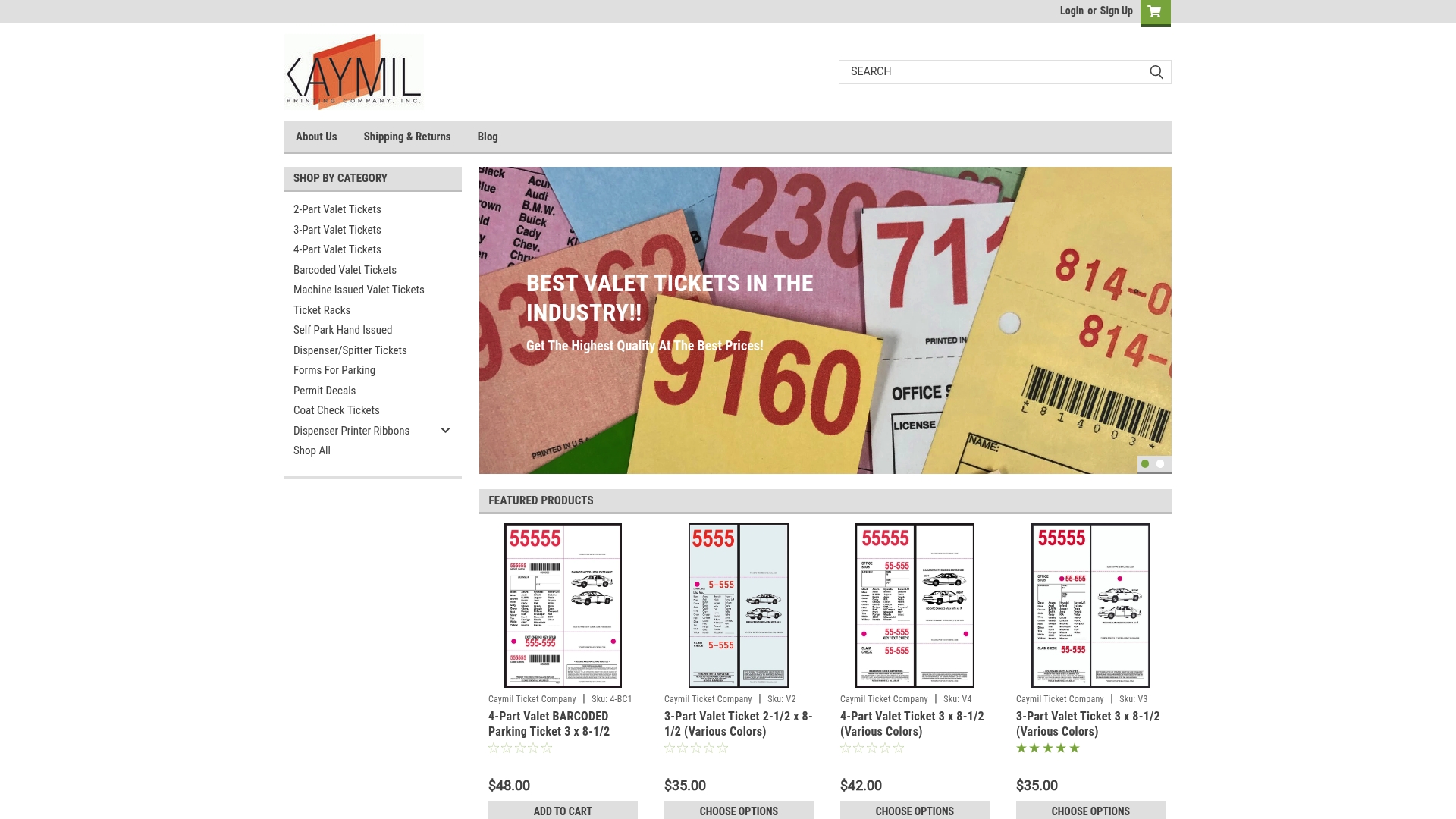
Every format is built to work with common PARCS and valet setups, so a bilingual valet stub or barcoded machine-issued ticket fits your existing equipment instead of forcing a workaround. Whether you need 2-part valet stubs for a quick pilot, barcoded rolls for PARCS integration, or permit decals for a university or municipal program, Caymil ships nationwide and provides proofs before anything goes to press. Start your order on the forms for parking page and request a bilingual proof with your system’s compatibility details included, so the first ticket off the press is the one you actually need.
Sources
- The Crucial Role of Language Diversity in Global Hospitality Success
- Closing the Hospitality Language Gap — LODGING
- Multilingual Guest Communication for Hotels in 2026 | Hotel Tech Insight
FAQ
Do I need a full translation on the front of the ticket?
No. Keep front-of-ticket copy to essential action words and use back copy or a QR link for expanded, translated instructions.
How many languages should a parking ticket include?
Most facilities only need their top four or five guest languages by volume, based on real booking or visitor data rather than assumptions.
Can Caymil print barcoded tickets compatible with my PARCS system?
Yes. Caymil produces barcoded and sequential-numbered tickets compatible with major systems including Amano, TIBA, SKIDATA, FLASH Parking, Scheidt & Bachmann, and Flowbird.
What’s the biggest mistake buyers make with multilingual tickets?
Skipping native-speaker proofing and relying on machine translation alone, which leads to costly reprints once errors are caught after the run is printed.
Should I use bilingual or multilingual tickets for permit hang tags?
Bilingual usually covers short hang tag labels, while multilingual back-copy works better for longer permit terms that need more than two languages.
Recommended
- Sequential Numbering Parking Tickets: A Practical Guide - Caymil Printing Co., Inc.
- How Bulk Parking Ticket Orders Work: A Pro Guide - Caymil Printing Co., Inc.
- Printed Parking Tickets: A Practical Guide for Operators - Caymil Printing Co., Inc.
- Event Parking Ticket Types: A Planner’s 2026 Guide - Caymil Printing Co., Inc.