
30 Day Ticket Lifespan: Thermal Reactive Ink Tickets for Operators
For most short-term parking and valet workflows, direct thermal tickets are the practical default. Reserve thermal transfer or top-coated and synthetic stocks for tickets that must survive outdoor exposure, long-term permits, or archival storage. The decision hinges on one question: how long does this ticket need to stay readable, and under what conditions?
TL;DR:
- Direct thermal tickets are ideal for short-term parking and valet workflows due to faster printing speeds and simpler mechanics, but they fade quickly under UV, heat, and humidity.
- Thermal transfer tickets, though slower and more expensive per ticket, provide superior durability and resistance, making them suitable for outdoor or long-term applications.
- Higher-grade thermal media with protective coatings can last up to 20 to 25 years when stored properly, but exposure to light, heat, and moisture accelerates fading.
- Regular printhead maintenance and correct storage practices help prevent unreadable tickets more effectively than switching media types.
- Confirming ticket compatibility with your dispenser, scanner, and expected lifespan conditions before bulk purchasing minimizes operational issues and unexpected costs.
Table of Contents
- Thermal Reactive Ink Tickets: Direct Thermal vs. Thermal Transfer Explained
- What Ticket Media Grade Fits Your Use Case?
- What Do Ribbons and Printhead Wear Really Cost You?
- What Ticket Specs Should You Confirm With Your Supplier?
- How Do You Keep Tickets Readable and Printers Running Longer?
- What I’ve Learned Watching Operators Choose Ticket Media
- Get Thermal Parking and Valet Tickets Fast From Caymil
- Sources
- FAQ
Thermal Reactive Ink Tickets: Direct Thermal vs. Thermal Transfer Explained
The term “thermal reactive ink tickets” covers two distinct printing technologies, and knowing which one you’re buying matters for your bottom line. Direct thermal media reacts to heat directly at the printhead. No ink, no ribbon, just heat-sensitive paper that darkens where the printhead touches it. Thermal transfer works differently: a heated ribbon melts wax or resin ink onto the ticket surface, creating a printed image that sits on top of the media rather than being burned into it.
Speed is where direct thermal earns its reputation for high-volume operations. Direct thermal printers typically run at moderate to high speeds suitable for fast printing(https://www.beontag.com/blog/the-difference-between-direct-thermal-and-thermal-transfer/), which explains why it dominates fast-moving parking and valet contexts. Thermal transfer printers usually run slower, in the range of 2 to 4 inches per second, because the ribbon transfer process adds a mechanical step. For a garage issuing thousands of tickets during a morning rush, that speed gap is the difference between a smooth entry lane and a backed-up queue.
Durability tells the opposite story. Thermal transfer printing resists UV exposure, chemical contact, and abrasion far better than direct thermal, which can fade when left on a dashboard in summer heat or exposed to humidity. Direct thermal tickets are genuinely disposable by design. They’re meant to get scanned, validated, and thrown away within hours or days, not filed for later reference.
Here’s how the two stack up on the factors that matter operationally:
- Speed: Direct thermal wins for high-throughput kiosks and attended booths; thermal transfer runs slower due to ribbon handling.
- Consumables: Direct thermal needs only media; thermal transfer requires ribbon stock, adding a recurring cost line.
- Durability: Thermal transfer holds up to sunlight, moisture, and handling; direct thermal degrades faster under the same conditions.
- Mechanics: Direct thermal has fewer moving parts and simpler printer setup; thermal transfer requires ribbon alignment and periodic changeovers.
Honeywell’s technical guidance confirms direct thermal remains the preferred choice for mobile and high-speed printing precisely because of that mechanical simplicity. If your tickets get issued, scanned, and discarded within a day or two, direct thermal is almost always the right call. If they need to survive a season on a windshield or serve as a long-term permit, thermal transfer earns its higher per-ticket cost.
What Ticket Media Grade Fits Your Use Case?
Not all direct thermal paper performs the same way, and the coating on the surface matters as much as the printing method. Four grades cover nearly every parking and valet scenario:
- Standard thermal stock: The baseline option for same-day valet claim checks and short-stay parking tickets that get tossed within hours.
- Top-coated thermal stock: A protective layer over the heat-reactive surface adds resistance to light abrasion and minor moisture, suited to multi-day event passes.
- Premium top-coated stock: Heavier coatings extend both shelf life and printed-image stability, a good fit for monthly permits or hang tags issued in bulk.
- Synthetic thermal stock: A plastic-based substrate built for tickets that live outdoors for weeks, such as construction site permits or long-term lot access cards.
The gap between these grades shows up clearly in archival testing. Standard thermal paper typically stays readable for 7 to 20 years under proper storage conditions, while premium top-coated stock can extend that window to 20 to 25 years. That’s a wide range, and the variable is almost always exposure: heat, light, and humidity accelerate fading regardless of grade.
Top-coated and synthetic media earn their price premium through resistance, not just longevity. The coating creates a barrier against UV rays, spilled coffee, and the friction of sliding in and out of a wallet or glove box, all common hazards for permit tags and event passes. For a deeper comparison of how stock thermal rolls perform against these upgraded options, Caymil’s guide to parking ticket paper breaks down real-world durability differences.
Before committing to a full order, request a sample roll and run it through your actual printer. Check print contrast after a week of exposure to your typical storage conditions, whether that’s a glove box, an attendant booth, or an outdoor kiosk. A grade that reads perfectly on day one, but fades by day ten isn’t the right fit, no matter how good the price looks on the invoice.
What Do Ribbons and Printhead Wear Really Cost You?
The sticker price on a roll of tickets is only part of the cost equation. Thermal transfer printing requires ribbon, and that ribbon needs scheduled replacement, adding a per-ticket consumable cost that direct thermal skips entirely. But direct thermal isn’t free of hidden expense either.
Here’s what happens with heavy use: direct thermal media contacts the printhead directly on every single ticket, and that friction wears the head down faster than the ribbon-buffered contact in thermal transfer printing.
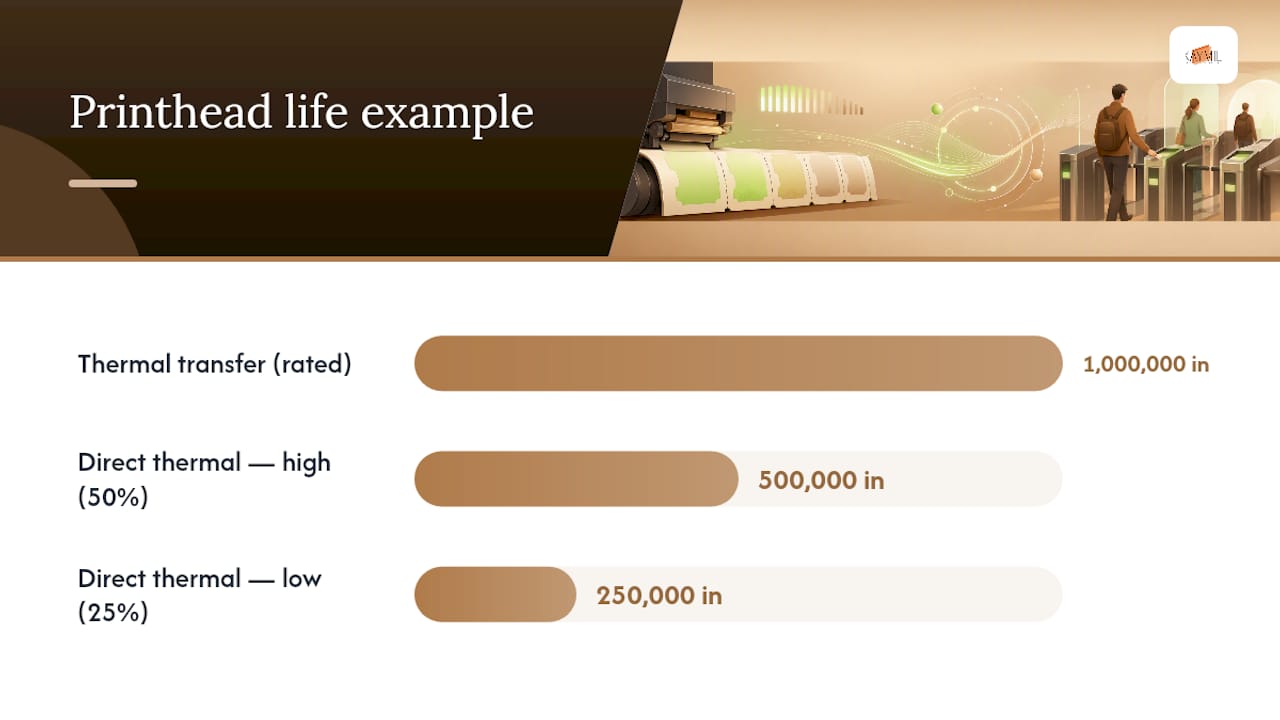
Direct thermal printhead life commonly runs at 25% to 50% of a comparable thermal transfer printhead under similar duty cycles. A printhead rated for 1 million inches in thermal transfer mode might only deliver 250,000 to 500,000 inches in direct thermal use.
For a garage printing 2,000 tickets a day at roughly 3 inches per ticket, that’s 6,000 inches of daily wear. A lower-end direct thermal printhead lifespan could mean a replacement every few months instead of once a year, and each swap means downtime, a service call, and a line of cars waiting at the gate.
To model total cost of ownership properly, factor in these variables:
- Per-ticket media price across your expected order volume.
- Ribbon cost per ticket for any thermal transfer lanes, plus ribbon changeover frequency.
- Printhead replacement frequency scaled to your actual daily throughput, not a manufacturer’s best-case estimate.
- Labor time for media loading, ribbon changes, and printhead servicing across your shift schedule.
High-volume deployments can flip the math entirely. A garage that saves a few cents per ticket on direct thermal media may spend far more replacing printheads twice a year than a thermal transfer operation spends on ribbon.
What Ticket Specs Should You Confirm With Your Supplier?
Getting the print method right doesn’t matter if the ticket doesn’t fit your dispenser or scan cleanly at your gate. Before placing a bulk order, confirm these specs in writing:
- Format and core size: Roll versus fanfold sheet, roll core diameter, and ticket width matched to your printer’s spool.
- Perforation and dispenser fit: Perforation spacing that matches your presenter mechanism to avoid jams, especially in unattended kiosks.
- Barcode grade and placement: Barcode type and print quality rated for your scanner model, positioned where your reader expects it.
- Numbering and multi-part needs: Sequential numbering ranges and carbonless multi-part formats if you need duplicate records for revenue tracking.
- System compatibility: Confirm fit with your parking system, whether that’s Amano, TIBA, SKIDATA, FLASH Parking, Scheidt & Bachmann, or Flowbird hardware.
Mismatched ribbon and media combinations can damage printheads or produce poor print quality, so always request a sample roll before scaling to a full order. Run a real scan test at your gate, not just a visual check, and confirm the roll feeds through your dispenser without jamming. Caymil’s practical guide for operators covers the full spec checklist in more depth.
How Do You Keep Tickets Readable and Printers Running Longer?
Most unreadable-ticket complaints trace back to maintenance, not media quality. A few consistent habits protect both print clarity and hardware life:
- Clean the printhead on a set schedule using a manufacturer-approved cleaning kit or isopropyl wipes, especially in dusty garage environments.
- Set heat and density to the media manufacturer’s recommended range. Overheating burns through printheads faster and doesn’t improve contrast.
- Store unused rolls flat, away from direct sunlight, in a cool and dry space to prevent premature fading before the ticket even prints.
- Run a quick scan test after any settings change to catch smudging or faint barcodes before they cause gate delays.
Regular printhead cleaning often matters more than the DT-versus-TTR choice itself when it comes to avoiding unreadable tickets. For more on storage and handling, see Caymil’s durability tips for garage operators.
Pro Tip: Keep a spare printhead cleaning card taped inside your kiosk cabinet. A 30-second wipe at shift change catches buildup before it shows up as streaky, unreadable barcodes.
What I’ve Learned Watching Operators Choose Ticket Media
My rule of thumb: tickets lasting 30 days or less belong on direct thermal; anything running 30 to 90 days, or facing outdoor exposure, needs top-coated or thermal transfer stock. The most common mistake I see is skipping the sample test entirely and discovering compatibility problems after a bulk order arrives. Test scan rates and dispenser fit before you scale.
— Richard
Get Thermal Parking and Valet Tickets Fast From Caymil
Thermal reactive ink tickets can be sourced for the lifecycle your operation needs, whether that’s a same-day valet claim check or a multi-month permit tag. Standard and custom thermal ticket formats are available, including barcode-capable stock, machine-issued rolls, and multi-part carbonless designs with sequential numbering, with nationwide shipping offered.
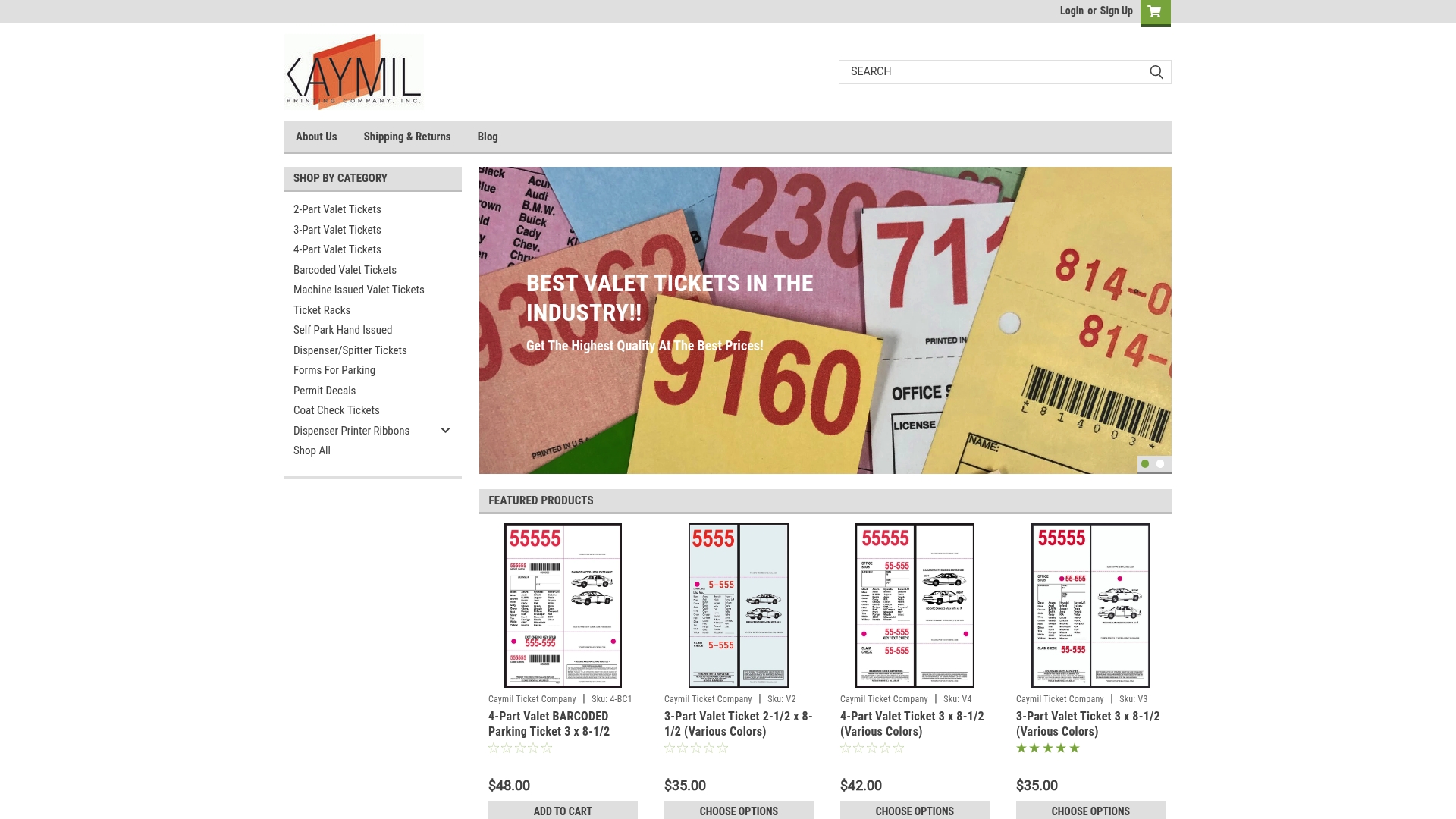
Before you commit to a full order, request a sample roll to confirm dispenser fit and run a barcode scan test against your actual scanner hardware. Caymil’s barcoded valet tickets work across major parking system brands, and the machine-issued valet ticket line covers unattended kiosk formats. If your operation runs multi-part carbon records for revenue tracking, the 3-part valet ticket format starts at $35 for smaller orders. Reach out to request samples and get a fit check started this week.
Sources
Technical guidance from SATO, Zebra, and Beontag informed the technical claims above. See Caymil’s material options guide for ordering.
- The difference between direct thermal and thermal transfer
- Thermal Transfer vs. Direct Thermal: Five Key Considerations | SATO
- Thermal paper white paper (Anixter / Brother)
- Difference between direct thermal and thermal transfer printing | Zebra
FAQ
What Are Thermal Reactive Ink Tickets?
They’re tickets printed on heat-sensitive media using either direct thermal (heat directly darkens the paper) or thermal transfer (a heated ribbon melts ink onto the surface) printing technology.
How Long Do Direct Thermal Tickets Stay Readable?
Standard direct thermal paper typically remains readable for 7 to 20 years under proper storage, though heat and sunlight exposure shortens that window considerably.
Is Thermal Transfer Printing Worth the Extra Cost?
It’s worth it when tickets face outdoor exposure or need to last more than 30 to 90 days, since thermal transfer resists UV, moisture, and abrasion far better than direct thermal.
Does Caymil Sell Both Direct Thermal and Custom Barcoded Tickets?
Yes. Caymil supplies stock and custom thermal tickets, including barcoded valet tickets and machine-issued rolls compatible with major parking systems.
What Causes Faded or Unreadable Thermal Tickets?
Overheated print settings, UV or heat exposure during storage, and a dirty printhead are the most common causes; regular cleaning and correct density settings usually resolve them.