

Never Run Out: Ticket Inventory Management for Parking & Valet Ops

Ticket inventory management is the practice of tracking, storing, and reordering printed ticket stock, valet claim tickets, parking permits, and roll tickets so a facility never runs short or loses control of its numbering. The first action for any operation: standardize sequential numbering and keep one authoritative tracking location, whether that’s a ledger, spreadsheet, or centralized system. Everything else, formats, storage, reorder timing, builds on that single decision.
TL;DR:
- Managing ticket inventory effectively requires standardizing numbering and centralizing tracking, especially when handling multiple locations or shifts.
- Specialized ticket formats like barcoded claim tickets and durable, sequentially numbered options reduce disputes and speed up reconciliation processes.
- Transitioning from manual methods to automated or centralized systems is necessary when reconciliation exceeds 15 minutes per shift or disputes become frequent.
- Keeping strict control over blank stock and documenting vehicle conditions at drop-off help prevent theft and disputes over damaged or lost tickets.
- Calculating reorder points based on daily usage, lead time, and safety stock ensures stock shortages do not occur during peak operation times.
Table of Contents
- What Ticket Formats Should You Actually Stock?
- How Do You Track Ticket Inventory Day to Day?
- Securing Ticket Stock and Maintaining Chain of Custody
- How to Calculate Your Reorder Point for Printed Tickets
- A Simple Checklist for Ticket Inventory Controls
- Why Cutting Corners on Tickets Costs More Than It Saves
- Order Tickets Built for Real Inventory Control
- Sources
- FAQ
What Ticket Formats Should You Actually Stock?
Not every printed ticket does the same job, and stocking the wrong format creates problems that surface weeks later during a dispute or an audit. Most operators need a mix, not a single style.
- Multi-part carbonless tickets (2, 3, or 4-part): the standard for valet operations, where one portion goes to the customer, one stays with the vehicle, and one remains in the operator’s audit copy. Three-part tickets have been a fixture in stacked parking for close to a century, and each portion serves a distinct purpose: customer receipt, vehicle locator, and internal record.
- Barcoded claim tickets: speed up retrieval and reconciliation when paired with a scanner, and they cut down on manual entry errors during busy shifts.
- Thermal roll tickets: built for machine-issued dispensers at gated garages, where speed matters more than a printed diagram.
- Magnetic-stripe tickets: common in longer-stay parking systems that need to encode entry time and rate data directly on the ticket.
- Permit hang tags and decals: used for monthly or reserved parking rather than transactional traffic, and typically ordered in smaller, less frequent batches.
Stock tickets work fine for generic numbering needs. Custom prints earn their cost when you need a logo, a vehicle damage diagram, a specific barcode symbology, or numbering that matches an existing system. If your equipment runs on Amano, TIBA, SKIDATA, FLASH Parking, Scheidt & Bachmann, or Flowbird, roll and dispenser formats need to match that hardware exactly, or you’ll be fighting jams and misreads all season.
How Do You Track Ticket Inventory Day to Day?
The right tracking method depends less on your ticket volume and more on how many hands touch the stock. A single-location valet stand can run on paper. A hotel with three shifts and a casino garage cannot.
- Paper ledger. Works for small operations with one point of issuance. The rule that makes it work: a single ledger, unique daily ticket ranges assigned per shift, and a supervisor who reconciles issued numbers against the log at close.
- Spreadsheet tracking. The natural upgrade once you have more than one attendant or location. Build columns for ticket number start and end, date and time, attendant name, transaction type, and disposition (issued, redeemed, voided, lost). Run a daily check that the ending number from one shift matches the starting number of the next.
- Centralized inventory systems. Worth the investment once you’re managing multiple sites or need role-based permissions and an audit trail that survives staff turnover. Municipal parking operations that moved from fragmented spreadsheets to centralized tracking found it easier to budget and plan once they had one consistent data source, and the rollout worked best in phases: establish baseline counts first, then layer in roles and workflow rules.
Watch for the signals that tell you it’s time to move up a tier: reconciliation that takes longer than 15 minutes a shift, recurring disputes over “phantom” ticket numbers, or a supervisor who can’t say with confidence how many tickets are in the building right now. Platforms like Genetec Security Center document formal reconciliation steps for exactly this reason, including rules for handling partial inventories and conflicting reads.
Pro Tip: Assign daily ticket ranges by shift, not by attendant. It’s far easier to spot a gap in a range (“shift 2 should have used tickets 4501 to 4650”) than to track down which individual mishandled a number.
Securing Ticket Stock and Maintaining Chain of Custody
Loss and theft rarely happen in dramatic ways. They happen because a box of blank tickets sat on an open shelf, or because a key changed hands without anyone writing it down.
- Lock down blank stock. Store unissued tickets in a locked cabinet with access limited to shift supervisors, and keep boxes sealed until they’re actually needed at the podium.
- Tie key control to ticket control. Numbered key tags that match claim ticket numbers, a locked key board, and a master key log turn a chaotic valet stand into a system anyone can audit. Structured key organization with numbered tags reduces both theft and honest mistakes, and digital tracking (barcode or RFID tags on keys) adds a timestamped record of who pulled what and when.
- Document vehicle condition at intake. Standard valet operations manuals recommend inspecting bumpers, doors, hood, trunk, and windshield at drop-off and noting any existing damage directly on the claim ticket.
- Build in a lost-ticket delay. Require ID verification and a short waiting period before releasing a vehicle without a ticket. That pause alone stops most opportunistic theft attempts.
- Count daily, not weekly. A supervisor tally of issued versus remaining stock at close catches a missing ticket while the shift’s memory is still fresh.
How to Calculate Your Reorder Point for Printed Tickets
Running out of valet tickets mid-shift is a self-inflicted crisis, and it’s entirely preventable with basic arithmetic. The formula: reorder point = (average daily usage × lead time in days) + safety stock.
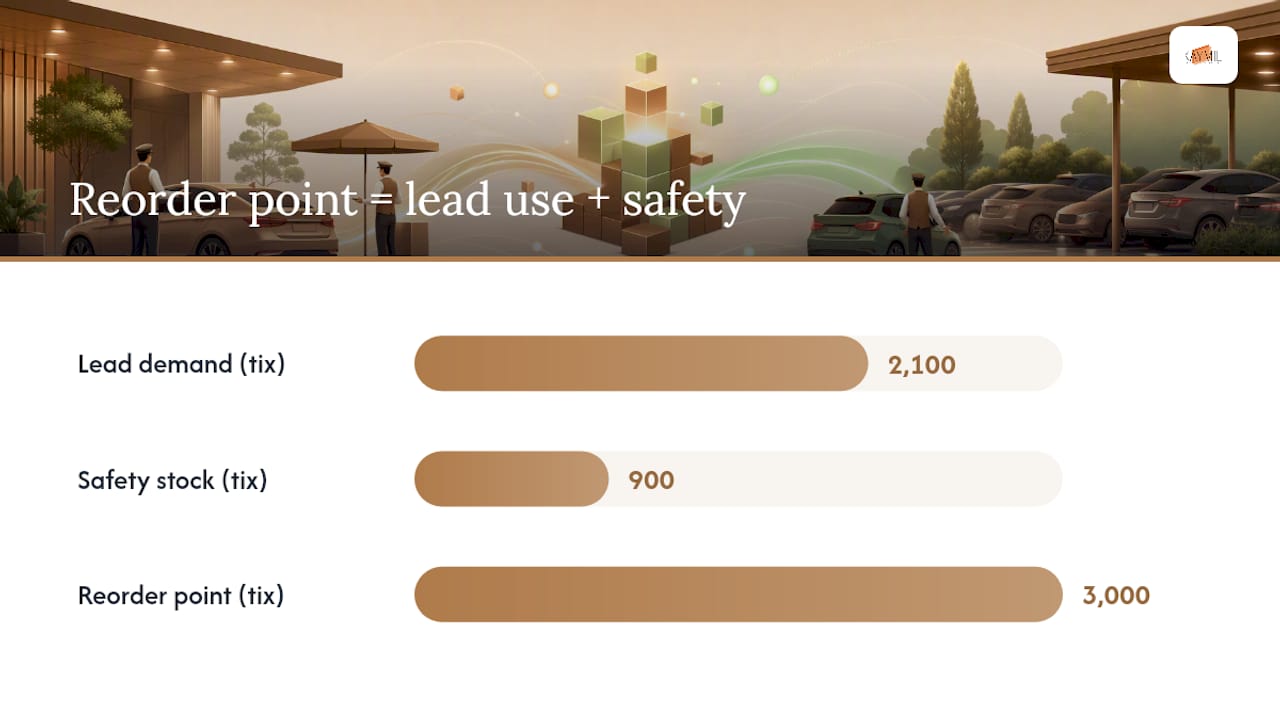
Say your valet operation issues 300 tickets a day, your printer’s standard lead time runs 7 days, and you want a 3-day safety buffer. Your reorder point is (300 × 7) + (300 × 3) = 3,000 tickets. Once your stock drops to 3,000, place the next order, not when the shelf looks thin.
Custom tickets, especially those with logos, barcodes, or vehicle diagrams, carry longer lead times than generic stock rolls, so build that difference into your calendar rather than discovering it during a slow week that suddenly turns busy.
- Track usage separately for each format. A garage issuing both roll tickets and multi-part valet tickets needs two reorder points, not one blended guess.
- Set a rush-order policy in advance. Know your printer’s expedited turnaround and price before you need it, not while a weekend event is bearing down.
- Evaluate vendors on more than price. Turnaround time, compatibility with your existing dispensers, minimum order quantities, and whether they’ll send physical samples before a full print run all matter more than a few cents per ticket.
Before assuming a fully paperless system solves your reorder headaches, check your local rules. New York regulation 20 NYCRR 538.3 requires consecutively numbered tickets or a pre-approved computer issuance scheme, and related state guidance notes that electronic receipts need approval and a numbering scheme filed in advance. Requirements vary by jurisdiction, so confirm your local rules before dropping printed tickets from the plan.
A Simple Checklist for Ticket Inventory Controls
Most inventory failures trace back to skipped routine, not bad judgment. A short, repeatable checklist closes that gap faster than any software purchase.
- Daily: Record opening and closing ticket counts, spot-check that issued ranges match the log, and verify the key board against the master list.
- Weekly: Reconcile the week’s issued ticket ranges against your spreadsheet or system, update running totals, and physically inspect that storage cabinets and boxes are still secure.
- Monthly: Review supplier lead times, adjust your safety stock if usage patterns shifted, and walk through any lost-ticket incidents from the month to see if the release procedure held up.
Build your log with columns that make reconciliation nearly automatic: date, shift, ticket range start and end, issued count, attendant initials, and any exceptions noted. For ticket numbering conventions that make weekly reconciliation faster, keep number blocks assigned to specific shifts rather than issued at random.
Pro Tip: Run your monthly lost-ticket postmortem even in months with zero incidents. A clean month tells you the current procedure works. A skipped review tells you nothing.
Why Cutting Corners on Tickets Costs More Than It Saves
Cheap tickets and loose tracking feel like savings until the labor cost of chasing disputes and mismatched counts eats the difference several times over. Operators who skip a real tracking system, or run bargain stock through it, tend to lose far more in reconciliation time and mischarges than they ever saved on paper.
A longstanding manufacturer has experience in details important during audits, such as consistent numbering, durable damage diagrams, and formats that endure a full shift in a valet’s pocket. Start small. One tracking sheet, one supervisor accountable for it, then pilot a centralized system once the volume justifies it.
— Richard
Order Tickets Built for Real Inventory Control
Specialized suppliers offer ticket formats with sequential numbering, barcoding, and durability that help make daily reconciliation faster rather than adding chores to busy shifts.
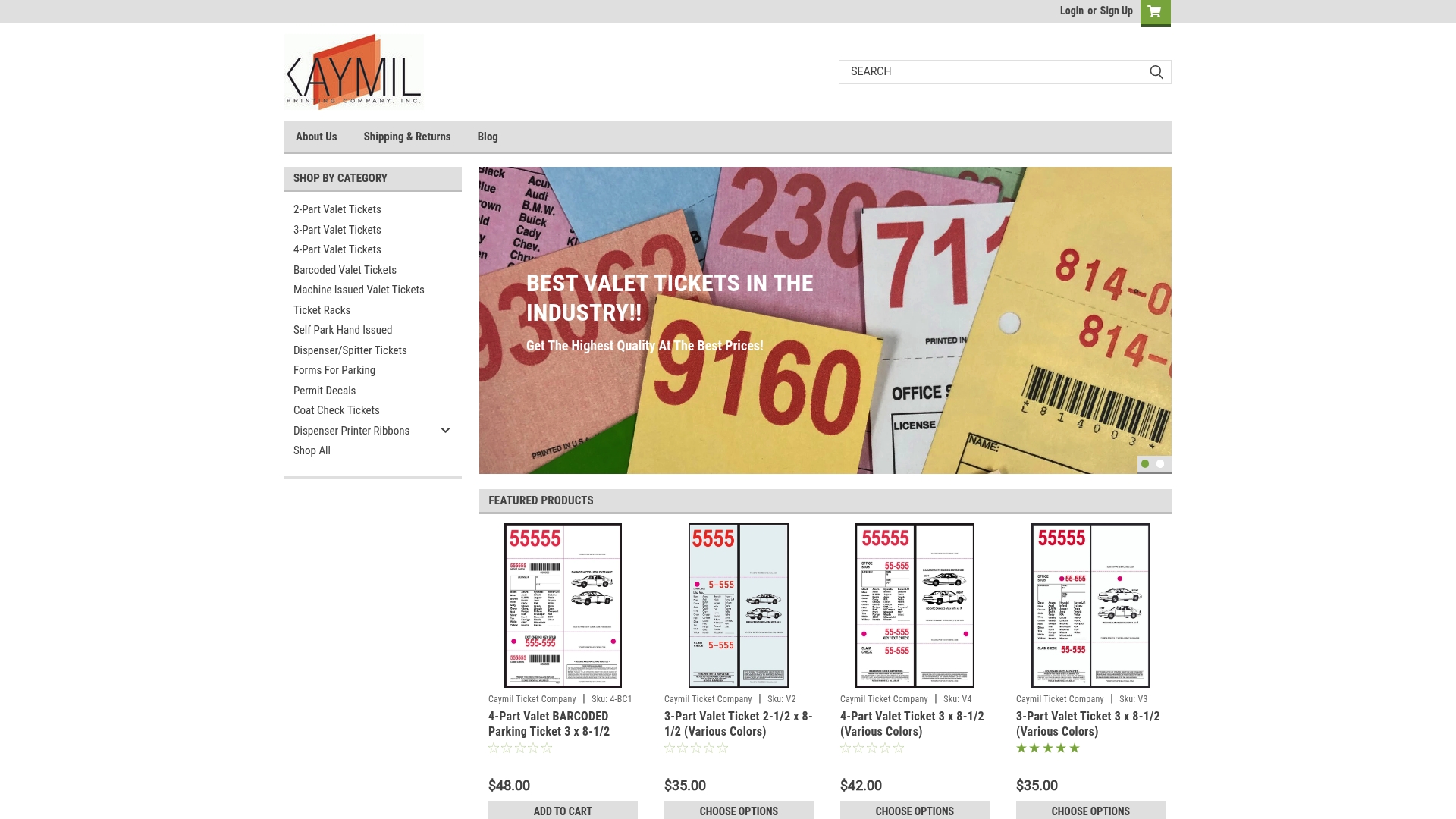
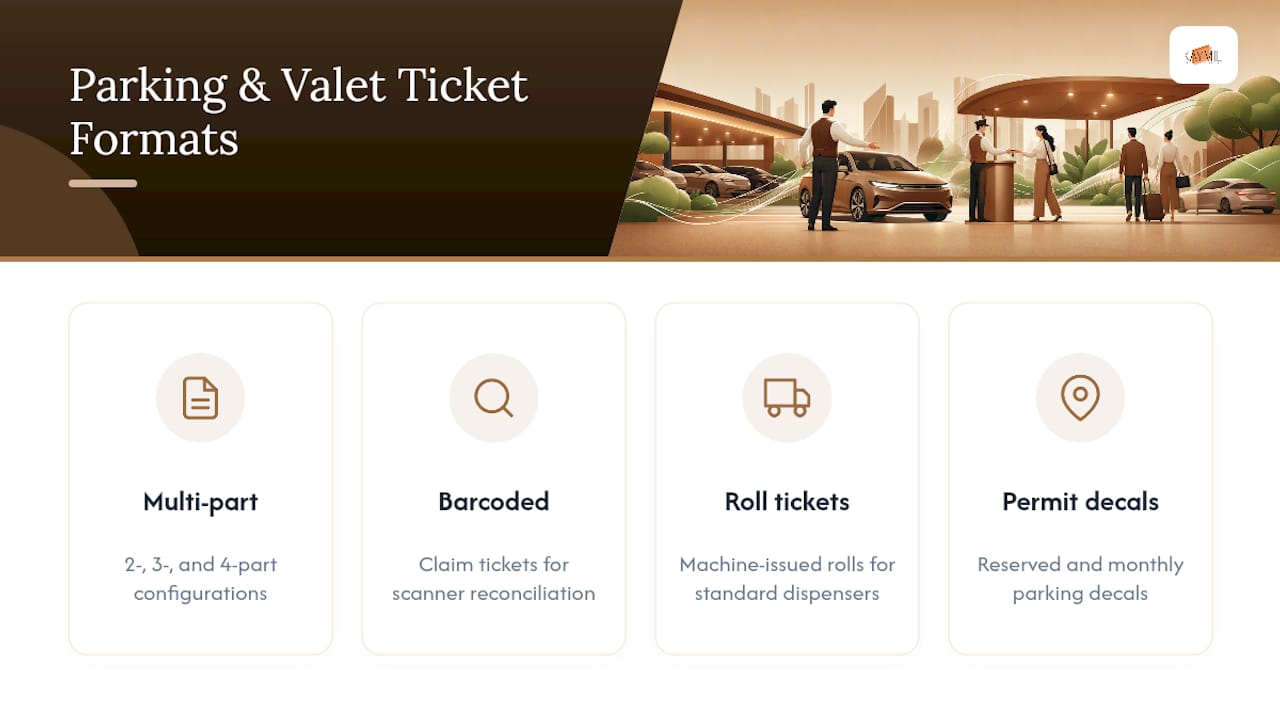
Caymil manufactures multi-part valet tickets in 2, 3, and 4-part configurations, barcoded claim tickets for scanner-based reconciliation, machine-issued roll tickets compatible with standard dispensers, and permit decals for reserved and monthly parking. Operators who switch from generic stock to sequentially numbered, custom-printed tickets typically see fewer disputes at pickup and a noticeably faster monthly reconciliation, because the numbering and damage-diagram fields are built into the ticket itself rather than added after the fact.
Browse the full parking and valet ticket catalog to match a format to your equipment, or request a sample before committing to a full print run.
Sources
This guide draws on operational standards from the Parking Professional valet operations manual, Genetec’s Security Center documentation on facility inventories, and New York’s recordkeeping rules under 20 NYCRR 538.3. Confirm requirements in your own jurisdiction before changing numbering or recordkeeping practices.
- Parking Valet Operations Manual: Key Control, Damage Claims, and Insurance | Parking Professional
- 3-Part Tickets for Parking Operations | H2H2H Foundation
- Parking Enterprise centralized inventory project updates | City of Austin (GitHub)
- N.Y. Comp. Codes R. & Regs. Tit. 20 § 538.3 - Issuance of tickets or other documentation | LII / Cornell
FAQ
What is ticket inventory management?
It’s the process of tracking, storing, and reordering physical printed tickets, such as valet claim tickets, parking tickets, and permits, so a facility maintains accurate counts and never runs short on stock.
How many ticket parts do I need for valet operations?
Most valet operations use 2 or 3-part tickets: one for the customer, one attached to the vehicle, and a third retained for internal audit when extra documentation is needed.
What’s the minimum data I should track for each ticket?
Track sequential number, date and time issued, location, the attendant who handled it, and its disposition (issued, redeemed, voided, or lost) at minimum.
When should I switch from a spreadsheet to a centralized system?
Consider it once reconciliation regularly takes more than 15 minutes per shift, disputes over ticket numbers become frequent, or you’re managing multiple locations that need shared visibility.
Are there legal requirements for ticket numbering?
Some jurisdictions, including New York under 20 NYCRR 538.3, require consecutively numbered tickets or an approved computer issuance scheme with retained copies for audit. Check your local regulations before changing your process.
Can I switch to fully digital tickets instead of print?
Only if your jurisdiction approves electronic receipts and your numbering scheme meets its recordkeeping requirements. Many operators keep printed tickets as the primary record specifically to avoid that compliance risk.