

Valet Operation Efficiency Tips That Cut Wait Times

Cut average valet wait times by prioritizing queue control, ticketing upgrades, and targeted staff deployment. Poorly organized valet services can increase wait times during peak periods by 20%, directly damaging guest satisfaction and repeat business. Switching from manual ticket handling to digital platforms can reduce average wait times by 40% or more. These three levers, addressed in order, produce the fastest measurable improvements.
Three actions you can start within the hour:
- Assign one attendant exclusively to greeting and pre-processing guests at the drop-off curb.
- Audit your current ticket format: confirm sequential numbering is legible and that stubs match claim checks without ambiguity.
- Physically walk the drop-off lane and identify any single-point bottleneck blocking vehicle flow.
Pro Tip: Time ten consecutive retrievals with a stopwatch before making any changes. That baseline number is your proof of improvement — and your pitch to venue leadership.
Table of Contents
- What low-cost fixes can you deploy today?
- Which staff behaviors actually speed service and build trust?
- How do ticket type and technology choices affect throughput?
- How should you design drop-off lanes and staging areas?
- How do you staff for peak periods without overspending?
- What KPIs should you track to measure valet performance?
- What security controls reduce liability and key-loss claims?
- How should you choose valet tickets and supplies?
- What does a realistic rollout plan look like?
- Key Takeaways
- The metric that actually tells you if your operation is working
- Caymil supplies the tickets your operation actually needs
- Useful sources
- FAQ
What low-cost fixes can you deploy today?
Most throughput problems have a low-cost fix hiding in plain sight. These adjustments require no procurement and minimal training.
- Designate an express drop-off lane for guests who pre-registered or are hotel guests. Separation alone cuts average intake time.
- Add a greeter station six feet ahead of the valet stand. Pre-processing (name, ticket hand-off, condition note) before the car stops eliminates dead time at the curb.
- Pre-stage vehicles for predictable departures: restaurant last-call, hotel checkout windows, and post-event rushes. Pre-retrieval staging converts variable demand into a predictable, parallel-processing workflow.
- Use simple A-frame signage to direct self-park guests away from the valet lane. Confusion between the two streams is a silent throughput killer.
- Implement a no-idle rule at the drop-off curb. Attendants who finish intake should immediately move the vehicle, not wait for direction.
- Brief staff at shift start on the day’s expected volume and any VIP arrivals. A two-minute huddle prevents mid-shift improvisation.
Pro Tip: Communicate every change to guests with one sentence at the point of contact. “We’ve added a second drop-off lane tonight — follow the sign to your left.” Guests who understand the process wait more patiently.
Which staff behaviors actually speed service and build trust?
Consistency and trust beat raw speed for guest satisfaction. A guest who waits three minutes with a confident, communicative attendant rates the experience higher than one who waits two minutes with no acknowledgment. Professional acknowledgment and transparent communication improve tips and repeat business more reliably than shaving seconds off retrieval times.
Training checklist for front-line attendants:
- Greet the guest within ten seconds of vehicle arrival — name use when available.
- Deliver a scripted intake: confirm the ticket number aloud, note any visible damage, and state an estimated retrieval time.
- Complete a walk-around condition check and mark the ticket before driving away.
- Use single-point radio protocol: one attendant calls, one confirms, no cross-talk.
- Execute a clean handoff: vehicle running, A/C or heat set, door held open.
- Never carry keys in pockets. Keys go directly to the lockbox after parking.
Measuring service consistency matters more than tracking average speed alone. Pull retrieval times by attendant, not just by shift. An average of four minutes can hide one attendant running two minutes and another running seven. Coaching the outlier produces faster results than any process change.
How do ticket type and technology choices affect throughput?

Digitization and barcode-based systems can cut wait times by 40% or more by enabling real-time vehicle tracking, eliminating handwriting errors, and supporting SMS pre-retrieval. The format you choose shapes every step from intake to key return.
| Format | Best for | Throughput impact | Security level |
|---|---|---|---|
| Paper sequential (2-part carbonless) | Low-volume, simple operations | Baseline | Moderate |
| Barcoded printed tickets | Mid-to-high volume, system-integrated | High | High |
| Machine-issued thermal rolls | High-volume, dispenser-equipped stands | Very high | Moderate–High |
| Mobile/SMS retrieval (ticketless) | Tech-forward, hotel/event venues | Highest | High |
Compatibility matters. Major parking platforms, including Amano, TIBA, SKIDATA, FLASH Parking, Scheidt & Bachmann, and Flowbird, each have specific ticket dimension, barcode format, and stock-thickness requirements. Ordering tickets without confirming compatibility first is one of the most common and costly procurement errors. A proper valet ticket system accounts for system specs before the first order ships.
For POS integration, confirm that your ticket’s barcode symbology (Code 39, Code 128, QR) matches what your parking management software reads. A mismatch forces manual entry and eliminates the speed advantage entirely.
How should you design drop-off lanes and staging areas?
Layout is a primary throughput limiter. A single-lane drop-off processes a limited number of vehicles per hour; increasing to multiple parallel lanes can significantly increase capacity. That gap is not a staffing problem — it is a geometry problem.
- Multi-lane intake: Minimum two lanes for venues expecting more than 30 vehicles per peak hour. Mark lanes clearly with painted lines and signage.
- Off-street queuing: Queue spillback onto a public road creates safety liability and guest frustration. Design the approach so at least four vehicles can stack off-street.
- Staging zones: Dedicate a section of the lot to pre-staged vehicles for imminent retrievals. In garages, vehicles parked on higher levels take 3–4 minutes longer to retrieve; pre-staging the most likely departures on level one cuts that penalty to 2–3 minutes.
- One-way loops: Eliminate opposing traffic inside the lot. Head-on conflicts are the single fastest way to stall throughput.
- ADA and EV charger placement: Position these near the exit to minimize movement for guests who need them most.
- Traffic director role: During peak windows, one attendant dedicated solely to directing vehicles — not parking them — prevents lane confusion.
Pro Tip: Sketch your current layout on a whiteboard during a shift-change review. Ask attendants where they lose the most time. They know the friction points before any manager does.
Well-designed valet lots can park substantially more vehicles than self-parking through stacking and dwell-time zoning — but only if the intake flow supports that density.
How do you staff for peak periods without overspending?
The headline rule: maintain a bench roster proportionate to your active team. For example, a small operation needs a few confirmed on-call attendants available for every peak shift. No-shows without a bench create cascading delays that no process fix can recover.
Peak staffing sequence:
- Pull occupancy forecasts or reservation counts 48 hours out and set a staffing target.
- Divide expected peak-hour vehicles by an estimated single-attendant throughput per hour to get your minimum active count.
- Add one traffic director and one stand supervisor above that minimum.
- Confirm bench availability 24 hours before the shift.
- Brief the full team 15 minutes before doors open: roles, radio channels, staging assignments.
For garage operations, assign attendants by zone rather than by vehicle. Zone-based assignments eliminate the search-and-find delay that license-plate recognition and GPS tracking are designed to solve technologically. When technology isn’t available, zoning is the manual equivalent.
What KPIs should you track to measure valet performance?
Consistency, throughput, and wait-to-retrieve ratio are the three primary success metrics. Average speed alone tells you very little.
| KPI | Definition | Target | Cadence |
|---|---|---|---|
| Average wait time | Ticket issue to vehicle delivery | Under 5 minutes | Real-time / per shift |
| Retrieval time | Key pull to vehicle staged | Under 3 minutes (surface) | Per shift |
| Throughput | Vehicles processed per hour | Venue-specific baseline | Daily |
| Ticket mismatch rate | Mismatched stubs per move | Under 1% | Weekly |
| Damage incidents | Claims per 10,000 moves | Low | Monthly |
If a full digital dashboard isn’t available, timed samples work. Time 20 retrievals per shift, log them in a shared sheet, and review weekly trends. A valet parking log structured around these metrics gives supervisors a defensible record and a coaching tool in one document.
What security controls reduce liability and key-loss claims?
Keys and documentation are the biggest single liability drivers in valet operations. Modern key-fob replacement costs range from $500 to $2,000, and a single lost fob can erase an entire evening’s revenue.
- Numbered lockboxes: Every key gets a numbered hook matching the ticket stub. No exceptions.
- Photo condition checks: Photograph every vehicle at intake and at return. Time-stamped photos are your first line of defense against damage claims.
- Digital ticket logs: Record ticket number, attendant ID, parking location, and key-box number at intake.
- Shift transfer protocol: Outgoing supervisor signs off on every key in the box before the incoming supervisor takes over.
- Incident photo log: Any damage, pre-existing or new, gets photographed and noted on the ticket before the vehicle moves.
For ticket security, barcoded valet tickets with sequential numbering and tamper-evident stock make fraudulent claims far harder to sustain. Multi-part carbonless formats give the guest, the attendant, and the stand each a copy — eliminating “I never got a ticket” disputes entirely. Common valet ticketing mistakes often trace back to formats that lack these basic security features.
How should you choose valet tickets and supplies?
Picking the right ticket format reduces retrieval friction, cuts disputes, and supports the security controls described above. The format decision starts with your parking system.
Procurement checklist:
- Confirm ticket dimensions and barcode symbology with your parking platform (Amano, TIBA, SKIDATA, FLASH Parking, Scheidt & Bachmann, or Flowbird).
- Choose part count based on record-keeping needs: 2-part tickets for simple operations, 3-part for reconciliation copies, 4-part when front desk, lot, guest, and accounting each need a copy.
- For high-volume or dispenser-equipped stands, specify machine-issued roll tickets compatible with your printer model.
- Request a sample order before committing to a full run. Confirm print clarity, carbonless transfer quality, and barcode scan rate.
- Specify sequential numbering, custom logo, and any security features (void pantograph, tamper-evident ink) at the time of order.
- Confirm lead times against your next peak event. Stock tickets ship faster; custom orders need more runway.
Caymil produces ticket formats compatible with all major parking systems and offers both stock and fully custom options with sequential numbering, barcoding, and multi-part carbonless construction. For operations coordinating valet with guest luggage or airport transfers, pairing ticket logistics with a luggage delivery service can further reduce congestion at the departure curb.
What does a realistic rollout plan look like?
Prioritize queue control, then ticketing, then staffing for the fastest return on effort.
- Within the hour: Walk the drop-off lane, assign a greeter, and baseline your retrieval times.
- Day 1: Brief staff on the new intake script, radio protocol, and no-keys-in-pockets rule. Post updated signage.
- Week 1: Audit your current ticket format for system compatibility. Order samples if a format change is needed. Set up the KPI log.
- 30 days: Review one full week of KPI data, coach outlier attendants, confirm bench roster is at 20–30% of active staff, and place your first optimized ticket order.
Present ROI to venue leadership as time saved per vehicle multiplied by peak-hour volume. A two-minute reduction across 40 vehicles per hour is 80 minutes of recovered capacity per peak window — a figure that translates directly into guest throughput and revenue.
Key Takeaways
Valet operations improve fastest when queue control, compatible ticketing, and a bench roster of 20–30% of active staff are addressed in that order.
| Point | Details |
|---|---|
| Fix queue geometry first | Multi-lane drop-off can triple hourly throughput versus a single-lane setup. |
| Digitize ticketing for speed | Barcode and mobile systems can reduce average wait times by 40% or more. |
| Staff with a bench roster | Keep a portion of active staff on call to absorb no-shows without service collapse. |
| Track the right KPIs | Measure retrieval time, throughput, and ticket mismatch rate — not just average speed. |
| Caymil for compatible supplies | Caymil supplies stock and custom tickets compatible with Amano, TIBA, SKIDATA, FLASH Parking, Scheidt & Bachmann, and Flowbird systems. |
The metric that actually tells you if your operation is working
The valet industry tends to fixate on average retrieval time, and that fixation is a trap. An average hides the variance, and variance is what guests actually experience. A guest who waits seven minutes while watching others leave in two does not care that your average is four. They remember the seven.
The operators who consistently earn high satisfaction scores are not the fastest — they are the most predictable. Guests tolerate a five-minute wait when they receive an honest estimate and a visible signal that their car is being retrieved. They do not tolerate a three-minute wait that felt like ten because no one acknowledged them.
The most common rollout error is deploying a technology upgrade (SMS retrieval, digital ticketing) without training attendants on the communication behaviors that make the technology feel trustworthy. The tool is only as good as the person explaining it at the curb. Roll out any new system with a scripted guest-facing line before the first shift goes live.
Pro Tip: During rapid operational change, recognize attendants publicly for following the new protocol correctly — not just for speed. Culture shifts when the behavior being praised is the behavior you want repeated.
Caymil supplies the tickets your operation actually needs
Valet operations that have worked through the queue, staffing, and training improvements described above eventually hit the same wall: the ticket format is holding them back. Mismatched barcodes, illegible numbering, or the wrong part count for the parking system creates friction that no process change can fix.
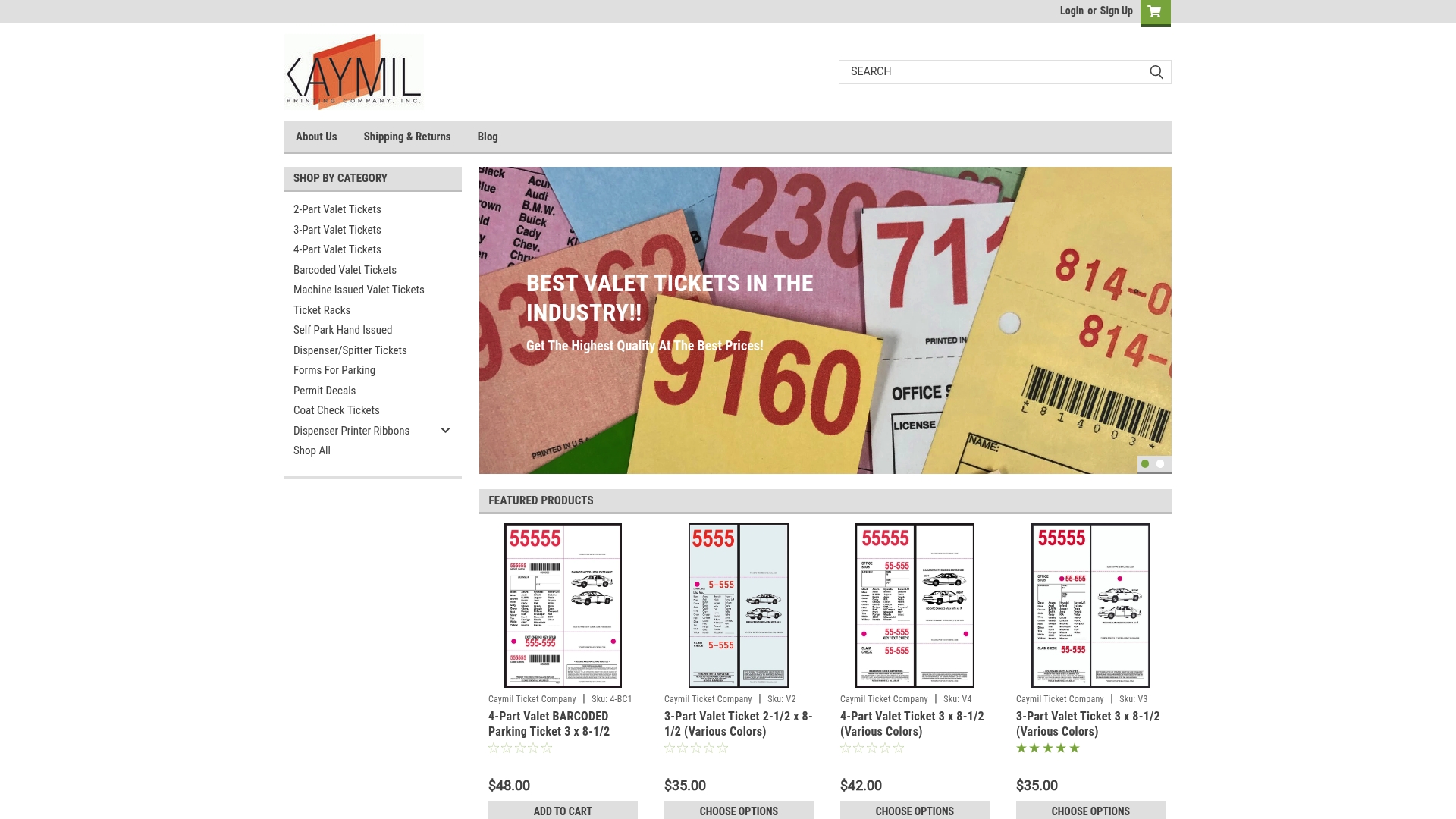
Caymil has manufactured compatible valet tickets since 1937, supplying operations across the United States with formats built to spec for Amano, TIBA, SKIDATA, FLASH Parking, Scheidt & Bachmann, and Flowbird systems. Stock options ship fast; custom orders include sequential numbering, barcoding, logos, and multi-part carbonless construction. Browse machine-issued valet tickets, barcoded ticket formats, and ticket racks, or request a sample to confirm compatibility before your next peak event.
Useful sources
- Valet queue management: handling peak volume without guest frustration — Open Door Valet
- Valet staff management: a venue perspective — Open Door Valet
- Hotel parking garage valet: urban operations done right — Open Door Valet
- Valet fleet management: best practices — Open Door Valet
- Valet parking lot layout: optimizing flow and capacity — Open Door Valet
- How to reduce valet wait times — Summon Inc.
- Building customer trust: valet service best practices — Summon Inc.
- Valet parking operations guide — Parksy
- Caymil blog: ticketing setup, common mistakes, and supplies — Caymil Printing Co.
For deeper technical topics including license-plate recognition and machine integrations, the Open Door Valet garage guide and the FC Parking technology overview are the most detailed publicly available resources.
FAQ
How much can digitizing valet tickets reduce wait times?
Switching from manual ticket handling to digital or barcode-based platforms can reduce average wait times by 40% or more, primarily by enabling real-time vehicle tracking and eliminating handwriting errors.
What is the right bench roster size for valet operations?
Best practice is to keep a bench roster equal to 20–30% of your active team, so a 10-person operation should have 2–3 confirmed on-call attendants available for every peak shift.
Which ticket formats work with Amano, TIBA, and SKIDATA systems?
Barcoded tickets with confirmed symbology (Code 39 or Code 128) and correct stock dimensions are required. Caymil produces formats compatible with Amano, TIBA, SKIDATA, FLASH Parking, Scheidt & Bachmann, and Flowbird systems.
What is the biggest liability risk in valet operations?
Lost or damaged key fobs are the primary liability driver, with replacement costs ranging from $500 to $2,000. Numbered lockboxes, photo condition checks, and strict shift-transfer protocols are the standard controls.
How do you measure valet efficiency beyond average retrieval time?
Track throughput (vehicles per hour), ticket mismatch rate, and damage incidents per 10,000 moves alongside retrieval time. Consistency across attendants matters more than a low average that hides wide variance.
Recommended
- Common Valet Ticketing Mistakes Operators Must Fix - Caymil Printing Co., Inc.
- Valet Tickets 101: The Simple System That Keeps Your Lot Moving - Caymil Printing Co., Inc.
- How Upscale Valet Operations Work: 2026 Guide - Caymil Printing Co., Inc.
- Why Sequential Valet Tickets Matter for Operators - Caymil Printing Co., Inc.