
Ticket Lead Time for Printed Parking and Valet Tickets
Stock tickets from Caymil ship in 1–5 business days. Small custom digital runs typically take 2–7 business days. Larger custom or specialty tickets, including multi-part carbonless, embossed, or metallic-ink formats, generally require 2–4 weeks or more from order to shipment. The single fastest way to guarantee your in-hands date: choose a stock SKU or submit press-ready artwork, then select the shipping method that matches your deadline.
- Stock preprinted tickets: 1–5 business days (includes pick, pack, and dispatch)
- Simple 1- or 2-part custom tickets (digital print): 2–7 business days
- Multi-part carbonless, barcoded rolls, or machine-issued thermal: 7–14 business days
- Specialty finishes (foil, embossing, Pantone match, metallic inks): 2–4+ weeks
Carriers like UPS, FedEx, and USPS add 1–5 transit days on top of production, depending on destination and service level. Build that buffer into every purchase order.
Key Takeaways
Choosing stock tickets or submitting press-ready artwork is the single most reliable way to hit a tight in-hands date without paying rush surcharges.
| Point | Details |
|---|---|
| Stock tickets ship fastest | Caymil stock valet and parking tickets ship in 1–5 business days with no proofing delay. |
| Custom digital runs: 2–7 days | Small custom orders using digital printing clear production in 2–7 business days after proof approval. |
| Specialty finishes add weeks | Foil, embossing, and Pantone-match finishes typically extend lead time to 2–4 weeks or more. |
| Transit is a separate clock | Add 1–3 business days for ground shipping within the contiguous U.S.; confirm guaranteed delivery for fixed event dates. |
| Caymil for rush and repeat orders | Caymil offers expedited production lanes and pre-approved repeat-order profiles to compress custom timelines. |
Table of Contents
- What is the typical ticket lead time by ticket type?
- How does production work after you place an order?
- What factors lengthen or shorten ticket lead time?
- How can you shorten ticket order turnaround?
- What shipping options and transit times should you plan for?
- What should your order checklist include to avoid delays?
- Sample planning calendars for common order scenarios
- What Caymil sees as the most common causes of missed in-hands dates
- Caymil delivers stock and custom tickets on tight schedules
- Sources
- FAQ
What is the typical ticket lead time by ticket type?
Digital printing enables the fastest turnaround for short runs, often same-day to a few days, while offset and complex finishing push timelines toward one to two weeks. The table below reflects common production windows by ticket type and quantity band.
| Ticket Type | — | — | — |
|---|---|---|---|
| Stock preprinted (valet, event) | 1–3 business days | 1–5 business days | 1–5 business days |
| 1- or 2-part custom (digital) | 2–5 business days | 3–7 business days | 7–14 business days |
| Multi-part carbonless (3- or 4-part) | 5–10 business days | 7–14 business days | 2–4 weeks |
| Barcoded/sequential numbered rolls | 3–7 business days | 7–14 business days | 2–3 weeks |
| Machine-issued thermal rolls | 2–5 business days | 5–10 business days | 10–15 business days |
| Specialty finish (foil, embossing) | 10–15 business days | 2–4 weeks | 4–6 weeks |
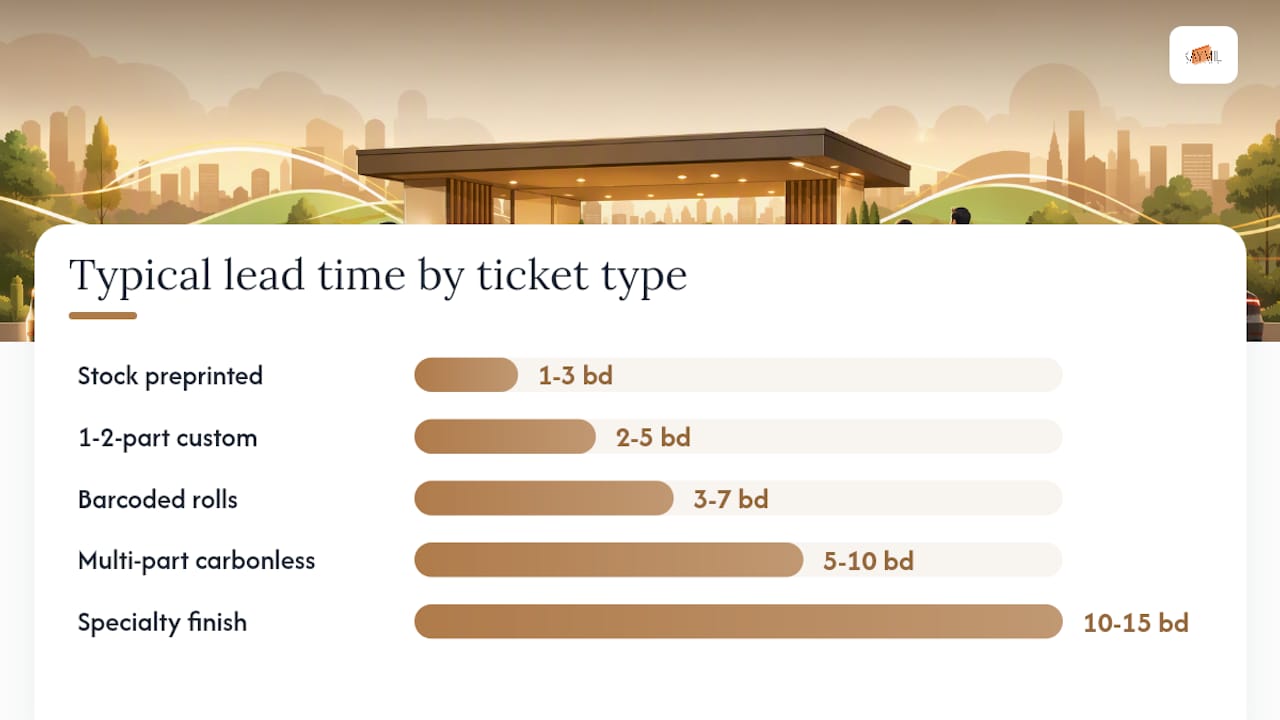
Quantity-based production brackets from ticket suppliers commonly show 3–5 business days for runs up to 24,000 and 6–15 business days for mid-range volumes of 25,000–108,000. Specialty finishes add 3–7 days on top of base production regardless of quantity.
Pro Tip: When your event or facility opening is fewer than 10 days out, choose a stock valet or parking ticket rather than a custom run. Stock ships the same or next business day and eliminates prepress entirely.
How does production work after you place an order?
Understanding each step helps procurement teams pinpoint where time is gained or lost.
- Order entry and PO confirmation (same day to 4 hours): The order is logged, pricing confirmed, and a production ticket issued.
- File and artwork check (prepress) (1–2 days): Artwork is reviewed for bleed, resolution, color mode, and barcode readability. Incomplete files restart this clock.
- Proofing and approval (1–2 days): A digital or physical proof is sent. A single-round, same-day approval is the most reliable way to shave days off the total timeline.
- Plate, cylinder, or digital setup (4–8 hours for digital; 1–2 days for offset/flexo): Digital jobs skip platemaking entirely, which is why digital workflows reduce total production time by roughly 30% versus manual plate-based transfers.
- Printing (3–7 days for complex jobs, often same-day for short digital runs): Press time scales with quantity and substrate.
- Finishing (die-cutting, binding, sequential numbering, laminating): Adds 3–5 days for complex jobs. Numbering and perforation run concurrently with binding on most production lines.
- Quality inspection (4–8 hours): Barcode scans, color checks, and sequential-number verification.
- Packing and dispatch (same day as QA clearance): Palletized or boxed, labeled, and handed to the carrier.
Prepress typically takes 2–4 days, printing 3–7 days, and finishing another 3–5 days for complex jobs. A delay in prepress cascades through every downstream step, so approved artwork on day zero is the single highest-leverage action a buyer can take.
What factors lengthen or shorten ticket lead time?
Some variables are within your control. Others require a buffer.
Buyer-controlled factors:
- Artwork readiness (press-ready PDF vs. files needing redesign)
- Proof-round count (one round versus multiple revision cycles)
- Ticket type selection (stock vs. custom, digital vs. offset)
- Shipping method (ground vs. 2-day vs. overnight)
- Order timing relative to seasonal peaks
Supplier-side and external risks:
- Material shortages for specialty substrates and inks commonly add 3–8 extra workdays, and ocean freight delays have added 10–25 days during recent supply-chain disruptions.
- Seasonal demand surges (Q4 holidays, spring event season) fill production queues weeks in advance.
- Substrate-specific requirements for systems like Amano, TIBA, SKIDATA, FLASH Parking, Scheidt & Bachmann, and Flowbird can limit material substitution options when a preferred stock runs short.
Choosing a standard substrate and avoiding Pantone-match or specialty-ink requirements is the most reliable way to insulate an order from material-availability delays. For parking ticket durability without specialty-ink risk, a coated thermal or carbonless stock covers most operational needs.
How can you shorten ticket order turnaround?
Rush manufacturing compresses a 10–14 business day job to 2–5 business days by assigning priority press slots, running overtime shifts, and using overnight curing or UV finishing alternatives. Standard production runs commonly take 7–10 business days after proof approval, with rush options available in 3–5 business days for many ticket types.
Rush options and their tradeoffs:
- Priority production slots: Fastest path for custom jobs; typically carries a 20–40% surcharge on the base print cost.
- Split runs: Print a partial stock quantity immediately while the custom run completes. Useful for valet operations that can use a generic ticket temporarily.
- Stock inventory orders: No rush fee, no proofing, no setup. Caymil’s stock inventory ships in 1–5 business days with no minimum order constraint for most SKUs.
- Pre-approved repeat orders: Buyers who have an approved proof on file skip prepress entirely, effectively converting a custom order into a near-stock timeline.
The tradeoff with rush manufacturing is reduced proofing time. A compressed approval window increases the risk of a numbering or barcode error reaching the press. For multi-part valet tickets where part-color sequence and numbering are operationally critical, a single thorough proof review is worth the extra hours even on a rush job.
What shipping options and transit times should you plan for?
Production lead time and transit time are separate clocks. Both must fit inside your in-hands window.
- UPS and FedEx Ground (contiguous U.S.): 1–5 business days depending on origin-to-destination distance. Near-state shipments often arrive in 1–2 days; cross-country runs take 4–5 days.
- UPS/FedEx 2-Day Air: Reliable 2-business-day delivery for most contiguous U.S. addresses, with carrier cutoffs typically at 3:00–5:00 PM local time.
- UPS/FedEx Overnight: Next-business-day delivery for most addresses when dispatched before the carrier cutoff. Confirm guaranteed delivery windows directly with the carrier for high-stakes event dates.
- USPS Priority Mail: 1–3 business days for most domestic addresses; not a guaranteed service and not recommended for time-critical shipments.
- Hawaii, Alaska, and U.S. territories: Add 2–4 business days to any ground estimate; air freight is the reliable option.
A practical buffer rule: add 1–3 business days to your printed lead time for ground shipping within the contiguous U.S., and 2–4 days for cross-country routes. Holiday-season parcel surges (November through January) and carrier volume peaks can add 1–2 days beyond published transit windows. For any event with a fixed date, confirm a guaranteed delivery commitment from the carrier rather than relying on estimated transit times.
What should your order checklist include to avoid delays?
Submit every item below with your purchase order and prepress starts on day zero.
- Approved vector PDF (minimum 300 dpi for raster elements, fonts embedded or outlined)
- Bleed and trim dimensions (typically 0.125 in. bleed on all sides)
- Pantone or CMYK color callouts (avoid RGB-only files for print)
- Exact substrate selection (thermal, carbonless, coated paper, magnetic stripe)
- Sequential numbering or barcode specification (start number, end number, barcode symbology, check digit)
- Quantity per SKU and part count for multi-part sets
- Ship-to address, contact name, and phone number
- PO number and billing address
- Desired in-hands date (not just order date)
- Rush acknowledgment if applicable (single proof round, compressed approval window)
Pro Tip: Route the proof internally before it arrives from the printer. Assign one person to consolidate all feedback into a single response. A consolidated reply within 24 hours of proof receipt is the most reliable way to keep a rush job on schedule.
Sample planning calendars for common order scenarios
Procurement planning works best when orders are segmented into routine reorders, campaign launches, and contingency stock. Repeat orders with unchanged artwork can use shorter reorder triggers (4–6 weeks of stock remaining), while campaign launches or new designs require planning 8–12 weeks ahead.

| Scenario | Recommended PO Lead Time | Key Milestones |
|---|---|---|
| Weekend event (stock tickets) | 5–7 business days before event | Order day 1; ships day 2–3; arrives day 4–5 |
| Routine valet reorder (custom, repeat artwork) | 10–14 business days before need date | Proof day 2; approval day 3; ships day 8–10 |
| Large multi-part carbonless campaign | 4–6 weeks before need date | Artwork due week 1; proof week 2; press week 3; ships week 4–5 |
| Specialty finish or new custom design | 6–8 weeks before need date | Design finalized week 1–2; proof week 3; production weeks 4–6; ships week 7 |
Seasonal factors expand every window. Orders placed in November or December compete with holiday print queues across the industry. If your facility runs a high-volume spring event season, placing custom orders in February rather than April is the difference between standard pricing and rush surcharges.
What Caymil sees as the most common causes of missed in-hands dates
The root cause of most missed delivery dates is not production speed. It is late artwork. Orders that arrive without press-ready files sit in prepress limbo while back-and-forth revisions consume the production buffer the buyer thought they had. The second most common cause is underestimating finishing time, particularly for multi-part carbonless sets where collating, padding, and wrapping add days that buyers do not account for when they calculate from the print date alone.
Seasonal queueing is the third factor. Production capacity fills weeks before major holidays and event seasons. Buyers who request capacity holds for recurring seasonal orders, or who maintain a standing stock of generic tickets for gap coverage, consistently avoid the last-minute rush that drives up cost and risk.
Setting up a repeat-order profile with pre-approved artwork on file converts future custom orders into near-stock timelines. For operations running Amano, TIBA, SKIDATA, FLASH Parking, Scheidt & Bachmann, or Flowbird systems, confirming substrate compatibility at the first order and locking that specification into the repeat-order profile eliminates a common source of prepress delays on reorders.
Caymil delivers stock and custom tickets on tight schedules
Caymil has manufactured parking, valet, and hospitality tickets since 1937, with millions of units in stock and production capacity for both short digital runs and large offset campaigns. Stock 2-part, 3-part, and 4-part valet parking tickets ship in 1–5 business days. Custom barcoded, sequentially numbered, and machine-issued formats are available with expedited production lanes for time-sensitive orders.
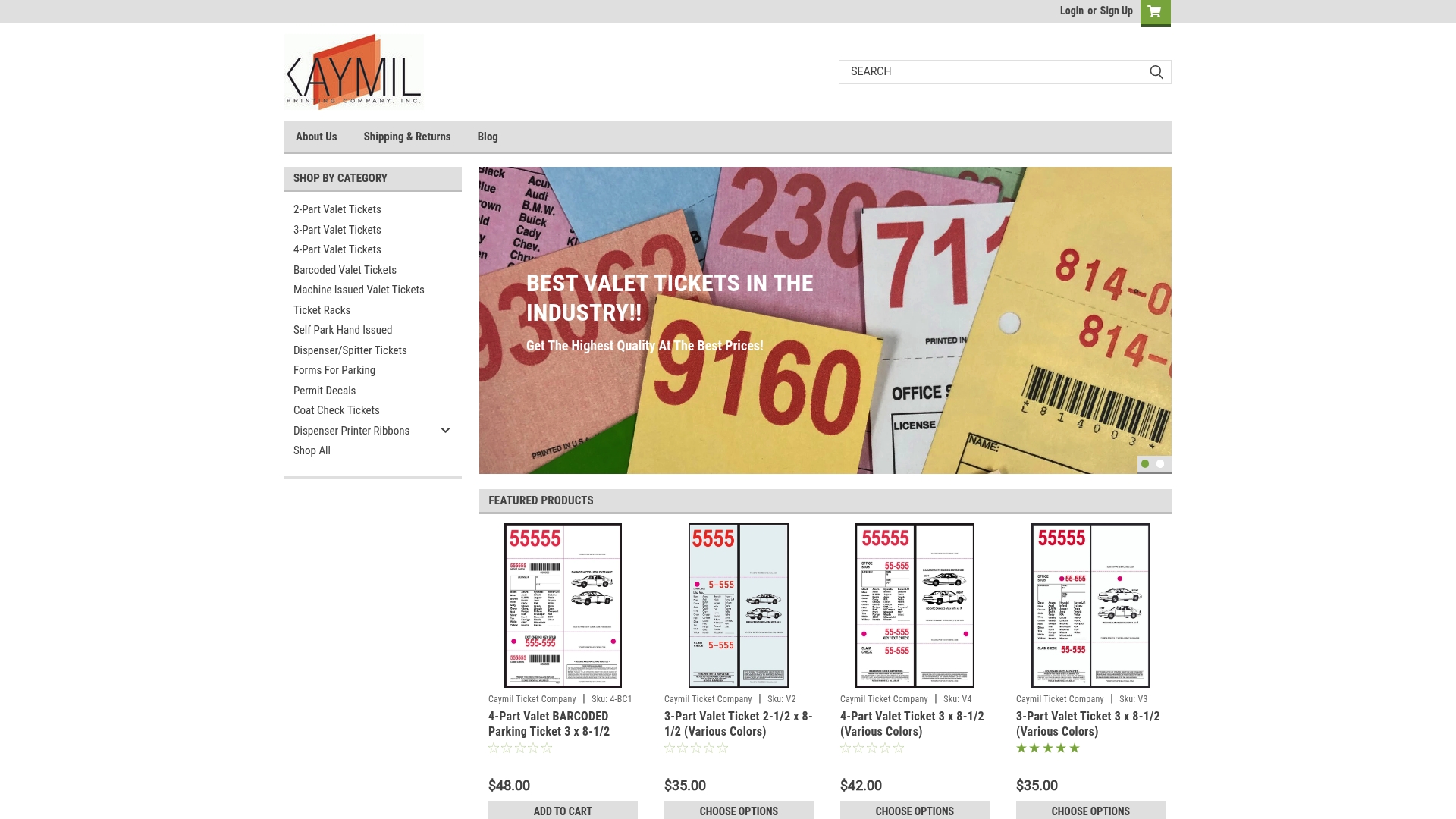
Caymil’s product line covers the full range of ticket formats compatible with Amano, TIBA, SKIDATA, FLASH Parking, Scheidt & Bachmann, and Flowbird systems. For buyers who need a guaranteed in-hands date, Caymil’s sales team can confirm production capacity, issue a rush slot, and recommend the right stock or custom format for your operation. Contact Caymil directly or browse parking forms and ticket options to place a priority order today.
Sources
- Custom Printing Lead Time Factors: 5 Key Drivers & Fixes
- Custom Print Turnaround Times: Print Shop Lead Times Guide
- Custom Printing Lead Times & Reorder Planning Guide
- Production & Turnaround Times FAQ
- Custom Valet Parking Tickets
FAQ
What is a typical ticket lead time for valet parking tickets?
Stock valet tickets ship in 1–5 business days. Custom printed valet tickets typically take 7–14 business days after proof approval, depending on quantity and finishing requirements.
How do I shorten my ticket printing turnaround for a last-minute event?
Order from Caymil’s stock inventory for same-week delivery, or request a rush production slot for custom tickets, which can compress a standard 10–14 day job to 2–5 business days.
Does quantity affect ticket processing time?
Yes. Runs up to 24,000 units commonly complete in 3–5 business days; mid-range volumes of 25,000–108,000 typically take 6–15 business days; very large runs may require several weeks.
What shipping options are available for domestic ticket delivery?
UPS and FedEx offer ground (1–5 business days), 2-day air, and overnight service for contiguous U.S. destinations. For guaranteed delivery on a fixed event date, confirm the carrier’s service commitment at the time of order.
How far in advance should I place a custom ticket order?
For routine reorders with unchanged artwork, place the order when 4–6 weeks of stock remain. For new designs or campaign launches, plan 8–12 weeks ahead to avoid rush fees and production queue delays.