

Types of Garage Revenue Tickets: Operator’s Guide

Garage revenue tickets are defined as the physical or digital instruments that record, classify, and account for every parking transaction in a facility. The industry term for this system is parking access and revenue control, commonly abbreviated as PARCS. Operators who understand the types of garage revenue tickets available can separate revenue by category, flag discrepancies in real time, and make pricing decisions based on actual demand. The five core parking ticket categories are transient, monthly or permit, validated, event, and lost ticket. Each one carries distinct accounting implications and operational requirements.
1. What are the types of garage revenue tickets?
Effective revenue management requires categorizing ticket types to track occupancy and leakage across transient, monthly, validated, and event parking. That categorization is not just an accounting convenience. It is the foundation of any audit trail, and without it, revenue leakage goes undetected for weeks or months. Caymil has manufactured tickets for all five categories since 1937, supplying garages that run Amano, TIBA, SKIDATA, FLASH Parking, Scheidt & Bachmann, and Flowbird systems. Each ticket type must be physically durable and machine readable to function correctly inside a PARCS environment.

2. Transient parking tickets and their revenue role
A transient parking ticket is issued to a customer who parks by the hour or day with no prior reservation or contract. It is the most common ticket type in public garages and the primary driver of variable revenue.
Two payment models govern transient ticketing:
- Pay-on-exit: The driver pays at the exit lane. This model is simple but creates bottlenecks during peak hours.
- Pay-on-foot: The driver pays at an interior kiosk before returning to the vehicle. Pay-on-foot reduces exit congestion by decoupling payment from the exit barrier, which is why it is considered the gold standard for high-volume garages.
Transient tickets must carry a readable barcode or magnetic stripe so that automated pay stations can calculate the correct fee based on entry time. These stations accept coin, cash, card, and mobile pay, and they print a receipt that serves as the exit credential. A ticket with a smeared or faded barcode causes a read failure, which stalls the lane and forces a manual override. That manual override is a revenue risk because it bypasses the automated fee calculation.
Pro Tip: Order thermal tickets rated for your garage’s temperature range. Thermal paper degrades faster in hot, humid parking structures. Caymil’s durable garage tickets are manufactured to maintain barcode clarity even in harsh conditions.
Transient tickets also support dynamic pricing. When your PARCS software sees high occupancy, it can raise the hourly rate automatically. That rate change only generates accurate revenue if every ticket entry and exit is recorded cleanly.
3. How monthly and permit tickets work in garage revenue systems
Monthly tickets, also called contract or permit tickets, grant a specific parker access for a set period, usually 30 days, in exchange for a flat fee paid in advance. They are the most predictable revenue stream a garage operator can have.
Key characteristics of monthly and permit ticketing:
- Reserved vs. unreserved access: Reserved permits guarantee a specific stall. Unreserved permits allow access to any available space up to capacity.
- Hang tags and proximity cards: Physical hang tags and RFID cards are the most common permit formats. Both integrate with gate systems to log entry and exit times.
- Revenue reconciliation: Modern PARCS platforms track contract revenue separately from transient revenue, which simplifies monthly reconciliation and forecasting.
The main challenge with permit programs is enforcement. A permit issued to one vehicle can be passed to another, which inflates occupancy counts without generating additional revenue. Sequential numbering on physical permits, combined with license plate recognition at the gate, closes that gap. Caymil produces PARCS-compatible permit tickets with sequential numbering and custom security features that make duplication difficult.
Permit programs also require accurate tracking of active versus expired permits. An expired permit that still opens the gate is a direct revenue loss. Your PARCS software should flag expired credentials automatically, and your physical tickets should include a clear expiration date printed in a high-contrast format.
4. What are validated tickets and merchant discount programs?
A validated parking ticket is a standard transient ticket that a merchant or event sponsor partially or fully discounts on behalf of the parker. The garage still collects the full rate. The merchant reimburses the discounted portion later.
Validated tickets link parking revenue to merchant discount programs and affect reconciliation when the process is not managed carefully. Common validation formats include:
- Stamp validation: A physical stamp applied to the ticket at the merchant location.
- Sticker validation: A pre-printed sticker that the cashier applies to the ticket.
- Electronic validation: A code entered at the pay station or a QR scan at the merchant point of sale.
The revenue risk in validation programs is abuse. A merchant who validates every customer, regardless of purchase, shifts parking costs to the garage operator without a corresponding increase in traffic. Proper management requires setting clear validation caps per merchant, auditing validation counts monthly, and reconciling reimbursement invoices against PARCS data.
Pro Tip: Use sequentially numbered validation stickers or stamps. When you reconcile, you can match the number series against your PARCS validation log. Any gap in the sequence is a red flag worth investigating.
Electronic validation is the cleanest format because it creates a digital record at the moment of validation. Physical stamps and stickers still work well in lower-volume settings, but they require more manual reconciliation effort.
5. What role do event tickets play in garage revenue management?
Event parking tickets are issued for a specific date and time window, typically tied to a concert, game, conference, or other scheduled gathering. They represent the highest revenue potential per stall of any ticket category.
Properties using advance reservation ticketing in event-heavy garages can capture 25–40% of revenue from pre-booked reservations, significantly smoothing demand. Managed event parking can generate 3–5 times the revenue per stall compared to unmanaged, open-lot parking during the same period. Those numbers explain why event ticketing deserves its own category in your revenue model.
Operational considerations for event ticketing include:
- Pre-sale tickets: Sold online before the event. These reduce gate congestion and lock in revenue regardless of weather or last-minute cancellations.
- Day-of tickets: Sold at the gate or pay station. These capture walk-up demand but require enough staff and equipment to handle surge volume.
- Surge pricing: Charging a premium rate for high-demand events. This requires flexible ticket categories and integration with your reservation system.
Dynamic pricing and event ticketing require flexible ticket categories and integration with reservation systems to capture maximum possible revenue during peak events. Large venues such as stadiums and convention centers often use barcoded or QR-coded event tickets that scan at the entry gate and expire automatically after the event window closes. Caymil supplies barcoded valet and event tickets compatible with major gate systems for exactly this use case.
6. How to manage lost tickets and their financial impact
A lost ticket occurs when a parker cannot produce the original entry ticket at the time of payment. Without a record of entry time, the garage cannot calculate the correct fee.
Lost ticket fees, often equal to the daily maximum, are the standard recovery mechanism. Setting the lost ticket fee at the daily maximum protects revenue because the garage assumes the worst case: the vehicle has been parked since the facility opened. Key policy elements include:
- Clear signage at entry: Post the lost ticket fee prominently at the entry gate and on the ticket itself.
- Staff training: Every cashier must know the policy and apply it consistently. Inconsistent enforcement creates disputes and revenue gaps.
- Exception handling: Offer a documented appeal process for parkers who can prove a shorter stay through credit card records or parking app history.
Pro Tip: Print the lost ticket fee directly on the entry ticket. Parkers who see the fee at the moment of entry are less likely to dispute it later. Caymil’s lost ticket policy guide covers fee structures and signage best practices in detail.
Weak lost ticket management is one of the most common sources of revenue leakage in garages. A facility that waives the fee routinely or applies it inconsistently trains parkers to claim a lost ticket as a discount strategy.
Key takeaways
The most effective garage revenue management system treats every ticket type as a data instrument, not just a receipt, because accurate categorization of transient, monthly, validated, event, and lost tickets is what makes real-time revenue tracking and leakage control possible.
| Point | Details |
|---|---|
| Categorize every ticket type | Separate transient, monthly, validated, event, and lost ticket revenue in your PARCS for clean reporting. |
| Barcode quality is non-negotiable | A failed barcode read forces a manual override and bypasses automated fee calculation. |
| Validation programs need caps | Set monthly validation limits per merchant and reconcile against PARCS data to prevent revenue loss. |
| Event tickets multiply revenue | Managed event parking generates 3–5 times the revenue per stall compared to unmanaged open parking. |
| Lost ticket fees need signage | Print the fee on the entry ticket and post it at the gate to reduce disputes and enforce the policy consistently. |
What I’ve learned from watching operators overlook ticket categories
Parking operators who treat all tickets as the same document consistently undercount revenue. I have seen facilities running six-figure monthly volumes where the accounting team lumped transient and validated revenue into a single line item. When a validation partner disputed a reimbursement invoice, there was no clean data to resolve it. The dispute dragged on for months and the operator absorbed the loss.
The operators who get this right view tickets as data instruments first and paper products second. They build their PARCS configuration around the ticket categories before they print a single roll. They also invest in ticket quality because a durable, readable ticket is the only thing standing between a clean transaction and a manual exception.
The most common pitfall I see is treating event parking as an afterthought. Operators who do not set up a separate event ticket category miss the surge pricing window entirely. They charge the standard hourly rate during a sold-out concert and leave significant revenue on the table. Setting up the category in advance, even if you only use it a few times a year, pays for itself the first time you run a high-demand event.
Technology integration matters, but it starts with the physical ticket. A PARCS system is only as accurate as the data it reads from the ticket at entry and exit. If the ticket stock is wrong for the machine, or the print quality degrades mid-roll, the system produces errors that require manual correction. That correction takes staff time and introduces human error. Choosing the right ticket stock for your specific dispensers and gate readers is not a minor detail. It is the foundation of accurate revenue reporting.
— Richard
Caymil’s ticketing solutions for garage operators
Caymil Printing Co. has supplied parking facilities with high-quality ticket stock since 1937, and the product range covers every category covered in this article.
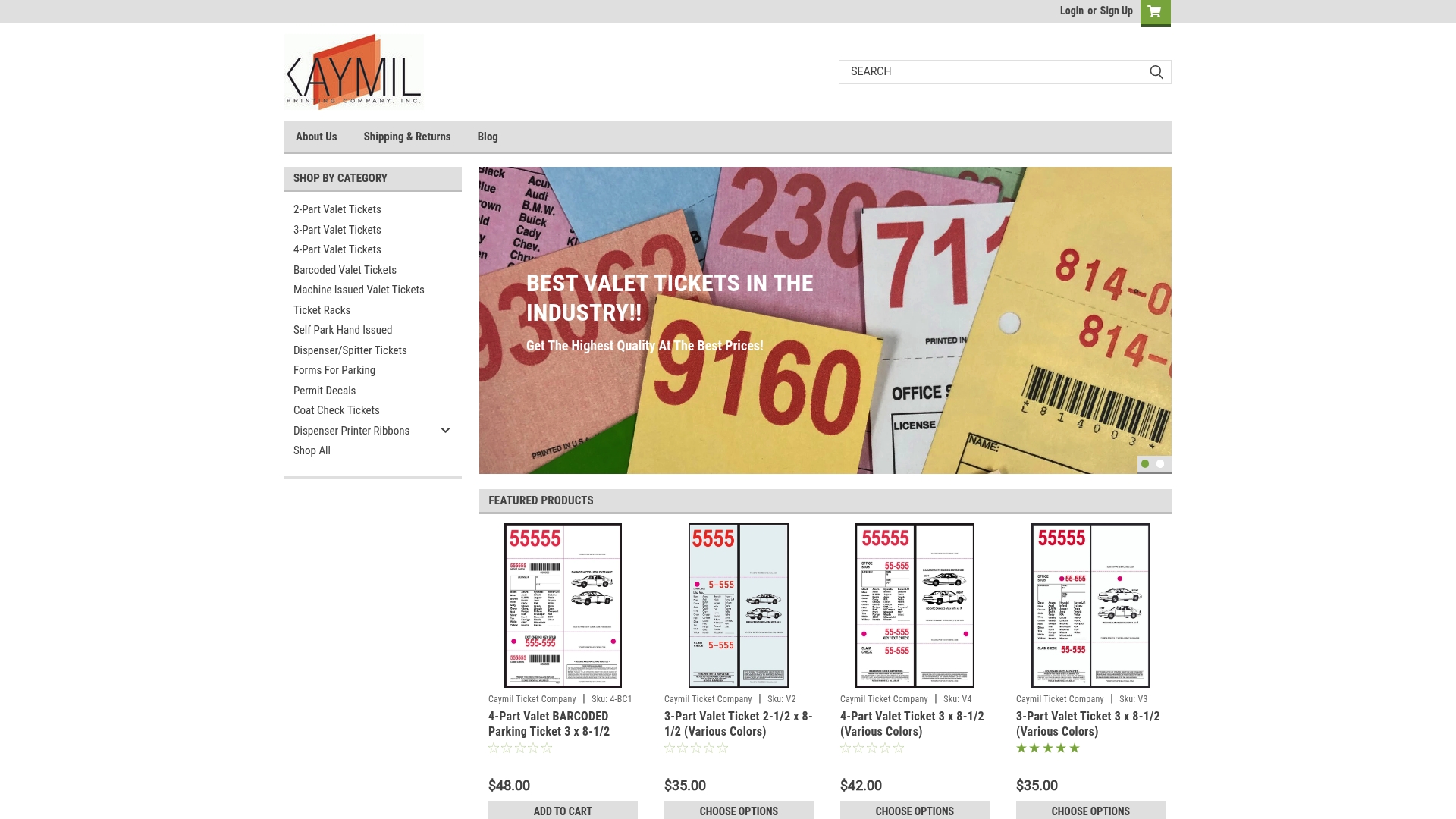
Caymil manufactures thermal, barcode, magnetic stripe, and multi-part carbonless tickets compatible with Amano, TIBA, SKIDATA, FLASH Parking, Scheidt & Bachmann, and Flowbird systems. Products include dispenser spitter tickets for automated entry lanes, machine-issued valet tickets, sequentially numbered permit stock, and custom validation stickers. Every product ships with options for custom branding, security features, and sequential numbering. Caymil’s parking forms and supplies catalog covers both stock and fully custom orders, with fast nationwide shipping and competitive pricing for facilities of any size.
FAQ
What are the main types of garage revenue tickets?
The five main types are transient, monthly or permit, validated, event, and lost ticket. Each category serves a distinct revenue function and requires separate tracking in a PARCS system.
What is a transient parking ticket?
A transient parking ticket is issued to a parker who pays by the hour or day with no prior contract. It is the most common ticket type and the primary source of variable revenue in public garages.
How do validated parking tickets affect garage revenue?
Validated tickets reduce the fee charged to the parker, with a merchant reimbursing the discount. Without monthly caps and reconciliation against PARCS data, validation programs can create significant revenue leakage.
What should a lost ticket fee be set at?
The standard practice is to set the lost ticket fee equal to the daily maximum rate. This protects revenue by assuming the vehicle has been parked for the full operating day.
Why does ticket print quality matter for revenue tracking?
A barcode or magnetic stripe that fails to read forces a manual override at the exit lane, which bypasses automated fee calculation and introduces the risk of undercharging or waiving fees entirely.
Recommended
- Parking Garage Lost Ticket Fee Policy: Operator’s Guide - Caymil Printing Co., Inc.
- Garage parking receipt explained for facility managers - Caymil Printing Co., Inc.
- Garage Parking Ticket Durability Tips for Operators - Caymil Printing Co., Inc.
- Printed Parking Tickets: A Practical Guide for Operators - Caymil Printing Co., Inc.