
What Is a Monthly Parking Permit? Costs and Benefits
If you’ve ever stared at a street sign wondering whether your monthly parking permit actually covers you there, you’re not alone. Understanding what is a monthly parking permit goes well beyond knowing you paid a monthly fee. A permit defines where you can park, under what conditions, and for how long. It does not create a parking space out of thin air, and it does not override every rule on the street. This guide covers how these permits work, what they cost, how to apply, and what rules you need to follow to actually use one without getting a ticket.
Table of Contents
- Key takeaways
- What is a monthly parking permit and how it works
- Cost of a monthly parking permit
- How to apply for a monthly parking permit
- Rules, limitations, and tips for permit holders
- My honest take on navigating monthly parking permits
- How Caymil supports parking permit operations
- FAQ
Key takeaways
| Point | Details |
|---|---|
| Permits grant access, not guaranteed spaces | A monthly parking permit allows legal parking in designated zones but does not reserve a specific spot. |
| Costs vary widely by location and type | Monthly permit pricing ranges from roughly $60 to $165 or more depending on city, facility, and access privileges. |
| Application requirements differ by permit type | Residential, commuter, and commercial permits each have distinct eligibility criteria and required documentation. |
| Local rules still apply | Permit holders must comply with street sweeping, time restrictions, and movement requirements regardless of permit status. |
| Businesses can manage permits through online portals | Multi-user account systems let organizations handle billing, renewals, and permit assignments in one place. |
What is a monthly parking permit and how it works
A monthly parking permit is a credential issued by a municipality, transit agency, private facility, or university that grants the holder the right to park in a specific designated area for a calendar month. Think of it as a recurring license for a parking privilege rather than ownership of any particular space. Permits allow legal parking that may override typical time restrictions in designated zones, but only where signage explicitly permits it.
The physical form of a permit varies considerably. Older programs issue a monthly parking sticker or hang tag you display in your vehicle. Newer programs have moved to entirely digital credentials. Arizona State University, for example, uses QR codes and Bluetooth Low Energy features through a mobile app for facility entry, with fees prorated based on the permit start date.
Understanding the common permit types helps clarify what you are actually purchasing:
- Residential permits are issued to people who live in a designated neighborhood and need to park near their home. They typically allow parking in zone-marked streets during restricted hours.
- Commuter permits target people who drive to transit hubs, downtown cores, or employment centers. Many facilities offer discounted monthly rates for regular commuters as an incentive to reduce daily transaction volume.
- Commercial permits are purchased by businesses or fleet operators who need consistent access to a facility or on-street zone for deliveries, service vehicles, or employee parking.
- Transit agency permits such as those offered by BART provide reserved or preferred access at transit station lots, often with a guaranteed space available until a specific cutoff time in the morning.
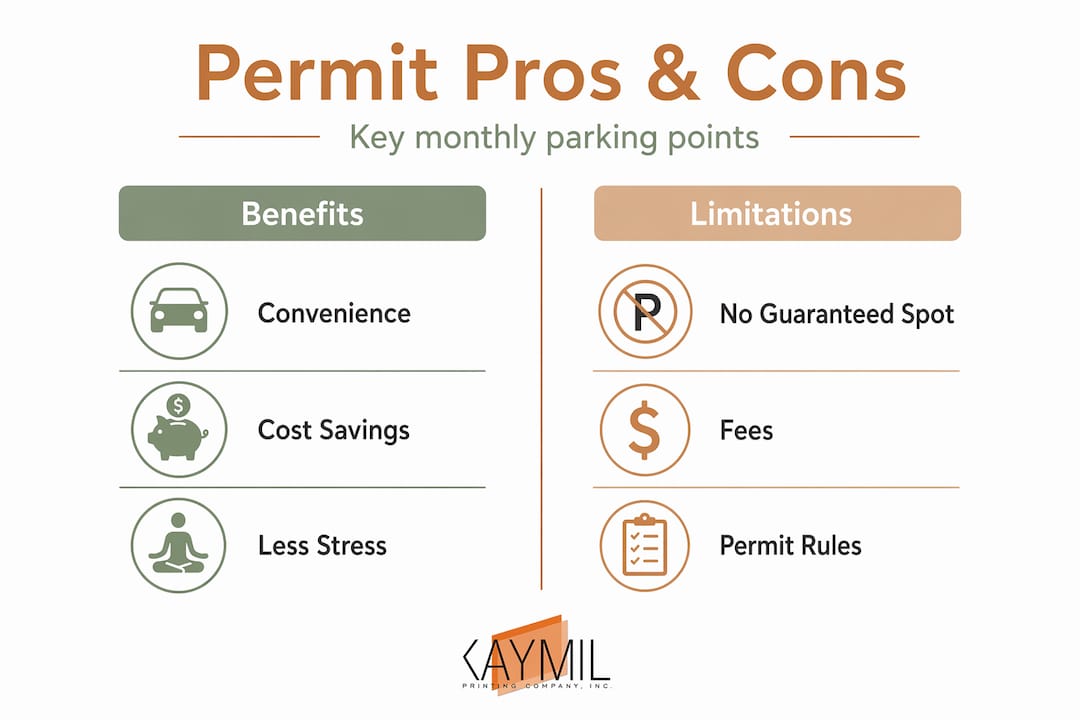
One point that surprises many first-time permit holders: permits do not create parking spaces. If a lot is full, your permit does not entitle you to block a driveway or occupy a spot assigned to a different zone. The credential authorizes parking where the rules allow it. Nothing more.
Exploring parking hang tag programs in more detail can also help parking operators understand the physical credential side of this equation.
Cost of a monthly parking permit
Permit pricing is one of the most frequently searched topics, and for good reason. The cost of a monthly parking permit can range from modest to significant depending on where you are, what type of access you need, and whether you want a reserved or non-reserved space.
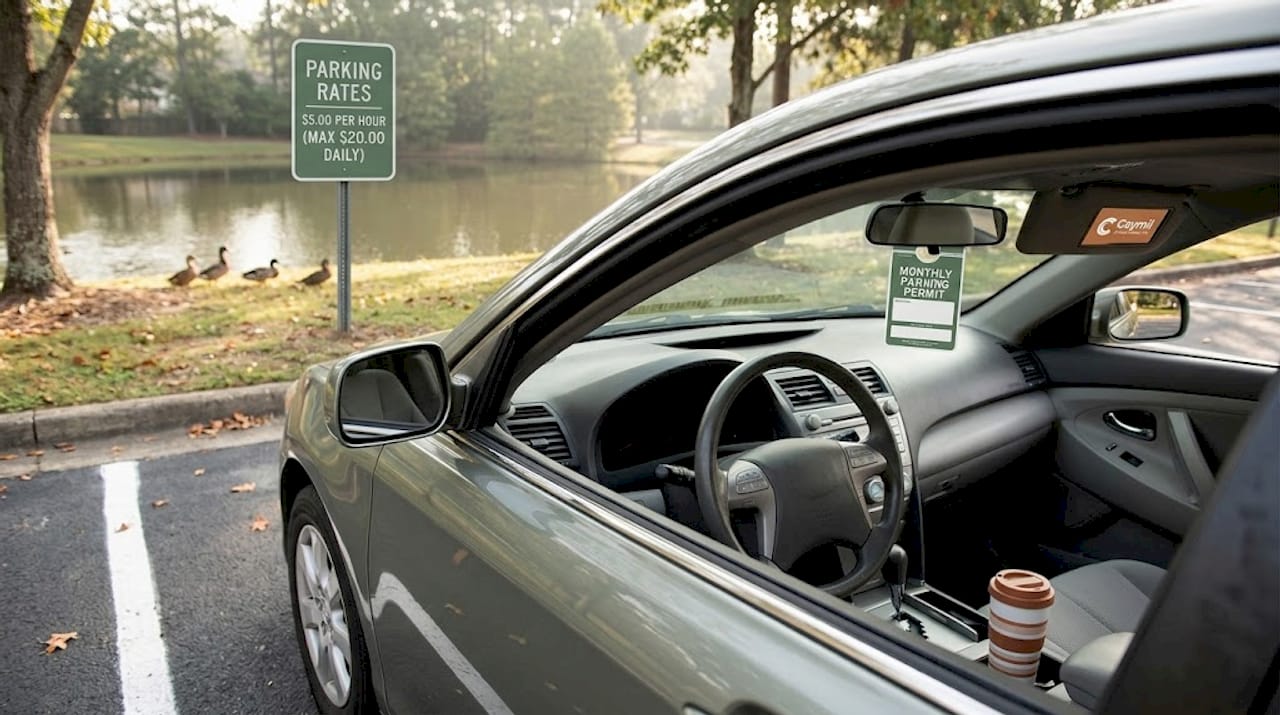
The City of Sacramento illustrates how multiple pricing tiers can coexist in one city. It offers commuter discounts and different credential types for city-owned facilities versus private facilities, with payment terms that differ between them. In California’s Santa Barbara, commuter surface lot permits are priced between $60 and $165 per month depending on the specific lot and access level.
| Permit type | Typical monthly cost | Reserved space | Common users |
|---|---|---|---|
| Residential street permit | $10 to $50 | No | Homeowners, renters |
| Commuter lot (surface) | $60 to $165 | Sometimes | Transit riders, downtown workers |
| Covered garage (unreserved) | $100 to $250 | No | Office tenants, urban residents |
| Covered garage (reserved) | $150 to $400+ | Yes | Executives, high-demand locations |
| Transit agency monthly pass | $70 to $130 | Partial | Rail and bus commuters |
Several factors push the price up or down. Location is the biggest driver. A monthly parking pass in midtown Manhattan will cost significantly more than the same privilege in a mid-size Midwestern city. The type of facility matters too. Underground or covered garages command more than surface lots. Reserved spaces carry a premium over first-come, first-served access.
Administrative fees are another cost many people overlook. Some municipalities charge a one-time registration or processing fee on top of the monthly rate. Payment method can also affect total cost. Many facilities offer a slight discount for enrolling in AutoPay, and some use proration for permits starting mid-month, meaning you pay only for the days remaining in that calendar month.
Pro Tip: If you are weighing daily rates against a monthly parking pass, calculate your actual days of use per month carefully. Most monthly permit programs break even financially around 15 to 18 days of monthly use compared to standard daily rates. If you park fewer days than that, paying daily may cost less overall.
How to apply for a monthly parking permit
The application process for a monthly parking permit depends heavily on the issuing authority and the type of permit you need. However, most programs share a common structure that you can prepare for in advance.
- Identify the correct permit type. Determine whether you need a residential, commuter, commercial, or facility-specific permit. Applying for the wrong category is one of the most common application delays.
- Confirm eligibility. Residential permits usually require proof that you live within the permit zone. The City of Cambridge, for example, requires proof of residence documents along with strict renewal deadlines, and outstanding unpaid parking tickets can prevent permit issuance entirely.
- Gather your documentation. Common requirements include a valid driver’s license, current vehicle registration, proof of residency (utility bill or lease agreement), and sometimes proof of employment for commuter permits.
- Submit your application. Most municipalities and facilities now offer online applications through a city portal or facility website. Paper applications are still accepted in some municipal programs, particularly for residential permits.
- Pay fees and receive credentials. After approval, you pay the applicable fees. Some programs issue a physical monthly parking sticker or hang tag by mail. Others send digital credentials via email or through a parking app.
- Renew on time. Most monthly permits renew monthly or annually. Missing the renewal window can result in a lapse in parking privileges, which means your vehicle could be ticketed even in your usual spot.
For businesses managing multiple employees or vehicles, account-based portal systems simplify this significantly. The City of Tampa’s monthly parker system, for instance, provides a portal for managing multiple permits and payments online, which reduces administrative overhead for parking managers considerably.
Pro Tip: Clear any outstanding parking tickets before applying. Several programs, including Cambridge, will flat-out deny your application if you have unpaid violations on record. A $50 forgotten ticket can block a permit worth hundreds of dollars per year.
When you need physical permit materials for a facility or organization, reviewing options for parking forms and permits gives you a clear picture of what professional printed credentials look like at scale.
Rules, limitations, and tips for permit holders
Holding a monthly parking pass does not exempt you from every rule that applies to public streets or shared facilities. This is the area where most permit holders run into unexpected fines, and it is almost always because they assumed the permit covered more than it does.
Here are the most important rules and limitations to understand before you park:
- Street sweeping days still apply. A residential permit does not protect you from a street sweeping citation. Residential permits do not exempt from street rules, and time limits in your zone still apply even if your permit is valid.
- The 72-hour movement rule. Many municipalities require that vehicles on public streets move at least once every 72 hours. A monthly permit does not override this. Leaving your car in one spot for four or five days, even in a permit zone, can result in a citation or tow.
- Transit lot stay limits. BART, for example, limits consecutive-day unattended parking and charges on a recurring monthly basis. The program is designed for daily commuters, not for travelers who want to leave a car at the station for a week.
- Signage overrides everything. Permit zones are mapped to specific area letters or color codes. If the sign says your zone letter does not apply between certain hours, that is the governing rule regardless of what your permit card says. Always read the sign, not just the permit.
- Digital credentials require working hardware. Programs using Bluetooth or QR code access require a charged phone with the correct app installed. A dead battery or app error does not excuse a missed scan. Have a backup plan.
Understanding how signage and permit zones work in your specific city before you commit to a permit is genuinely worth an hour of research upfront. The enforcement practices and fine structures vary enough by city that what is acceptable in one location could be a $100 ticket in another.
My honest take on navigating monthly parking permits
I’ve spent years working alongside parking operators, municipalities, and facility managers, and the single most consistent mistake I see is people treating a monthly permit like a golden ticket. They get the credential, they stop reading signage, and then they’re genuinely confused when they get a citation.
What I’ve learned is that the rules governing monthly permits are almost always logical once you understand the system’s intent. A residential permit exists to prioritize neighborhood residents over all-day commuters, not to waive every street rule on their behalf. A transit lot permit exists to serve daily commuters, not long-term vehicle storage. Once you see the purpose behind each permit type, compliance becomes much more intuitive.
The shift to digital credentials is real and accelerating. QR codes and app-based access are increasingly replacing the physical parking decal, and that trend will only continue. My advice: if your program issues digital credentials, set up the app correctly before your first day of use and test it. Do not assume it will work when you need it.
For businesses, the account portal systems available today genuinely reduce headaches. Managing 20 employee permits through a spreadsheet and a check every month is unnecessary when most major facilities offer structured online billing. That is a quality-of-life change worth making.
— Richard
How Caymil supports parking permit operations
For parking facilities, operators, and municipalities that manage permit programs at scale, the physical and printed components of a permit system matter more than most people realize. A poorly printed hang tag fades in direct sunlight. A sticker without proper security features gets duplicated. The credential itself carries the integrity of the entire permit program.
Caymil has designed and manufactured parking permit materials since 1937, serving garages, municipalities, universities, and transit facilities across the United States. From durable parking permit hang tags and thermal permit decals to barcoded valet parking tickets compatible with major access control systems, Caymil builds permit materials that hold up under real-world conditions. Custom options include sequential numbering, barcoding, color coding by zone, and security features that prevent duplication. If your facility manages a monthly permit program and needs credentials that operators and enforcement staff can trust, Caymil has the production capacity and industry experience to deliver.
FAQ
What does a monthly parking permit actually allow?
A monthly parking permit grants the holder the right to park in specifically designated zones or facilities for the permit duration. It does not guarantee an open space or exempt the vehicle from all local street rules.
How much does a monthly parking permit cost?
The cost of a monthly parking permit typically ranges from $10 to $50 for residential street permits and $60 to $165 or more for commuter and garage permits, depending on location, facility type, and whether the space is reserved.
How do you get a monthly parking permit?
To get a monthly parking permit, identify the permit type you need, confirm eligibility, gather required documents such as proof of residency or vehicle registration, and apply through the issuing authority’s online portal or office.
Is a monthly parking permit worth it?
A monthly parking permit is worth it if you park in the same location 15 or more days per month. Below that threshold, daily rates often cost less in total.
Can a business apply for monthly parking permits?
Yes. Most facilities and municipalities offer commercial or fleet permit options, and many provide online account portals that allow businesses to manage multiple permits, payments, and renewals in one place.
Recommended
- Real-world temporary parking permit examples and best practices - Caymil Printing Co., Inc.
- How to launch a parking garage permit hang tag program - Caymil Printing Co., Inc.
- Garage parking receipt explained for facility managers - Caymil Printing Co., Inc.
- What is an event parking ticket? The pro’s guide - Caymil Printing Co., Inc.