

Amano Parking System Explained for Facility Operators

Amano ONE is a cloud-based Parking Access and Revenue Control System (PARCS) built for high-volume facilities that need fast, reliable access control and centralized revenue management. The platform issues tickets as fast as 0.5 seconds, runs on plug-and-play hardware with a single moving part, and delivers real-time dashboards accessible from any device without a dedicated server. For parking facility managers, that combination means fewer technician calls, faster lane throughput, and a cleaner view of revenue across every property.
The system covers the full operational spectrum. Software modules handle casual parking, season pass management, valet operations, and cashless enforcement. The cloud architecture removes physical points of failure and supports multi-tenant management so portfolio operators can push configuration updates across multiple sites from a single interface. Three core software products anchor the platform: Amano ONE, PRO+ Facility Management Software, and Aria Series One Software.
Amano ONE is designed to be the most simplified, powerful, and reliable cloud-based PARCS on the market, giving operators expedited access with best-in-class reporting and rapid system processing speeds.
Key capabilities at a glance:
- Cloud-based architecture with no on-site server requirement
- Ticket issue speeds very fast, designed to minimize entry lane queue time for high-volume throughput
- Plug-and-play hardware with one moving part to minimize downtime
- Real-time dashboards with interactive reporting and system alerts
- Multi-tenant management for centralized multi-property control
- Integrated modules for casual parking, season passes, valet, and cashless enforcement
- Open architecture supporting third-party hardware and software integration
How the Amano ONE software platform manages your facility
Amano ONE is the flagship cloud-based platform, and its software architecture is what separates it from older server-dependent systems. Operators get dynamic dashboards that update in real time, with one-click access to transaction data, lane status, and revenue summaries. There is no app to install. Any browser-capable device, whether a tablet in the booth or a laptop in a corporate office, connects directly to the same live data.
The platform’s reporting module goes beyond basic transaction logs. Interactive reports let managers filter by date range, lane, credential type, or payment method, then export results for accounting or auditing. System alerts and notifications flag equipment issues, low ticket stock, or unusual transaction patterns before they become operational problems.
Specialized modules extend the platform’s reach across different parking scenarios:
- Casual parking: Manages transient parkers with ticket issuance, rate calculation, and payment processing at entry and exit lanes.
- Season pass handling: Supports flexible parking accounts with multi-credential access, so a monthly parker can use a proximity card, a mobile credential, or license plate recognition interchangeably.
- Valet management: Tracks vehicle keys and positions within a valet operation, linking each vehicle to a ticket record for accurate retrieval and billing.
- Cashless enforcement: Enables fully unmanned operation by routing all payments through mobile pay, prepaid accounts, or automated pay stations.
- Built-in call center: Connects parkers directly to support staff through the lane intercom without requiring a separate phone system.
- Powerful API library: Allows integration with third-party validation systems, hotel property management platforms, and event ticketing software.
Multi-tenant management is particularly valuable for operators running more than one property. Portfolio managers can control multiple sites, push security updates remotely, and view consolidated reporting across their entire portfolio from one interface. That capability alone replaces what used to require either on-site IT staff at each location or expensive VPN infrastructure.
Pro Tip: Set up system alert thresholds for ticket stock levels and gate cycle counts. Amano ONE’s notification system can flag these automatically, letting your team address issues during off-peak hours rather than during a busy morning rush.
What hardware components make up an Amano parking system?
The physical layer of an Amano parking system is designed around one principle: fewer moving parts means less downtime. The plug-and-play hardware design means most components swap out without calling a specialized technician, which keeps lanes operational during repairs.
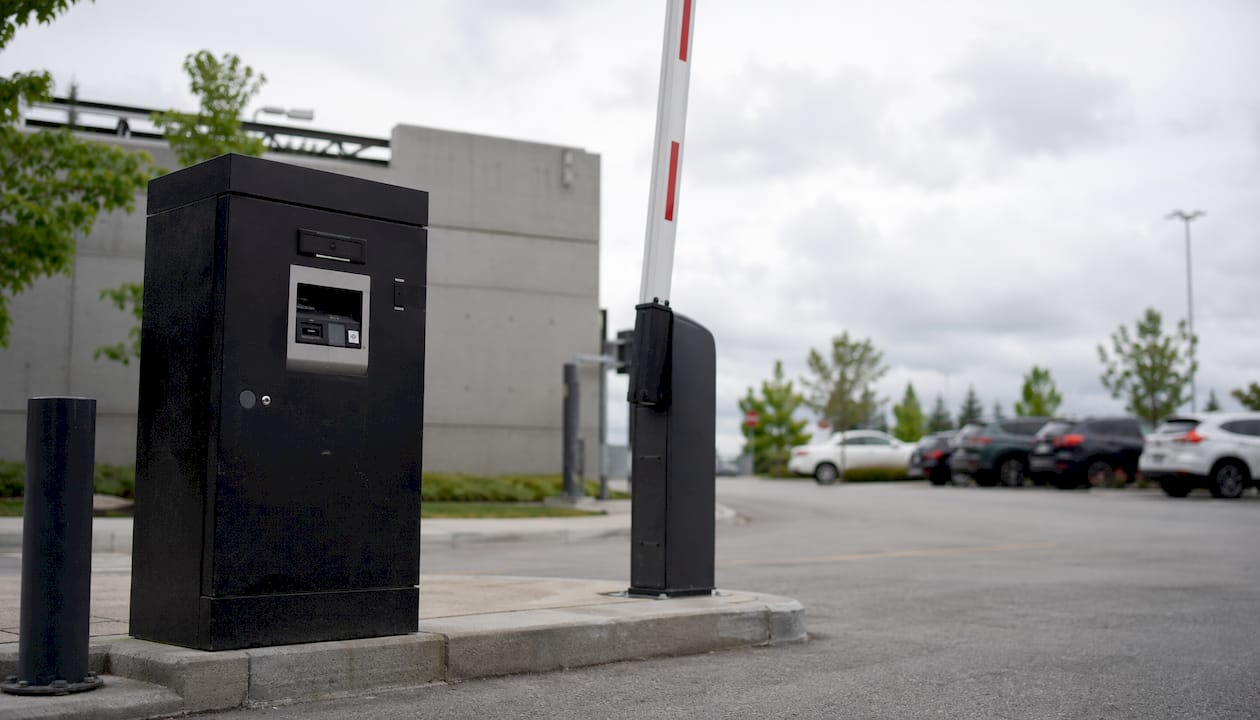
A standard Amano installation includes the following hardware components:
| Component | Function |
|---|---|
| Ticket issuing machine | Dispenses entry tickets at speeds as fast as 0.5 seconds per ticket |
| Barrier gate | Controls vehicle entry and exit; arm auto-reverses on obstacle contact |
| License plate recognition (LPR) camera | Captures plate data for ticketless access and monthly permit validation |
| Vehicle presence detector | Inductive loop coil or ultrasonic sensor that confirms vehicle position before gate activation |
| Payment terminal | Processes cashless, mobile, and card payments at pay-on-foot or exit stations |
| Parking guidance displays | LED signs showing available space counts by zone, updated in real time |
| Intercom / call center unit | Connects parkers to support staff directly from the lane |
Barrier gates in the Amano lineup, such as the APB-1800 series, can lift a three-meter arm in 1.2 seconds, which keeps traffic moving in high-volume lanes. The arm auto-reverses when it contacts an obstacle, protecting both the vehicle and the gate mechanism. Vehicle detectors use inductive loop coils embedded in the pavement or ultrasonic sensors mounted above the lane to confirm presence before the gate activates, preventing false cycles that wear out the mechanism prematurely.
LPR cameras are the most environment-sensitive component in the system. Capture accuracy depends heavily on lighting conditions and camera angle, not just camera resolution. Facilities that install LPR in covered garages with inconsistent lighting often see lower read rates than those that add dedicated illumination at the capture point.
Pro Tip: For LPR installations, position cameras at a 15-to-25-degree angle to the vehicle’s travel path and add dedicated white LED illumination at the capture zone. This setup maintains high read accuracy in low-light conditions and during nighttime operations without relying on headlights alone.
How an Amano parking system moves a vehicle from entry to exit
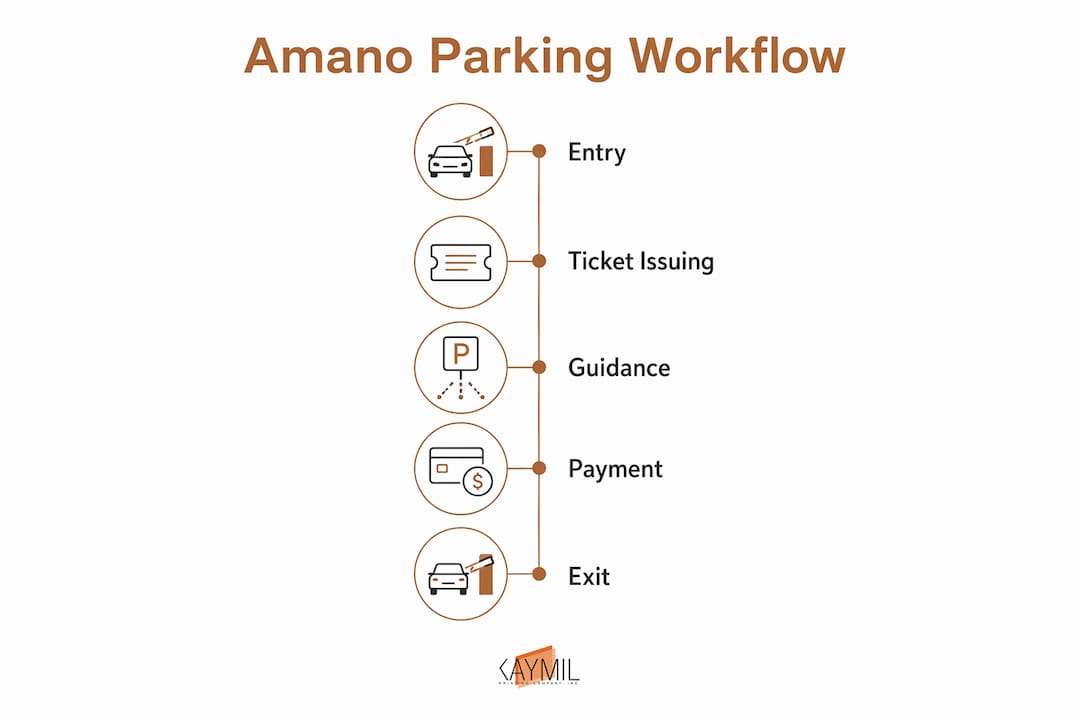
The operational workflow of an Amano PARCS follows a clear sequence that can run fully attended, partially attended, or completely unmanned depending on the facility’s configuration. Understanding each step helps operators identify where delays occur and where automation can replace manual intervention.
Entry sequence:
- Vehicle approaches the entry lane; the inductive loop detector confirms presence.
- The ticket issuing machine dispenses a barcoded or magnetic stripe ticket in as little as 0.5 seconds.
- The barrier gate lifts and the vehicle enters; the gate closes after the detector confirms clearance.
- The system timestamps the ticket and logs the transaction in the cloud dashboard.
Payment and exit sequence:
- Parker proceeds to a pay-on-foot station or exit lane terminal before leaving.
- The system reads the ticket barcode or magnetic stripe, calculates the fee based on the entry timestamp and current rate schedule.
- Payment is accepted via credit card, mobile pay, prepaid account, or validation code.
- A paid exit ticket or digital confirmation is issued; the parker proceeds to the exit lane.
- The exit reader confirms payment, the barrier gate opens, and the transaction closes in the cloud.
| Workflow Stage | Amano Feature | Operator Benefit |
|---|---|---|
| Entry | 0.5-second ticket issue | Reduces lane queue time |
| Access control | Multi-credential (card, LPR, mobile) | Supports monthly and transient parkers |
| Payment | Cashless, mobile, prepaid options | Enables unmanned operation |
| Exit | Automated gate release on confirmed payment | Eliminates cashier requirement |
| Reporting | Real-time cloud dashboard | Instant revenue visibility |
Parking guidance displays integrate into this workflow by directing drivers to available spaces before they begin circling. Parking guidance systems reduce search time and stress for drivers, which accelerates space turnover and increases revenue for the facility. In fully unmanned configurations, the entire sequence from arrival to exit runs without staff involvement, which is particularly effective for overnight or low-traffic periods.
Pro Tip: Configure rate schedules and validation rules in Amano ONE before a facility opens for the day. The cloud platform applies rate changes instantly across all lanes, so a promotional rate for an event can go live and expire automatically without manual intervention at each terminal.
What are the key benefits of adopting Amano ONE?
The operational case for Amano ONE centers on three areas: speed, reliability, and cost of ownership. Each one connects directly to measurable outcomes for parking operators.
Speed and throughput are the most immediate benefits. Ticket issue speeds are very fast, designed to minimize entry lane queue time per transaction, meaning a busy entry lane processes vehicles faster than a cashier-dependent system ever could. Combined with multi-credential access, monthly parkers move through without stopping to interact with a terminal at all.
Reliability improves because the cloud architecture eliminates the on-site server as a single point of failure. If a local network issue occurs, the system continues to operate on cached credentials and reconnects automatically when connectivity restores. Hardware with one moving part means fewer mechanical failures, and plug-and-play components mean a replacement takes minutes rather than hours.
Key benefits for parking operators:
- Accelerated transaction speeds reduce lane queues during peak periods
- Cloud management eliminates server hardware costs and IT maintenance overhead
- Plug-and-play components allow non-specialist staff to swap failed hardware quickly
- Real-time dashboards give managers instant visibility into revenue and lane status
- Multi-tenant management lets portfolio operators control all sites from one interface
- Parking guidance integration reduces driver search time and increases space turnover
- Cashless and mobile pay options support fully unmanned overnight or low-traffic operations
- Data privacy architecture ensures operator data is never sold or shared by the platform
Data security deserves specific attention in the U.S. market, where parking operators handle payment card data subject to PCI DSS requirements. Amano ONE’s cloud design keeps data encrypted in transit and at rest, and the platform’s stated policy is that operator data is never owned, sold, or disseminated by Amano. That posture matters when operators are evaluating vendor contracts and data governance obligations.
The financial case is also straightforward. Reduced downtime means fewer lost transactions during equipment failures. Unmanned operation capability reduces labor costs during low-volume periods. And centralized reporting gives finance teams accurate, auditable revenue data without manual reconciliation from paper logs.
What types of Amano parking systems are available?
Amano’s product family covers a wider range of parking environments than most operators realize. The core U.S. platform is Amano ONE, but the global product line includes several distinct system types suited to different facility configurations.
Amano ONE is the primary cloud-based PARCS for U.S. parking facilities. It handles gated entry and exit with full software integration, supports transient and monthly parkers, and runs on the plug-and-play hardware described throughout this article. It is the right choice for garages, surface lots, and mixed-use facilities that need centralized management and high throughput.
PRO+ Facility Management Software extends Amano ONE’s capabilities for larger or more complex operations. It adds deeper reporting, more granular rate management, and additional integration options for facilities with specialized revenue control needs, such as hospitals with validation programs or universities with multi-tier permit structures.
Aria Series One Software targets facilities that need a more configurable software layer, particularly those integrating with third-party access control or property management systems. Aria Series One supports custom workflows and credential types beyond what standard PARCS configurations require.
Xparc is Amano’s open architecture platform deployed in over 40 countries. Its modular design allows operators to integrate auxiliary hardware and specialized third-party software over time, making it a strong choice for facilities with unique operational requirements or those in markets where Amano ONE is not the primary offering.
Beyond software platforms, Amano’s hardware product family includes:
- Gated entry/exit systems: The standard configuration for most garages and surface lots, using ticket dispensers, barrier gates, and pay stations.
- Flap-locking systems: A ground-level locking mechanism that physically immobilizes a vehicle until payment is confirmed, common in smaller or unattended lots.
- Ticketless LPR systems: Entry and exit based entirely on license plate recognition, eliminating the ticket entirely for monthly parkers or pre-registered vehicles.
- Bicycle parking systems: Gate-type and individual-locking configurations for managed bicycle facilities, a growing segment in urban markets.
- Parking guidance systems: Sensor-based space monitoring with LED displays that direct drivers to available spaces in real time.
Amano’s open architecture approach means operators are not locked into a single hardware vendor. The system is designed to integrate new auxiliary hardware and third-party environments as facility needs evolve.
For U.S. operators evaluating system types, the choice usually comes down to transaction volume, staffing model, and whether the facility serves primarily transient parkers, monthly permit holders, or a mix of both. Gated LPR systems work well for monthly-heavy facilities. Full PARCS with ticket dispensers and pay stations handle high transient volume more effectively. Guidance systems add value in any configuration where driver search time is a known friction point.
How Caymil’s custom tickets work with Amano parking systems
Amano ONE and related PARCS platforms depend on physical ticket media at the entry lane, and the quality of that media directly affects system performance. A ticket that jams in the dispenser, fails to scan at the exit reader, or tears during handling creates a transaction exception that requires staff intervention. Caymil has manufactured parking tickets compatible with Amano systems since 1937, and that depth of experience shows in the print tolerances and material specifications that keep dispensers running without interruption.
Caymil produces several ticket formats that integrate directly with Amano hardware:
- Barcoded parking tickets: Printed with high-density barcodes that read reliably in Amano exit lane scanners, even after handling in humid or high-traffic environments.
- Magnetic stripe tickets: Compatible with Amano magnetic stripe readers for facilities that use mag-stripe encoding for access control or validation.
- Machine-issued spitter tickets: Thermal roll stock sized and coated for Amano ticket dispensers, with print clarity that holds up through the full transaction cycle.
- Multi-part carbonless tickets: Used in valet operations where a claim check and a vehicle record need to travel separately; available in 2-part, 3-part, and 4-part formats.
- Validation tickets: Pre-printed or custom-printed tickets used by merchants or event operators to reduce or waive parking fees within the Amano rate structure.
Customization options include sequential numbering, facility logos, custom colors, security features such as void patterns, and variable data printing for date or location coding. Sequential numbering is particularly useful for revenue auditing: when every ticket has a unique number, reconciling issued tickets against paid transactions becomes a straightforward count rather than a manual review.
Caymil’s custom parking tickets are manufactured to the dimensional and print specifications required by Amano dispensers and readers, reducing jams, misreads, and transaction exceptions that cost operators time and revenue.
Caymil’s parking forms and tickets ship nationwide with fast turnaround, and the company maintains stock inventory for common Amano-compatible formats so operators are not waiting weeks for a reorder. For facilities running valet alongside a gated PARCS, Caymil’s barcoded valet tickets link the physical claim check to a digital transaction record, giving operators a complete audit trail from vehicle drop-off to retrieval.
Maintenance requirements and common troubleshooting tips
Amano’s hardware design philosophy reduces maintenance burden, but it does not eliminate it. The single-moving-part architecture means the barrier gate arm mechanism is the primary wear component in a gated lane. Regular inspection of the arm pivot, counterbalance spring, and loop detector sensitivity settings prevents most unplanned failures.
A practical maintenance schedule for Amano installations covers these areas:
- Barrier gate arms: Inspect pivot hardware and counterbalance springs monthly; replace arm assemblies showing stress cracks before they fail in service.
- Ticket dispensers: Clean the print head and ticket path weekly in high-volume lanes; check thermal print quality daily to catch fading before tickets become unreadable at the exit scanner.
- LPR cameras: Clean lens covers monthly and verify capture zone illumination; recalibrate camera angle after any physical disturbance to the mounting bracket.
- Vehicle detectors: Test loop sensitivity settings seasonally, as temperature changes affect loop coil inductance and can cause false triggers or missed detections.
- Payment terminals: Run end-of-day settlement reports to catch transaction errors; inspect card readers for skimming devices as part of PCI DSS compliance practice.
Common troubleshooting scenarios and their typical causes:
Gate not opening after valid payment: Usually a loop detector sensitivity issue or a communication timeout between the pay station and the gate controller. Check detector LED status first; if the detector is not registering the vehicle, adjust sensitivity before assuming a software fault.
Ticket jams in dispenser: Most often caused by ticket stock that is outside the dispenser’s dimensional tolerance or humidity-warped roll stock. Caymil’s Amano-compatible ticket stock is manufactured to the correct specifications, which eliminates most jam-related calls.
LPR misreads: Check illumination at the capture zone and verify that the camera angle has not shifted. Dirty license plates and non-standard plate fonts are the most common causes of genuine misreads that cannot be resolved through camera adjustment alone.
Pro Tip: Keep a log of gate cycle counts per lane. Most barrier gate mechanisms have a rated cycle life, and tracking cycles lets you schedule preventive replacement before a failure takes a lane offline during peak hours.
Security features and compliance standards in the U.S. market
Parking facilities in the U.S. handle payment card data, personal vehicle information, and in some cases biometric or license plate data that falls under state privacy regulations. Amano ONE addresses these obligations through its cloud architecture and stated data governance policies.
PCI DSS compliance is the baseline requirement for any facility accepting credit or debit card payments. Amano ONE’s payment processing integrates with PCI-compliant payment gateways, keeping card data out of the parking management system itself. The platform does not store raw card numbers; tokenization handles payment credentials so that even a breach of the parking system does not expose card data.
Data privacy is addressed at the platform level. Amano ONE’s published policy states that operator data is never owned, sold, or disseminated by the platform. For facilities subject to state privacy laws such as the California Consumer Privacy Act (CCPA), that posture supports compliance documentation by limiting third-party data exposure.
LPR data governance is an emerging compliance area in several U.S. states. License plate data captured for access control purposes may be subject to retention limits and use restrictions depending on state law. Operators using Amano’s LPR features should establish data retention policies that align with applicable state requirements and document those policies for audit purposes.
Physical security features in Amano hardware include tamper-resistant enclosures on ticket dispensers and payment terminals, encrypted communication between lane hardware and the cloud platform, and access-controlled administrative interfaces that require role-based credentials. The built-in call center function also creates an auditable record of every support interaction at the lane level.
For U.S. facilities that handle federal government parking contracts, additional compliance requirements under FedRAMP or agency-specific security frameworks may apply. Operators in those environments should verify current certification status directly with Amano McGann before deployment.
What the operator and parker experience looks like in practice
The operator-facing interface in Amano ONE is browser-based, which means there is no software to install and no version to update manually. Managers log in from any device and land on a dashboard that shows lane status, current occupancy, recent transactions, and any active alerts. The layout prioritizes the information a manager needs to act on immediately, with drill-down access to detailed reports one click away.
For multi-property operators, the multi-tenant view aggregates data across all sites on a single screen. A regional manager overseeing a portfolio of garages can see which properties are running at capacity, which lanes have active alerts, and how revenue compares across locations, all without switching between separate logins or systems.
The parker experience is designed around speed and clarity. At entry, the ticket dispenses in under a second and the gate opens without delay. Parking guidance displays, where installed, show available space counts by zone so drivers go directly to an open space rather than circling. At payment, mobile pay options let parkers pay from their phones before returning to the vehicle, which eliminates the queue at the exit lane entirely.
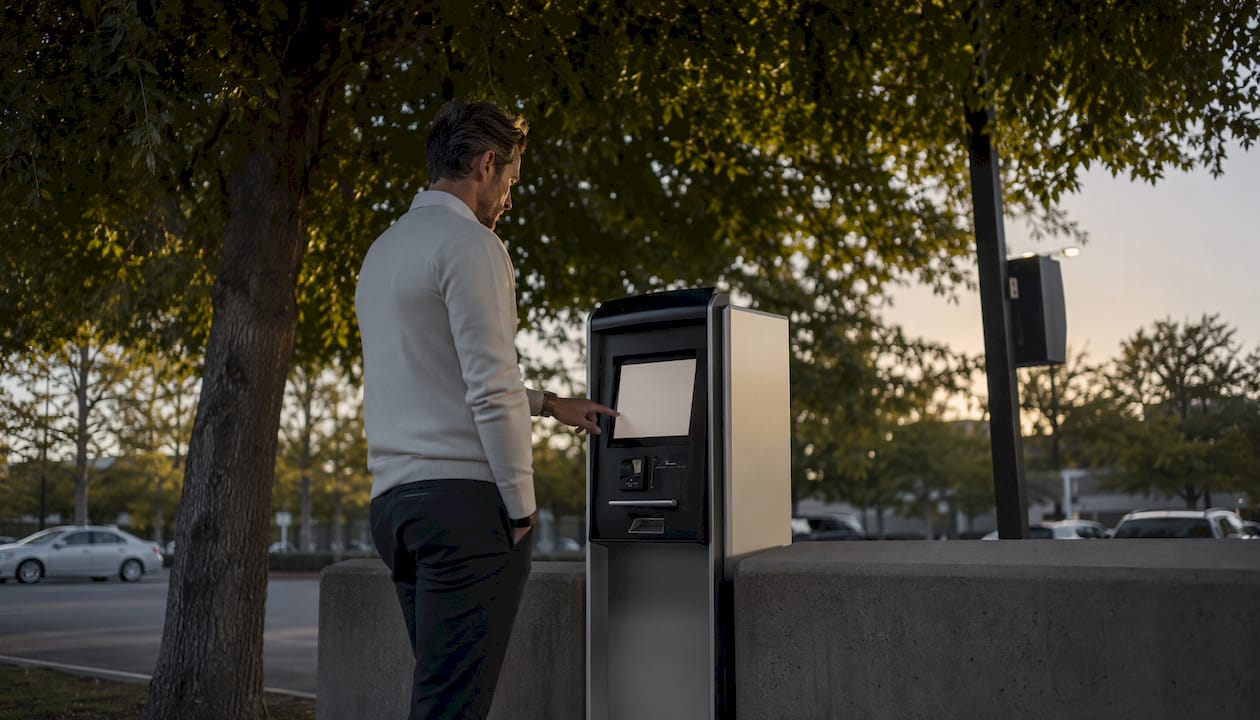
For parking access control in facilities with monthly permit holders, multi-credential access means a parker can use whichever credential they have available, whether a proximity card, a mobile credential, or license plate recognition, without needing to carry a specific physical token. That flexibility reduces credential-related support calls and improves throughput at monthly parker lanes.
The Amano Parking mobile app extends the parker experience further by offering QR code access, integrated payment, parking spot tracking, and parking history. For facilities that have enabled the app, parkers can pre-register, view rates, and manage their session from their phone, which reduces interaction with physical terminals and shortens lane dwell time.
Real-world Amano installations across U.S. parking environments
Amano McGann’s U.S. installations span a wide range of facility types, and the operational requirements differ significantly across them. Understanding how the system performs in different contexts helps operators assess fit for their own environment.
Hospital and healthcare facilities present some of the most demanding parking environments: high daily transaction volumes, complex validation programs for patients and staff, and a visitor population that is often unfamiliar with parking technology. Amano ONE’s built-in call center function is particularly valuable here, giving confused parkers immediate access to support without requiring staff to be physically present in the lane. Validation integration with hospital billing systems allows automatic fee reduction for patients, which reduces cashier workload and speeds exit processing.
University and campus parking typically involves a large monthly permit population alongside transient visitor parking. Multi-credential access handles the permit side efficiently, while the transient lane configuration manages visitor throughput. PRO+ Facility Management Software adds the rate management depth that universities need for multi-tier permit structures, departmental billing, and event rate overrides.
Hotel and hospitality parking combines valet operations with self-park, often in the same structure. Amano ONE’s valet management module tracks vehicle positions and links each vehicle to a ticket record, while the self-park lanes run standard PARCS workflow. For hotel operators looking at valet and guest experience integration, the combination of Amano’s software modules and Caymil’s multi-part valet tickets creates a complete, auditable workflow from drop-off to retrieval.
Municipal and event parking requires the ability to handle surge volumes during events and then return to standard transient rates. Amano ONE’s cloud-based rate scheduling handles this without manual intervention at each terminal. A rate change configured before an event goes live automatically and expires on schedule, which is exactly the kind of operational detail that prevents revenue leakage during high-volume periods.
For operators evaluating parking management system options across these environments, the consistent thread in Amano installations is the combination of cloud reliability, hardware durability, and software flexibility that handles both routine operations and exceptional circumstances without requiring constant IT support.
Key Takeaways
Amano ONE is a cloud-based PARCS that delivers ticket issue speeds as fast as 0.5 seconds, plug-and-play hardware with one moving part, and multi-tenant management across multiple properties from a single interface.
| Point | Details |
|---|---|
| Ticket issue speed | Amano ONE issues tickets as fast as 0.5 seconds, reducing entry lane queue time in high-volume facilities. |
| Hardware design | Plug-and-play components with one moving part allow non-specialist staff to swap failed hardware quickly. |
| Cloud management | Multi-tenant architecture lets portfolio operators control all sites and push updates from one interface. |
| Software modules | Amano ONE covers casual parking, season passes, valet, and cashless enforcement in a single platform. |
| Ticket media quality | Caymil’s Amano-compatible tickets are manufactured to dispenser specifications, reducing jams and misreads. |
FAQ
What is Amano ONE parking?
Amano ONE is a cloud-based Parking Access and Revenue Control System (PARCS) that manages vehicle entry, payment, and exit through integrated software modules and plug-and-play hardware, with ticket issue speeds as fast as 0.5 seconds.
How does an Amano parking system work?
A vehicle triggers an entry detector, the ticket issuing machine dispenses a barcoded ticket, and the barrier gate opens. The parker pays at a pay-on-foot station or exit terminal, and the gate releases after the system confirms payment through the cloud platform.
What are the benefits of using Amano ONE?
Amano ONE reduces downtime through plug-and-play hardware, eliminates server costs with cloud architecture, supports unmanned operation through cashless payment options, and gives operators real-time revenue visibility across multiple properties from a single dashboard.
What types of parking systems does Amano offer?
Amano offers gated entry/exit PARCS, ticketless LPR systems, flap-locking systems for unattended lots, bicycle parking systems, and parking guidance systems with real-time space availability displays.
Are Amano parking systems compatible with custom-printed tickets?
Yes. Amano ticket dispensers accept barcoded, magnetic stripe, and thermal roll tickets manufactured to the correct dimensional and print specifications. Caymil produces Amano-compatible ticket stock in multiple formats, including machine-issued spitter tickets and multi-part valet tickets.
Recommended
- Parking Access Control Explained for Facility Operators - Caymil Printing Co., Inc.
- Hotel Parking Permit System Explained for Managers - Caymil Printing Co., Inc.
- Parking Management System Examples for Operators in 2026 - Caymil Printing Co., Inc.
- How Parking System Compatibility Works for Managers - Caymil Printing Co., Inc.