
Security Features on Casino Tickets: A Buyer’s Guide
Layered ticket security — machine-verified barcodes combined with physical overt and covert elements, plus sequential numbering — stops most casino and hotel ticket fraud and makes end-of-shift reconciliation faster. That is the operational verdict, and it holds whether you are managing a cage payout line, a valet stand, or an event gate. The role of security features on casino tickets is not decorative; each feature targets a specific fraud vector.
Prioritize these features first:
- Barcode symbology + server validation: A PDF417 or Code 128 barcode tied to a first-scan-wins server check blocks duplicate and screenshot attacks at the point of redemption.
- Sequential numbering + at least one covert element: Sequential serials enable manual spot checks and batch reconciliation; UV-reactive inks or a hologram give cage staff a fast physical verification that no scanner can fake.
The operational payoff is concrete: faster cage reconciliation, fewer payout disputes, and a clear audit trail when a ticket is questioned.
Key Takeaways
Layered ticket security combining machine-verified barcodes, sequential numbering, and at least one covert physical feature stops the most common casino and hotel ticket fraud scenarios while keeping reconciliation fast and auditable.
| Point | Details |
|---|---|
| Prioritize barcode + serial | PDF417 or Code 128 with first-scan-wins blocks duplicates; sequential numbers catch gaps at reconciliation. |
| Match features to payout risk | High-value cage vouchers warrant holograms and UV fibers; low-value valet stubs need only a barcode and serial. |
| Require pre-production samples | Mandate a 50-ticket scan test and UV verification demo before approving full production. |
| Confirm hardware compatibility | Test 1D/2D scanner support, offline cryptographic validation, and printer stock compatibility before rollout. |
| Caymil for spec and samples | Caymil supplies casino, hotel, and valet tickets with security options and provides scan/UV demos before production. |
Table of Contents
- What security features do casino tickets actually stop?
- Which barcode symbology fits your casino or hotel ticket?
- How do holograms and CGH/Holocode work as covert security?
- Why sequential numbering still matters alongside barcodes
- How do validation workflows use ticket security at each checkpoint?
- What to specify in an RFP or ticket order
- What drives cost and lead time for secure tickets?
- Is your hardware compatible with secure ticket features?
- Recommended feature combinations by use case
- Balancing security, speed, and cost in practice
- Caymil supports your ticket spec from sample to production
- Sources
- FAQ
What security features do casino tickets actually stop?
The role of security features on casino tickets maps directly to the fraud vectors they block. Knowing which feature stops which attack lets you specify only what you need.
Overt features (visible to staff and guests):
- Holograms and foil stamps — Difficult to reproduce on consumer printers; used at casino cages and event gates as a first-pass visual check.
- Watermarks — Pressed into the substrate during manufacturing; absent on photocopied or reprinted fakes.
- Gloss marks and spot UV coatings — Catch the light at an angle; specialty ticket printers list these alongside foils as standard anti-fraud options.
- Microprinting — Text readable only under magnification; a copied ticket loses the detail.
- Perforations — Provide a tamper-evident tear line; a reattached stub shows visible damage.
Covert features (invisible without a device):
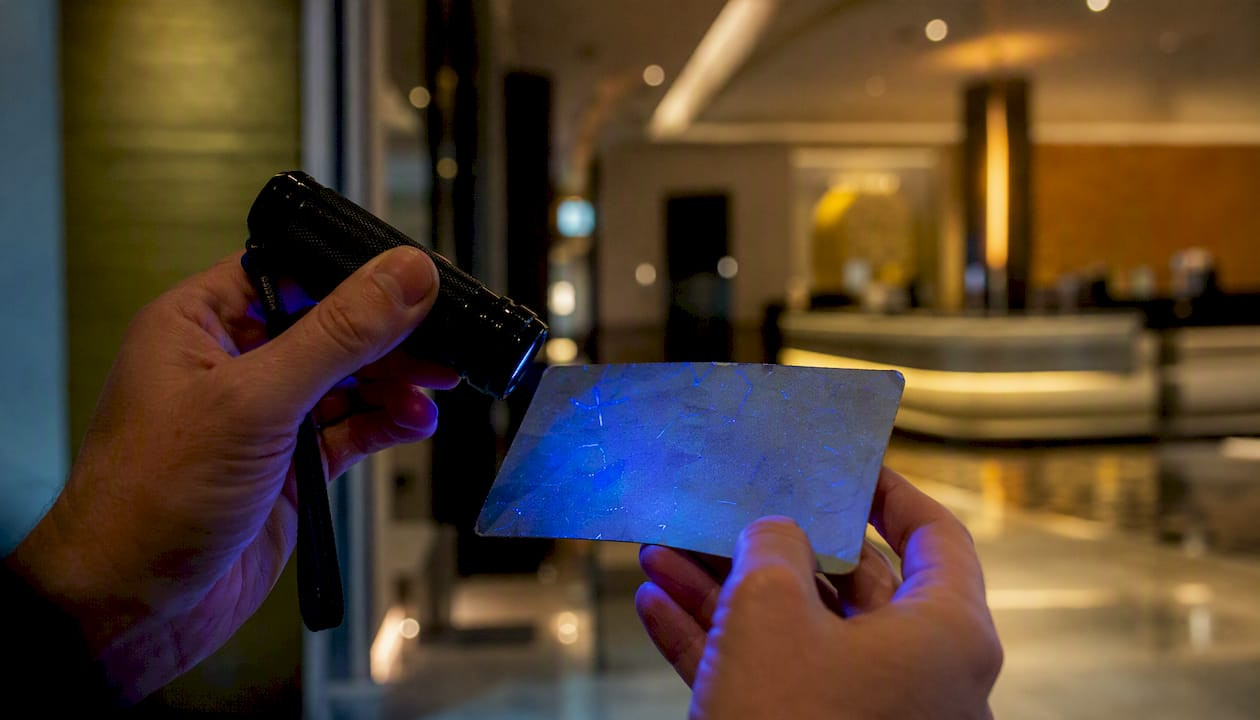
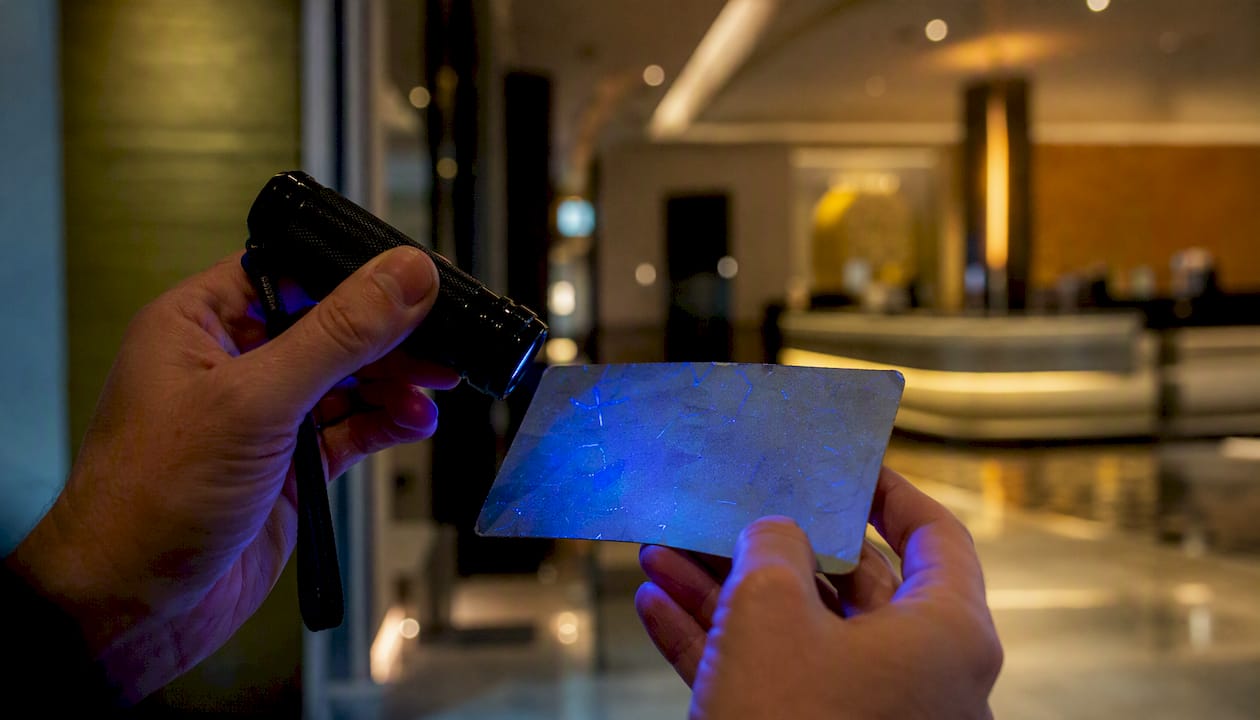
- UV-reactive inks and fibers — Fluoresce under a UV lamp; fast to check at a cage window.
- Chemical taggants — Molecular markers detectable only with a proprietary reader; used on high-value vouchers.
- Infrared inks — Readable by IR scanners but invisible to the naked eye.
Machine-readable features:
- Barcodes — Block duplication and screenshot attacks when tied to server validation.
- Magnetic stripes — Encode a ticket ID for legacy readers; vulnerable to cloning without additional covert layers.
- Cryptographic hashes — Embedded in the barcode payload; an offline kiosk can verify authenticity without a live server call.
Substrate and durability matter more than most managers expect. Authentic slot voucher stock includes pressed watermarks, UV-reactive fibers, holographic threads, and premium thermal coatings that resist heat and fading. Standard receipt paper lacks every one of those features and will be rejected by kiosks or cage staff. Specifying the wrong stock is one of the most common procurement errors in casino environments.
Which barcode symbology fits your casino or hotel ticket?
Barcode symbologies differ by data capacity, print size, and use case. The table below maps the four most common options to casino and hospitality applications.
| Symbology | Data capacity | Best use case | Notes |
|---|---|---|---|
| PDF417 | High (around 1 KB) | Printed stubs, cage vouchers, print-at-home | Carries ticket ID, event code, digital signature |
| Code 128 | Medium (numeric/alpha) | Short ticket IDs, parking, valet | Fast scan; pairs well with sequential numbering |
| QR Code | Medium | General mobile, self-service kiosks | Widely supported; less dense than PDF417 |
| Aztec | Medium | Mobile wallet passes (Apple Wallet, Google Wallet) | Compact; preferred for wallet integrations |
What to encode in the barcode:
- Unique ticket ID (server-side primary key)
- Event or session code and date
- Ticket type or section/seat
- Digital signature or cryptographic hash for offline validation
Keep all PII and payment data server-side. The barcode carries only the identifiers needed to look up the record; the server holds the value.
First-scan-wins is the single most effective server-side control. The first scan marks the ticket as redeemed; every subsequent scan of the same ID returns a reject. Rolling codes add a time-based layer for mobile wallet passes, and offline cryptographic signatures let kiosks validate tickets without a live network connection.
How do holograms and CGH/Holocode work as covert security?
Standard holographic foils are visible deterrents. Computer-generated holograms (CGH), sometimes called Holocodes, go further: they can be printed directly on paper, embed a digital identifier, and tolerate up to 70% surface distortion while remaining readable by a smartphone or specialized reader. That resilience matters on a casino floor where tickets get folded, wet, or creased.
When to specify each type:
- Visible foil hologram — Use on any ticket where a fast visual check at a cage or gate is the primary workflow. Low training burden; staff recognize the shimmer immediately.
- CGH/Holocode — Use on high-value vouchers where you want a covert digital identifier that survives physical damage. Requires a verification app or handheld reader and a short staff training step.
- UV fibers and chemical taggants — Use where you need a covert layer that does not add visible complexity to the ticket face. UV lamps are inexpensive and already common in cage environments.
For low-risk valet stubs or short-term parking tickets, covert features are often unnecessary overhead. Reserve them for tickets with payout risk above a threshold your finance team sets.
Pro Tip: Require the supplier to demonstrate the readout method — phone app, handheld device, or UV lamp — during sample approval. Confirm which device your cage staff will use and factor any device procurement into your rollout budget before signing a production order.
Why sequential numbering still matters alongside barcodes
Barcodes handle machine validation. Sequential numbers handle the human audit layer, and the two controls catch different failure modes. A sophisticated counterfeit might pass a barcode scan if the server record was manipulated; a sequential gap in the stub count will surface the anomaly at reconciliation.
Practical reconciliation checks that use serial numbers:
- End-of-shift stub count — Total issued stubs should match the sequential range assigned to that shift. A gap signals a missing or skipped ticket.
- Missing-range detection — Compare the first and last serial of each batch against the count of redeemed tickets. Any range with unexplained gaps warrants investigation.
- Batch verification at the cage — High-value voucher batches can be cross-referenced against the server redemption log using serial ranges rather than scanning every ticket individually.
A simple spot-check protocol for a busy shift: pull 10 random stubs per 500 issued, verify the serial sequence is unbroken, and log any exceptions in a shift report. Escalate gaps of more than two consecutive numbers immediately.
How do validation workflows use ticket security at each checkpoint?
Gate or turnstile scanning:
- Scan barcode at entry.
- Server checks ticket ID: first scan accepts; duplicate or unknown ID rejects.
- Rejected tickets route to a manual escalation desk where staff check the hologram and serial number before any override.
Cage workflow for high-value vouchers:
- Visual hologram or UV check first — reject immediately if absent.
- Barcode scan against server record.
- Manual serial reconciliation against the batch log before payout.
Valet workflow:
- Ticket issued with sequential number and barcode at vehicle intake.
- Retrieval requires the matching stub or a PIN; the barcode scan confirms the record.
- Mismatches trigger a supervisor review before vehicle release.
Train cage staff on UV and hologram verification at least quarterly. A short, repeatable drill — five tickets, two of which are intentional fakes — keeps recognition sharp without pulling staff off the floor for long. Log every incident where a ticket fails verification; patterns in the log often reveal a specific fraud source.
What to specify in an RFP or ticket order
A well-specified ticket order removes ambiguity and gives suppliers no room to substitute lower-security stock. Include every item below:
- Substrate type (thermal, coated stock, or carbonless multi-part) and thickness
- UV/IR ink placement and fluorescence color
- Hologram or foil type, size, and placement
- Barcode symbology, data fields, and encoding format
- Sequential numbering format (starting number, digit count, prefix)
- Perforation placement and tear-line spec
- Multi-part or carbonless copy requirements
- Magnetic stripe if legacy readers require it
Testing tolerances to require:
- Barcode scan success rate on production samples (target 100% on a 50-ticket test run)
- UV-reactivity confirmation under a 365 nm lamp
- Durability test: fold the ticket four times and rescan; heat exposure at 120°F for 30 minutes
- Serial alignment tolerance: no offset greater than 1/32 inch
Pro Tip: Require pre-production samples and a scan/UV verification demo at no extra charge before approving full production. Mandate a pilot run of 200–500 tickets through your actual gate or cage hardware before committing to the full order quantity. Per event ticket design best practices, high-value tickets benefit from combining 4–7 security features, and scan testing before printing is non-negotiable.
What drives cost and lead time for secure tickets?
Cost and timeline vary significantly based on the security level you specify.
- Substrate type — Premium thermal or coated casino stock costs more than standard paper; the price difference is small relative to payout risk.
- Hologram or foil application — Requires a custom die; adds tooling cost on the first order, amortized over volume.
- Covert inks and taggants — UV inks add modest cost; chemical taggants add more and require a proprietary reader.
- Custom dies and perforations — One-time tooling fees; reusable on reorders.
- Sequential numbering and barcoding — Standard on most custom orders; minimal cost adder.
- Small-run fees — Short runs under a few thousand tickets often carry a setup surcharge.
Typical timelines: Stock items ship within days. Custom tickets with standard security (barcode, sequential numbering, UV ink) typically take 1–2 weeks. Orders requiring custom holograms, foil dies, or chemical taggants can run 3–6 weeks or longer depending on tooling lead time. Plan procurement cycles accordingly, especially before a property opening or a high-volume event season.
Larger print runs reduce per-unit cost and reduce the frequency of reorders, which limits the window during which a depleted stock creates a fraud exposure gap.
Is your hardware compatible with secure ticket features?
Before committing to a ticket spec, confirm compatibility across every device in the workflow.
Integration checklist:
- Printer compatibility: roll vs. sheet feed, thermal coating grade, ribbon type for thermal-transfer models
- Scanner compatibility: confirm 1D (Code 128) and 2D (PDF417, QR, Aztec) symbology support
- POS and kiosk validation: test both online (server lookup) and offline (cryptographic signature) modes
- Mobile wallet support: confirm Aztec or QR decode on gate readers if wallet passes are in scope
Short test script for IT and operations:
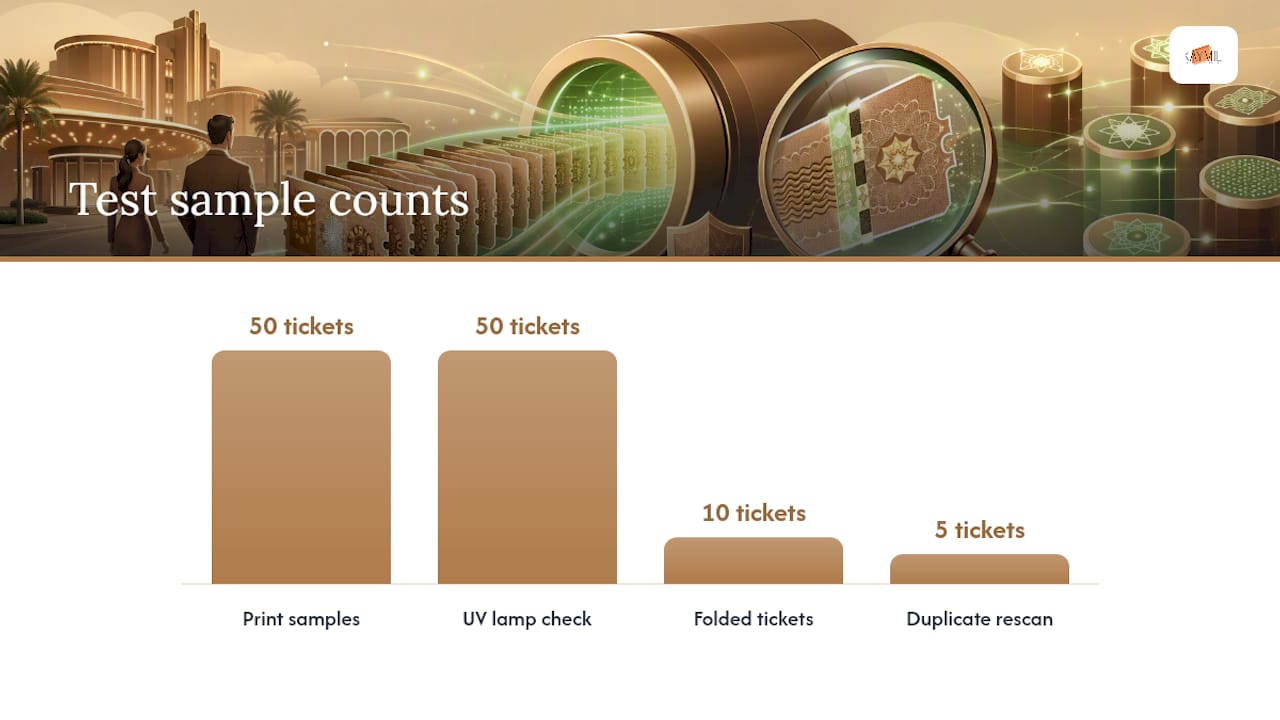
- Print 50 sample tickets on production stock using production hardware.
- Scan each ticket; log any read failures.
- Simulate a duplicate scan on five tickets; confirm server returns a reject on the second scan.
- Disconnect the scanner from the network; verify offline cryptographic validation accepts a valid ticket and rejects a tampered one.
- Run UV lamp over all 50 tickets; confirm fluorescence is uniform and matches spec.
- Fold and crease 10 tickets; rescan and confirm readability.
A barcode-based system modernization at Marcus Hotels and Resorts demonstrated that replacing legacy magnetic-stripe tickets with barcode-based terminals and integrated software reduced reconciliation time and enabled license-plate recognition integrations. The compatibility work done upfront made the transition smooth.
Data privacy note: Keep PII off the barcode entirely. Validate ticket value and identity server-side, and document your log retention policy before go-live.
Recommended feature combinations by use case
| Use case | Overt features | Covert features | Machine-readable | Fraud scenario blocked |
|---|---|---|---|---|
| Casino cage voucher | Hologram foil, microprinting | UV fibers, chemical taggant | PDF417 + cryptographic hash | Counterfeit payout voucher, duplicate redemption |
| Valet ticket | Sequential numbering, perforation | UV ink | Code 128 barcode | Stub swap, vehicle theft via fake claim ticket |
| Event admission | Hologram, gloss mark | UV ink | QR or PDF417 + first-scan-wins | Screenshot duplicate, printed copy attack |
| Mobile wallet pass | None required | None required | Aztec + rolling code | Screenshot replay, expired pass reuse |
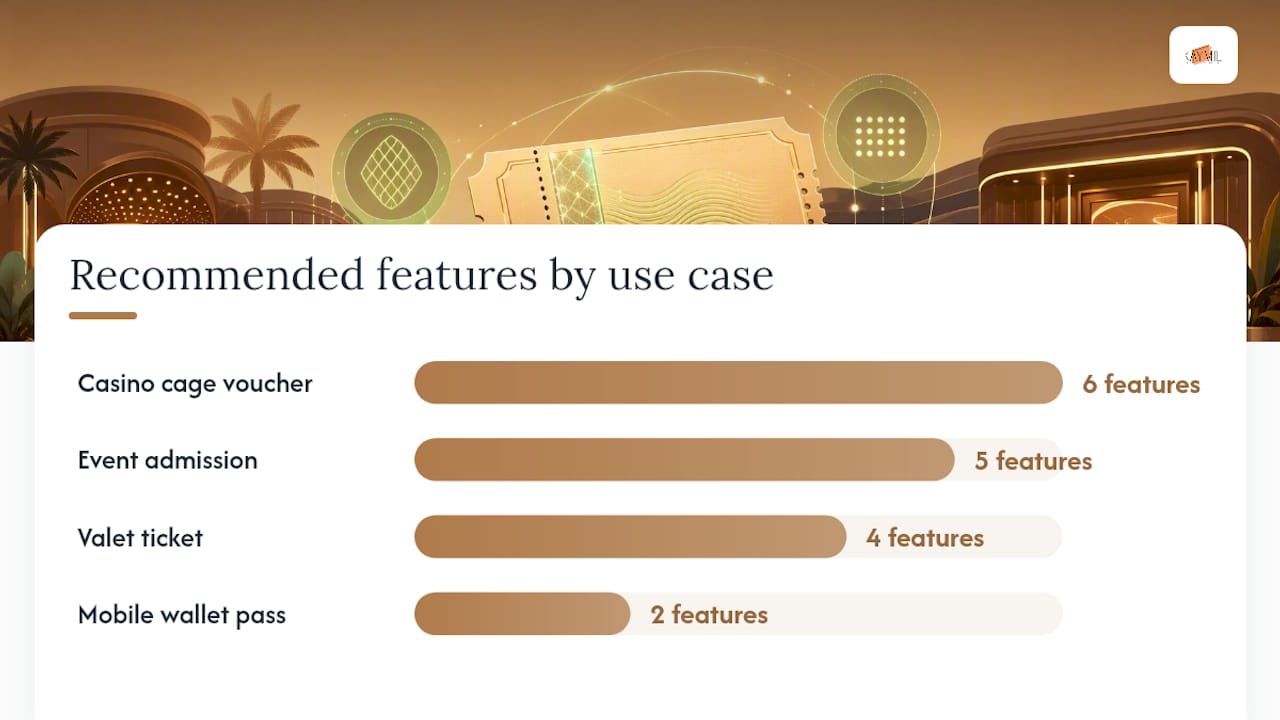
Scale the bundle to dollar value and throughput. A $5 valet stub needs a barcode and sequential number; a $500 slot voucher warrants a hologram, UV fibers, and a cryptographic hash. High-throughput event gates prioritize scan speed, so keep the barcode symbology simple (QR or Code 128) and rely on server-side first-scan-wins rather than physical inspection at the gate.
For barcoded valet tickets, pairing a Code 128 barcode with sequential numbering and a UV ink stripe covers the most common valet fraud scenarios without slowing retrieval workflows.
Balancing security, speed, and cost in practice
The instinct to add every available security feature to every ticket is understandable, but it creates operational friction and inflates cost without proportional fraud reduction. A few principles worth keeping in mind:
Add covert features where payout risk is high. A UV fiber or chemical taggant on a $500 voucher costs fractions of a cent per ticket. The same feature on a $3 parking stub adds cost with no meaningful fraud deterrent, because the fraud economics do not support sophisticated counterfeiting at that value.
Keep gate workflows fast with a scanner-first policy. Physical inspection at a high-volume gate slows throughput and creates guest friction. Let the barcode and server do the work; reserve hologram and UV checks for the cage, where the transaction value justifies the extra seconds.
Recurring audits matter as much as the initial spec. A well-specified ticket loses its value if staff stop checking the covert features. Short quarterly drills — five minutes, a handful of sample tickets — keep verification habits sharp. Invest in those drills for cage staff specifically, where the payout risk is highest.
Caymil supports your ticket spec from sample to production
Caymil has manufactured custom casino, hotel, valet, and parking tickets since 1937, and that depth of experience shows in the specifics: substrate selection, barcode symbology compatibility with Amano, TIBA, SKIDATA, FLASH Parking, Scheidt & Bachmann, and Flowbird systems, and security feature options that match real cage and gate workflows.
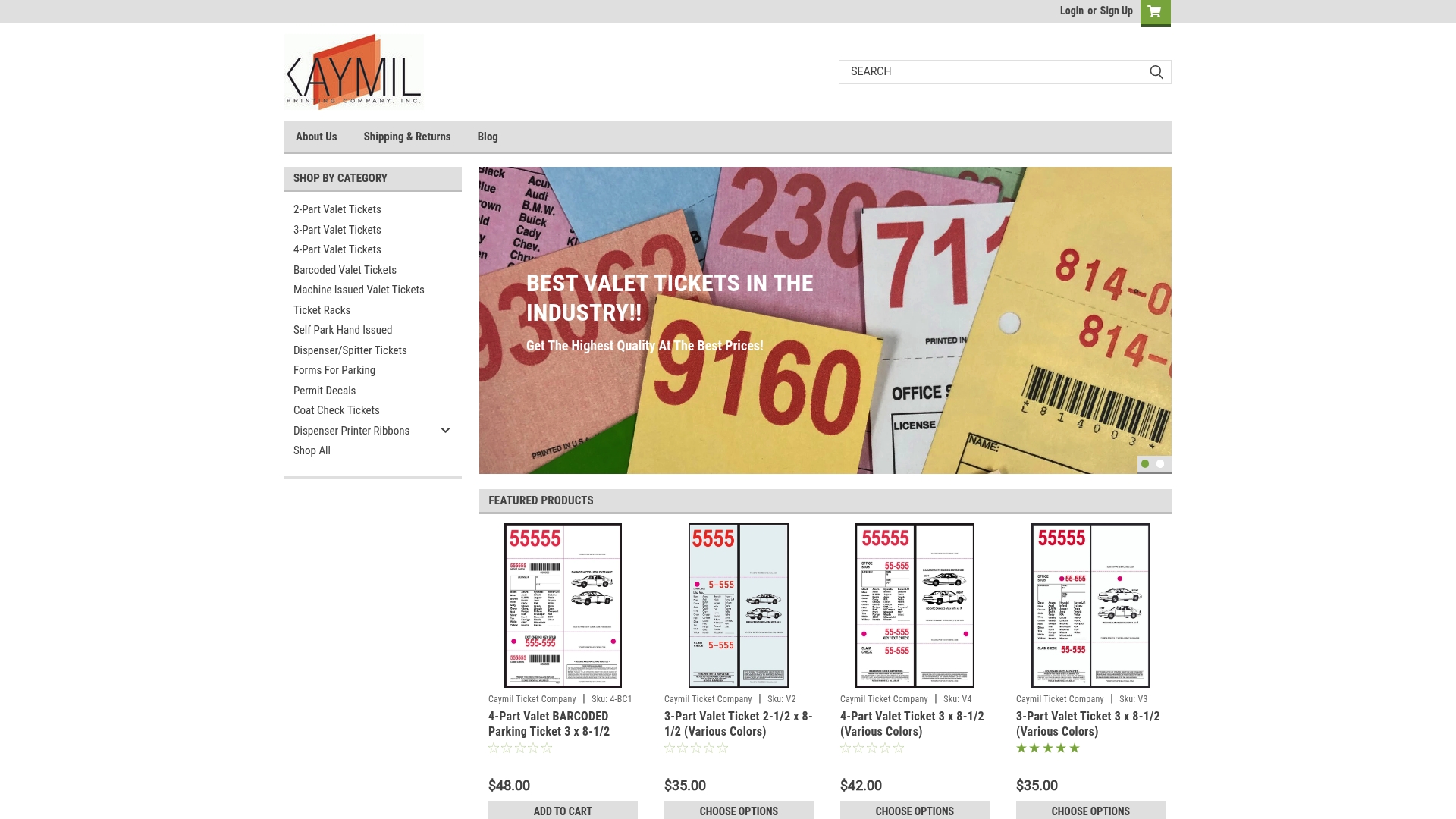
For procurement managers writing a spec or evaluating a supplier, Caymil provides pre-production samples, scan demonstrations, and UV verification checks before full production begins. You can review machine-issued valet ticket options and 2-part valet parking tickets with security feature configurations, or request a custom spec review for casino vouchers and event tickets. Contact Caymil to request a sample package and a scan/UV demo before committing to a production run.
Sources
- Event Ticketing Barcodes: From PDF to Mobile — BarcodeFYI
- Application of computer-generated holograms in security printing — MDPI Applied Sciences
- Slot machine voucher paper — JDMillworks
- Security - An important part of your ticket sales - BOCA Printers, Thermal Tickets & Wristbands
- Event Ticket Printing and Design Checklist | PrintPlace
FAQ
What security features should a casino ticket always include?
At minimum, a casino ticket should carry a machine-readable barcode tied to server-side first-scan-wins validation and sequential numbering for manual reconciliation. High-value vouchers should add at least one covert feature such as UV-reactive fibers or a hologram.
How does first-scan-wins prevent duplicate ticket fraud?
First-scan-wins marks a ticket ID as redeemed on the first valid scan; every subsequent scan of the same ID returns a reject. This blocks both photocopied tickets and screenshot-based mobile duplicates at the point of redemption.
What barcode symbology works best for printed casino vouchers?
PDF417 is the standard choice for printed casino vouchers because it carries a full ticket ID, event code, and cryptographic hash in a compact footprint. Code 128 works well for shorter numeric IDs on valet and parking tickets.
How do UV inks help with casino ticket fraud prevention?
UV-reactive inks are invisible under normal light but fluoresce under a 365 nm UV lamp, giving cage staff a fast physical verification that a photocopied or reprinted ticket cannot replicate. The check takes under five seconds and requires no specialized training beyond lamp familiarity.
When should procurement require a pre-production sample approval?
Always, for any ticket with security features. A pre-production sample run of 50–200 tickets lets you confirm barcode scan rates, UV fluorescence uniformity, serial alignment, and durability before committing to a full production quantity.
Recommended
- Why Casinos Use Validated Parking Tickets: A Manager’s Guide - Caymil Printing Co., Inc.
- Parking ticket security: How to prevent fraud and protect revenue - Caymil Printing Co., Inc.
- Barcode Casino Parking Ticket Integration: A Manager’s Guide - Caymil Printing Co., Inc.
- Coat Check Tickets for Events: Stock vs Custom Guide - Caymil Printing Co., Inc.