

Barcode Casino Parking Ticket Integration: A Manager’s Guide

Barcode casino parking ticket integration is practical, cost-effective, and operationally beneficial for virtually every casino parking operation running a modern PARCS platform. The immediate next step: identify one or two entry lanes and a valet podium for a scoped pilot, then request a barcode ticket sample and compatibility check from Caymil to confirm symbology and material fit before committing to a full rollout. Three signals confirm feasibility at most properties: your PARCS vendor (TIBA, Amano, SKIDATA, FLASH Parking, Scheidt & Bachmann, or Flowbird) already supports barcode credential lookup; license plate recognition (LPR) can serve as a backup validation layer; and printed barcode tickets from a qualified supplier like Caymil are available in dispenser-compatible formats with lead times measured in days, not months.
Table of Contents
- Why barcode casino parking ticket integration pays off quickly
- How a barcode parking system works from entry to exit
- What hardware and software does your system need?
- What ticket specifications should you order?
- Integration checklist and project timeline
- Valet, validated discounts, and loyalty workflows in practice
- What to monitor after go-live
- Key Takeaways
- What most integration guides get wrong about ticket quality
- Caymil’s barcode parking ticket products for casino operations
- Useful sources
- FAQ
Why barcode casino parking ticket integration pays off quickly
Switching from magnetic-stripe tickets to scannable barcodes removes the single most common source of lane jams: the mangled stripe. Case studies from Marcus Hotels and Resorts confirm that replacing magnetic-stripe tickets with barcode credentials reduces mechanical gate failures and improves lane throughput, because a dirty or creased barcode still scans where a degraded stripe fails completely. For casino operations running high volumes across multiple entry points, that reliability difference compounds fast.
The operational benefits extend well beyond lane reliability:
- Reduced lane jams: Barcode readers have no moving parts that grip or pull a ticket, so mechanical jams drop sharply.
- Higher scanner read rates: Modern 1D and 2D readers tolerate minor print imperfections that would defeat a magnetic head.
- Faster reconciliation: High-throughput ticket sorters can image and sort barcoded tickets at rates up to 1,000 documents per minute, cutting back-office labor and simplifying dispute resolution.
- Faster valet workflows: Podium scanners read a ticket in under a second, so attendants spend time on the guest, not the credential.
- Loyalty and room-key integration: Barcode data links directly to player club accounts and property management systems (PMS), enabling automatic folio posting and tiered discount application.
- Improved revenue control: Sequential numbering and encoded timestamps make ticket duplication and substitution fraud far harder to execute.
Parking technology is now a guest-service touchpoint. Integrating parking credentials with room keys and loyalty accounts measurably improves guest satisfaction, which matters in a casino environment where the parking experience sets the tone for the entire visit.
Pro Tip: When selecting lanes for your pilot, choose one high-volume self-park entry lane and one valet podium. That combination surfaces the widest range of integration issues early, before you commit hardware to every lane.
How a barcode parking system works from entry to exit
The architecture is straightforward: a credential is issued at entry, validated against a back-office record, and confirmed at exit. Every variation of casino parking, whether self-park, valet, or hybrid, maps onto that three-step spine.
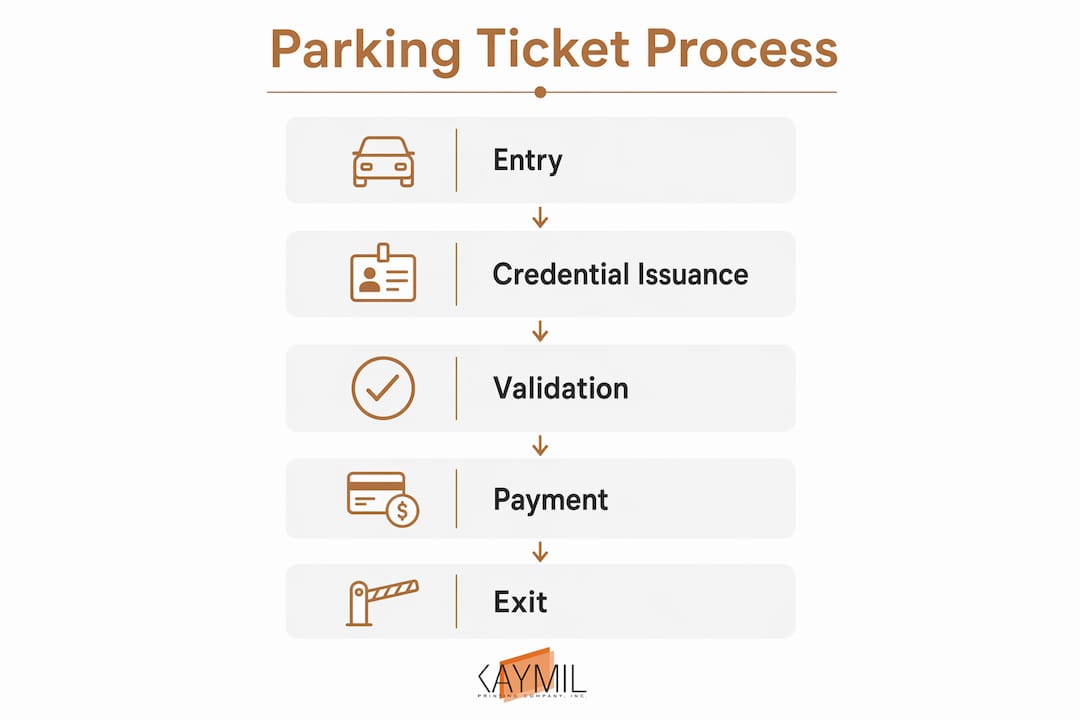
Entry and credential issuance
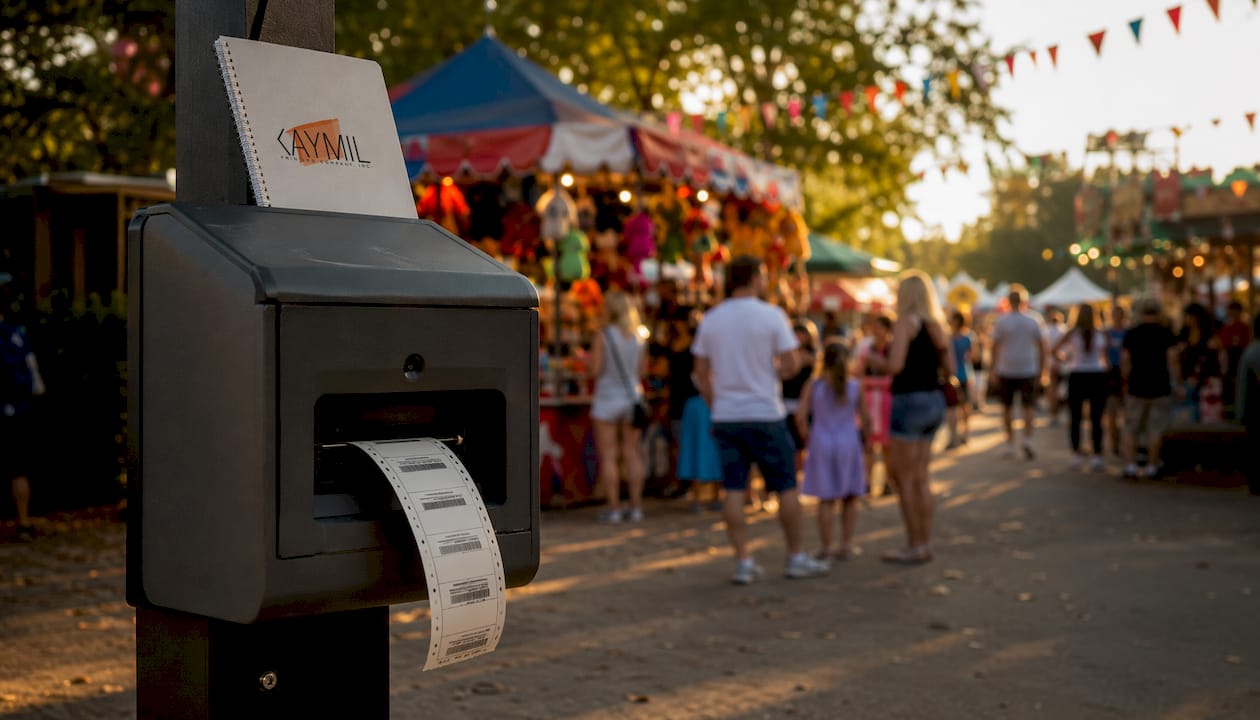
At a standard entry lane, a dispenser (often called a spitter) prints a thermal barcode ticket the moment a vehicle triggers the loop sensor. The ticket carries a unique barcode encoding the entry timestamp, lane ID, and session identifier. Alternatively, a guest can receive a mobile QR credential via text-for-ticket, or the system can use LPR to link the license plate itself as the credential, bypassing a physical ticket entirely. Each method feeds the same back-office session record.
Validation and payment
Validation happens at lobby kiosks, valet podium scanners, or lane exit readers. A casino host, restaurant cashier, or automated kiosk scans the ticket barcode and flags the session for a discount or full comp. Valet kiosk and tablet systems support barcode and QR scanning alongside credit card transactions, player club card reads, and direct folio posting to guest accounts. When the guest reaches the exit lane, the reader queries the PARCS back office, confirms the validation record, and opens the gate. If the session requires a payment balance, the kiosk or lane pay station handles it through a PCI-compliant gateway.

Where middleware fits
Most modern PARCS platforms expose APIs for validation lookups and session updates. When your PMS or loyalty platform does not speak the same protocol as your PARCS, a middleware layer translates between them. That translation layer is the most common integration point that gets underestimated in scoping, so budget for it explicitly.
What hardware and software does your system need?
A complete barcode parking system for a casino property requires hardware at every touchpoint and software that ties them together. The checklist below covers the full inventory; use it as a procurement starting point.
Hardware inventory:
- Entry ticket dispensers (spitter machines) with thermal print heads
- Lane barcode/QR readers at entry and exit
- Valet podium scanners or scanner-equipped tablets
- Lobby payment kiosks with integrated barcode readers
- Back-office servers (on-premises or cloud-hosted, depending on PARCS vendor)
- Network switches, cabling, and UPS units for lane equipment
Software requirements:
- PARCS platform with barcode credential support (see compatibility table below)
- Middleware or API gateway for PMS and loyalty integration
- Payment gateway with PCI DSS compliance
- Optional: LPR software and CRM/loyalty hooks for personalized guest workflows
Compatibility notes by PARCS vendor:
| PARCS Vendor | Barcode/QR Support | Common Integration Points | Notes |
|---|---|---|---|
| TIBA | Yes | API, LPR, loyalty, PMS | SmartPark Command supports centralized multi-property control |
| Amano | Yes | API, kiosk, lane readers | Widely deployed; confirm symbology support with local rep |
| SKIDATA | Yes | API, mobile QR, LPR | Strong mobile credential and contactless support |
| FLASH Parking | Yes | Cloud API, mobile, LPR | Cloud-native; middleware needs are typically minimal |
| Scheidt & Bachmann | Yes | API, kiosk, lane readers | Confirm firmware version for 2D QR support |
| Flowbird | Yes | API, mobile, contactless | Strong multi-modal payment integration |
Before finalizing hardware orders, verify supported barcode symbologies, API endpoint documentation, transaction throughput ratings, and remote management capabilities with each vendor’s technical team. Checking parking system compatibility before procurement prevents costly retrofits.
Pro Tip: Ask each PARCS vendor for their certified hardware list. Some platforms restrict which scanner models they will support under warranty, and an uncertified reader can void your SLA.
What ticket specifications should you order?
Ticket design is where many integration projects lose time. Ordering the wrong symbology or the wrong paper stock creates read failures that look like a scanner problem but are actually a print problem.
Barcode symbology selection
For machine-issued lane tickets, Code 39 and Code 128 are the most widely supported 1D symbologies across PARCS platforms. Code 128 encodes more data in a smaller footprint, which matters when ticket width is constrained by the dispenser. For valet podium and mobile workflows where data capacity and scan-angle tolerance matter more, a 2D QR code or Data Matrix symbol is preferable. Confirm the exact symbology your PARCS vendor requires before placing a print order.
Printing methods and durability
Thermal direct printing is standard for machine-issued spitter tickets: no ribbon, fast print speed, and dispenser-compatible roll formats. The trade-off is heat and UV sensitivity, so thermal tickets should not be stored in direct sunlight or hot vehicles for extended periods. For valet multi-part forms where a carbon copy is needed for the attendant stub, offset or laser printing on carbonless stock is the right choice. Thermal transfer printing offers better durability for longer-term credentials like monthly permits.
| Ticket Format | Use Case | Recommended Material | Print Method |
|---|---|---|---|
| Machine-issued roll ticket | Entry/exit lane dispenser | Thermal direct paper | Thermal direct |
| Multi-part valet form | Valet check-in and retrieval | Carbonless NCR stock | Offset/laser |
| Lobby validation stub | Discount application at kiosk | Thermal or bond paper | Thermal or laser |
| Monthly permit hang tag | Long-term parkers and staff | Durable card stock | Offset |
Anti-fraud and security features
Sequential numbering is the baseline fraud control: every ticket carries a unique number that the PARCS back office can verify. Beyond that, tamper-evident paper, microtext printing, invisible UV inks, and encoded payloads (timestamp plus lane ID embedded in the barcode data string) make duplication and substitution attacks significantly harder. For high-value comped parking, a perforation line between the guest stub and the validation record adds a physical audit trail.
Pro Tip: Place the barcode scan window at least 0.25 inches from any ticket edge and maintain a clear quiet zone on all four sides. Dispensers that grip near the barcode edge are the leading cause of partial-print read failures in lane environments.
Integration checklist and project timeline
A structured rollout moves through five stages. The timeline for each depends on lane count, network readiness, and whether custom-printed tickets require a new design proof cycle.
- Scoping and requirements (weeks 1–2): Document existing PARCS version, lane count, network topology, and PMS/loyalty platform. Identify integration points that need middleware. Request barcode ticket samples from Caymil and confirm symbology with your PARCS vendor.
- Hardware procurement and site prep (weeks 3–6): Order lane readers, podium scanners, and kiosks. Run network cabling and install UPS units. Confirm server capacity for peak-hour transaction loads.
- Software configuration and middleware setup (weeks 5–8): Configure PARCS for barcode credential lookup. Set up API connections to PMS and loyalty platforms. Configure payment gateway and confirm PCI DSS scope.
- Pilot testing (weeks 7–10): Activate one entry lane and one valet podium. Run end-to-end tests: ticket issuance, validation, payment, and exit. Measure scanner read rates, lane throughput, and reconciliation accuracy. Lobby kiosks and lane exit readers should be tested for throughput and PCI integration before full rollout.
- Staff training and phased rollout (weeks 9–14): Train valet attendants, cashiers, and operations staff on new workflows. Roll out lane by lane. Monitor KPIs daily for the first two weeks post-launch.
Primary cost drivers: hardware units per lane, software license or middleware fees, installation and cabling labor, custom-printed ticket run quantities, and acceptance testing time. Custom ticket printing lead times at Caymil are typically short, but a new barcode layout requires a proof approval cycle, so factor that into weeks 1–2.
Acceptance test checklist: scanner read rate at or above your target threshold, end-to-end payment reconciliation with zero unmatched sessions in test runs, confirmed failover behavior when the back-office server is unreachable, and staff procedural verification across all shift types.
Valet, validated discounts, and loyalty workflows in practice
Barcode validation changes day-to-day operations most visibly in three workflows: valet check-in and retrieval, validated discount application, and loyalty or room-folio posting.
Valet check-in and retrieval
When a guest arrives, the valet attendant scans the vehicle’s license plate or prints a barcode valet ticket at the podium. The ticket links to the guest’s session record in the PARCS back office. At retrieval, the guest presents the ticket or a mobile QR, the attendant scans it, and the system surfaces the vehicle location and the guest’s loyalty status simultaneously. If the property uses a CRM integration, the attendant sees folio-posting options before the car arrives at the door.
Validated discount application
A casino host or restaurant cashier scans the guest’s parking ticket barcode at a validation terminal. The PARCS back office flags the session for the applicable discount, whether that is a flat-rate reduction, a time-based comp, or a full validation. When the guest reaches the exit lane, the reader confirms the flag and applies the discount automatically. No manual override is needed, and the transaction posts to the reconciliation report in real time.
Loyalty and room-folio integration
Centralized PARCS solutions allow property-wide control of parking policies, LPR, and loyalty integrations. In a casino environment, that means a player’s tier level can trigger automatic parking comps, and the charge can post directly to the room folio without the guest stopping at a kiosk. The guest arrival workflow looks like this: vehicle enters, barcode ticket issued, guest checks in at the hotel desk and links their player account, casino host validates parking from a tablet, guest exits with a zero-balance transaction posted to the folio. The valet integration with PMS and CRM is what converts a routine parking transaction into a personalized guest touchpoint.
What to monitor after go-live
Post-launch monitoring keeps the system reliable and gives operations the data to optimize staffing and lane allocation.
Critical KPIs to track:
- Scanner read rate: Target 98% or higher on first-pass reads. Anything below 95% warrants immediate investigation of print quality or scanner calibration.
- Lane throughput: Vehicles per hour per lane. Compare against pre-integration baseline to confirm improvement.
- Average exit transaction time: Measures the combined speed of credential lookup, payment processing, and gate release.
- Reconciliation discrepancies: Unmatched sessions between PARCS and the payment gateway, flagged daily.
- Ticket fraud incidents: Sequential number gaps or duplicate session IDs detected by the back-office audit log.
Monitoring cadence: Check read rates and lane throughput hourly during peak periods (arrival and departure surges). Review reconciliation discrepancies daily. Audit fraud indicators weekly.
Common failure modes and troubleshooting:
A common failure is under-specifying backend server and network capacity. Kiosks and readers may scan correctly, but legacy networks and slow database queries cause peak-hour delays that look like hardware problems. When a lane shows elevated read failures, work through this checklist before replacing hardware:
- Pull a sample of failed tickets and inspect print quality under magnification. Faded or smeared barcodes point to a worn thermal print head or low ribbon, not a scanner fault.
- Check network latency between the lane reader and the back-office server. Delays above 200ms will cause timeout errors that register as read failures.
- Verify that the PARCS database has not exceeded its session table capacity. A full table causes lookup failures that mimic scanner errors.
- Confirm that the barcode quiet zone has not been compromised by a dispenser adjustment or a ticket roll change to a different stock width.
- If reconciliation mismatches appear, cross-reference the PARCS transaction log against the payment gateway log by session ID to isolate whether the gap is at the scan, the validation, or the payment step.
Barcode scans also feed productivity reports that let managers optimize valet staffing and lane allocation in real time, so a well-monitored system pays dividends beyond fraud prevention.
Key Takeaways
Barcode casino parking ticket integration is feasible on any modern PARCS platform and delivers measurable gains in lane reliability, reconciliation speed, and guest experience when the ticket specifications, hardware, and software are aligned before rollout.
| Point | Details |
|---|---|
| Feasibility verdict | Barcode integration works on all six major PARCS platforms: TIBA, Amano, SKIDATA, FLASH Parking, Scheidt & Bachmann, and Flowbird. |
| Top reliability gain | Replacing magnetic-stripe tickets with barcodes eliminates the mechanical jams that degrade lane throughput at high-volume casino entries. |
| Ticket spec matters | Confirm barcode symbology (Code 128 for 1D lanes, QR for valet/mobile) and quiet-zone dimensions with your PARCS vendor before ordering. |
| Timeline driver | A scoped pilot covering one lane and one valet podium typically runs 7–10 weeks from scoping to acceptance testing. |
| Caymil as supplier | Caymil manufactures dispenser-compatible barcode tickets, multi-part valet forms, and machine-issued thermal tickets with custom layouts, security features, and fast nationwide shipping. |
What most integration guides get wrong about ticket quality
There is a persistent assumption in casino parking projects that the ticket is a commodity: order the cheapest roll that fits the dispenser and move on. That assumption is wrong, and it tends to surface at the worst possible moment, during a peak Friday-night arrival surge when a bad print run starts generating read failures across every entry lane.
The ticket is the credential. Its print quality, quiet-zone dimensions, paper stock, and barcode placement determine whether your $50,000 scanner investment performs at 98% read rates or 87%. An 11-point gap in read rates does not sound dramatic until you calculate how many vehicles per hour are backing up in a lane while an attendant manually keys a ticket number.
What operations teams consistently overlook is the relationship between dispenser orientation and barcode placement. A ticket designed for a horizontal dispenser that gets installed in a vertical unit will present the barcode at the wrong angle relative to the scanner beam. The fix is a layout adjustment, not a hardware replacement, but catching it requires someone who understands both the print specification and the dispenser mechanics. That is the kind of detail Caymil has been working through with parking operators since 1937, and it is exactly the kind of detail that does not appear in a PARCS vendor’s integration guide.
The other underestimated variable is thermal paper grade. Not all thermal stock responds the same way to high-speed print heads running at lane-dispenser speeds. A paper grade optimized for a slow receipt printer will produce inconsistent density at dispenser speeds, which means inconsistent barcode contrast, which means elevated read failures. Specifying the right paper grade for the dispenser model is a procurement decision that costs nothing extra but prevents a category of failure that is genuinely difficult to diagnose after the fact.
Caymil’s barcode parking ticket products for casino operations
Casino parking operations need a ticket supplier who understands both the print specification and the operational environment. Caymil manufactures machine-issued valet tickets and barcoded valet parking tickets in dispenser-compatible roll formats, with custom barcode layouts, sequential numbering, security features, and material grades matched to the dispenser model and PARCS platform.
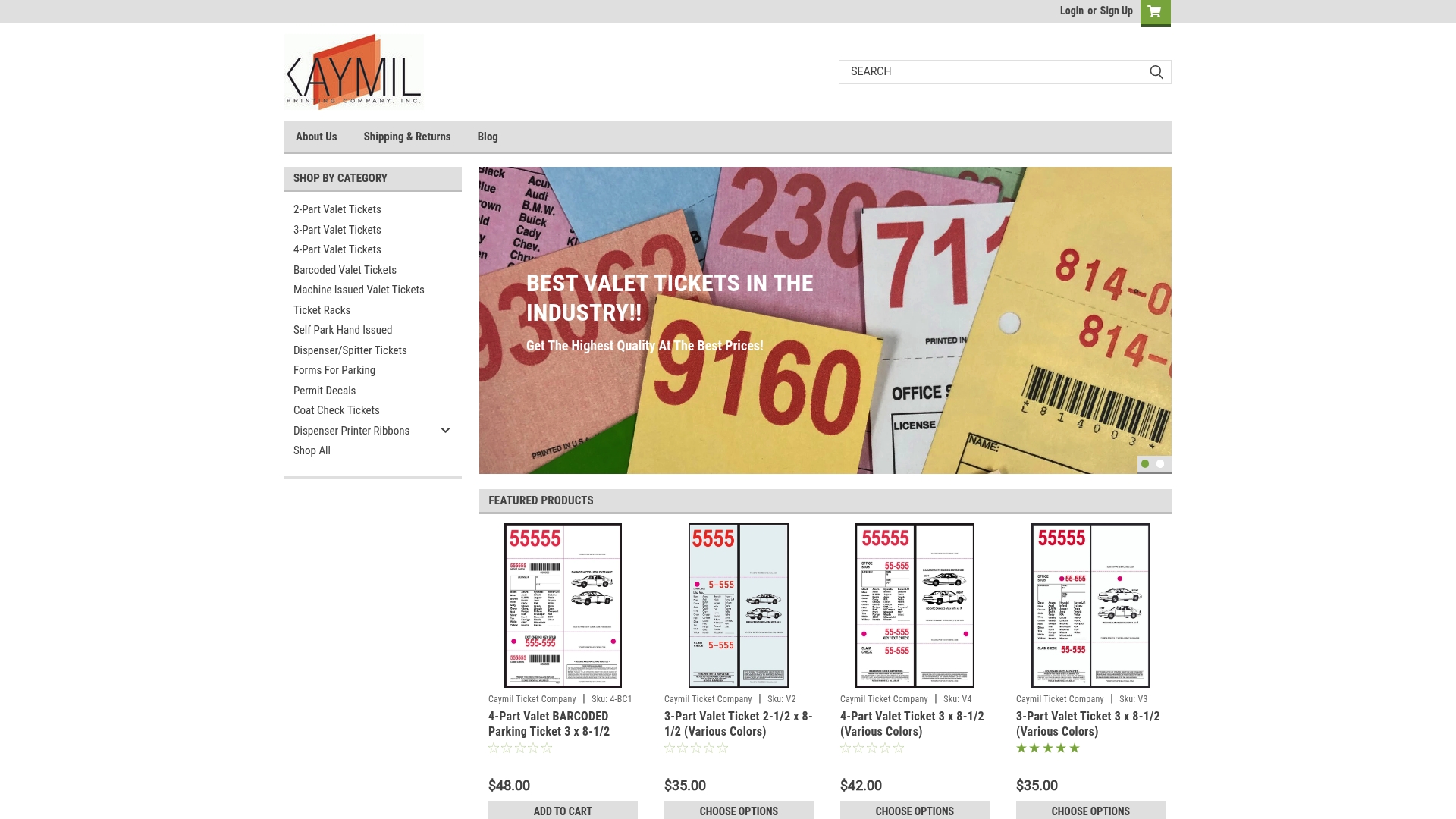
For casino properties running multi-part valet workflows, Caymil produces two-part, three-part, and four-part carbonless valet forms with barcode printing on the guest stub. For self-park lanes, dispenser-format thermal tickets are available in stock and custom configurations compatible with Amano, TIBA, SKIDATA, FLASH Parking, Scheidt & Bachmann, and Flowbird systems. Caymil also offers custom layout design, compatibility checks for specific PARCS integrations, and sample kits so procurement teams can verify fit before committing to a full run. Request a sample kit or compatibility check at caymil.com/forms-for-parking or browse dispenser spitter tickets to find the right format for your entry lanes.
Useful sources
Procurement and technical teams can use the following resources to verify claims, request technical specifications, and evaluate vendor capabilities:
- Marcus Hotels and Resorts case study (TAPCO/TIBA integration): Documents lane throughput improvements and loyalty integration outcomes after switching to barcode tickets. Request the full technical brief from TAPCO for SLA and throughput specifications.
- Caesars PARCS centralization case study (TIBA/SmartPark Command): Covers multi-property PARCS deployment across 68 lanes and 24 kiosks with LPR and loyalty integration. Useful for large-scale procurement planning.
- CVPS valet parking solutions: Product overview for valet kiosks and tablet systems supporting barcode/QR scanning, folio posting, and player club card reads.
- JetScan ticket reading and processing (Cummins Allison): Specifications for high-throughput ticket sorters used in back-office reconciliation. Request throughput and imaging specs for your transaction volume.
- Scan to Pay — Secure Parking USA: Illustrates a public-facing QR scan-to-pay flow and PCI-compliant payment gateway integration.
- PayTix payment portal: Documents PCI DSS payment handling and no-card-storage procedures for parking payment gateways.
- Caymil barcode ticket resources: Caymil’s technical content on barcode ticket benefits, dispenser compatibility, and material selection for casino and garage environments.
- Parking access control explainer for facility operators: Technical overview of PARCS concepts and access-control patterns relevant to integration planning.
FAQ
What is a barcode parking ticket?
A barcode parking ticket is a pre-printed or machine-issued credential with a scannable 1D or 2D code that entry and exit readers use to validate access, apply discounts, and process payment. The barcode encodes session data such as entry time, lane ID, and session identifier.
How does QR code parking payment work?
A guest scans a QR code at a kiosk or on a printed ticket, enters their plate or session ID, selects a payment duration if applicable, and submits payment through a PCI-compliant gateway. The transaction updates the PARCS session record and releases the exit gate.
Do validated parking tickets require the guest to pay anything?
Validated tickets flag the session in the PARCS back office for a discount or full comp, so the guest pays only the remaining balance, which is zero for a full validation. The discount is applied automatically when the exit reader confirms the validation record.
Is card data stored when guests pay at a parking kiosk?
PCI DSS-compliant parking payment systems, including platforms like PayTix, process payments without storing card data on the parking system itself. Confirm PCI scope and card-data handling with your payment gateway vendor before go-live.
Which PARCS platforms support barcode ticket integration?
All six major platforms used in U.S. casino parking, TIBA, Amano, SKIDATA, FLASH Parking, Scheidt & Bachmann, and Flowbird, support barcode credential lookup and API-based validation. Confirm the specific symbologies and API versions supported by your installed firmware version with each vendor’s technical team.
Recommended
- Why Casinos Use Validated Parking Tickets: A Manager’s Guide - Caymil Printing Co., Inc.
- Player Rewards Parking Ticket Program: A 2026 Guide - Caymil Printing Co., Inc.
- Garage Parking Fee Calculation: A Manager’s Guide - Caymil Printing Co., Inc.
- The role of ticket dispensers in parking: A manager’s guide - Caymil Printing Co., Inc.