

Garage Parking Fee Calculation: A Manager’s Guide

Garage parking fee calculation is the process of computing parking charges based on time parked, rate tier applied, and daily maximum limits. Property managers who understand this process control revenue outcomes directly. The industry term for the underlying logic is “tariff table application,” and it governs every transaction at the gate. Tiered rate structures combine hourly fees, bracket flat fees, and daily caps to produce the final charge. Getting these components right separates profitable operations from ones that bleed revenue through miscalculation.
How garage parking fee calculation works
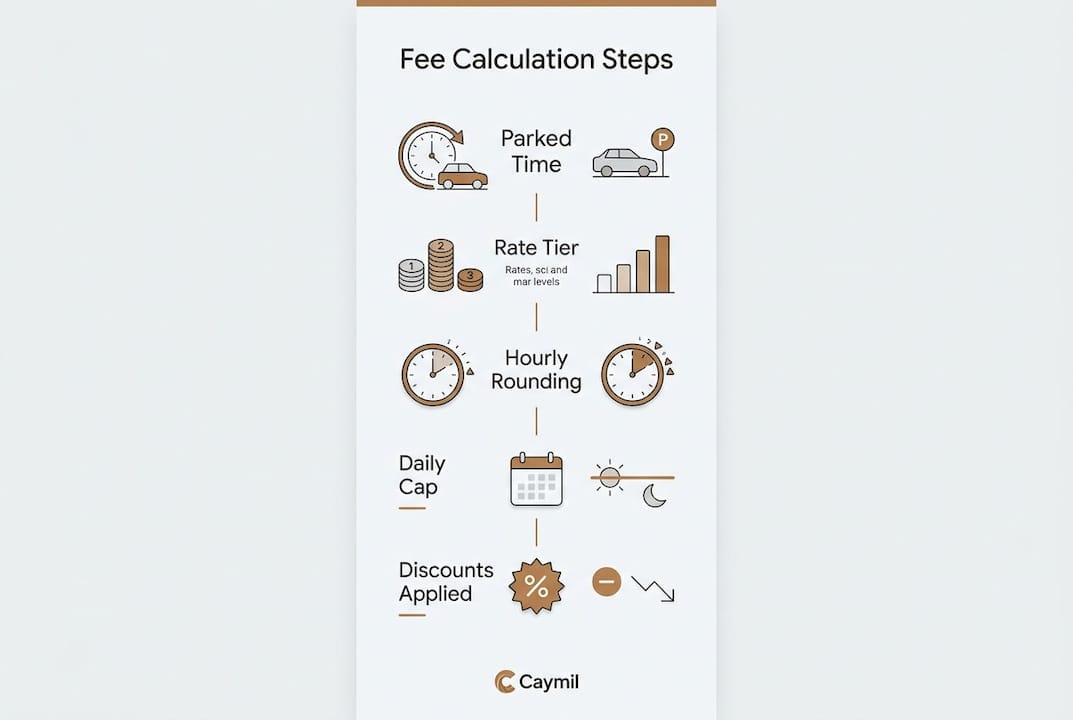
Garage parking fee calculation applies a structured rate system to the total time a vehicle occupies a space. The three core components are the base hourly rate, tiered bracket fees, and the daily maximum cap. Each component activates at a different point in the parking session.

Hourly rates and rounding
The base hourly rate is the simplest component. A driver parks for a set number of hours, and the system multiplies that count by the rate. The critical detail is rounding. Standard industry practice rounds partial hours up to the next full hour. A driver who parks for 65 minutes is charged for 2 full hours. That policy must appear on posted signage and printed tickets, or disputes follow at the exit lane.
Tiered bracket structures
Tiered brackets apply different rates to different time blocks within a single session. A common structure looks like this:
| Time parked | Rate applied |
|---|---|
| First hour | $5.00 flat |
| Hours 2–3 | $3.00 per hour |
| Hours 4–8 | $2.00 per hour |
| Daily maximum | $20.00 cap |
The calculation adds each bracket’s charge separately, then stops at the daily maximum. A driver parked for 6 hours would pay $5 + $6 + $4 = $15, which falls below the $20 cap. A driver parked for 10 hours would hit the cap and pay no more than $20 regardless of additional time.
Daily maximum caps and reset policies
The daily maximum is the ceiling charge for any single parking session. Daily maximums reset either at midnight or on a rolling 24-hour cycle from entry time. The reset method matters enormously. A midnight reset means a driver entering at 10:00 PM and leaving at 9:00 AM the next day pays two separate daily maximums. A rolling 24-hour reset means that same driver pays one maximum. Property managers must configure their systems to match their posted policy exactly.
Pro Tip: Audit your daily maximum reset setting quarterly. A misconfigured reset is one of the most common sources of undercharges and overcharges in automated systems.
Multi-day parking adds another layer. Each 24-hour period or calendar day generates its own charge cycle. Sophisticated rate calculation is industry best practice for these scenarios because simple hourly multipliers break down and create disputes.
How discounts, monthly passes, and validation affect fee calculations
Discounts and monthly contracts alter the base calculation and affect both revenue predictability and customer retention. Property managers who ignore these elements leave money on the table and miss retention opportunities.
Monthly passes and break-even analysis
Monthly passes trade variable transient revenue for predictable income. The break-even point is straightforward: divide the monthly rate by the daily transient rate. Monthly rates in major U.S. cities average $300–$650, while daily transient rates vary widely by market. A $200 monthly rate against a $15 daily rate produces a 14-day break-even. Any customer who parks more than 14 days per month saves money on a pass, and the garage locks in guaranteed revenue.
Communicating this math to customers directly increases monthly contract uptake. A simple sign at the entry or a line on the printed ticket showing the break-even threshold gives customers the information they need to make the decision themselves.
Validation and discount integration
Validation programs reduce the fee a customer pays by crediting a portion of the charge, typically funded by a retail or office tenant. The calculation adjusts the gross fee by subtracting the validated amount before presenting the net charge at exit. Common discount structures include:
- Flat validation: A fixed dollar amount credited regardless of time parked (example: $3 off any stay)
- Time-based validation: A set number of free hours credited (example: first 2 hours free with retail purchase)
- Percentage discount: A percentage reduction applied to the total calculated fee
- Event rate: A flat fee replacing the standard tariff for a defined event window
Each type requires a different calculation step. Flat and time-based validations are the easiest to apply and audit. Percentage discounts require the system to calculate the gross fee first, then apply the reduction. Event rates bypass the standard tariff entirely and must be activated and deactivated precisely to avoid charging event rates to non-event customers.
Pro Tip: Track validation redemption rates monthly. A validation program that accounts for a large share of exits without corresponding tenant revenue is a subsidy, not a marketing tool.
What are the most common pitfalls in garage parking fee calculation?
Fee calculation errors fall into three categories: rounding errors, tariff table misapplication, and daily maximum handling failures. Each category carries distinct revenue and customer satisfaction consequences.
Rounding and tariff table errors
Improper tier application is the most damaging error type. A customer overcharged by 66% due to incorrect tier application for a 5-hour stay illustrates how quickly miscalculation erodes trust. The error typically occurs when a system applies the wrong bracket boundary, charging the higher tier rate for time that should fall in a lower tier.
Rounding policy errors are equally damaging. Charging 65 minutes as 2 hours is standard practice, but only when clearly posted. Customers who see a charge for 2 hours when they believe they parked for just over 1 hour will dispute the charge. The policy is defensible; the surprise is not.
Common operational pitfalls
- Unclear signage at entry: Customers who cannot read the tariff before parking have grounds for disputes at exit
- Event rate activation errors: Leaving event pricing active after an event ends charges transient customers the wrong rate
- Midnight vs. rolling reset confusion: A mismatch between posted policy and system configuration creates systematic undercharges or overcharges
- Validation credit not applied: Manual validation processes fail more often than automated ones, resulting in customers paying full rate after a merchant stamps their ticket
- No audit trail on manual overrides: Staff overrides without documentation create revenue leakage that is invisible until a full parking facility audit reveals the gap
Transparent tariff communication at entry and exit points is the single most effective control against disputes. Municipal parking authorities treat this as a compliance requirement, not a courtesy.
What technology supports accurate parking fee calculations?
Automated fee calculation systems replace manual tariff lookups with deterministic logic that applies the correct rate every time. Consistent deterministic rate logic steers customer behavior and eases operational audits. Manual systems introduce human error at every transaction point.
Barcode tickets and machine-issued tickets
Barcode parking tickets encode entry time at issuance. The exit terminal reads the barcode, calculates elapsed time, applies the tariff table, and presents the charge without manual input. This eliminates transcription errors and creates an auditable record for every transaction. Machine-issued tickets from systems compatible with Amano, TIBA, SKIDATA, FLASH Parking, Scheidt & Bachmann, and Flowbird generate the same data trail. Caymil manufactures tickets compatible with all of these systems, giving property managers a reliable supply chain for the physical media that drives the calculation process.
Tools and systems that reduce disputes
- Online fee calculators: Customer-facing calculators let drivers estimate their fee before exiting, reducing exit-lane disputes and improving throughput
- Automated validation terminals: Retail tenants scan a barcode on the ticket to apply credit instantly, eliminating manual validation errors
- Integrated payment systems: Connecting the fee calculation engine to payment terminals removes the manual step of entering a calculated amount
- Audit reporting: Systems that log every transaction, override, and validation redemption give managers the data to catch errors before they compound
A parking management system that integrates all of these functions produces a closed loop from entry to payment with no manual handoffs.
Best practices for setting fees to optimize revenue and satisfaction
Fee structure design is a direct lever on both revenue and customer behavior. Segmented rate structures steer customer behavior and maximize utilization. Short-term hourly rates promote turnover in high-demand facilities. Flat daily rates suit commuters and long-term parkers who value predictability.
Set daily maximum caps by analyzing actual customer dwell time data. Daily maximum settings directly impact revenue. A cap set too low leaves money uncollected from long-stay customers. A cap set too high discourages repeat visits from price-sensitive customers. The right cap sits just above the median dwell time for your customer profile.
Communicate every policy element in writing. Post the full tariff table at the entry gate, on the ticket itself, and at the pay station. Customers who understand the fee structure before they park are far less likely to dispute charges at exit. Caymil’s printed parking forms and custom-branded tickets give property managers a direct channel to communicate tariff terms at the point of issuance.
Pro Tip: Review your rate structure against local market rates every six months. Parking demand shifts with new developments, transit changes, and event calendars. A rate set in January may underperform by July.
Audit your calculation system quarterly. Compare expected revenue from transaction logs against actual collected revenue. Any gap signals a calculation error, a validation abuse, or a system misconfiguration. Catching these gaps early prevents compounding losses.
Key Takeaways
Garage parking fee calculation accuracy depends on correctly applying tiered rate structures, rounding policies, and daily maximum caps at every transaction.
| Point | Details |
|---|---|
| Tiered rate structures | Apply hourly, bracket, and daily cap components separately to calculate the correct total fee. |
| Rounding policy transparency | Post rounding rules on signage and tickets to prevent disputes at the exit lane. |
| Daily maximum reset method | Confirm whether your system resets at midnight or on a rolling 24-hour cycle, and match it to posted policy. |
| Monthly pass break-even | Divide the monthly rate by the daily rate to find the break-even day count and communicate it to customers. |
| Quarterly audits | Compare transaction logs to collected revenue every quarter to catch calculation errors before they compound. |
What I’ve learned from years of watching fee calculation go wrong
The most expensive mistakes in parking fee management are not the dramatic ones. They are the quiet, systematic errors that run undetected for months. A daily maximum that resets at the wrong time. A validation credit that stops applying after a software update. A tariff table that was never updated after a rate change. These errors do not trigger alarms. They just quietly drain revenue or overcharge customers until someone runs an audit.
The facilities that avoid these problems share one habit: they treat their ticketing media as a control document, not a commodity. When the ticket itself carries the tariff terms, the entry time, and a scannable barcode, every transaction is self-documenting. Disputes drop because the evidence is in the customer’s hand from the moment they enter. That is not a technology argument. It is an operational discipline argument. The technology only works if the physical ticket is accurate, durable, and readable.
The other lesson is that fee structure complexity has a cost. Every additional tier, every special event rate, every validation type adds a point of failure. The facilities with the fewest disputes tend to have the simplest rate structures. Complexity should only be added when the revenue gain clearly outweighs the operational risk.
— Richard
Caymil’s ticketing solutions for accurate fee management
Accurate fee calculation starts with a reliable ticket at entry. Caymil has manufactured parking tickets and forms since 1937, and the product line covers every format property managers need to support their calculation systems.
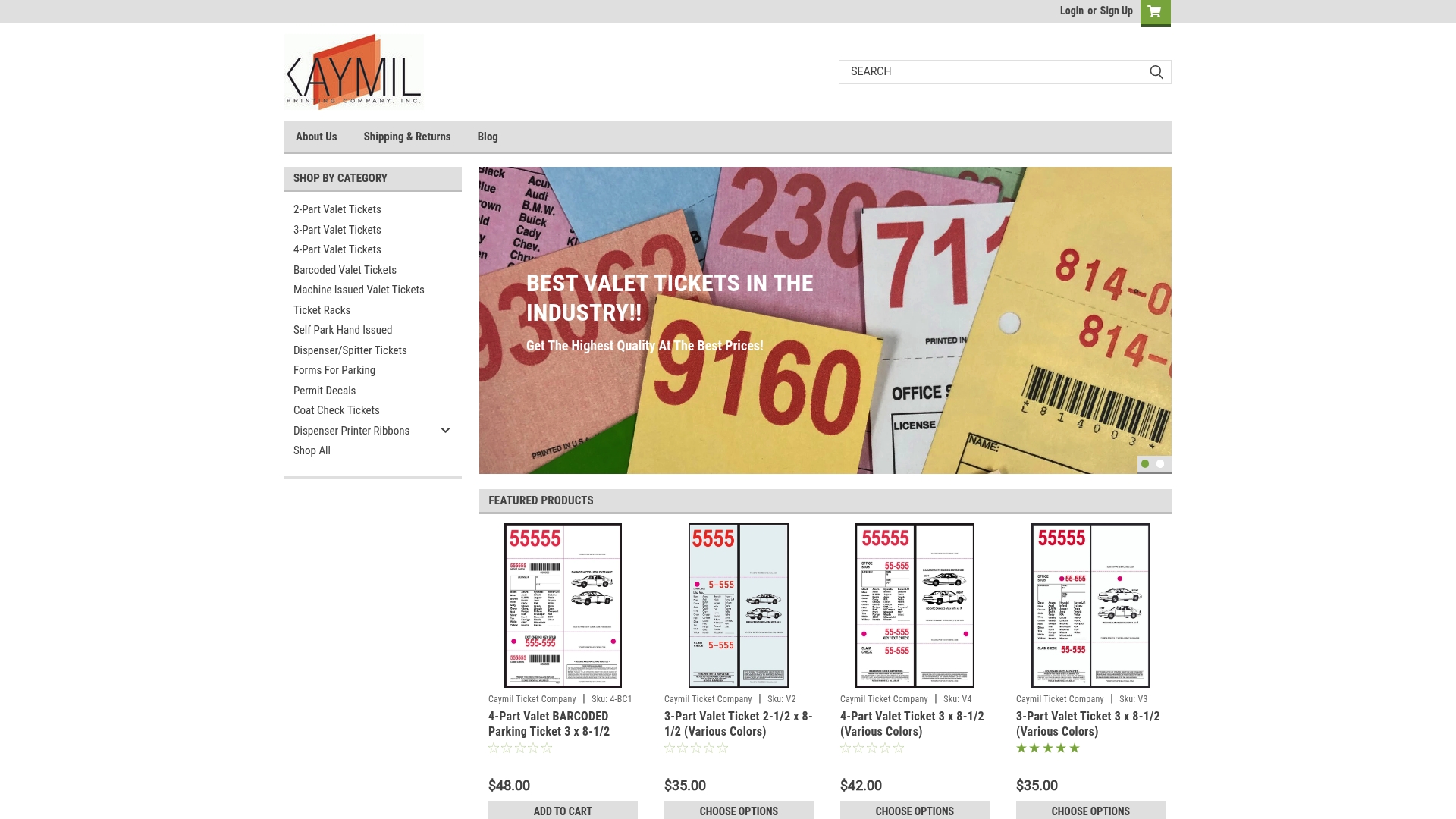
Caymil’s machine-issued valet tickets and barcoded parking tickets integrate directly with major parking systems including Amano, TIBA, SKIDATA, FLASH Parking, Scheidt & Bachmann, and Flowbird. Each ticket encodes entry time at issuance, creating the audit trail that accurate fee calculation requires. Custom printing options include sequential numbering, tariff terms, logos, and security features that reduce fraud and support dispute resolution. With millions of tickets in stock and fast nationwide shipping, Caymil keeps parking operations running without supply gaps.
FAQ
What is the standard method for calculating garage parking fees?
Standard garage parking fee calculation applies tiered rate brackets to elapsed parking time, rounds partial hours up to the next full hour, and caps the total at the daily maximum. Each bracket is calculated separately and summed to produce the final charge.
How does a daily maximum cap work in parking fee calculations?
The daily maximum is the ceiling charge for a single session. It resets either at midnight or on a rolling 24-hour cycle from entry time, depending on the facility’s configuration. Charges stop accumulating once the cap is reached, regardless of additional time parked.
Why do parking fee disputes happen most often?
Rounding policy confusion and tariff table misapplication cause the majority of parking fee disputes. Customers who are not informed of rounding rules before parking are most likely to challenge charges at exit.
How do monthly passes affect parking fee revenue?
Monthly passes replace variable transient revenue with predictable income. The break-even point is the monthly rate divided by the daily rate. Customers who park more days than the break-even threshold save money on a pass, while the facility gains revenue certainty.
What is the role of barcode tickets in fee calculation accuracy?
Barcode tickets encode entry time at issuance and allow exit terminals to calculate elapsed time automatically. This removes manual input from the fee calculation process and creates an auditable transaction record for every parking session.