Valet Ticket Printing Cost: What Operators Really Pay

Valet ticket printing typically costs from about $0.10 to more than $1.00 per set for custom multi-part books, and from $0.03 to $0.20 per ticket for stock formats, according to Caymil’s pricing handbook for operators. Where your order lands in that range depends on five things: quantity, number of parts, numbering and barcodes, color and logo work, and the setup, shipping and rush charges that sit outside the unit price. Compare suppliers on the delivered cost per usable ticket, not the headline price per box.
TL;DR
- Expect roughly $0.03 to $0.20 per ticket for stock formats, $0.05 to $0.50 for thermal rolls, and $0.10 to over $1.00 per set for custom multi-part valet books.
- Quantity, number of parts, sequential numbering, barcoding, colors and logo setup move the price most.
- Setup, art, rush and freight charges can outweigh a low unit price on small orders.
- Always compare quotes as delivered cost per ticket, with the same parts, stock weight, numbering and quantity.
- Match the ticket to your equipment and workflow before you price it. A cheaper ticket that jams a machine or breaks your audit trail costs more.
Table of Contents
- What valet tickets cost per ticket
- What moves the price
- Costs outside the unit price
- A worked example: pricing a year of valet tickets
- How to compare supplier quotes
- Machine-issued and dispenser formats
- Where operators overspend
- Order tickets sized to your operation
- FAQ
- Sources
What valet tickets cost per ticket
There is no single price for a valet ticket, because “valet ticket” covers several different products. A paper claim stub, a four-part carbonless set with a barcode and a thermal roll for a dispenser are built differently and priced differently.
The ranges in Caymil’s parking ticket printing cost guide show delivered costs by format:
| Format | Typical delivered cost | What drives it |
|---|---|---|
| Stock fan-folded or citation-style tickets | $0.03 to $0.20 per ticket | Quantity, stock weight |
| Thermal rolls | $0.05 to $0.50 per ticket | Roll length, roll quantity |
| Custom multi-part valet books | $0.10 to over $1.00 per set | Parts, color, numbering, barcode, logo |
Public bids give another anchor. Government agencies buy ticketing supplies by competitive bid, as with the Philadelphia Parking Authority’s Bid No. 22-13 for ticketing rolls, paper ticket books and envelopes. Large public orders tend to price far below small commercial runs, which is why order size matters so much for a single hotel or valet company.
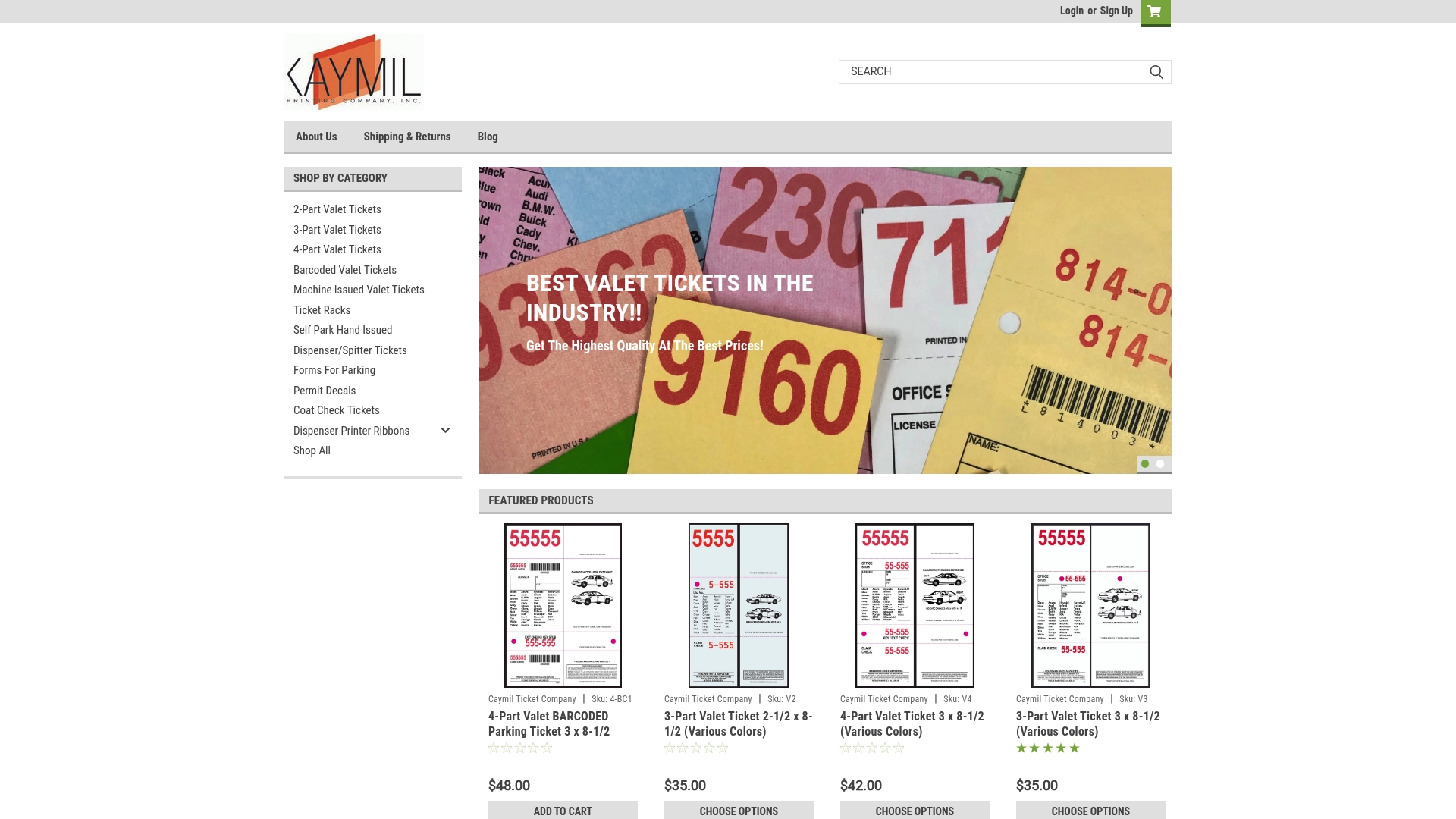
Published prices on our product pages
Our product pages show what a typical order costs before any custom work. At the time of writing, our listed prices are:
- 4-Part Valet Tickets: $42 to $48
- Barcoded Valet Tickets: $42 to $48
- 3-Part Valet Tickets: $35 to $250, depending on the option selected
- 2-Part Valet Tickets: $250
- Ticket racks: $125
- Permit decals: $88
The spread inside a single product comes from the options chosen: quantity, stock, imprint and numbering. Open the product page and select your specifications to see the exact price for your order. Prices on a site change, so treat the product page as the current figure.
What moves the price
Quantity and order minimums
Quantity is the largest lever. Printing has fixed work that does not depend on how many tickets you order: preparing the artwork, setting up the press, setting the numbering. Spread across 1,000 tickets, that work weighs heavily. Spread across 10,000, it nearly disappears. That is why unit prices fall in steps as quantity rises, and why small orders carry the highest cost per ticket.

A working rule: if you will use a ticket design for a full year or more, price the larger quantity. Paper valet tickets store well, and the saving per ticket usually exceeds the cost of holding stock. Estimate your annual use first. A hotel valet stand running 300 tickets on a busy weekend and 100 on a quiet one can count its yearly volume in a few minutes from the numbering on last year’s books.
Number of parts
Each added part adds paper and carbonless coating, so a 4-part set costs more than a 2-part set. The extra part is worth paying for when it does a job. In a typical valet flow, one copy stays with the guest, one goes on the key or vehicle, and a third may go to the cashier or the audit file. A fourth can serve a damage report or a lost-ticket record. Our article on multi-part valet ticket benefits explains how each copy is used.
Buy the number of parts your process uses. Paying for a part nobody handles is waste. Dropping a part you need pushes someone to write the same information by hand, and that costs more in labor than the paper.

Sequential numbering
Consecutive numbering adds to the cost per ticket, and it is the feature that most protects revenue. When every ticket carries a unique number, a manager can reconcile tickets issued against cash collected and spot missing sequences. See why sequential valet tickets matter and the role of ticket numbering in operations. For an operation that handles cash, the numbering usually pays for itself in the first reconciliation.
Barcodes
Barcoding raises the price over a plain numbered ticket, and its value depends on what reads it. If your cashiering or parking system scans tickets, a barcode speeds exit and cuts keying errors. If nothing scans it, you pay for a feature you do not use. Our barcoded valet tickets are made for operations that scan, and compatible with major parking systems including Amano, TIBA, SKIDATA, FLASH Parking, Scheidt & Bachmann and Flowbird.
Colors, logos and stock
A one-color logo is the least expensive way to brand a ticket. Each added ink color, full-color artwork or specialty stock increases the price. Heavier card stock holds up better in a wet pocket or a hot vehicle but costs more per ticket. Options for branding, from a one-line business name to a full logo layout, are covered in custom logo parking ticket options.
For luxury hotels and casinos, the ticket is part of the guest experience, and the extra for color and a clean layout is a reasonable line in the guest-service budget. For a municipal garage or a high-turnover event lot, a plain one-color design is often the right call.
Costs outside the unit price
The unit price is only part of the bill. When you request quotes, ask about each of these charges:
- Setup or plate fees. A one-time charge to prepare your design, often waived or reduced on repeat orders of the same design.
- Art and proofing charges. Some suppliers charge for artwork preparation. A digital proof before production avoids reprinting mistakes.
- Rush production. Standard production usually takes several business days after proof approval. Rush work costs extra, so plan reorders before you run low.
- Shipping. Paper is heavy. A pallet of tickets can cost real money to ship across the country, and a free-shipping promotion on one product may not apply to another.
- Minimum order quantity. A low price per ticket on a minimum of 10,000 is not low for a lot that uses 2,000 a year.
- Reprint risk. A misprinted number sequence or a ticket that does not fit your machine becomes a second order.
Setup, art and shipping charges matter most for orders under 1,000 tickets, where they can make up a large share of the total.
A worked example: pricing a year of valet tickets
Take a hotel with a valet stand that issues about 40 tickets a day, or about 14,600 a year. The manager wants three-part numbered tickets with a one-color logo.
- Option A: order 2,000 now and reorder seven times. That means seven setup checks, seven shipments and seven chances to run out.
- Option B: order 15,000 once, or two runs of 7,500. The unit price is lower, the setup is paid once and the shipping is consolidated.
If the quoted difference between the two unit prices is a few cents a ticket, the saving across 14,600 tickets is a few hundred dollars, before shipping and setup. The figures are for illustration, not a quote. Run the same arithmetic with your own numbers. Multiply daily tickets by operating days, add a buffer of 10 to 15 percent for spoiled or lost stock, and ask for pricing at that quantity and at the next break above it.
How to compare supplier quotes
Quotes from different printers are often impossible to compare because the specifications differ. Use this routine:
- Write one spec sheet. Number of parts, ticket size, stock weight, ink colors, numbering range, barcode type, and quantity.
- Ask every supplier to quote that sheet. Do not accept a quote for a different product and compare it informally.
- Ask for the delivered price. Include setup, art, freight to your ZIP code and any rush fee.
- Divide by tickets. Delivered total divided by the number of usable tickets gives a cost per ticket you can compare.
- Check compatibility. If tickets feed a dispenser or read at a gate, confirm the size, stock and barcode match your hardware.
- Check lead time and reorder terms. Ask what a repeat order costs and how fast it ships.
A stock ticket that fits your process is the least expensive route when you do not need a custom design. Where your logo, numbering range or barcode format matter, move to custom. Our Valet Tickets 101 guide shows how the pieces of a valet ticket system fit together.
Machine-issued and dispenser formats
If you run a garage with entry lanes, a printed valet book is not your main cost. Machine-issued tickets, often called “spitter” tickets because the machine dispenses them at the gate, are bought in volume and priced by the roll or box. Thermal rolls and printer ribbons are consumables, so cost per ticket and equipment compatibility matter more than a design. See our machine-issued valet tickets and dispenser and spitter tickets. For CVPS systems, read about tickets for CVPS parking systems.
Where operators overspend
- Ordering too often. Many small orders carry setup and shipping each time.
- Over-specifying. Four parts, full-color artwork and a barcode on a lot that uses none of them.
- Under-specifying. A thin stock that tears, or no numbering on a cash operation.
- Ignoring fit. A ticket that does not suit your equipment leads to jams, reprints and slow lines.
- Comparing list prices. A low listed price with high freight and setup is not low.
Our view on valet ticket cost
The cheapest ticket is the one that does its job at the lowest total cost, and for a valet operation that job is control. A numbered, multi-part ticket gives you a guest copy, a vehicle copy and an audit copy, and it lets a manager account for every vehicle and every dollar. We have manufactured parking and valet tickets since 1937, and our approach is to help operators buy the right ticket, not the most elaborate one.
That is why we offer both stock and fully customized tickets. Stock works when you need speed and low cost. Custom works when branding, numbering ranges or barcodes matter to your operation. We keep millions of tickets in stock and ship nationwide, so a reorder does not have to become a rush job, and our tickets are made for compatibility with major parking systems.
Our advice is to define your specification first, size the order to a year of use, and look at the delivered price. Do that, and ticket cost becomes a predictable line in your budget.
Richard
Order tickets sized to your operation
We print stock and custom valet tickets in 2-part, 3-part and 4-part formats, with sequential numbering, barcodes, logos and custom colors. Start with the 4-part valet tickets or the barcoded valet tickets for listed prices, or browse the full range at Caymil, including ticket racks, permit decals and coat check tickets.
If you need a custom layout, send your specification and we will work from it. A 50-pocket steel ticket rack completes a valet stand, and a 2-part self-parking ticket suits high-volume lots.
FAQ
How much does it cost to print valet tickets?
Per our pricing guide, custom multi-part valet books run from about $0.10 to over $1.00 per set delivered, and stock formats from about $0.03 to $0.20 per ticket. The final number depends on quantity, parts, numbering, barcodes and color. Quantity has the largest effect.
Is it cheaper to buy stock or custom valet tickets?
Stock tickets are generally less expensive per ticket and ship quickly, because there is no custom setup. Custom tickets add your logo, numbering range and colors. Choose stock when speed and price lead, and custom when your brand or audit process needs it.
How many tickets should I order at once?
Order about a year of use plus a 10 to 15 percent buffer if storage allows. Larger orders lower the unit price and consolidate shipping. Ask for pricing at your quantity and at the next price break.
Do numbering and barcodes cost extra?
Yes, both add to the unit price. Numbering is worth it wherever cash or accountability is involved. A barcode is worth it when your system scans tickets.
Sources
- Philadelphia Parking Authority, Bid No. 22-13 Ticketing Rolls, Paper Tickets and Ticketing Envelopes