
Spitter Tickets for Parking Operators: What You Need to Know
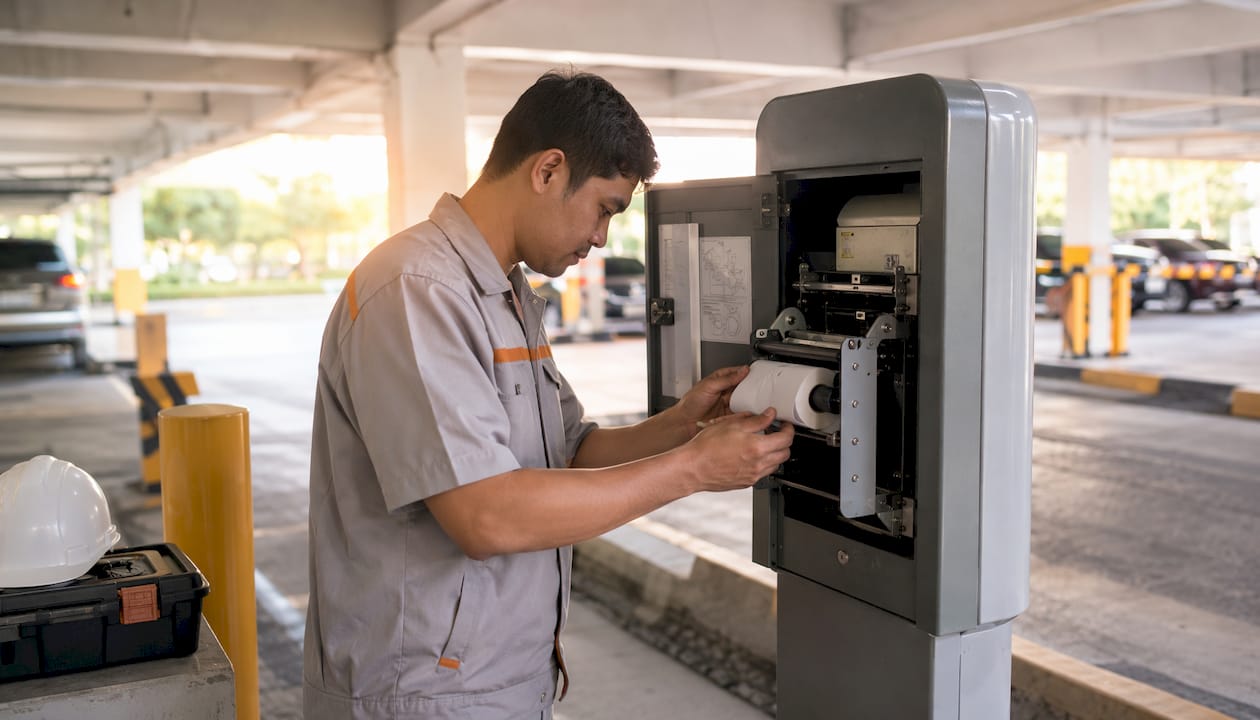
A spitter ticket is the paper access card a parking-entry machine dispenses to a driver on arrival, recording the entry time and generating a unique identifier that the exit system reads to calculate the fee. Law Insider defines it as “the paper access card provided to a transient parker when they enter the parkade.” The device that produces it goes by several names in vendor specs and operator conversations:
- Ticket spitter or spitter (informal, widely used on job sites)
- Entry station or entry lane dispenser (common in system integration docs)
- Parking ticket dispenser (the term used in industry audio references and equipment manuals)
- Paper access card (the legal and contractual term)
These tickets appear in gated garages, valet drop zones, and event lots wherever a machine controls entry and a printed record must travel with the driver to the exit.
Table of Contents
- How do spitter ticket dispensers work at an entry lane?
- What ticket formats and security features are available?
- What specs do you need to confirm before ordering?
- What should you specify when ordering spitter tickets?
- How are spitter tickets used in real operations?
- Key Takeaways
- The spec details most operators overlook
- Caymil’s spitter-compatible tickets and how to order
- Sources and further reading
- FAQ
How do spitter ticket dispensers work at an entry lane?
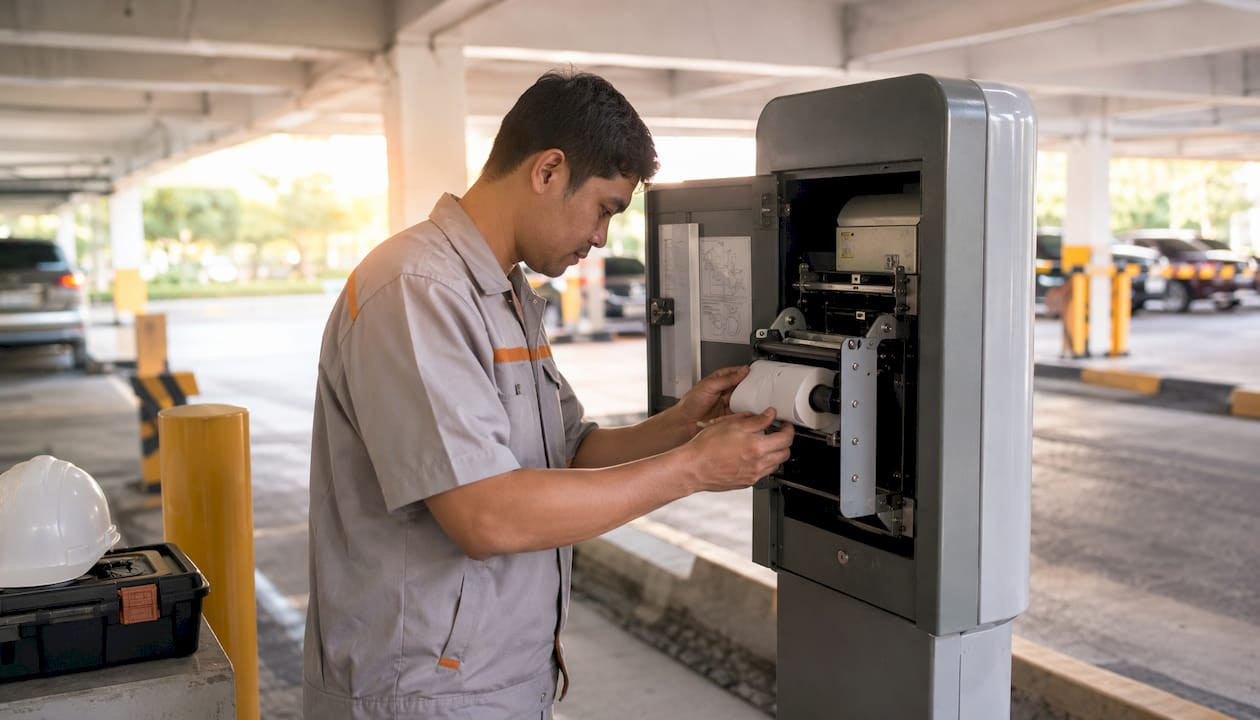
When a vehicle pulls up to an entry station, the dispenser runs through a tight mechanical sequence. Understanding each step tells you exactly what the ticket stock must deliver in terms of timing, print quality, and physical format.
- Vehicle detection. A loop sensor or camera triggers the dispenser the moment a vehicle is confirmed in the lane.
- Data capture and print. The system timestamps the entry, assigns a sequential ticket ID, and prints that data, along with a barcode or magnetic stripe if the system uses one, onto the ticket stock in under two seconds, a process made more efficient by adopting mobile signing tools for courier businesses.
- Ticket advance and cut. The roll advances, the ticket is cut or torn at the perforation, and the machine “spits” the ticket out through the exit slot.
- Driver takes the ticket. The gate arm rises only after the ticket clears the slot, keeping the lane moving.
- Exit validation. At the exit, the scanner reads the barcode or magnetic stripe, calculates the fee, and the ticket is either retained or returned to the driver as a receipt.
The printed ticket typically carries an entry timestamp, a ticket number, a facility identifier, and a machine-readable code. Some systems also print a rate schedule or validation instructions directly on the ticket face.
Pro Tip: The single most common cause of dispenser jams is a mismatch between the ticket roll’s core diameter and the dispenser’s spindle. Before ordering a new stock, measure your spindle diameter and confirm it against the supplier’s core spec, not just the roll width.
What ticket formats and security features are available?
The primary format families for machine-issued tickets are roll tickets for dispensers, thermal roll stock, barcoded tickets, magnetic stripe tickets, and multi-part carbonless valet tickets. Each serves a different operational need.
Materials and when to use them:
- Thermal paper rolls — the standard for high-speed entry dispensers; prints without ink ribbons, but untreated thermal paper can fade in heat or direct sunlight, which matters for long-term barcode scanning or document retention
- Coated bond stock — more durable than plain thermal; holds print quality longer in vehicles left in outdoor lots
- Carbonless multipart stock — used for valet and manual-entry workflows where attendants need simultaneous copies without a printer
| Format | Common uses | Security options | Durability |
|---|---|---|---|
| Thermal roll (single-part) | Gated garage entry lanes | Sequential numbering, barcodes | Moderate; fades with heat |
| Coated bond roll | Outdoor lots, long-stay parking | Sequential numbering, custom colors | High |
| Magnetic stripe roll | Systems requiring mag-read exit | Encoded stripe, sequential ID | Moderate |
| 2/3/4-part carbonless | Valet, manual handoff workflows | Sequential numbering, logo printing | High (bond plies) |
| Pre-printed numbered stub | Events, temporary lots | Sequential numbering, holographic ink | High |
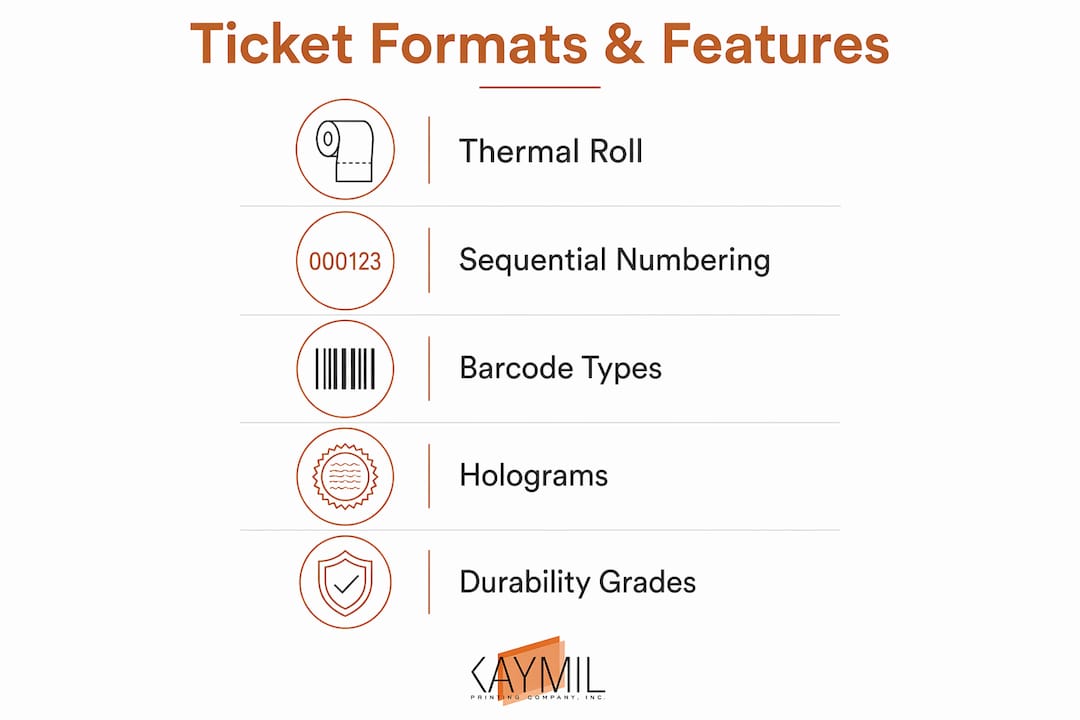
Security features worth specifying include sequential numbering, barcodes matched to your scanner’s symbology, holographic inks, microprinting, and custom colors that make duplication visually obvious. Barcodes and sequential numbering are the most cost-effective anti-fraud measures for transient parking. For events with high throughput, a pre-printed numbered stub with a holographic element adds a physical deterrent that a photocopied ticket cannot replicate. Caymil’s parking forms catalog covers stock and custom options across all these format families.
What specs do you need to confirm before ordering?
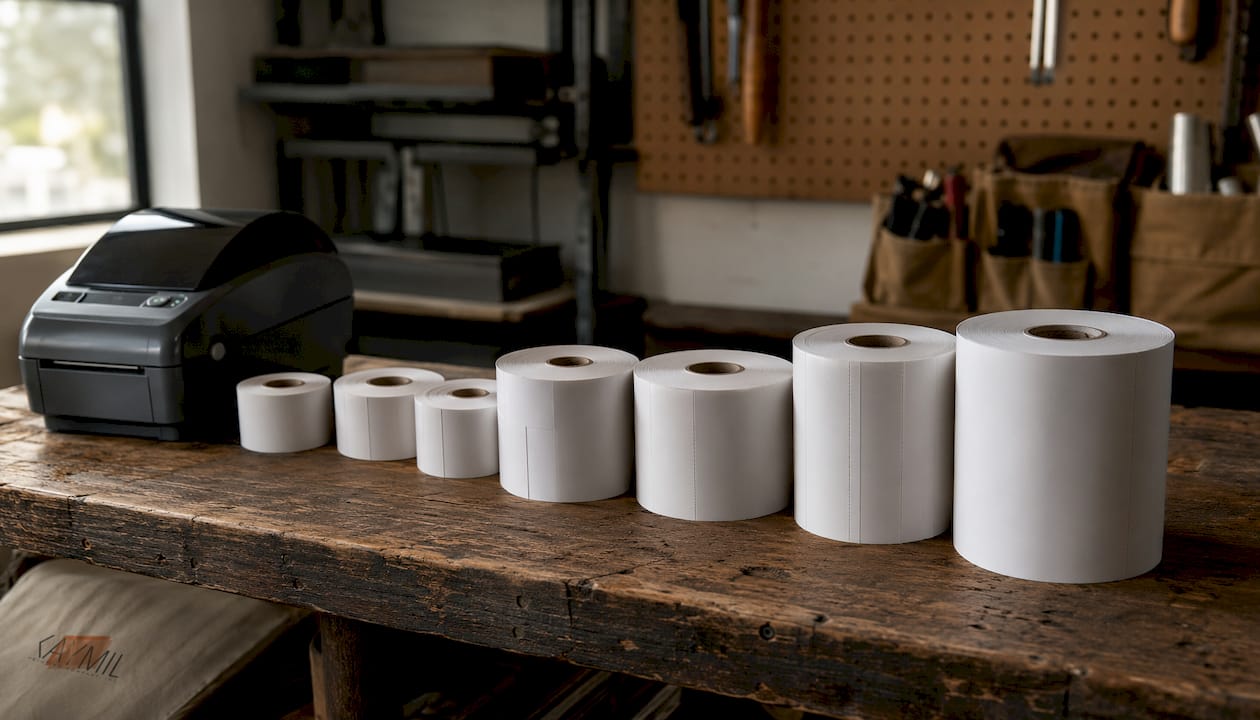
Physical roll dimensions and print method must match your dispenser or printer model exactly. A roll that is 0.25 inches too wide will not feed; a core that is too small will wobble and jam. Confirm every item on this list before placing an order:
- Roll width — measure the dispenser’s paper path, not just the slot opening
- Core diameter — typically 1.5 inches or 3 inches; confirm with a caliper, not by eye
- Maximum roll outer diameter — the dispenser’s roll compartment has a physical limit
- Ticket length and perforation orientation — some dispensers cut; others rely on a pre-perforated tear line, and the orientation (across vs. along the roll) must match the feed direction
- Print method — thermal direct, impact, or inkjet; the wrong coating will produce blank tickets
- Barcode symbology — Code 39, Code 128, QR, or PDF417; confirm with your access-control vendor
- Multipart stacking — for carbonless rolls, specify which ply faces up and how parts are paired
Roll tickets sized for specific industrial printers, such as the Intermec 2100, illustrate why printer-specific sizing matters: even a small deviation in roll width or core diameter causes misfeeds that halt an entire entry lane.
| Dispenser class | Typical roll width | Core diameter | Print method |
|---|---|---|---|
| Entry station (thermal) | — | 1.5 in | Thermal direct |
| Impact entry station | 3 in – 4 in | 1.5 in – 3 in | Impact/ribbon |
| Multi-part valet machine | — | 3 in | Impact |
| Industrial roll printer | Printer-specific | 3 in | Thermal/inkjet |
For parking system compatibility with platforms like Amano, TIBA, SKIDATA, or Flowbird, also confirm the barcode numbering format and starting sequence with your system integrator before the print run begins.
What should you specify when ordering spitter tickets?
The three decisions that drive every order are format, quantity, and customization level. Get those three right and the rest of the spec sheet fills in logically.
Give your printer the following when you place an order:
- Exact roll width, core diameter, and maximum outer diameter
- Dispenser or printer model name and number (a photo helps)
- Ticket length and perforation type
- Print method and any special coating requirements
- Artwork files for logos or custom face printing (300 dpi minimum)
- Barcode symbology and starting number for sequential runs
- Part count for multipart tickets, plus NCR chemistry preference (which ply gives the clearest copy)
- Required quantity and whether a split shipment is acceptable
Lead times vary by complexity. Stock thermal rolls ship quickly. Custom single-color print runs typically need additional production time, and multipart carbonless runs with variable data require more. Rush production is available but adds cost. For a detailed look at how bulk ticket orders are structured, the logistics differ meaningfully from small reorder runs.
Always request a physical production sample before approving a full run. Load it into your dispenser and run ten tickets through the full cycle. A sample that feeds, prints, and scans correctly in your machine is the only proof that matters.
How are spitter tickets used in real operations?
Gated garages, valet services, events, and validation programs each call for a different ticket type. Matching the format to the workflow prevents both operational headaches and revenue leakage.
- Gated parking garages — thermal roll tickets with timestamp and barcode; high volume, fast throughput, minimal manual handling
- Valet operations — 2-part, 3-part, or 4-part carbonless tickets; one ply stays with the vehicle, one goes to the customer, additional plies go to the cashier or records file
- Event lots — barcoded thermal stubs or pre-printed numbered admission stubs; barcoded valet tickets work well when scanning hardware is already on site for access control
- Validation programs — pre-printed validation stickers or coded stubs that a merchant stamps or scans to reduce the customer’s fee
For storage, keep ticket rolls in a cool, dry location away from direct sunlight. Thermal stock is especially sensitive to heat and humidity, which can pre-activate the coating and render rolls unusable. A parking supplies checklist should always include at least two spare rolls per active lane so a jam or roll-end never halts the entry queue.
Pro Tip: At peak-event entry, the bottleneck is almost never the dispenser speed. It is the driver fumbling with the ticket. A ticket length of 3–4 inches with a clean tear and a visible “TAKE TICKET” label on the dispenser face cuts average lane time noticeably.
Key Takeaways
Spitter tickets are machine-issued paper access cards that must match your dispenser’s roll width, core diameter, print method, and barcode symbology before a single ticket is ordered.
| Point | Details |
|---|---|
| Definition | A spitter ticket is the paper access card a parking-entry dispenser issues to a transient parker on arrival. |
| Critical specs | Confirm roll width, core diameter, ticket length, perforation orientation, and print method before ordering. |
| Format choice | Match the ticket format to the workflow: thermal rolls for gated lanes, carbonless multipart for valet, barcoded stubs for events. |
| Anti-fraud basics | Sequential numbering and barcodes matched to your scanner’s symbology are the most cost-effective fraud deterrents. |
| Caymil supply | Caymil stocks and custom-prints spitter-compatible tickets with compatibility across Amano, TIBA, SKIDATA, FLASH Parking, Scheidt & Bachmann, and Flowbird systems, with fast nationwide shipping. |
The spec details most operators overlook
There is a pattern that shows up repeatedly in parking operations: a facility manager orders tickets based on roll width alone, the rolls arrive, and the first morning of operation the dispenser jams within an hour. The culprit is almost always the core diameter or the perforation orientation, two specs that rarely appear on a quick reorder form but matter as much as the width itself.
The other overlooked issue is thermal coating grade. Standard thermal paper is fine for a ticket that lives in a driver’s hand for two hours. But if your operation retains tickets for auditing, or if vehicles sit in an outdoor lot for days, an untreated thermal ticket may be unreadable by the time it reaches the exit scanner. A top-coated thermal or coated bond stock costs marginally more and eliminates that failure mode entirely.
Caymil has been manufacturing parking tickets since 1937, and the questions that come in most often are not about price. They are about why a new roll is jamming or why barcodes are not scanning. In nearly every case, the answer is a spec that was not verified before the order was placed. Fast nationwide fulfillment and millions of tickets in stock mean a replacement order ships quickly, but the downtime between the jam and the reorder is avoidable.
Caymil’s spitter-compatible tickets and how to order
Caymil manufactures and stocks spitter-compatible parking tickets for operations of every scale, from a single-lane municipal garage to a multi-facility valet network. The product line covers machine-issued valet tickets for automated dispensers, thermal and bond roll tickets, barcoded valet tickets for trackable operations, and 2-part, 3-part, and 4-part carbonless formats for valet and manual workflows.
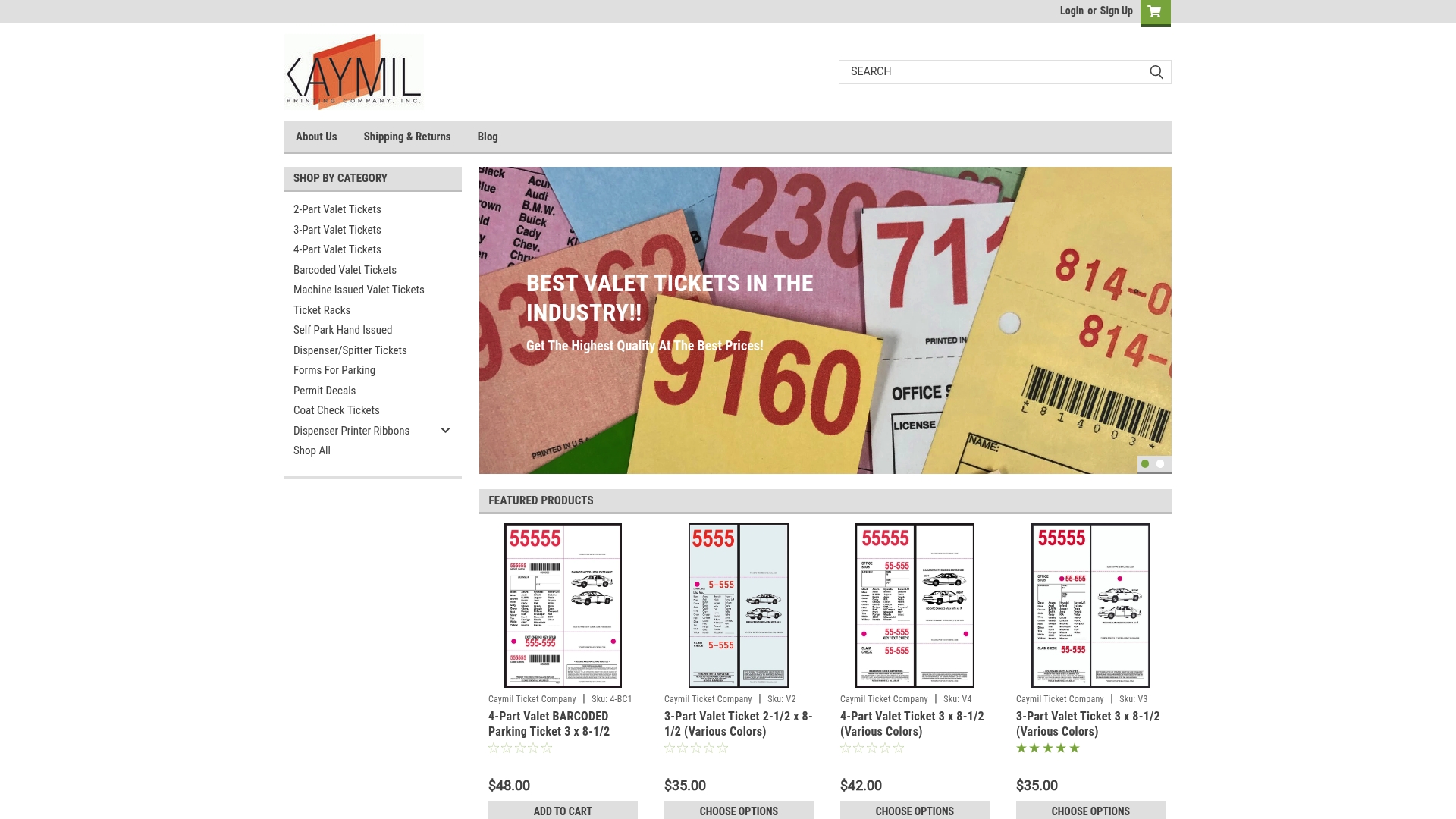
Caymil’s compatibility spans the major parking platforms in use across the U.S., including Amano, TIBA, SKIDATA, FLASH Parking, Scheidt & Bachmann, and Flowbird. Every order can include sequential numbering, custom barcodes, logos, security colors, and special coatings. Physical production samples are available before a full run is approved. Rush production and split shipments are both options for time-sensitive needs. To place an order or request a sample, visit Caymil’s parking forms page and submit your dispenser model and roll specs directly.
Sources and further reading
- Spitter Ticket Definition, Law Insider — legal dictionary definition of “spitter ticket” as a paper access card for transient parkers
- Ticket Spitters, Wayword Radio — industry audio explanation of the terms “ticket spitter,” “entry station,” and “parking ticket dispenser”
- Machine Issued Valet Tickets, Caymil — product specs and ordering details for dispenser-compatible machine-issued tickets
- Forms For Parking, Caymil — full catalog of stock and custom parking ticket formats
- Roll Tickets for Intermec Printer 2100, Caymil — example of printer-specific roll sizing and core diameter requirements
Consult your dispenser manufacturer’s documentation for the mechanical tolerances specific to your model before finalizing any ticket order.
FAQ
What is a spitter ticket in parking?
A spitter ticket is the paper access card a parking-entry dispenser issues to a driver on arrival, recording the entry time and a unique ID the exit system uses to calculate the fee. The term comes from the machine “spitting” the ticket out of the entry slot.
Are spitter tickets the same as valet tickets?
Not always. Spitter tickets are machine-issued by an automated entry dispenser, while valet tickets are typically multi-part carbonless forms handled manually by attendants. Some valet operations use machine-issued formats, but the two serve different workflows.
What specs do I need before ordering spitter tickets?
Confirm roll width, core diameter, maximum roll outer diameter, ticket length, perforation orientation, print method (thermal or impact), and barcode symbology. Providing your dispenser model number to the supplier is the fastest way to verify all dimensions at once.
How do I prevent jams in my ticket dispenser?
Match the roll’s core diameter and width exactly to the dispenser’s spindle and paper path, and always run a physical sample through the machine before approving a full production run. Storing rolls in a cool, dry location also prevents thermal pre-activation that causes feed failures.
Where can I order custom spitter-compatible parking tickets?
Caymil manufactures stock and custom spitter-compatible tickets with options for sequential numbering, barcodes, logos, and multipart carbonless formats, with compatibility across Amano, TIBA, SKIDATA, FLASH Parking, Scheidt & Bachmann, and Flowbird systems and fast nationwide shipping.