

What Is a Gate-Issued Parking Ticket? Explained

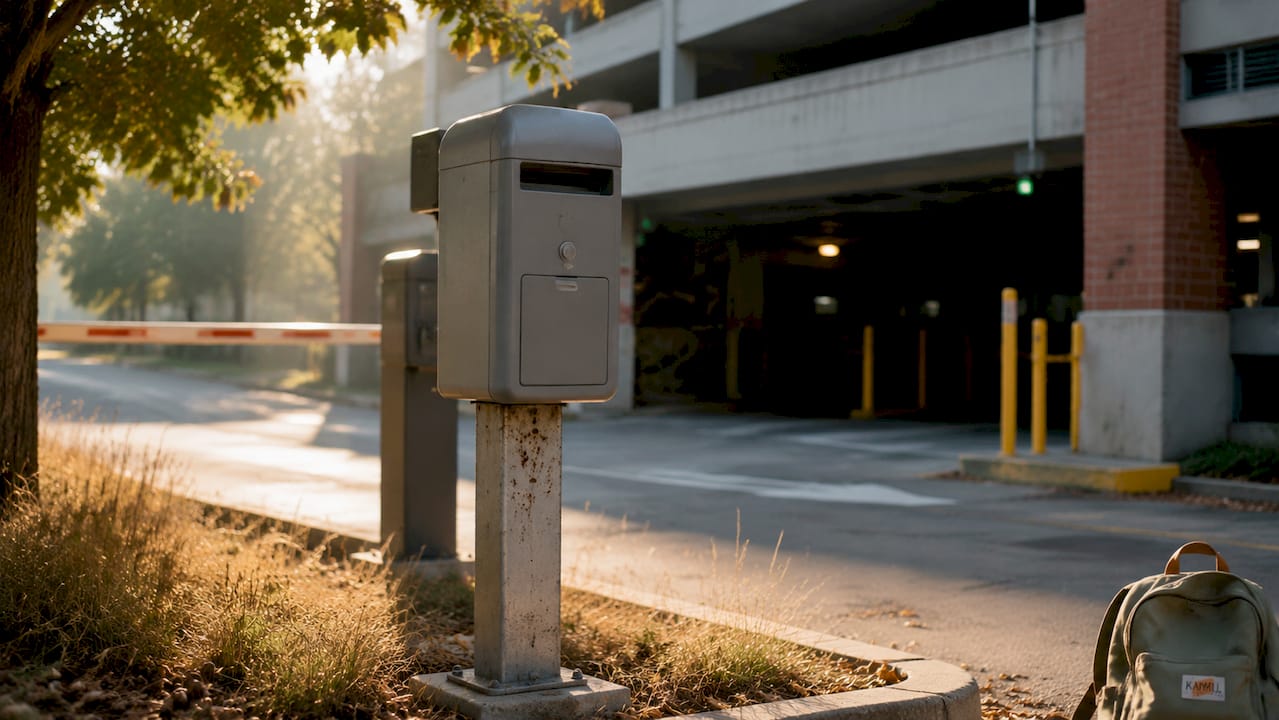
A gate-issued parking ticket is the entry session token dispensed at a parking facility gate that records your vehicle’s arrival time and enables fee calculation at exit. Formally called a parking access and revenue control system (PARCS) entry ticket, this document is not a fine or a legal citation. It is a billing instrument. The moment you pull that ticket from the dispenser, the system logs your session start time and holds the barrier gate open. Without it, you cannot exit without paying a penalty or involving an attendant.
The distinction matters more than most drivers realize. Confusion between session tokens and violation citations is the single most common source of parking disputes at garages, airports, and hospital facilities. This article explains how gate-issued tickets work, how they differ from enforcement citations, what technologies power them, and what happens when things go wrong.
What is a gate-issued parking ticket and how does it work?
A gate-issued parking ticket functions as a cryptographically verifiable session reference tied to your specific parking entry event. When a driver presses the button at a PARCS entry lane, the dispenser prints a paper ticket encoded with a timestamp, lane ID, and session number. That data is simultaneously logged in the facility’s backend system. The barrier arm rises, and the session is live.
The operational workflow follows a clear two-step structure:
- Entry: The driver presses the entry button. The ticket dispenser issues a session token and the gate opens. No payment occurs at this stage.
- Pre-exit payment: The driver takes the ticket to a pay station or kiosk before returning to the vehicle. The pay station reads the ticket, calculates the fee based on duration, and processes payment.
- Exit validation: The paid ticket is inserted into or scanned at the exit lane reader. The system verifies payment and gate validation before releasing the barrier arm.
The University of Wisconsin–Milwaukee Transportation Services uses exactly this model at its gated garages. Drivers pull a ticket on entry, pay at an interior kiosk, and present the validated ticket at the exit gate. This separation of issuance from payment is intentional. Facilities separate ticket issuance from payment collection to optimize traffic flow and reduce bottlenecks at both entry and exit points.
Pro Tip: Always take your ticket immediately when the dispenser prints it. Leaving it in the machine or letting it retract can create a new session record or trigger a lost-ticket fee before you have even parked.
Gate-issued entry ticket vs. parking violation citation
The word “parking ticket” carries two entirely different meanings depending on context, and mixing them up creates real problems for drivers and facility operators alike.
| Feature | Gate-issued entry ticket | Parking violation citation |
|---|---|---|
| Purpose | Records parking session for billing | Documents a legal parking violation |
| Issued by | Automated gate dispenser at entry | Parking enforcement officer or camera system |
| Payment deadline | Due at exit or pay station | Fixed legal deadline (e.g., Boston’s 21-day window) |
| Legal status | No legal penalty; operational billing tool | Legal document with fines and appeal rights |
| Consequence of non-payment | Gate does not open; attendant required | Late fees, collections, or license hold |
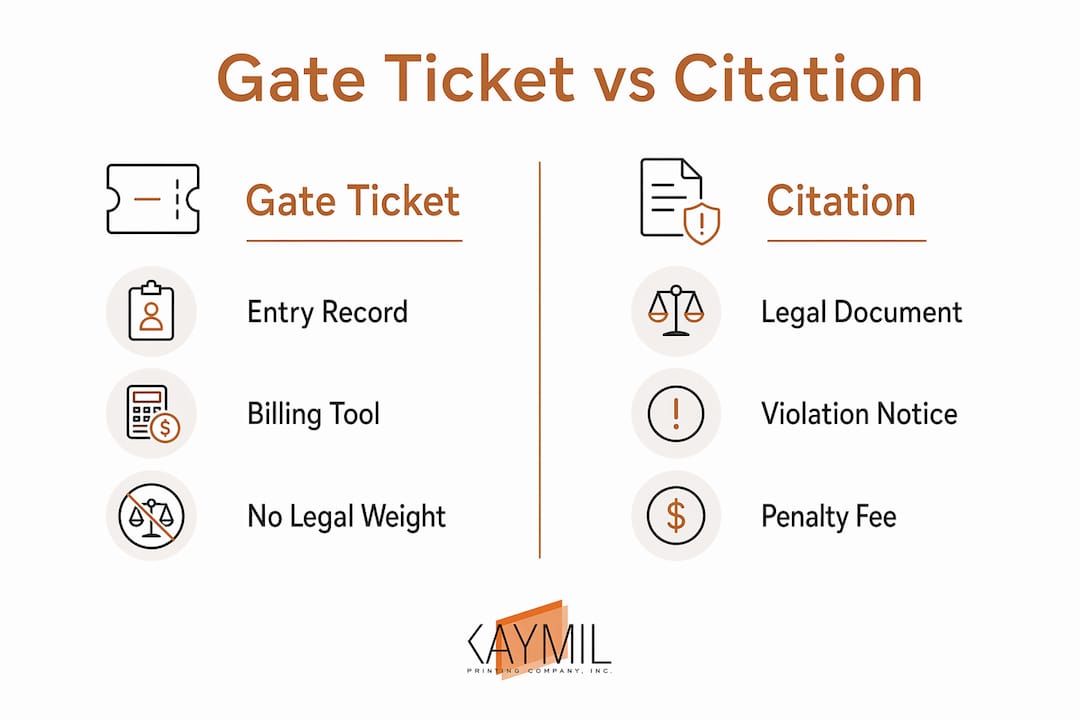
A parking citation is a legal violation document issued by a municipal officer or enforcement camera when a vehicle is parked illegally, past a meter, or in a restricted zone. Cities like Boston require payment or appeal within 21 days or the fine increases. That is a fundamentally different instrument from the entry ticket you pull at a garage gate.
Gate-issued tickets carry no legal weight on their own. They are operational billing tools. If you lose one, you pay a lost-ticket fee. If you receive a citation, you face a legal process with deadlines, appeals, and potential license consequences. The signage at most facilities does not make this distinction clearly enough, which is why parking managers at hospitals, universities, and airports field daily calls from confused drivers who think their entry ticket is a fine.
Understanding this difference also matters for organizations managing parking facilities. Policies, staff training, and customer communications should use precise language: “entry ticket” for PARCS tokens and “citation” or “violation notice” for enforcement documents. Blurring the terminology creates disputes that cost time and damage customer trust.
Types and technologies of gate-issued parking tickets
Gate-issued tickets are not a single product. They exist across a spectrum of formats, each suited to different facility types, budgets, and system integrations.
- Paper tickets with magnetic stripes: The oldest and still most common format in legacy garages. The magnetic stripe stores session data that exit readers decode. Systems from Amano, TIBA, and Scheidt & Bachmann have used this format for decades.
- Barcode and QR code tickets: Printed at entry with a 1D or 2D barcode, these tickets are scanned at pay stations and exit lanes. Barcode tickets improve garage efficiency by reducing read errors and supporting faster throughput at high-volume exits.
- Thermal paper tickets: Used in high-speed machine-issued dispensers, thermal printing eliminates ink cartridges and reduces maintenance. These are standard in airport parking structures and large urban garages.
- QR code and mobile tokens: At facilities like Dulles Airport (IAD), paper tickets and QR scanning at exit coexist with app-based entry options. Some lanes issue a QR code on a paper slip; others send it directly to a mobile device.
- License plate recognition (LPR) tokens: The most modern alternative replaces the physical ticket entirely. A camera reads the plate on entry, creating a virtual session record. The driver pays by plate number at a kiosk or app. No paper changes hands.
Ticket machines remain common in many facilities due to infrastructure costs and the lack of reliable mobile or LPR coverage in older structures. A hospital garage built in 1995 is unlikely to have the network infrastructure for full LPR deployment. Paper tickets with barcodes remain the practical, cost-effective solution for those environments.
For parking managers evaluating their options, the choice of ticket format directly affects fraud exposure, throughput speed, and maintenance costs. Barcode and thermal formats offer the best balance of reliability and cost for most mid-size facilities. LPR works best in high-volume, high-tech environments where the capital investment is justified.
Operational challenges with gate-issued parking tickets
Even well-designed PARCS systems encounter predictable failure points. Knowing them in advance helps both drivers and facility operators handle them without disruption.
Lost tickets and maximum fee charges
The most frequent issue is a lost ticket. Systems cannot reconstruct entry time without the physical or digital session token, so facilities charge a lost-ticket fee equal to the maximum daily rate or a fixed penalty. This is not punitive by design. The system has no other way to verify how long the vehicle was present. Lost-ticket fees are an operational necessity, and disputing them rarely succeeds without proof of entry time.
Operators should post lost-ticket fee amounts clearly at entry lanes and pay stations. Facilities that bury this information in fine print generate the most complaints and the most time-consuming attendant interventions. A clear sign at the dispenser costs nothing and prevents significant friction.
Re-entry and lane-switching issues
Attempting to skip the gate ticket or re-enter through a different lane causes the system to start a new session or apply lost-ticket rules. This is a revenue protection mechanism, not a malfunction. PARCS systems are designed to treat any unmatched exit as a potential unpaid session. Drivers who re-enter after paying but before exiting will often find their validated ticket no longer works, because the system registered a second entry event.
For facilities with multiple entry and exit lanes, consistent lane assignment and clear directional signage reduce these incidents significantly. Operators managing high-turnover lots should also review their parking facility audit practices regularly to catch session mismatches before they become revenue gaps.
Payment timing and pre-exit kiosks
Most PARCS setups give drivers a grace period after paying at a kiosk before the validated ticket expires. That window is typically 15 to 30 minutes. Drivers who pay, return to their vehicle, and then stop to load groceries or take a call may find the ticket has expired by the time they reach the exit. The gate will not open, and an attendant must intervene.
Pro Tip: Pay at the kiosk only when you are ready to leave immediately. If you need to return to your vehicle for any reason before exiting, wait to pay until you are walking directly to the exit lane.
Key takeaways
Gate-issued parking tickets are operational billing instruments, not legal documents, and understanding that distinction prevents the most common parking disputes.
| Point | Details |
|---|---|
| Core definition | A gate-issued ticket is a session token that records entry time for fee calculation, not a fine. |
| Two-step payment model | Ticket issuance at entry and payment at a separate kiosk are intentionally separated to improve traffic flow. |
| Citation vs. entry ticket | Enforcement citations carry legal deadlines and penalties; entry tickets are billing tools with no legal standing. |
| Lost ticket policy | Systems charge maximum-rate fees for lost tickets because they cannot verify session length without the token. |
| Technology range | Formats span magnetic stripe, barcode, thermal, QR, and LPR, each suited to different facility types and budgets. |
Why the industry still gets this wrong
I have spent years working alongside parking operators, facility managers, and ticket manufacturers, and the same problem surfaces repeatedly: nobody explains what the entry ticket actually is. Drivers pull it from the dispenser, shove it in a cup holder, and forget about it until they are sitting at the exit gate with a line of cars behind them.
The industry has done a poor job of communicating the purpose of the gate-issued ticket at the point of use. A single line of text on the dispenser face, “Keep this ticket. You need it to exit and pay,” would eliminate a significant share of lost-ticket incidents and attendant calls. That is not a technology problem. It is a communication problem.
The shift toward LPR and mobile tokens will reduce paper ticket issues over time, but the transition is slower than vendors predict. Older garages, budget-constrained municipalities, and facilities with inconsistent cellular coverage will rely on paper PARCS tickets for years to come. The operational logic does not change with the format. Whether the session token is a thermal paper slip or a license plate scan, the system still needs a reliable reference to calculate what is owed.
What I find most interesting is that the confusion between entry tickets and enforcement citations persists even among parking professionals. Clear terminology, better signage, and staff training on the distinction between a parking receipt and a parking ticket would do more for customer satisfaction than most technology upgrades. The fundamentals matter more than the format.
— Richard
Caymil printing solutions for gate-issued ticket operations
Parking facility operators who rely on paper-based PARCS systems need tickets that perform reliably in high-speed dispensers, hold up in all weather conditions, and encode cleanly for barcode or magnetic stripe readers.
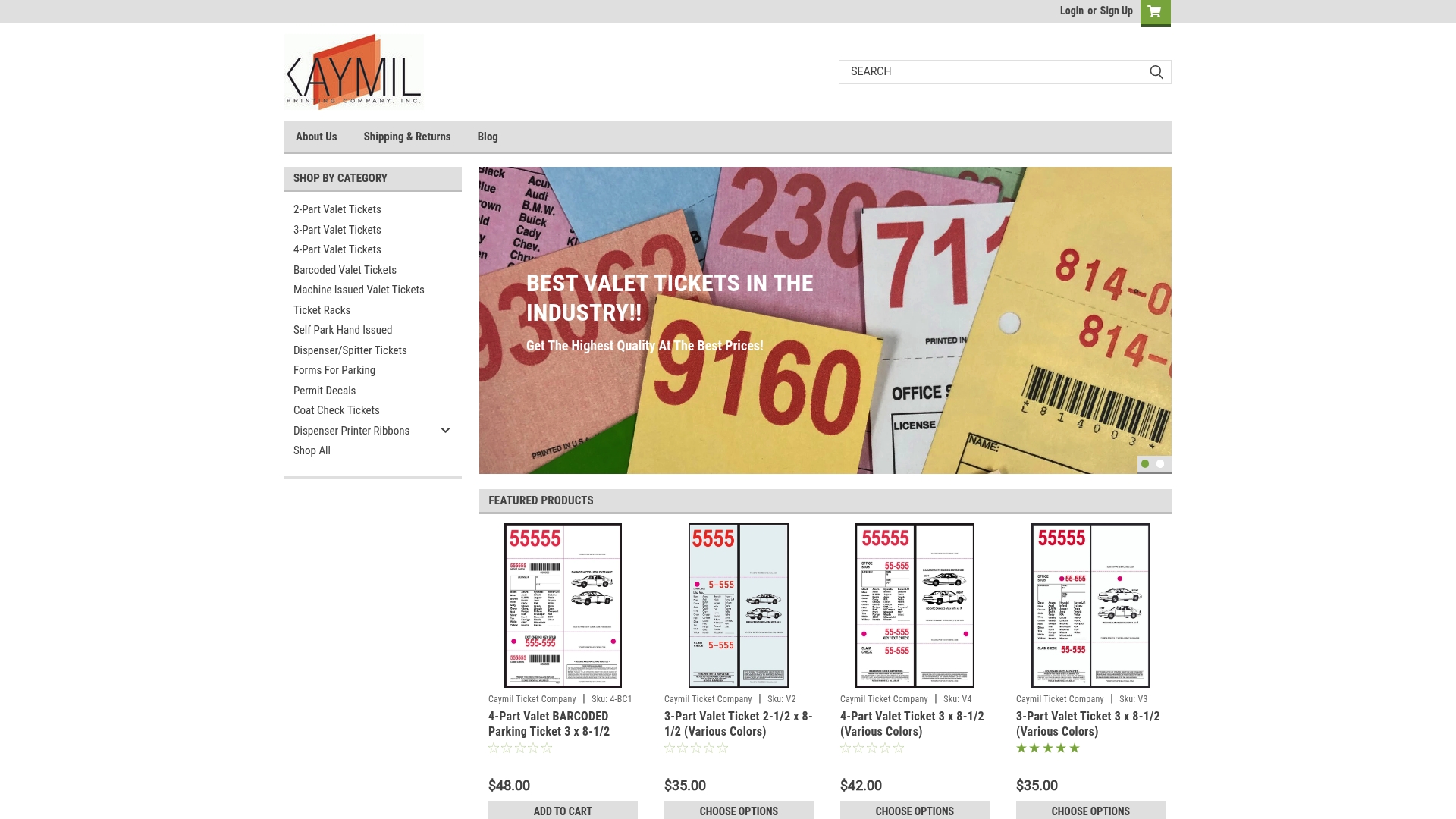
Caymil has manufactured machine-issued and barcode-enabled parking tickets since 1937, supplying garages, airports, hospitals, and universities across the United States. Caymil’s parking ticket forms cover the full range of PARCS-compatible formats, including thermal rolls, magnetic stripe tickets, and barcode stock compatible with Amano, TIBA, SKIDATA, FLASH Parking, and Scheidt & Bachmann systems. For facilities using machine-issued dispensers, Caymil’s machine-issued valet tickets and barcode parking tickets are available in stock and custom formats with fast nationwide shipping.
FAQ
What is a gate-issued parking ticket?
A gate-issued parking ticket is the entry session token printed at a parking facility gate when a driver arrives. It records the entry time and enables the system to calculate the parking fee at exit.
Is a gate-issued ticket the same as a parking fine?
No. A gate-issued ticket is a billing instrument, not a legal document. A parking fine or citation is issued by an enforcement officer for a violation and carries legal deadlines and penalties.
What happens if you lose a gate-issued parking ticket?
Losing a ticket triggers a lost-ticket fee equal to the maximum daily rate because the system cannot verify how long the vehicle was parked without the session token.
How do gate-issued tickets differ from pay-by-plate systems?
Gate-issued tickets use a physical or digital token to track the session. Pay-by-plate systems use license plate recognition to create a virtual session record, eliminating the need for a physical ticket entirely.
Can you contest a gate-issued parking ticket fee?
Gate-issued ticket fees are not citations and do not have a formal appeal process like enforcement fines. Disputes are handled directly with the facility operator, and outcomes depend on the facility’s lost-ticket or overpayment policy.