

What Is a Parking Audit Trail? A Guide for Operators

A parking audit trail is the physical record formed by sequentially numbered, barcoded, or machine-issued tickets and receipts that lets you track every vehicle entry and reconcile it against revenue collected. It is the paper backbone of sound parking management, not a software concept.
Two things it does immediately:
- Enables ticket-to-cash reconciliation by giving you a numbered start and end point for every shift, so you can calculate exactly how many vehicles entered and what revenue should be on hand.
- Prevents and detects revenue leakage by making unauthorized ticket use, skipped sequences, or missing stubs visible before they compound across shifts.
Table of Contents
- What components make up a physical parking audit trail?
- How does three-way reconciliation work?
- What does an end-of-shift reconciliation checklist look like?
- What discrepancies should you watch for, and how do you investigate them?
- What controls strengthen your physical audit trail?
- What should you specify when buying tickets to support an audit trail?
- How Caymil supports a reliable physical audit trail
- Key Takeaways
- Why physical audit trails still matter more than operators realize
- Caymil tickets built for audit-ready parking operations
- FAQ
What components make up a physical parking audit trail?
The trail is only as strong as the physical elements you control. Sequential ticket numbering is the foundation, but several supporting components complete it.
| Component | Traceability Level | Role in the Trail |
|---|---|---|
| Sequential roll/machine tickets | High | Start/end serial tracking per shift |
| Multi-part carbonless tickets | High | Attendant and guest copies for cross-reference |
| Barcoded valet tickets | Very High | Machine-readable, manipulation-detectable |
| Permit hang tags | Medium | Issued count vs. returned count reconciliation |
| Ticket stubs/receipts | High | Physical attestation of each transaction |
| Supply delivery receipts | High | Establishes opening inventory for three-way reconciliation |
A simple ticket range calculation illustrates the logic: if a roll starts at serial 04501 and ends at 04750, you issued 250 tickets. Any gap between that count and your cash or transaction log demands an explanation. Audit findings confirm that tracking start and end serial numbers per shift is the baseline control for verifying revenue.
For valet operations specifically, tickets should be numbered and used in strict sequence, with keys hung in matching order so attendants can locate the correct key quickly during high-volume events.

How does three-way reconciliation work?
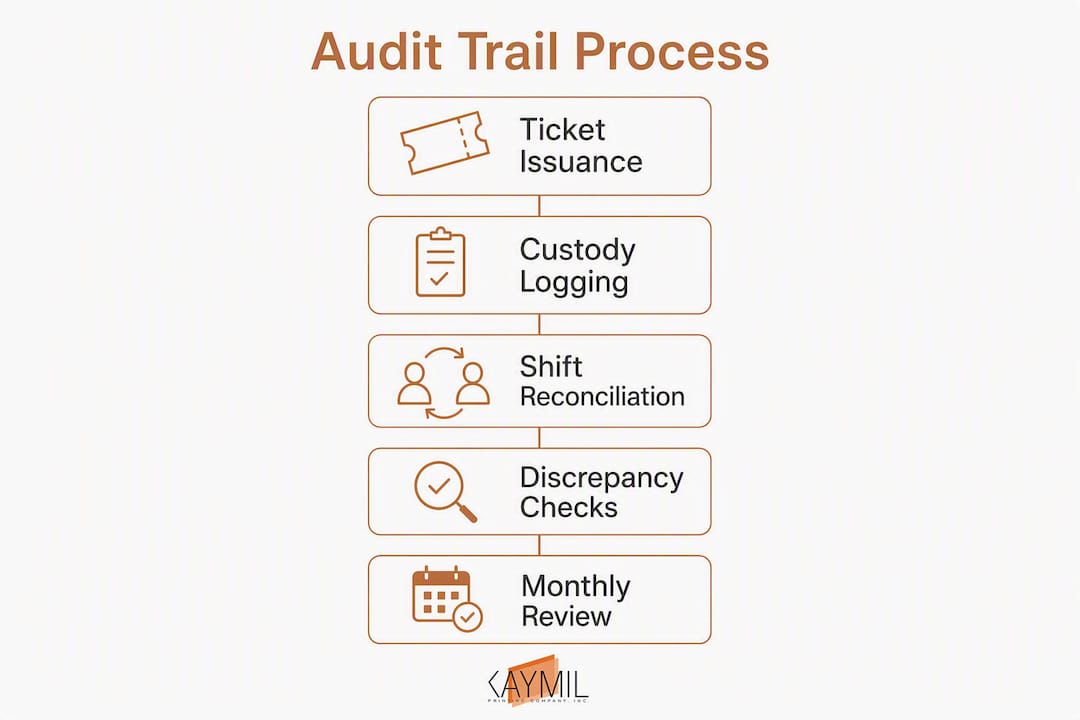
Auditors recommend a three-way reconciliation on at least a monthly basis, with supporting logs that record dates and serial number ranges for all tickets sold. The method is straightforward.
- Record the supply receipt. When a new ticket batch arrives, log the serial range (e.g., 10001–12000) and store it with the delivery receipt. This is your opening inventory.
- Log tickets issued per shift. Each attendant records the starting and ending serial number used during their shift, the quantity sold, and any exceptions (comps, lost tickets, forced opens).
- Count unused tickets. At reconciliation time, physically count remaining stock. The formula is: tickets received minus tickets issued minus tickets on hand should equal zero.
Practical fields to capture in your shift log: date, shift time, attendant name, starting serial, ending serial, quantity sold, cash collected, and a notes field for exceptions. Any unexplained variance triggers investigation.
Pro Tip: Document supply receipts the moment a new ticket batch arrives, and use a signed transfer-of-accountability form any time ticket stock moves between locations or attendants. A gap in custody documentation is often where discrepancies originate.
What does an end-of-shift reconciliation checklist look like?
End-of-shift reconciliation should happen at every shift close, reconciling issued ticket ranges to cash and receipts before the next attendant takes over.
Checklist:
- Secure all ticket stubs from the shift
- Record the starting and ending serial numbers used
- Count cash collected
- Calculate expected revenue: (tickets issued × posted rate)
- Compare expected revenue to actual cash on hand
- Document every exception: lost ticket, comp, validation, operator error
- Staple the beginning and ending ticket stubs to the shift report
Sample calculation: Starting serial 04501, ending serial 04600. Tickets issued are the difference plus one. Expected revenue is calculated by multiplying the number of tickets by the posted rate. Any cash shortfall requires a documented explanation before the shift closes.
Standard operating procedures for manual tickets require attendants to staple the beginning and ending ticket stubs to the shift report at shift end. That physical attachment is what makes the record auditable.
Reconciliation at this level typically takes 5–10 minutes per shift when ticket logs are kept current throughout the day. Letting it slip to weekly review means discrepancies can span dozens of shifts before anyone notices.
Pro Tip: Run a quick sequence check mid-shift. If serial numbers jump unexpectedly, address it before the shift closes rather than reconstructing events hours later.
What discrepancies should you watch for, and how do you investigate them?
- Missing tickets in sequence: Verify supply logs first, then inspect stub bundles for the gap. Interview the attendant about the specific serial range.
- Cash shortfall: Compare the computed revenue figure to cash collected. Check for undocumented comps or validations before assuming theft.
- Unrecorded comps or validations: Review shift reports for exception notes. Cross-reference with any validation coupon logs.
- Out-of-sequence issuance across lanes: Check lane-assignment logs. Audit findings show that out-of-sequence sales require lane-assigned sequences or strict logs to remain explainable.
If initial checks don’t resolve the gap, escalate to a supervisor, lock down remaining ticket stock immediately, and trigger a full recount. A complete audit trail links every entry event to a paid exit, validated exit, or documented exception. When that link is broken and no documentation explains it, that is the threshold for an internal audit. Involve external auditors or law enforcement only when theft indicators persist after internal review.
What controls strengthen your physical audit trail?
The short answer: combine sequential controls, chain-of-custody documentation, separation of duties, and daily review. Together, they close most of the gaps that let revenue walk out the door.
- Keep unissued ticket stock in a locked cabinet accessible only to authorized personnel
- Require signed delivery logs for every new ticket shipment
- Use transfer-of-accountability forms when moving stock between locations or shifts
- Staple start/end stubs to shift reports at every shift close
- Assign supervisors to conduct random spot checks on ticket ranges and cash counts
- Rotate attendants across lanes periodically to reduce collusion risk
Daily shift reviews and monthly three-way reconciliations are the recommended cadence. Operators who focus only on digital logs can miss real-world ticket manipulation; the physical trail catches shift-level discrepancies that software alone may not surface.
Pro Tip: Short daily audits of 5–10 minutes focused on sequence gaps and cash mismatches limit potential revenue leakage to a single shift rather than letting problems accumulate.
What should you specify when buying tickets to support an audit trail?
The direct answer: specify sequential numbering, stub perforations or multi-part carbonless formats, optional barcoding, and confirmed compatibility with your on-site machines or printers.
Procurement checklist:
- Sequential serial numbers with documented starting range
- Tear stubs or perforations for physical attestation
- Barcodes or QR codes for machine-readable traceability
- Multi-part carbonless for attendant and guest copies
- Security inks or microprinting to deter fraud
- Custom logo or color coding for facility identification
| Ticket Type | Traceability | Machine Compatibility | Best Use Case |
|---|---|---|---|
| Machine roll tickets | High | Roll-fed printers (Amano, TIBA, SKIDATA) | High-volume garages, unattended entrances |
| 2-part carbonless | High | Manual/valet operations | Valet, event parking with attendant copy |
| 3-part carbonless | Very High | Manual/valet operations | Valet operations needing management copy |
| Barcoded valet tickets | Very High | Barcode-compatible systems | Multi-lane, high-volume, fraud-sensitive sites |
Barcoding justifies the added cost at high-volume or multi-lane operations where sequence-number validation and barcodes make ticket manipulation detectable. For smaller lots, a well-managed carbonless multi-part ticket with strict serial logging delivers the same accountability at lower cost. Custom sequences and logos add lead time; stock templates ship faster when you need to replenish quickly.
How Caymil supports a reliable physical audit trail
Caymil provides sequential, barcoded, and multi-part ticket solutions compatible with common parking machines and valet workflows, covering the full range of physical audit trail requirements.
Relevant product features to specify:
- Sequential numbering with documented serial ranges
- Barcoding for machine-readable traceability
- Multi-part carbonless formats (2-part, 3-part, 4-part) for attendant, guest, and management copies
- Machine roll compatibility with Amano, TIBA, SKIDATA, FLASH Parking, Scheidt & Bachmann, and Flowbird systems
- Security inks and microprinting for anti-fraud protection
Example use case: A valet operation issues 3-part carbonless sequential tickets at shift start. The attendant retains one stub, the guest receives one copy, and the third goes to the shift report. At shift close, the attendant staples the starting and ending stubs to the report and runs the three-way reconciliation. Any gap between issued count and cash collected is documented before the next shift begins.
Operators can also request barcoded valet tickets for operations where machine-readable traceability reduces manual reconciliation time. Caymil’s team can confirm compatibility with your existing printers and provide sample proofs before you commit to a full order.
Key Takeaways
A physical parking audit trail built on sequential tickets, documented custody, and disciplined three-way reconciliation is the most reliable way to protect parking revenue and pass any audit.
| Point | Details |
|---|---|
| Three-way reconciliation | Reconcile supply receipts, issued ticket logs, and unused stock counts at least monthly. |
| Chain-of-custody controls | Use signed delivery logs and transfer-of-accountability forms whenever ticket stock moves. |
| End-of-shift discipline | Staple start/end stubs to every shift report and reconcile cash before the next shift begins. |
| Daily sequence checks | Run 5–10 minute audits daily to catch gaps within a single shift, not after the fact. |
| Caymil ticket supply | Caymil supplies sequential, barcoded, and multi-part carbonless tickets compatible with major parking systems nationwide. |
Why physical audit trails still matter more than operators realize
The parking industry has invested heavily in access control software and digital transaction logs, and those tools are genuinely useful. But they don’t replace the physical audit trail. Software records what the system sees; a sequentially numbered ticket records what actually happened at the lane. When an attendant hands out a ticket that never enters the system, the digital log has nothing to report. The physical stub does.
What operators often underestimate is how quickly small discrepancies compound. A single missing ticket per shift, across a 10-lane garage running two shifts daily, adds up to a material revenue gap before the month-end reconciliation catches it. The three-way reconciliation method, backed by proper ticket procurement and chain-of-custody controls, is what closes that window. Caymil has been manufacturing tickets that support exactly this kind of operational discipline since 1937, and the physical controls auditors recommend today are the same ones that have always worked: sequential numbers, signed custody, and a stub attached to every shift report.
Caymil tickets built for audit-ready parking operations
Operators who need tickets that hold up under audit scrutiny get a straightforward advantage with Caymil: sequential numbering, multi-part carbonless formats, and barcoding options, all confirmed compatible with the parking systems already running at your facility. Stock tickets ship fast for immediate needs; custom sequences and logos are available for operations that require facility-specific identification.
Caymil has supplied parking and valet operations across the United States since 1937, with millions of tickets in stock and the manufacturing depth to handle custom orders without long lead times. Request a sample proof or confirm compatibility for your printer model before placing a full order. Browse machine-issued valet tickets and 2-part valet parking tickets to find the format that fits your reconciliation workflow, or visit caymil.com to speak with the team directly.
FAQ
What is a parking audit trail in simple terms?
A parking audit trail is the physical record created by sequentially numbered or machine-issued tickets and receipts that lets operators verify every vehicle entry against revenue collected.
How often should parking operators run a three-way reconciliation?
Auditors recommend conducting a three-way reconciliation at least monthly, with shift-level ticket range checks and cash reconciliation at every shift close.
What makes a ticket suitable for an audit trail?
A ticket supports an audit trail when it carries a unique sequential serial number, includes a stub or multi-part copy for physical attestation, and optionally uses barcoding for machine-readable traceability.
What should operators do when ticket counts and cash don’t match?
Verify supply logs and stub bundles first, interview the attendant, and check transfer-of-accountability forms. If the gap remains unexplained, lock down remaining stock and trigger an internal audit.
Can Caymil supply tickets compatible with existing parking machines?
Yes. Caymil manufactures sequential and barcoded tickets compatible with Amano, TIBA, SKIDATA, FLASH Parking, Scheidt & Bachmann, and Flowbird systems, with sample proofs available before a full order.
Recommended
- Parking Facility Audit Using Tickets: 2026 Guide - Caymil Printing Co., Inc.
- How Parking Garage Revenue Audits Work: 2026 Guide - Caymil Printing Co., Inc.
- Common Parking Control Mistakes Operators Must Fix - Caymil Printing Co., Inc.
- Player Rewards Parking Ticket Program: A 2026 Guide - Caymil Printing Co., Inc.