Hologram Parking Permits: A Buyer’s Guide to Real Security
Hologram parking permits earn their place in any serious control program, but only as one layer in a stack. The strongest setups pair the holographic image with sequential numbering, a scannable barcode, and a tamper-evident material that tears or voids on removal. If your current permits lack even one of those elements, your first move is simple: request a numbered sample and a durability spec sheet from a printer before you order a full run.
TL;DR:
- Hologram permits must include sequential numbering, a scannable barcode, and tamper-evident features to be effective security layers.
- Visual holograms cannot be easily reproduced by casual counterfeiters but are vulnerable to determined forgers with origination equipment.
- Combining holograms with serial numbers, barcode validation, and tamper-resistant substrates forms a multi-layer security system that deters most fraud attempts.
- Proper permit formats like hang tags, decals, and placards vary in durability and verification ease, requiring specific specifications for size, material, and security features.
- Requesting samples, confirming durability specifications, and testing barcode compatibility are critical steps to ensure security and system integration before large orders.
Table of Contents
- What Are Hologram Parking Permits and How Do They Work?
- Layered Security: Why One Feature Isn’t Enough
- Choosing the Right Format: Hang Tags, Decals, and Placards
- What to Expect on Pricing, Minimums, and Lead Time
- How to Choose a Supplier: Your Ordering Checklist
- Why Caymil Fits the Brief
- Legal and Regulatory Considerations
- Real-World Examples of Effective Hologram Permit Programs
- Environmental and Durability Factors That Affect Permit Lifespan
- Technology Trends Shaping Hologram Permit Security
- Operator Perspective: Common Procurement Mistakes and Corrective Practices
- Get a Sample and a Quote from Caymil
- Sources
- FAQ
What Are Hologram Parking Permits and How Do They Work?
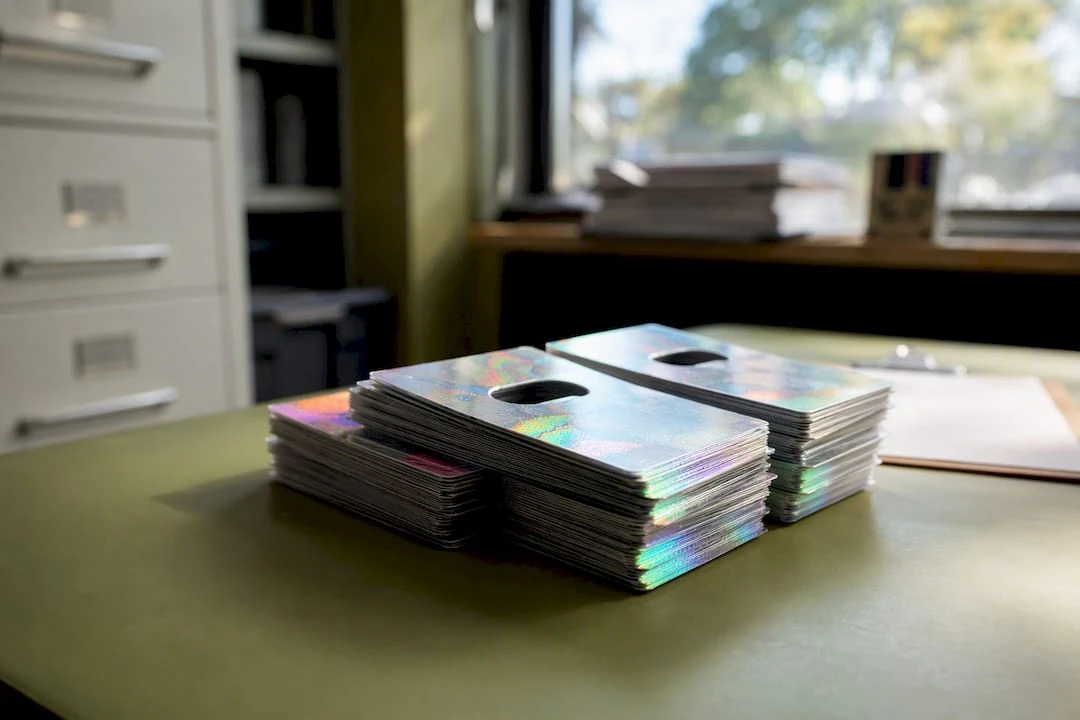
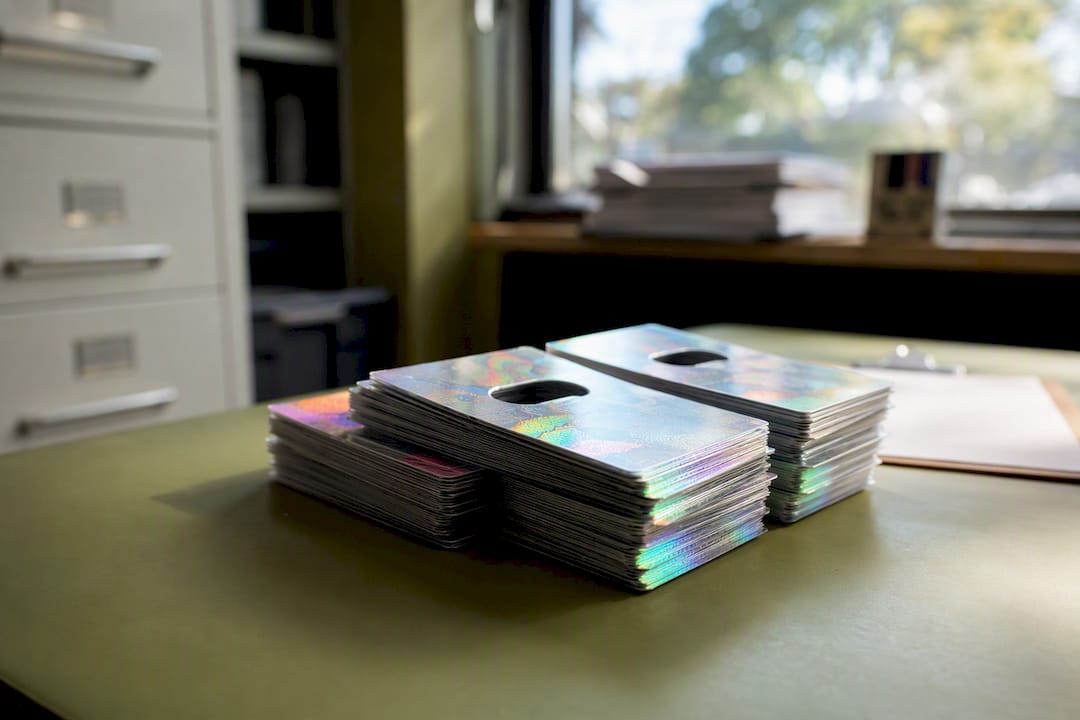
A hologram parking permit uses a foil or laminate layer containing a diffraction pattern that shifts color and shape as the viewing angle changes. Manufacturers apply this effect through a few production methods, and the method affects both cost and durability.
- Hot-stamped holograms transfer a metallic foil image directly onto the permit stock under heat and pressure, bonding it into the surface.
- Holographic laminate passes add a full-surface film, such as the Holographic Ice or Q-lam finishes some credential vendors offer, which raises replication difficulty across the entire card.
- Overt hologram stickers ship as a separate label applied to an existing permit, a lower-cost option often sold on its own as an add-on control.
Municipal programs have used this technology at scale. The city of Basel rolled out permits with a hot-stamped hologram specifically so enforcement staff could spot counterfeits without special equipment.
What the hologram actually stops matters as much as how it’s made. A genuine holographic image can’t be reproduced by a photocopier, a flatbed scanner, or a basic color printer, which eliminates the most common form of casual fraud: someone copying a valid permit at home. What it doesn’t stop is a determined counterfeiter with access to hologram origination equipment, which is rare but not impossible. That’s why a hologram functions best as a visible, at-a-glance verification aid for routine enforcement, while covert features (microtext, UV ink, forensic markers) get reserved for high-value programs where sophisticated fraud is a realistic threat.
Layered Security: Why One Feature Isn’t Enough
Security experts consistently point to the same principle: a hologram alone is a deterrent, not a system. Real protection comes from stacking multiple, independent checks so that defeating one doesn’t defeat the rest. The recommended model combines an overt hologram, a sequential serial number, a barcode or QR code tied to an issuance database, and a substrate that resists tampering, such as a void adhesive or a destructible laminate that shreds if someone tries to peel and reapply it.
Here’s how a field check should run in practice:
- Look at the hologram under a light source and confirm the image shifts as expected, without a flat, printed look.
- Read the serial number and confirm it matches the expected format and range for your current issuance batch.
- Scan the barcode or QR code, if your parking system supports it, and cross-reference against the issuance log in real time.
- Inspect the mounting surface for peel marks, residue, or a void pattern that indicates prior removal.
- Flag any mismatch immediately rather than waving the vehicle through on a “close enough” judgment call.
Tamper signs are usually obvious once staff know to look for them: a permit with a slightly different hologram color, a serial number that doesn’t match the visible wear pattern on the vehicle, or adhesive residue suggesting the tag came off another car. When enforcement staff spot one of these, the correct response is to hold the vehicle for a manual serial lookup, not to assume good faith. A field guide for spotting counterfeit permits gives officers a fast reference for exactly these situations.
Pro Tip: Train enforcement staff to check the serial number before the hologram. Most casual counterfeiters can fake a shiny sticker, but almost none can guess a valid number inside your current issuance range.
Choosing the Right Format: Hang Tags, Decals, and Placards
The physical format you choose affects visibility, durability, and how easily your staff can verify it in the field. Rearview mirror hang tags remain the most common choice for garages and controlled lots because they’re easy to see through the windshield and simple to transfer between vehicles for visiting or temporary use. Adhesive decals bond directly to glass, which makes them harder to swap between cars, a real advantage for reserved or resident parking where you want the permit tied to one vehicle. Rigid plastic placards sit in a middle ground, offering more durability than a paper hang tag while still allowing removal when needed.
When you request quotes, give your printer these specs so nothing gets left to guesswork:
- Overall size (common formats run around 2¾ by 4¾ inches for plastic hang tags)
- Material and laminate thickness, since thicker stock resists cracking in a hot dashboard environment
- Hologram size and exact placement on the card
- Serial numbering location and font size, for quick visual reading from a few feet away
- Barcode type (linear vs. QR) and whether it needs to integrate with your existing scanner hardware
| Format | Best fit | Typical durability feature |
|---|---|---|
| Rearview hang tag | Garages, visitor parking, easy visual check | Grommet hole, laminated card stock |
| Adhesive decal | Reserved or resident spots tied to one vehicle | Void adhesive that shreds on removal |
| Rigid plastic placard | High-turnover lots needing a sturdier tag | Thicker plastic, resistant to cracking |
For tamper resistance, ask about void adhesives that leave a visible “VOID” pattern if peeled, destructible films that tear rather than lift cleanly, and polyester laminates that resist moisture and UV fading better than basic paper stock. If decals are your format of choice, Caymil’s permit decal line covers these material options directly.
What to Expect on Pricing, Minimums, and Lead Time
Pricing on holographic permits scales with three variables: quantity, customization, and material. Stock holographic hang tags without custom artwork are the cheapest and fastest option, while custom logos, unique serial ranges, and barcode integration all add setup cost and a few days to production.
Vendors commonly sell stock holographic hang tags in small bundles, such as packs of 25 or 100, with per-unit pricing dropping as bundle size increases. That structure gives you a useful benchmark for budgeting, even before you request a formal quote.
| Order type | Typical minimum | Setup considerations | Approximate lead time |
|---|---|---|---|
| Stock hologram hang tags (no customization) | 25 to 100 units | None, ships from existing inventory | Days, often immediate for in-stock items |
| Custom hologram hang tags with logo and sequential numbering | Several hundred units | One-time art/setup fee | One to two weeks |
| Custom decals with barcode integration | Several hundred units | Setup fee plus barcode programming/testing | Two to three weeks |
Setup fees typically cover the one-time cost of preparing your artwork file and configuring the sequential numbering scheme, and most printers waive or reduce that fee on repeat orders using the same template. If you need barcodes or QR codes tied to a specific parking system, build extra time into your schedule for a scanning test before the full production run ships. Requesting a sample early in the process, rather than after the purchase order is signed, is the single easiest way to avoid a costly reprint.
How to Choose a Supplier: Your Ordering Checklist
Vetting a permit supplier comes down to a short, practical list. Work through these steps before you commit to a production order:
- Request a serialed sample, not a generic mockup, so you can hold the actual material and check the hologram in hand.
- Confirm durability specs in writing, including laminate thickness and expected lifespan under sun and temperature exposure.
- Test the barcode, scanning the sample against your own parking system before approving full production.
- Ask for references from clients running similar volume or a comparable facility type.
- Confirm compatibility with your specific hardware and software, since not every ticket format works cleanly with every reader.
Beyond the sample, ask suppliers pointed questions: Do they produce holograms in-house, or do they outsource that step to a third party? In-house capability usually means tighter quality control and faster turnaround on reorders. What’s their replacement policy if a batch arrives with a numbering error or a hologram defect? A supplier with decades of ticketing experience should have a clear answer, not a vague promise.
On the practical side, nail down your artwork file specs early, decide on a numbering scheme that won’t collide with any prior permit series, and confirm packaging and shipping terms, especially if you need permits staged for a specific launch date. Reviewing an operational guide for launching a hang tag program before you place the order can save a round of avoidable revisions.
Pro Tip: Ask for your serial numbering scheme to leave gaps for future expansion. Nothing forces an awkward renumbering project faster than running out of digits mid-year.
Why Caymil Fits the Brief
Caymil has manufactured ticketing and permit products since 1937, which means the company has spent decades refining the exact production details that determine whether a hologram permit holds up in daily use. Caymil ships nationwide and builds parking permit products compatible with the major parking systems facilities actually run, including Amano, TIBA, SKIDATA, FLASH Parking, Scheidt & Bachmann, and Flowbird.
On the security side, Caymil supports sequential numbering, barcoding, custom logo imprinting, and tamper-resistant material choices, the same feature set the checklist above calls for. That combination lets a facility manager address the hologram, the serial log, and the barcode scan requirement through one vendor relationship instead of stitching together multiple suppliers.
Evaluating Caymil against the checklist takes three concrete steps: request a numbered sample to inspect the hologram and material firsthand, confirm compatibility with your specific parking system before committing to a full order, and run a barcode integration test against your own scanner hardware. Those three checks answer the questions that matter most, without relying on marketing claims alone.
Legal and Regulatory Considerations
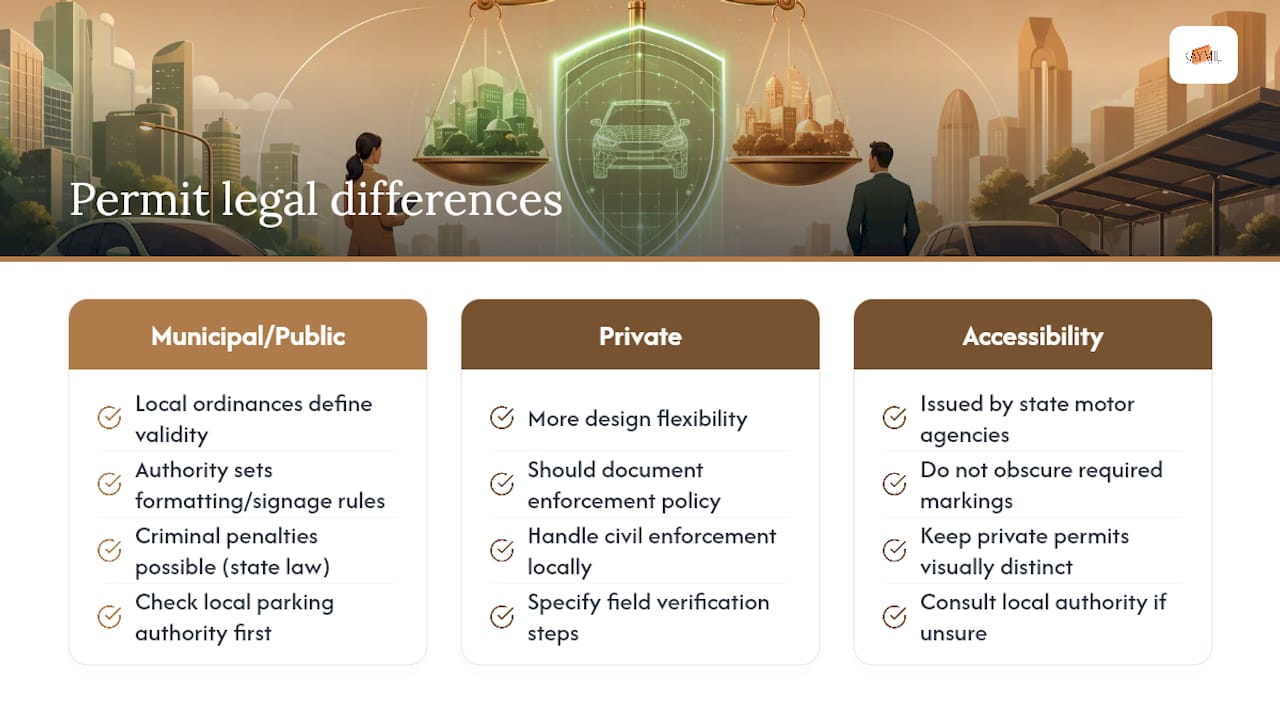
Parking permits used for enforcement, whether on public streets or in municipal garages, generally fall under local traffic and parking ordinances rather than a single national standard. Municipalities and property managers typically retain authority to define what counts as a valid permit, how permits get issued, and what penalties apply for forged or altered ones. If your facility operates on public right-of-way or under a municipal contract, check with your local parking authority about any formatting or signage requirements tied to permit validity before finalizing your design.
Counterfeiting a government-issued or officially recognized parking permit can carry criminal penalties under state fraud or forgery statutes, separate from any civil enforcement your facility handles on its own. Private lots and garages generally have more flexibility in permit design, but should still document their enforcement policy clearly, including what happens when a permit fails the field verification steps described earlier.
Accessibility placards and permits present a distinct category. Disability parking permits are typically issued and regulated by state motor vehicle agencies, and private security features layered onto those permits should never interfere with the state’s own required markings or verification process. If your facility issues its own permits alongside state-issued accessibility placards, keep the two systems visually and procedurally distinct so enforcement staff never confuse a private control feature with a legally mandated one. When in doubt on a jurisdiction-specific rule, a quick call to your local parking authority or municipal counsel resolves it faster than guesswork.
Real-World Examples of Effective Hologram Permit Programs
The Basel municipal rollout remains one of the clearest public examples of hologram permits working as intended. The city moved to hot-stamped holographic permits specifically to give enforcement officers a fast, no-equipment-needed way to separate genuine permits from forgeries at a glance, addressing a counterfeiting problem that had been costing the city enforcement revenue.
Commercial garages and universities tend to see a similar pattern once they add a hologram layer: casual counterfeiting drops sharply, since the easiest fraud method (photocopying a valid permit) simply stops working. The remaining fraud attempts shift toward more sophisticated methods, like reusing a genuine permit on multiple vehicles, which is exactly why the serial number and barcode layers matter as much as the hologram itself. A facility that only adds a hologram without tracking serials against an issuance log often finds enforcement staff can spot a fake hologram but has no way to catch a genuine permit being shared across three different cars.
Healthcare campuses and hotel valet operations, where permit volume is high and staff turnover is frequent, benefit especially from combining the hologram with a barcode that scans directly into the existing access system. That setup reduces the judgment call on enforcement staff, since the system flags a mismatch automatically rather than relying on someone remembering what a valid hologram looks like on a busy shift.
Environmental and Durability Factors That Affect Permit Lifespan
A permit’s biggest enemy usually isn’t a counterfeiter. It’s the sun. Dashboard-mounted permits and windshield decals sit in direct UV exposure for hours a day, and lower-grade laminates fade, yellow, or crack within months in hot climates. Polyester laminates hold up significantly better than basic paper laminates under sustained heat and UV, which matters most for facilities in warmer regions or permits meant to last a full year rather than a single semester or event.
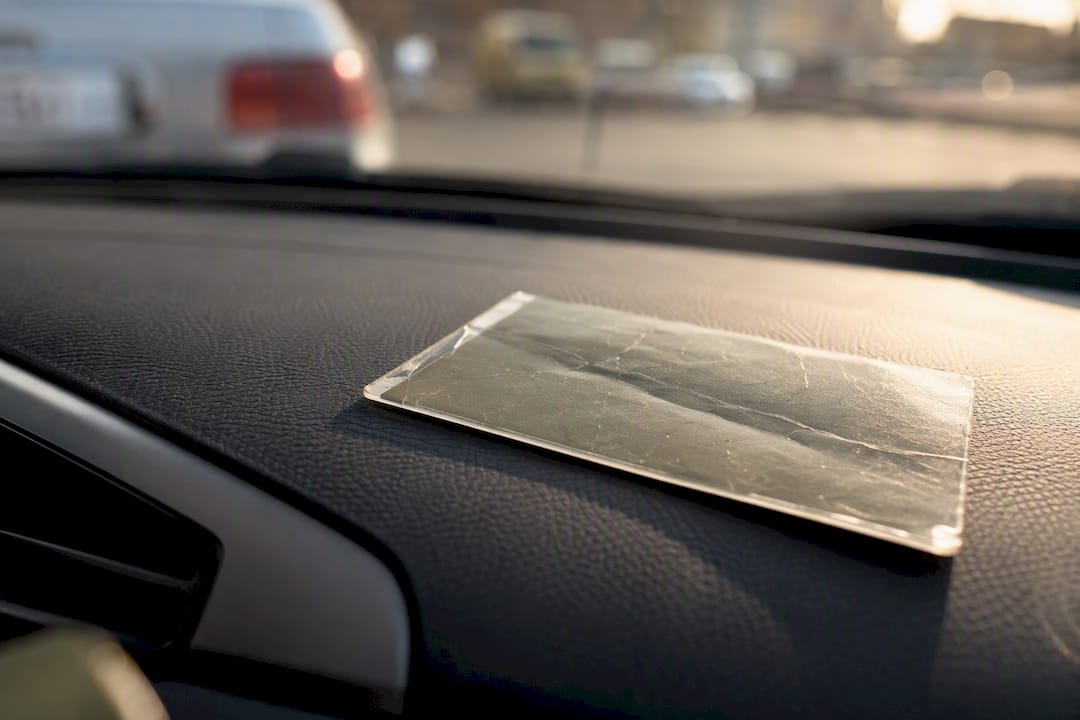
Temperature swings cause their own problems. A hang tag left on a mirror through a freeze-thaw cycle can become brittle at the grommet hole, the most common failure point on any hang tag design. Reinforced grommets and slightly thicker card stock reduce that risk without meaningfully raising cost.
Moisture matters for decals more than hang tags, since a decal applied to a windshield in humid or rainy conditions can lift at the edges if the adhesive wasn’t rated for exterior glass use. Confirming adhesive type and expected outdoor lifespan with your supplier avoids a batch of decals that start peeling within a season.
Finally, consider how long you actually need the permit to last. A temporary parking permit for a two-week event doesn’t need the same laminate thickness as an annual resident decal, and matching material grade to actual lifespan need is one of the simplest ways to control cost without sacrificing security where it counts.
Technology Trends Shaping Hologram Permit Security
RFID integration is the most significant shift affecting hologram permit design right now. Rather than relying solely on a visual hologram check or a manual barcode scan, some facilities now embed an RFID chip directly into the permit, allowing automated gate systems to read the permit without staff intervention while the hologram and serial number remain as a backup visual and manual check. This hybrid approach keeps the low-tech verification layer intact for situations where scanning equipment fails or a manual audit is needed.
QR codes have also become more common than traditional linear barcodes on newer permit programs, mainly because QR readers are now standard on most smartphones, which lets enforcement staff verify a permit with a phone camera rather than dedicated scanning hardware. That flexibility matters for smaller facilities that can’t justify a full barcode scanner fleet.
Digital parking permits, issued and verified entirely through an app rather than a physical card, are gaining ground in some university and municipal programs. They solve the physical counterfeiting problem entirely, but they introduce a different set of risks around account sharing and screenshot fraud, and they require reliable connectivity at the point of enforcement. Most facility managers running physical lots still find a hologram-plus-serial-number system more practical day to day, particularly anywhere enforcement staff need to make a fast visual call without pulling up an app or a database connection.
Operator Perspective: Common Procurement Mistakes and Corrective Practices
The single most common mistake I see in permit procurement is buying on looks alone. A holographic image that shimmers nicely under a showroom light says nothing about whether the adhesive will hold through a Texas summer or whether the serial number scheme leaves room to grow. Facility managers get sold on the shine and skip the questions that actually matter.
Skipping sequential numbering is the second mistake, and it’s the costlier one. A hologram without a tracked serial catches a photocopy but misses a permit shared across three vehicles. Tying every serial to a central issuance log closes that gap for less effort than most managers expect.
The fixes are straightforward: rotate your permit artwork annually so an old counterfeit stands out immediately, and keep a small replacement stock on hand rather than waiting weeks for a reorder when a batch runs low. Sequential numbering done right is the cheapest security upgrade most facilities never bother making.
— Richard
Get a Sample and a Quote from Caymil
Caymil covers the full checklist this guide just walked through: sequential numbering, barcoding, custom logo work, and material choices built to resist tampering, all from a manufacturer that’s produced ticketing and permit products since 1937 and ships nationwide. Instead of piecing together a hologram vendor, a numbering system, and a separate barcode provider, you get one supplier who already builds for compatibility with Amano, TIBA, SKIDATA, FLASH Parking, Scheidt & Bachmann, and Flowbird systems.
The next step is simple. Request a numbered sample through Caymil’s parking permit product line, confirm it matches your parking system before committing to volume, and ask directly about turnaround time and pricing tiers for your expected order size. If decals fit your facility better than hang tags, the permit decal page covers material options and specs you can request in the same conversation.
Sources
- Multi-Layered Security: overt, covert & forensic — angtech
- Holographic Hang Tag Parking Passes, Rear View Mirror Parking Permits - NovaVision
- Tamper-proof parking permits for the city of Basel - advast suisse AG
FAQ
What Makes a Hologram Parking Permit Hard to Fake?
The diffraction pattern inside a genuine hologram can’t be reproduced by a photocopier or standard color printer, which stops casual copying, though it should still be paired with sequential numbering for full protection against reuse.
Are Hologram Permits Required by Law?
No single national law mandates holograms; permit validity rules generally come from local traffic ordinances or municipal parking authorities, so check your jurisdiction’s specific requirements before finalizing a design.
How Much Do Holographic Parking Permits Typically Cost?
Stock holographic hang tags are usually sold in small bundles like 25 or 100 units with per-unit price dropping at higher volume, while custom logos, numbering, and barcodes add a setup fee and extra lead time.
Can Hologram Permits Work with My Existing Parking System?
Yes, when sourced from a manufacturer that builds for compatibility with major systems; Caymil produces permits compatible with Amano, TIBA, SKIDATA, FLASH Parking, Scheidt & Bachmann, and Flowbird.
What Should I Check Before Placing a Large Order?
Request a serialed sample, confirm laminate thickness and durability specs in writing, and scan any barcode against your own system before approving full production.
Recommended
- Fake Parking Permit Detection: A Field Guide for Officers - Caymil Printing Co., Inc.
- Parking ticket security: How to prevent fraud and protect revenue - Caymil Printing Co., Inc.
- Security Features on Casino Tickets: A Buyer’s Guide - Caymil Printing Co., Inc.
- Hotel Package Parking Deals: What Operators Need to Know - Caymil Printing Co., Inc.