
Single-Part vs. Multipart Tickets: How to Choose

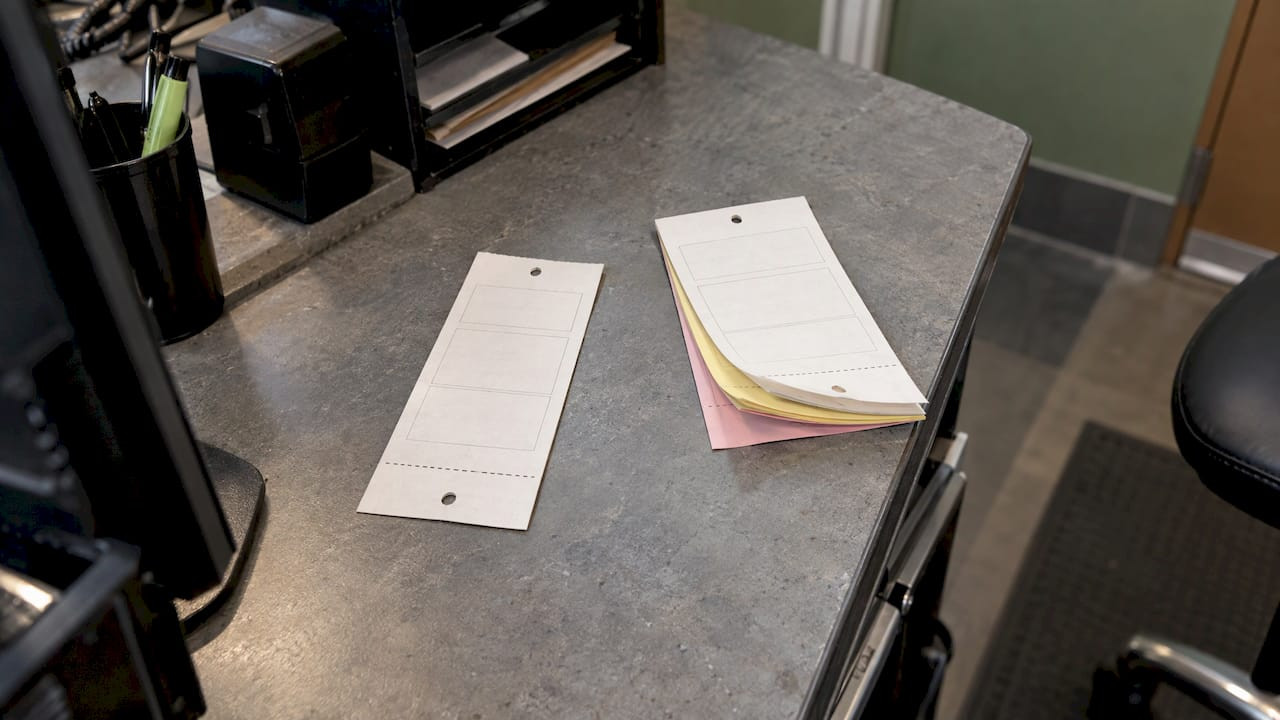
A single-part ticket gives you one piece of paper. A multipart ticket gives you two, three or four linked copies that are written in one pass, share one serial number and go to different places: the guest, the key board, the windshield, the file. For any operation where a vehicle, a coat, a bag or a payment has to be matched to a person later, multipart is the format that keeps the record in more than one place. Which part count fits depends on how many people or locations need to reference the same transaction.
This guide explains what each format does, how carbonless copies work, how two-, three- and four-part tickets differ in valet, garage, hotel, casino and event settings, and what to check on numbering, barcodes and equipment before you order.
TL;DR
- A single-part ticket is one record. A multipart ticket is a set of copies created at once, each with the same serial number, so the guest, the attendant and the file all hold matching evidence.
- Two-part covers a guest stub and a key tag. Three-part adds a dash or mirror copy. Four-part adds a file copy for vehicle condition at drop-off.
- Count the people or places that need a copy, then order that many parts and no more.
- Matching serial numbers on every part, sequential order and compatibility with your equipment matter as much as the part count.
- Caymil prints 2-, 3- and 4-part valet tickets, barcoded valet tickets and custom formats, in stock and custom versions.
Table of Contents
- What actually separates single-part from multipart
- How carbonless copies are made
- When one part is enough
- Two-, three- and four-part tickets compared
- Numbering is what makes the copies useful
- Barcodes, key tags and equipment compatibility
- What to include on the ticket itself
- Checklist before you order
- Putting the right ticket in your hands
- Our perspective on part counts
- FAQ
- Sources
What actually separates single-part from multipart
The difference is not thickness or quality. It is how many records exist after one transaction.
A single-part ticket is one sheet, stub or strip. It works when only one party needs to hold evidence: an admission ticket that is scanned and discarded, a parking permit hang tag, a receipt handed over at the exit lane, or a machine-issued ticket that the gate system reads and keeps in its own database. The record lives in a system, or nowhere at all.
A multipart ticket is a stack of sheets, usually separated by perforations, with each part carrying the same printed number. What is written on the top sheet appears on the ones below. Each copy is typically a different color so staff can tell at a glance which one goes where. Digital carbonless sets are commonly offered as 2-part (white and canary), 3-part (white, canary, pink) and 4-part (white, canary, pink, goldenrod), with variable numbering and barcoding available through digital printing.
The practical consequence is simple. With a single-part ticket, whoever holds the paper holds the only proof. With a multipart ticket, the guest, the attendant and the office each hold the same proof, and none of them can change theirs without the others noticing.

How carbonless copies are made
Most multipart tickets in parking and hospitality use carbonless paper, sometimes called NCR paper. There are no carbon sheets to slip between the layers. The back of the top sheet carries a coating of microscopic dye capsules, and the face of the sheet beneath carries a coating that reacts with the dye. Pressure from a pen or an impact printer breaks the capsules and leaves a mark on the sheet below.
Three coating types make up a set:
- CB (coated back): the top sheet.
- CFB (coated front and back): every middle sheet in a 3- or 4-part set.
- CF (coated front): the bottom sheet.
The order matters. Sheets pulled out of sequence will not produce a legible image, which is why pre-collated sets are the safer choice for busy podiums. Pressure matters as well: a ballpoint pen pressed firmly on a hard surface gives the clearest bottom copy, and a clipboard with a soft backing can weaken it.
The set only works when it is written on, not printed on heavy cardstock. Valet ticket guidance warns that printing in-house on heavy stock loses the multi-copy function and forces a separate log. For operators, that is the argument for buying tickets already manufactured as sets.
When one part is enough
Single-part tickets suit workflows where the ticket is a token and the data lives elsewhere:
- Gated garages with ticket dispensers. The entry ticket carries a time stamp or barcode, and the parking system holds the transaction. Machine-issued tickets in thermal or paper form are made for this, and they have to match the dispenser and reader.
- Event admission and coupons. One scan at the door, and the stub is done.
- Permits and decals. A hang tag or window decal identifies a vehicle, and no handoff happens.
- Validation tickets. A merchant hands one over, and the garage redeems it.
Even here, one rule applies. Pre-printed validation tickets carry inventory and reconciliation work, and without serialization fraud detection is nearly impossible. A single-part ticket is only as controllable as its numbering.
When a person hands over a vehicle, a coat, a bag or a key, the picture changes. Someone will come back and claim the item, and the operation needs a record that cannot be disputed by either side. That is where multipart tickets earn their place.
Two-, three- and four-part tickets compared
The right count is the number of people or locations that need to reference the same transaction.
| Format | Typical copies | Best fit | What it adds |
|---|---|---|---|
| 2-part | Guest stub, key tag | Small valet stands, coat check, luggage claim, bell desk | The minimum match between item and owner |
| 3-part | Guest stub, key tag, dash or mirror copy | Hotel, casino and restaurant valet, event valet | Vehicle number visible through the glass |
| 4-part | Guest stub, key tag, dash copy, file copy | Hospitals, luxury hotels, high-volume or high-value operations | A drop-off condition record kept on file |
Two-part: the minimum that works
A two-part ticket matches one half to the key or item and the other half to the guest. For coat check, luggage claim and bell desk, that is usually all that is needed. For valet it is the lean option for a small stand where the same attendant parks and retrieves the car. Caymil’s 2-part valet tickets are listed at $250.
Three-part: the valet standard
The three-part ticket is described by the H2H2H Foundation as the primary mode of service, control and audit for valet stacks. Each ticket is uniquely numbered on every portion. One part goes to the customer as proof of delivery and to match the correct keys. The locator part stays at the kiosk or with the keys on numbered hooks. The third part rides with the vehicle.

That third copy solves a real floor problem: a runner who finds a car in a lot can read its number through the windshield without walking back to the podium. Caymil’s 3-part valet tickets are listed at $35 to $250 depending on the option.
Four-part: adding a condition record
The fourth copy is a file copy. When the attendant marks the diagram and notes pre-existing damage at drop-off, that copy stays with the operation. If a guest calls back about a scratch, the operator holds a record written at the moment the car was received, and the guest holds a matching copy. Our damage claim ticket checklist walks through what to record on it.
For hotels, hospitals and casinos where claims are costly and reputations matter, that fourth part is a practical safeguard. Caymil’s 4-part valet tickets are listed at $42 to $48.
A simple way to decide
Write down every person or place that needs the information, then match the list to a part count:
- Does the guest need proof? That is one part.
- Does the key or item need an identifier? That is two.
- Does the car or bag need a visible tag? That is three.
- Does the office need a record of condition or payment? That is four.
Ordering more parts than the workflow uses adds cost and makes the stack harder to feed or write through. Ordering fewer leaves one party with no evidence.
Numbering is what makes the copies useful
A multipart ticket is only as reliable as its numbers. Stock valet tickets come numbered in runs, typically 000 to 999 within each thousand. The number on the guest stub, the key tag and the dash copy is the one the attendant uses to find the key on the board.
Three habits protect that system:
- Check that every part of a set carries the same serial number when you receive a print run. If the stub that stays with the attendant does not match the claim check the customer holds, reconciliation becomes worthless.
- Keep tickets in numeric order at the podium and pull them in sequence. Out-of-order tickets create gaps that make an audit impossible.
- Do not reuse tickets. Mark each one with the customer and car details so it cannot serve a second transaction.
For many operators numbering is also a compliance matter. New York’s parking tax rules, for example, require tickets to be consecutively numbered, with no number repeated in a calendar year unless it is distinguished by a letter, paper color or ink color. They also require the facility’s address and entry date and time on the parts. Rules differ by state and city, so confirm what your jurisdiction expects before you finalize a design. Our guides on valet ticket numbering and why sequential valet tickets matter cover the operational side.
Barcodes, key tags and equipment compatibility
Barcodes turn a multipart ticket into a faster one. Valet operators report that scanning a claim ticket can return the vehicle and key location instantly, which shortens retrieval and cuts errors from misread numbers. The same source describes the control that goes with it: attendants verify that the key tag number matches the claim ticket before releasing keys. Caymil’s barcoded valet tickets are listed at $42 to $48.
If your garage uses ticket dispensers or printers, compatibility comes first. Caymil makes tickets compatible with Amano, TIBA, SKIDATA, FLASH Parking, Scheidt & Bachmann and Flowbird systems, and carries machine-issued valet tickets and dispenser and spitter tickets alongside hand-written sets. Our key tag system guide explains how the key tag part ties into the board.
What to include on the ticket itself
Whatever the part count, the ticket should capture the details that settle a dispute. Typical valet fields include:
- Date and time of arrival, which establishes when the bailment began
- Vehicle make, model, color and year
- License plate as a backup identifier
- Key tag number cross-referenced to the ticket serial
- Parking location code
- Attendant initials, tying a staff member to each intake
These are the fields commonly listed for valet tickets. Add your terms and liability language where your counsel or insurer advises, and a damage diagram if you use a four-part set. Logos, custom colors and security features can be added on custom runs so the ticket is recognizably yours.
Checklist before you order
- List the copies needed. Guest, key, vehicle, file. That sets the part count.
- Confirm the paper is a collated carbonless set so the coatings run in the right order and the bottom copy stays readable at your volume.
- Choose numbering. Sequential, with a prefix or color change if your volume would repeat numbers within a year.
- Decide on barcodes if you scan at retrieval or reconcile electronically.
- Check equipment compatibility for dispensers, printers and readers.
- Plan storage and rotation. Keep unused boxes in order and issue in sequence.
- Estimate quantity by season. Peak events and holiday periods use far more tickets than an average week.
Our carbonless ticket printing guide covers proofing a custom run before it goes to press.
Putting the right ticket in your hands
Caymil has manufactured parking and valet tickets since 1937, and we keep stock tickets on hand for fast shipping across the United States, with custom runs available for logos, colors, numbering, barcodes and security features. If your stand is moving from a single-part or hand-built ticket to a set, start with the 3-part valet tickets for a full guest, key and dash record, or the 4-part tickets if you also want a file copy. For custom formats, coat check, permit decals and ribbons, the Caymil catalog has the full range.
Our perspective on part counts
Operators ask us whether they really need more than one part. Our answer comes from the way a valet stand works. The ticket is the only thing that connects a guest, a set of keys and a car, and a few minutes later three different people may need to refer to it.
We build multipart sets so that one writing pass produces every record, with matching numbers on each part. Nobody has to copy information by hand, and nobody has to trust memory. For most valet operations we see the three-part ticket as the foundation, and the four-part ticket as the right choice wherever a condition record at drop-off protects the operation, the guest and the brand.
Our specialty since 1937 is making these tickets durable, numbered in sequence and compatible with the systems operators already run. That focus is why we put as much care into the numbering and the paper as into the printed design.
Richard
FAQ
What is the difference between a single-part and a multipart ticket?
A single-part ticket is one sheet that holds the only record. A multipart ticket is a set of linked sheets, usually carbonless, that reproduce what is written on the top copy. Each part carries the same serial number and goes to a different person or place.
How many parts does a valet ticket need?
Two parts is the minimum: a guest stub and a key tag. Three parts adds a dash or mirror copy so the number is visible on the vehicle. Four parts adds a file copy that records vehicle condition at drop-off. Choose by the number of people or locations that need the record.
Do multipart tickets work with ticket dispensers and parking systems?
Hand-written multipart sets and machine-issued tickets are different products. Dispenser and spitter tickets must match your equipment’s size, stock and reader. Caymil makes tickets compatible with Amano, TIBA, SKIDATA, FLASH Parking, Scheidt & Bachmann and Flowbird systems.
Can I add barcodes and sequential numbers to a multipart ticket?
Yes. Numbering and barcodes can be printed on each part of a set so every copy matches. Caymil offers barcoded valet tickets and custom runs with sequential numbering, logos and security features.
Sources
- Jam-Free Digital Carbonless Paper | Nekoosa
- 3-Part Tickets for Parking Operations | H2H2H Foundation
- Parking Validation Systems: A Complete Guide | Parking Professional
- N.Y. Comp. Codes R. & Regs. Tit. 20 § 538.3 | Cornell Legal Information Institute
- Valet Key Management: Security Protocols & Best Practices | OpenDoor Valet
- Valet Ticket Template: Required Fields and Disclaimers | LegalClarity