
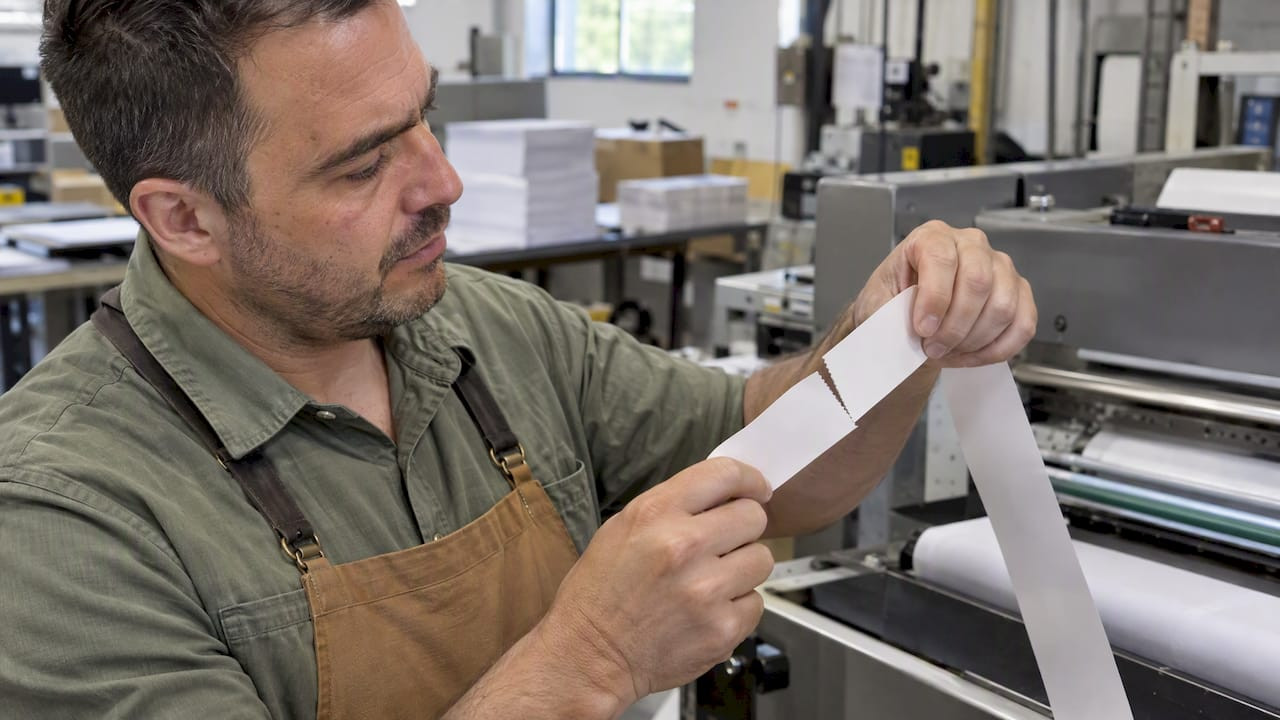
Ticket Perforation: Test 5:1 Before Printing Raffle Tickets

The simplest reliable way to get clean ticket tears is to match the perforation pattern to your exact stock and proof it before the run. Start at a 5:1 cut-to-bridge ratio, use ordinary perforation for cardstock and micro-perforation only for thin paper, then adjust TPI and stock from there. We have manufactured tickets for decades, and we never skip the proof.
TL;DR:
- Ordinary perforation tears harder as TPI rises from about 3 to 16, while microperforation tears easier as TPI rises from about 30 to 50.
- Use 5:1 as an easy tear starting point, 3:1 for general use, and 2:1 when the stub must stay attached longer; stock can change results.
- Choose single ply, chemically pulped wood card stock with a vellum finish for predictable fibers; laminated or coated stock needs a higher cut proportion.
- Test samples on the exact stock with normal, folded, and handled tears; adjust TPI first, the cut to bridge ratio next, and stock or finish last.
- For ragged tears, inspect the blade and align the grain with the perforation; for wandering lines, check cutter synchronization and feed tension.
Table of Contents
- What affects how a perforation tears?
- Ordinary perforation versus micro-perforation
- How should you choose cardstock, finishes, and laminates?
- Which tools and machine settings give a clean tear?
- How do you proof perforation before the full print run?
- How do you fix ragged, weak, or wandering tears?
- Why proof-first perforation is our standard practice
- Skip the trial and error with Caymil tickets
- FAQ
- Sources
What affects how a perforation tears?
Several things decide whether a stub comes off cleanly or arrives ragged. Control them one at a time and diagnosing a bad tear gets much easier.
- Pattern and TPI: Teeth per inch changes tear effort, and ordinary perforation and micro-perforation respond in opposite ways, as the next section explains.
- Cut-to-bridge ratio: This compares the length of each cut with each uncut bridge. A 3:1 pattern is general-purpose, 5:1 tears more easily, and 2:1 holds the stub on more securely.
- Stock: Paper weight, grain direction, coatings and lamination all change how the fibers separate. Laminated and synthetic tickets need their own specifications.
- Process: Press or platen pressure, rule or blade choice, and operator technique all leave their mark on the tear line.
No single setting rescues a poor combination. A tidy 5:1 pattern on a heavily coated stock can still tear badly, while the same pattern on plain, single-ply card may tear cleanly. That is why we treat every ratio and TPI figure in this article as a starting point, not a final answer. Change one variable per proof so you know what caused the improvement.
Ordinary perforation versus micro-perforation
Ordinary perforation uses larger cuts and fewer teeth per inch. Micro-perforation uses a fine row of tiny cuts, and the two behave in a way that surprises many buyers. According to Avery Dennison’s perforations technical bulletin, ordinary perforation from about 3–16 TPI tears harder as TPI rises, while micro-perforation around 30–50 TPI tears easier as TPI rises.
Ordinary perforation tears harder as TPI rises (about 3–16 TPI), while micro-perforation tears easier as TPI rises (about 30–50 TPI). More holes do not automatically mean an easier tear, so pick the family first and the number second.
The same bulletin gives practical guidance for ordinary perforation: 12–16 TPI is medium to very hard, 8 TPI is medium to easy, and 6 TPI or lower is very easy. For heavier ticket cardstock, that makes a lower TPI ordinary perforation a sensible first proof when you want a quick, clean tear. For thin paper, a micro-perforation in the 30–50 TPI band is the better place to start.
Treat these ranges as a starting point only. Coating, grain, rule type and press all shift the result, and the bulletin itself names paper weight, press, rule selection and operator experience as variables. If a spec that looks right on paper tears badly in your hands, the stock is usually the reason, not your arithmetic.

How should you choose cardstock, finishes, and laminates?
Pick the stock before you lock the perforation, because the stock sets the limits. According to Lexmark’s card stock guidance, fiber and grain direction, moisture, thickness, texture and finish all affect printing and perforation. It recommends single-ply, chemically pulped wood card stock with a vellum finish as a general-purpose choice. Our own guide to ticket paper stock and what really lasts goes deeper on durability.
Check these points before ordering a large quantity:
- Choose single-ply, chemically pulped wood card stock when you want predictable fiber behavior.
- Run the grain parallel to the perforation line when the layout allows it.
- Confirm the stock runs cleanly through your printer before you commit.
- Expect laminated or coated stock to need a higher cut proportion and a physical proof.
Laminates and coatings add a layer that resists tearing, so the cut has to do more of the work. The Technifold guide to micro-perforation advises a higher cut proportion and physical proofs for thicker or laminated stock.
Pro Tip: Ask your supplier for a proof on the exact stock and finish, not a similar one. A near match is how most easy-tear surprises happen.
Which tools and machine settings give a clean tear?
Production shops generally choose between rotary perforators, platen presses with perforating rules, and desktop or maker tools with perforation blades. Rotary units suit long continuous runs, platen setups suit shorter jobs with tight registration, and maker blades are fine for small raffle batches. Each can produce a good tear when the settings match the stock.
For a maker-style starting point, use a short cut and skip pattern, then proof it on the stock. Treat it as a first proof to tune, not a rule.
- Set the pattern: Start from your stock-matched TPI or cut-to-bridge ratio, such as 5:1 for an easy tear.
- Check the blade: Use a sharp blade or rule, since a dull edge crushes fibers instead of cutting them.
- Control feed and tension: Uneven tension makes the perforation drift off the intended line.
- Synchronize the cutter: The knives must stay in step with the feed, which the ticket-making apparatus filing from TREA describes, noting that perforation strength depends on TPI and folding.
- Match across sections: On continuous or fanfold tickets, keep perforation strength consistent with any existing pre-folds.
Fanfold and roll formats behave differently under tension, so our post on fanfold versus roll tickets is worth a read before you pick a format.
How do you proof perforation before the full print run?
A proof is the cheapest insurance in the whole process. Make or order samples on the exact stock, each with your chosen perforation spec, so you can compare them side by side and rule out a one-off fluke.
- Tear one sample normally, one after folding, and one after light handling in a pocket or bag.
- Log the result of every test next to the settings that produced it.
- If the results disappoint, adjust in order: TPI first, then cut-to-bridge ratio, then stock or finish.
- Keep a record of the settings that worked so the next run starts from known ground.
| Test | What to look for | What it tells you |
|---|---|---|
| Normal tear | Clean, straight separation | Whether the base spec works |
| Folded tear | Stub holds until you pull | Whether folding weakens it too much |
| Handled tear | Stub stays attached in a pocket | Whether it is too easy to separate |
Changing one variable at a time matters more than speed. If you change TPI and stock together, you will not know which change fixed the problem. Our post on parking ticket printing costs shows how a stock change shifts your unit price, which is worth knowing before you adjust.
How do you fix ragged, weak, or wandering tears?
Most tear problems fall into three patterns, and each has a short fix.
- Ragged or jagged tear: Inspect the blade for wear, lower the TPI or lengthen the cut, and align the grain with the perforation line.
- Stub separates too easily: Lengthen the bridge by moving from 5:1 toward 3:1 or 2:1, or switch to heavier stock.
- Tear wanders off the line: Check cutter synchronization and tension, and keep the perforation away from the sheet edge. Steel Rule’s technical paper on synthetic ticket materials notes that perforating too close to an edge can cause easy tears and that ink, heat and tension must be managed on synthetics.
When one fix does not work, go back to the proof log and change a single variable again.
Why proof-first perforation is our standard practice
We have printed tickets for decades, and the lesson has not changed: a matched perforation spec plus a proof beats guesswork every time. If you run events, order samples early and share your intended machine specs with your supplier so the tear is tuned to the equipment that will actually handle the tickets. A tear that works on a desk sample can fail on a dispenser, and it is cheaper to find that out before the run than after.
— Richard
Skip the trial and error with Caymil tickets
If you would rather not tune perforation in-house, we supply machine-issued and pre-perforated tickets, and we can match perforation specs to your target stock and machinery. Our team provides proofs so you can tear-test before committing to a full run. Our machine-issued valet tickets are built for production equipment, and you can contact us for samples and a spec matched to your setup.
FAQ
What cut-to-bridge ratio tears easiest on tickets?
A 5:1 ratio is a common easy-tear starting point for tickets and coupons, while 3:1 is general-purpose and 2:1 keeps the stub more secure, per Technifold’s die-cut guidance. Treat it as a first proof, since stock and coating change the result.
Does a higher TPI always make a ticket easier to tear?
No. In ordinary perforation, a higher TPI generally makes tearing harder, while in micro-perforation a higher TPI makes it easier. Choose the perforation family for your stock first, then tune the TPI.
Why does my ticket stub tear off too easily?
The bridge is probably too short for the stock. Lengthen it by moving from a 5:1 toward a 3:1 or 2:1 ratio, or use heavier stock, then proof again.
Do I really need to proof tickets before a full run?
Yes. Sample proofs on your exact stock reveal tear problems before you pay for thousands of tickets. Test a normal tear, a folded tear and a tear after light handling.