
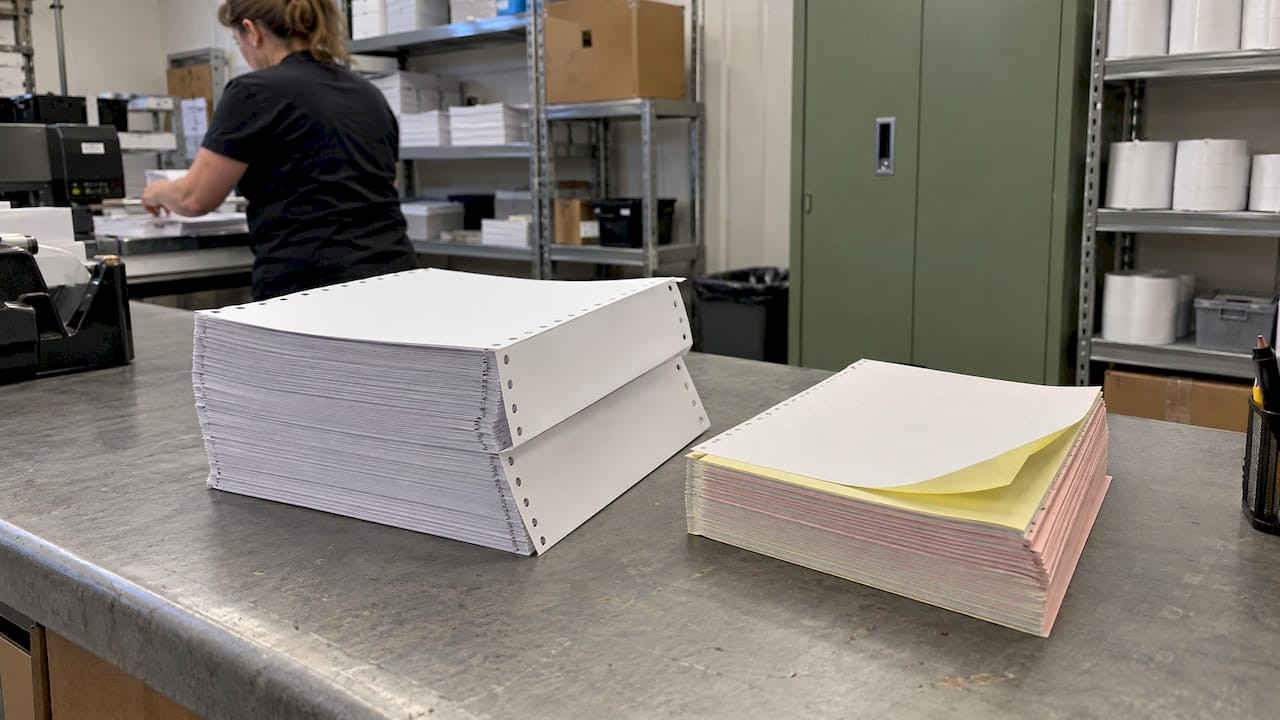
Casino Ticket Paper Options: Choosing the Right Stock

Casino ticket paper falls into three groups: thermal stock for slot machine TITO (ticket in, ticket out) printers, multi-part carbonless sets for the manual tickets that run the rest of the property, and single-part stock for claim checks and receipts. Each has a different job, and the right choice depends on what the ticket must survive, which printer or system reads it, and how long it has to stay legible. Caymil has manufactured custom and stock tickets for casinos, hotels and parking operators since 1937, and the guidance below is how we would sort the options for a casino or resort operator.
TL;DR
- Slot cash-out tickets run on thermal paper cut to the printer maker’s size and thickness. Using the wrong stock can damage the printer and affect the warranty.
- Valet, bell desk, coat check and luggage claim tickets are better served by numbered, multi-part carbonless sets or sturdy single-part stock.
- Match paper to the device before you match it to the price: width, thickness, fanfold or roll format, and feed method.
- Security features such as sequential numbering, barcodes, logos and custom colors belong on the ticket from the first print run.
- Storage and handling affect thermal prints as much as the paper grade does.
Table of Contents
- Start with the job the ticket has to do
- Paper for slot machine TITO tickets
- Why paper quality matters inside the printer
- Multi-part carbonless tickets for desks and doors
- Single-part and stock options
- Thermal versus carbonless: how to choose
- Security features worth specifying
- Size and format
- A printer-match checklist before you order
- What Caymil offers casino and hotel operations
- Our view
- FAQ
- Sources
Start with the job the ticket has to do
A casino property uses tickets in at least three very different ways, and the paper that suits one rarely suits another.
- Machine-issued cash-out tickets. A slot machine’s printer produces a ticket with a barcode that another machine or cashier scans. The ticket is printed in seconds, handled by guests, and redeemed through a validation system.
- Hand-issued claim tickets. Valet, coat check, luggage claim and bell desk tickets are written or stamped at a desk, split into stubs, and matched later. They need a unique number on every part and a surface that takes pen or marker.
- Receipts and validations. Parking receipts, validation tickets and coupon books are issued in volume and need clean printing and consistent sizes.
The first group is dictated by printer hardware. The second and third are where an operator has real choice, and where paper decisions show up in lost-ticket disputes, line speed and audit trails.
Paper for slot machine TITO tickets
TITO tickets are almost always thermal. The printer applies heat to coated paper, so there is no ink or ribbon to refill and the print head does the work. Printer manufacturers specify the stock closely. One widely used gaming printer, the FutureLogic GEN2, calls for 65 mm by 156 mm tickets, nominal thickness of 4.5 mil, supplied as fanfold stacks of 300, 600 or 900. The same manual warns that improper paper may damage the device and void its warranty.
That warning is the main point for buyers. TITO paper is not a commodity where any thermal roll will do. Other printer families ship with their own tray sizes: the Nanoptix PayCheck 4, for example, lists ticket tray capacities of 200 (the default), 400, 600 and 800 notes and prints at 203 dots per inch. Those numbers differ from the GEN2, which is why a purchase order should name the printer model, not just “TITO tickets.”
Things to confirm before you order TITO stock:
- Width and length. The ticket must clear the feed path and the bezel without drag.
- Thickness. Too thin and tickets jam or crease; too thick and they stall in the transport.
- Fanfold or roll. TITO printers are generally fed with fanfold stacks, with perforations and notches the printer senses. Our note on fanfold versus roll tickets explains how a format mismatch costs operators a whole order.
- Sensor marks and notches. If the printer reads them, the stock must carry them in the right place.
- Coating. The thermal layer should be matched to the print head and the expected shelf life.
Your slot system supplier or the printer’s manufacturer is the right contact for the approved stock specification, because gaming regulators and validation systems work from that specification.
Why paper quality matters inside the printer
Paper that is the wrong grade does its damage quietly. Dust, edge debris and inconsistent thickness collect on print heads and sensors, and the symptoms are faint barcodes, intermittent jams and rising service calls. A well-made thermal stock keeps its flatness in the stack, cuts cleanly at the perforation and holds a consistent caliper from the first ticket to the last.
The broader principle applies to any printed product: paper choice affects print quality and reliability, and the cost of a poor choice is usually paid later, in reprints and downtime, not at the purchase order.
Multi-part carbonless tickets for desks and doors
Where a person issues the ticket, carbonless paper is the workhorse. Multi-part sets reproduce what is written on the top sheet onto the copies underneath without carbon sheets, so the guest keeps one part, the item or vehicle gets another, and the office retains the last. Caymil makes 2-part, 3-part and 4-part tickets, plus barcoded valet tickets, and the same construction is used for bell desk, luggage claim and coat check formats.
How many parts you need follows from how many places the ticket must be recorded:
| Parts | Typical use at a casino or hotel | Who keeps what |
|---|---|---|
| 2-part | Coat check, simple claim tickets | Guest stub and item stub |
| 3-part | Valet and bell desk | Guest, vehicle or luggage, office record |
| 4-part | Valet with key tag or cashier reconciliation | Guest, vehicle, key, office |
| Single-part | Receipts, validations, coupons | Issued once and collected or scanned |
Caymil lists the 4-Part Valet Tickets and Barcoded Valet Tickets at $42 to $48, and 3-Part Valet Tickets at $35 to $250, depending on the product configuration. The product pages show current options.
The numbering is what makes carbonless tickets auditable. Sequential numbers on every part let a manager account for each ticket issued, and a missing number is an immediate flag. Barcodes add a second path: a scanner at the cashier or valet stand can pull up a record instead of relying on a handwritten number.
Single-part and stock options
Not every ticket needs copies. Coat check tickets, parking receipts and coupon books are often single-part, printed on a heavier stock that handles being tucked into a pocket, a wallet or a coat sleeve. For these, durability and clear numbering matter more than the number of copies. Caymil carries coat check tickets, including a 1,000-count format in 1-5/8 by 5-1/4, and stock designs can be ordered quickly when a custom run is not worth the lead time.
Stock versus custom is a straightforward trade. Stock tickets ship fast and suit a property that needs numbered tickets now. Custom tickets carry your logo, colors, barcode and security features, and they make sense for any ticket a guest sees on the way in or out, where the brand and the control features both count.

Thermal versus carbonless: how to choose
Operators sometimes weigh thermal against carbonless as if one must win. In practice they serve different points on the property.
Choose thermal when a machine must print the ticket: slot printers, kiosks, parking dispensers and machine-issued valet tickets. Speed and consistency come from the device, and the paper has to be right for it.

Choose carbonless when a person writes the ticket and several parties need a copy. There is no printer to maintain, no power requirement and no dependence on a device being online.
If you run thermal at any point, plan for how it ages. Thermal prints react to heat, light and moisture, and our pieces on thermal ticket printing in the field, moisture and ticket paper and thermal ticket fading cover what to store where. Garage entries, porte-cocheres and outdoor valet stands are the places where a thermal ticket is most exposed, and cold weather has its own effects on print sharpness.
Security features worth specifying
A casino ticket is a stand-in for value or custody, so it gets the same attention to tamper resistance as anything else on the floor. The features operators commonly ask for on printed tickets include:
- Sequential numbering on every part, so each ticket can be accounted for.
- Barcodes that link the ticket to a record at the point of redemption or return.
- Logos and custom colors that make a counterfeit or a ticket from another property stand out.
- Security features built into the print, available on Caymil custom orders.
- Multi-part carbonless formats that leave a matching record with the office.
In the slot environment, the validation system tracks each voucher, so the controls sit largely in software and in the printer’s approved stock. On the hand-issued side, the paper itself is the control, and that is where specifying numbering, color and barcode up front pays off.
Size and format
The common question “what size is a ticket?” has no single answer. Slot TITO tickets follow the printer, as the 65 mm by 156 mm GEN2 specification above shows. Hand-issued tickets follow the way they are used: a coat check stub is small enough for a pocket, while a valet ticket with a hang tag or key section is longer. Parking and valet systems add their own constraints. If your property runs automated parking equipment alongside the casino, check specs such as those in our TIBA ticket quick reference, and compare materials in the parking ticket material options guide. For a general view of stock and roll choices, see parking ticket paper options.
A printer-match checklist before you order
Use this when buying any ticket stock for a device:
- Write down the device model and generation. Different generations of the same printer can take different stock.
- Get the stock specification from the device maker or system supplier. Width, length, thickness, notch or mark position, and fanfold or roll.
- Confirm the feed method. Stack, roll, tray or hopper, and the capacity in tickets.
- Confirm the data the ticket must carry. Property name, amount or identifier, date and time, barcode and any required terms, as set by your system and jurisdiction.
- Order a small run first for a new format and run it through a few devices before a full order.
- Record the part number and lot so reorders match what worked.
Caymil’s products are compatible with major parking systems including Amano, TIBA, SKIDATA, FLASH Parking, Scheidt & Bachmann and Flowbird, which covers the garage and valet side of a resort. If your property also issues machine-printed tickets from a spitter or dispenser, see our machine-issued valet tickets and dispenser and spitter tickets.
What Caymil offers casino and hotel operations
For the tickets around the gaming floor, the valet stand, the bell desk and the coat room, we manufacture stock and custom tickets with sequential numbering, barcoding, logos, custom colors, security features and multi-part carbonless formats, with millions of tickets in stock and fast nationwide shipping. Valet and claim tickets are sold through the Caymil shop, and ticket racks, including a 50-pocket steel rack at a compact 5-1/8" by 26-1/4", keep issued tickets organized at the stand.
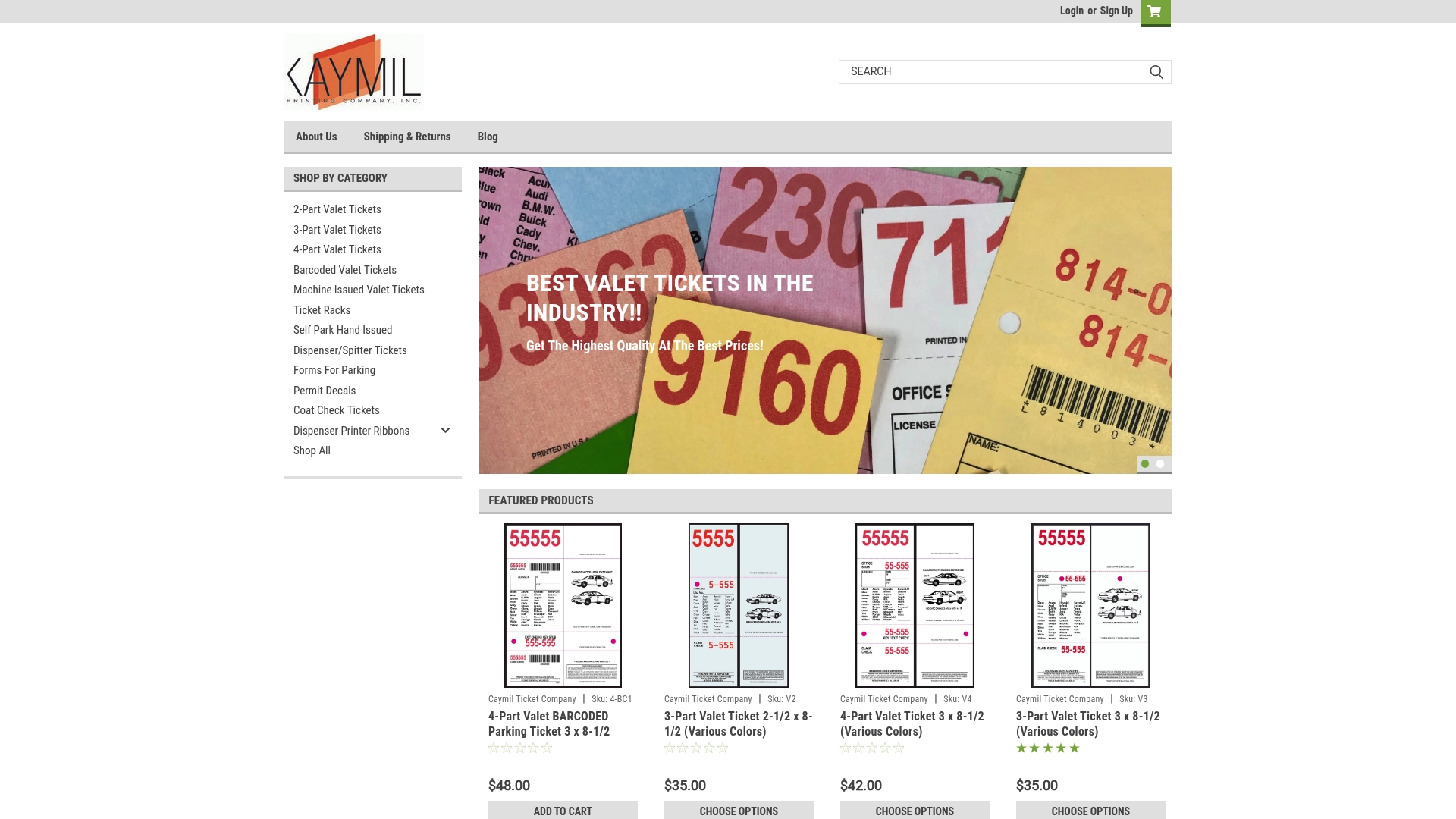
If you are standardizing tickets across a property, start with the product that handles the most volume, usually valet or coat check, and extend the same numbering and branding to the rest.
Our view
Most paper problems we hear about are not paper problems. They are specification problems: a ticket ordered by name instead of by device, or a format picked for price and then asked to do a job it was not built for.
At Caymil we have made tickets since 1937, and the pattern is consistent. The operations that run smoothly decide what the ticket has to do first, whether that is split into stubs, survive a rainy valet stand, or feed through a high-speed machine. Then they choose the paper.
That is why we build around numbering, barcoding, durable printing and carbonless copies, and why we offer both stock and fully custom tickets. A casino or hotel should not have to compromise between control and guest experience. A clean, numbered, branded ticket gives you both.
Richard
FAQ
What paper is used for casino slot machine tickets?
Slot machine TITO tickets are printed on thermal paper cut to the printer maker’s specification. That includes width, length, thickness and the fanfold or roll format the device expects. Ask your slot system supplier for the approved stock for your printer model.
What paper is best for valet and coat check tickets at a casino?
Numbered multi-part carbonless sets suit valet and bell desk tickets, because every part carries the same number and the office keeps a copy. Coat check tickets work well as 2-part or single-part stock, depending on whether you want a record at the desk.
Can I use stock tickets, or do I need custom?
Stock tickets ship quickly and work for any property that needs numbered tickets now. Custom tickets add your logo, colors, barcode and security features, which matters most on tickets guests see and on any ticket that must be told apart from another property’s.
How do I make sure ticket paper fits my equipment?
Get the device model, then the maker’s stock specification: size, thickness, format and feed method. Order a small run and test it on several units before you commit to a full order.