
Guest Experience Parking Touchpoints: Operator’s Guide
The top guest experience parking touchpoints to optimize are pre-arrival communications, arrival and curb design, wayfinding and Parking Guidance Systems (PGS), payment and touchless retrieval, accessibility and safety, staff protocols, and ticketing and validation. Fix these in order and you address the full arc of how parking shapes guest perception, from the moment a confirmation email lands in their inbox to the moment they drive away.
Three things to do this week:
-
Add parking instructions, gate codes, and valet vs. self-park guidance to every booking confirmation and pre-arrival message.
-
Walk your facility as a first-time, tired guest and photograph every sign gap, lighting failure, and unclear turn.
-
Pull your current average Time-to-Park from PGS analytics or front-desk feedback logs and set it as your baseline.
The single metric to watch first: Time-to-Park. It captures wayfinding quality, signage clarity, and PGS performance in one number, and it correlates directly with guest anxiety and review sentiment. Quick wins live in pre-arrival messaging, temporary directional signage, and staff positioning at peak arrival windows.
Table of Contents
- Why parking shapes guest reviews and revenue more than operators expect
- How pre-arrival messaging reduces parking anxiety before guests leave home
- What makes the arrival curb experience work for guests and staff
- How Parking Guidance Systems reduce Time-to-Park and where to spend first
- Accessibility, lighting, and safety as baseline guest expectations
- KPIs and ROI: what to measure after you make changes
- How Caymil ticketing supplies support every parking touchpoint
- Key Takeaways
- The operator blind spots suppliers see most often
- Caymil parking and valet supplies for operators ready to upgrade
- Further reading and source links
- FAQ
Why parking shapes guest reviews and revenue more than operators expect
Parking is the first and last physical touchpoint in almost every guest visit. A guest who circles a garage for eight minutes before a dinner reservation arrives at your front desk already frustrated, and that frustration colors every interaction that follows. Conversely, a smooth exit after a great stay reinforces the entire experience. As WA Hospitality notes, a confusing parking experience can overshadow other positive guest experiences and surfaces directly in online reviews and repeat-booking decisions.
The business case is concrete. Operators who treat parking as a revenue and reputation lever, rather than a logistics afterthought, report fewer front-desk calls about directions and gate issues, higher Net Promoter Scores, and captured revenue from validation programs and paid parking that previously leaked through untracked exits. Parking & Mobility Magazine recommends integrating parking details directly into CRM and booking workflows so guests feel considered from the moment they leave home, not just when they walk through your door.
Pro Tip: Run a quick text search of your last 50 guest reviews for the words “parking,” “garage,” and “lot.” The frequency and sentiment of those mentions will tell you more about your parking experience than any internal audit.
How pre-arrival messaging reduces parking anxiety before guests leave home
The guest parking experience begins well before arrival. According to Parking Today, 73.5% of drivers find parking stressful, and that anxiety starts building the moment a confirmation email arrives without clear parking instructions. Operators who close this gap see measurable reductions in anticipatory stress and fewer calls to the front desk on arrival day.
Every booking confirmation and pre-arrival message should include:
- Specific parking address or garage entrance coordinates (not just the property address).
- Valet vs. self-park options with pricing, hours, and how to access each.
- Gate codes, app links, or pre-registration steps for touchless entry.
- Estimated walk time from the parking structure to the main entrance.
- A visual map or link to real-time availability where the system supports it.
- A direct contact number or text line for parking questions.
For hotel and venue operators integrating valet, include a note on luggage assistance so guests with heavy bags know what to expect at the curb.
Pro Tip: A/B test two versions of your pre-arrival parking message: one with a static map image and one with a Google Maps deep link. Track which version generates fewer “where do I park?” calls in the 24 hours before arrival.
What makes the arrival curb experience work for guests and staff
The curb is where pre-arrival promises meet physical reality. Valet parking, when managed well, raises perceived service level and creates the kind of first impression that guests mention in reviews. The decision between valet and self-park comes down to three factors: property positioning, peak-hour staffing capacity, and the physical layout of your entrance.
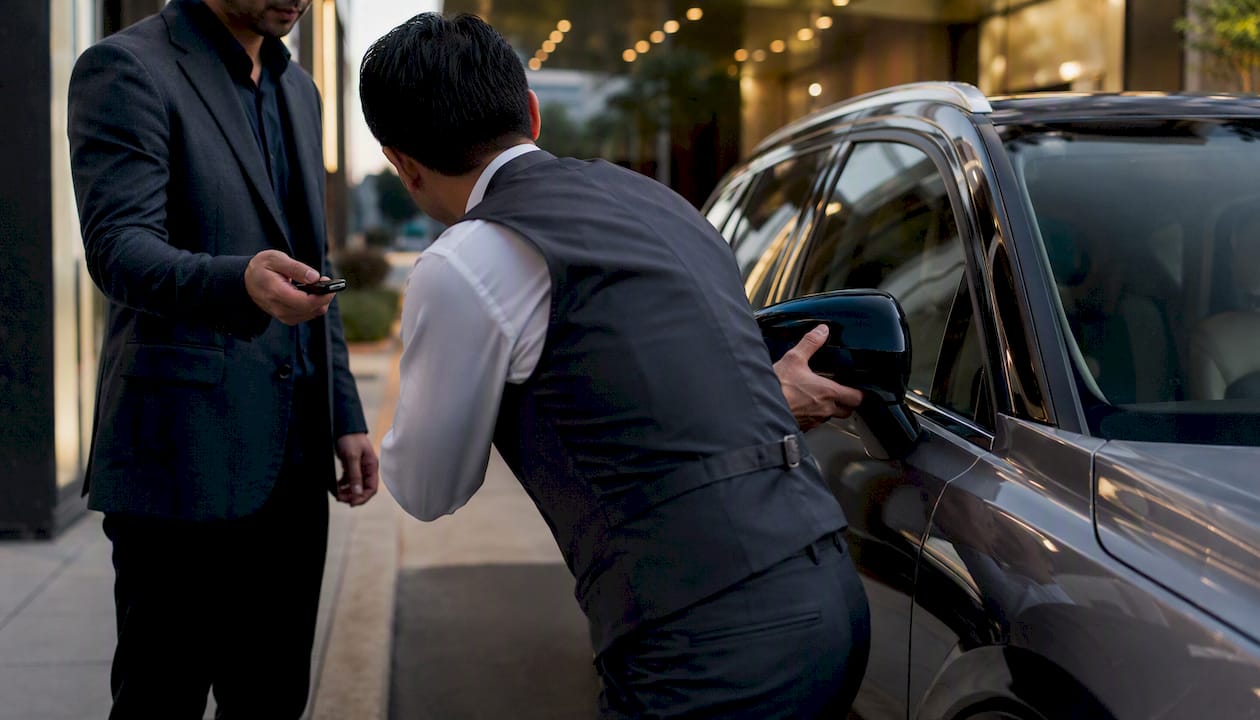
Valet is the right call when your property targets guests who expect white-glove service, when your self-park structure is more than a short walk from the entrance, or when peak arrivals create a congestion problem that attendants can resolve faster than signage alone. Self-park works well for extended-stay properties, budget segments, and facilities where guests prefer control over their vehicle.
Operational standards that matter at the curb:
- Clear, illuminated signage distinguishing valet drop-off from self-park entry before guests commit to a lane.
- A staffed position at the curb during every peak arrival window, not just when it gets busy.
- Luggage assistance offered proactively, not reactively.
- A defined process for guests who arrive with mobility aids or oversized vehicles.
Pro Tip: Train attendants on two specific edge cases: what to do when the LPR camera fails to read a plate, and what to say when the valet queue backs up past the entrance. A confident, scripted response in both situations prevents a tech or staffing problem from becoming a guest complaint.
For deeper guidance on upscale valet operational standards, the protocols around attendant positioning and vehicle handoff are worth reviewing before your next peak season.
How Parking Guidance Systems reduce Time-to-Park and where to spend first
A PGS directly addresses the most measurable guest friction point in self-park facilities. Park Assist’s documented deployments produced average Time-to-Park reductions of about one-third across facilities, with some high-turnover short-term levels achieving substantial reductions. Disabled-bay search time dropped significantly in one documented use case, which has direct implications for ADA compliance and guest satisfaction among mobility-impaired visitors.
The features that drive those results are real-time occupancy displays at garage entrances, level-by-level availability indicators, per-aisle sensor pilot lights, and dynamic routing signs that update as spaces fill. Guests make faster decisions when they can see availability before they commit to a level, rather than discovering a full floor after they have already driven up two ramps.
| KPI | Baseline (no PGS) | With PGS (Park Assist documented) |
|---|---|---|
| Average Time-to-Park | Facility-dependent | 33–36% reduction |
| Short-term level Time-to-Park | Facility-dependent | Up to 50% reduction |
| Disabled-bay search time | Facility-dependent | significant reduction |
PGS investment is highest-ROI in high-turnover short-term lots, event-peak facilities, and any garage where guests regularly contact the front desk about finding a space. For operators not yet ready for a full PGS rollout, interim fixes include floor-level availability signs updated manually by staff, color-coded level markers on elevator lobbies, and temporary directional cones during peak events. These cost almost nothing and reduce Time-to-Park meaningfully while a PGS procurement is in progress.
Accessibility, lighting, and safety as baseline guest expectations
ADA compliance is a legal floor, not a differentiator. Guests with mobility impairments notice immediately when accessible bays are blocked, poorly marked, or located far from accessible building entrances. The significant reduction in disabled-bay search time documented in Park Assist’s PGS case study reflects how much friction currently exists in facilities without guidance systems, and it is a gap that affects a meaningful share of your guests.
Operational checklist for accessibility and safety:
- Accessible bays clearly marked with ADA signage at eye level and on the pavement, with enforcement protocols to prevent non-compliant parking.
- Continuous, well-lit pedestrian routes from every parking level to the main entrance, with no dark segments between dusk and dawn.
- CCTV coverage of all pedestrian routes and stairwells, with visible camera housings that signal surveillance to guests.
- Staff patrol routes that include parking levels, especially during evening events.
- Accessible routes free of temporary signage, equipment, or seasonal decorations that narrow the path.
Pro Tip: Walk your facility after dark, alone, as a first-time visitor. The lighting gaps and signage failures that are invisible during a daytime management walkthrough become obvious under realistic conditions. This is the audit that actually finds the problems.
KPIs and ROI: what to measure after you make changes
Parking improvements are easy to justify when you can show the numbers. The priority KPI stack for operators is: Time-to-Park, occupancy by user type (valet vs. self-park vs. validated), revenue capture rate, valet retrieval time, and guest feedback scores from post-stay surveys and review platforms.
| KPI | Why it matters | Target after a small intervention |
|---|---|---|
| Time-to-Park | Directly measures wayfinding and PGS effectiveness | about one-third reduction |
| Revenue capture rate | Identifies payment leakage at exit | Increase toward all parked vehicles |
| Valet retrieval time | Reflects staff efficiency and ticketing accuracy | Under 5 minutes at peak |
| Validated parking transactions | Measures program uptake and front-desk workload | Increase month-over-month |
| Parking mentions in reviews | Tracks reputation impact | Shift from negative to neutral/positive |
Collect these metrics through LPR logs, PGS analytics dashboards, front-desk validation counts, and post-stay survey questions that specifically ask about parking. A monthly reporting cadence is sufficient for most properties; event-heavy venues benefit from per-event snapshots.
“A confusing parking experience can overshadow other positive guest experiences.” — WA Hospitality
How Caymil ticketing supplies support every parking touchpoint
Quality ticketing is the operational backbone of valet and self-park programs. When a guest hands a ticket to a valet attendant, that ticket is the only physical record linking their vehicle to their stay. A ticket that fades, tears, or lacks a unique identifier creates retrieval delays, disputes, and the kind of exit experience that ends up in a review.
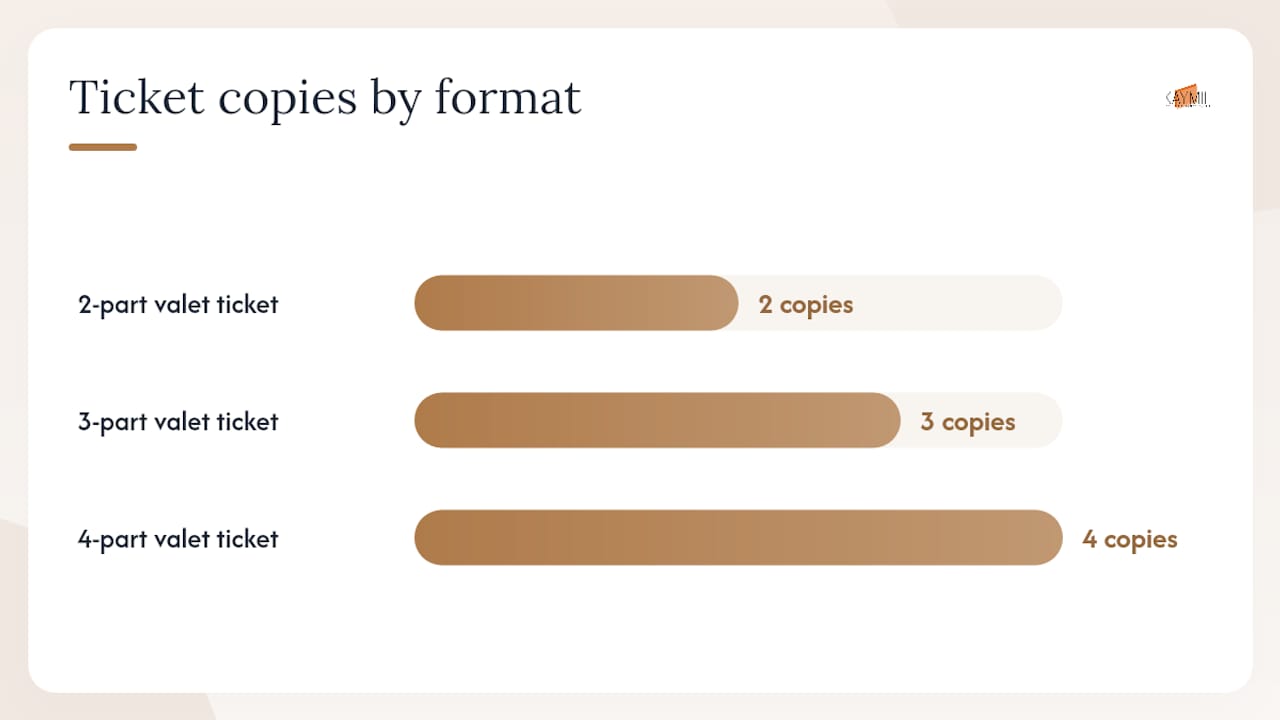
Caymil’s ticketing products address this directly. Sequential numbering eliminates duplicate claims. Barcodes enable scan-based retrieval that integrates with PGS and LPR workflows. Multi-part carbonless formats give operators an operator copy, a guest copy, and an accounting stub for reconciliation, without requiring a printer at the curb. Barcode tickets specifically reduce reconciliation time and support audit trails that manual systems cannot match.
Caymil’s products are compatible with major parking systems including Amano, TIBA, SKIDATA, FlashParking, Scheidt & Bachmann, and Flowbird. This means operators upgrading to a new PMS or LPR system do not need to replace their ticketing supply chain; Caymil’s formats are already tested against the systems most operators run.
| Ticket format | Best for | Key feature |
|---|---|---|
| 2-part valet ticket | Standard valet operations | Guest copy + operator copy |
| 3-part valet ticket | Operations needing accounting reconciliation | Adds accounting stub |
| 4-part valet ticket | Multi-department properties (hotel, casino, event) | Four copies for complex record-keeping |
| Machine-issued (spitter) ticket | High-volume self-park with kiosk dispensers | Compatible with Amano, TIBA, SKIDATA, Flowbird |
| Barcoded valet ticket | LPR-integrated or scan-based retrieval | Barcode for scan-out and PGS integration |
Caymil has manufactured parking and valet ticketing supplies since 1937, serving hotels, casinos, hospitals, municipalities, and event venues across the United States. That depth of experience in parking system compatibility means operators get supplies that work with their existing equipment, not against it.
Key Takeaways
Parking is the first and last guest touchpoint, and operators who treat it as a revenue and reputation lever, not a logistics afterthought, consistently see measurable gains in Time-to-Park, review sentiment, and revenue capture.
| Point | Details |
|---|---|
| Start with pre-arrival messaging | Add parking instructions to every booking confirmation to reduce guest anxiety before arrival. |
| Track Time-to-Park first | Park Assist PGS deployments document about one-third average reductions; use this as your baseline KPI. |
| Fix low-effort items this quarter | Sequential numbering, barcoded tickets, staff training, and signage audits require no capital investment. |
| Integrate payment with PMS | ANPR and validation integration automates guest treatment and reduces front-desk workload. |
| Caymil for ticketing supply | Caymil’s multi-part, barcoded, and machine-issued formats are compatible with Amano, TIBA, SKIDATA, FlashParking, Scheidt & Bachmann, and Flowbird systems. |
The operator blind spots suppliers see most often
The most common gap in parking operations is not technology. It is the assumption that because management knows where to park, guests do too. Operators who have worked at a property for years stop seeing the signage failures that are obvious to a first-time visitor arriving after dark with luggage and a phone with 12% battery.
The second blind spot is untested communications. A pre-arrival email that was written two years ago and never updated may still reference a gate code that changed, a valet entrance that moved, or a parking app that was discontinued. Suppliers who work across dozens of properties see this repeatedly: the communication exists, but no one has tested it as a guest in years.
The third is staff training for edge cases. Lodging Magazine’s coverage makes the point directly: when automated systems fail, the human response is the critical touchpoint. Operators who train attendants on LPR failure workflows, gate malfunction scripts, and overflow routing protocols turn a potential complaint into a demonstration of service quality.
For procurement teams evaluating ticketing or equipment changes, a short checklist worth running before any purchase: confirm format compatibility with your current parking system, verify that sequential numbering and barcoding are standard (not add-ons), and test a sample batch under your actual operating conditions before committing to a full order.
Caymil parking and valet supplies for operators ready to upgrade
Operators who have identified ticketing gaps, retrieval delays, or reconciliation problems have a direct path to fixing them. Caymil manufactures 2-part valet parking tickets, 3-part valet parking tickets, and machine-issued formats compatible with the major parking systems most U.S. operators already run. Every format is available with sequential numbering, barcoding, custom logos, and security features that reduce fraud and speed reconciliation.
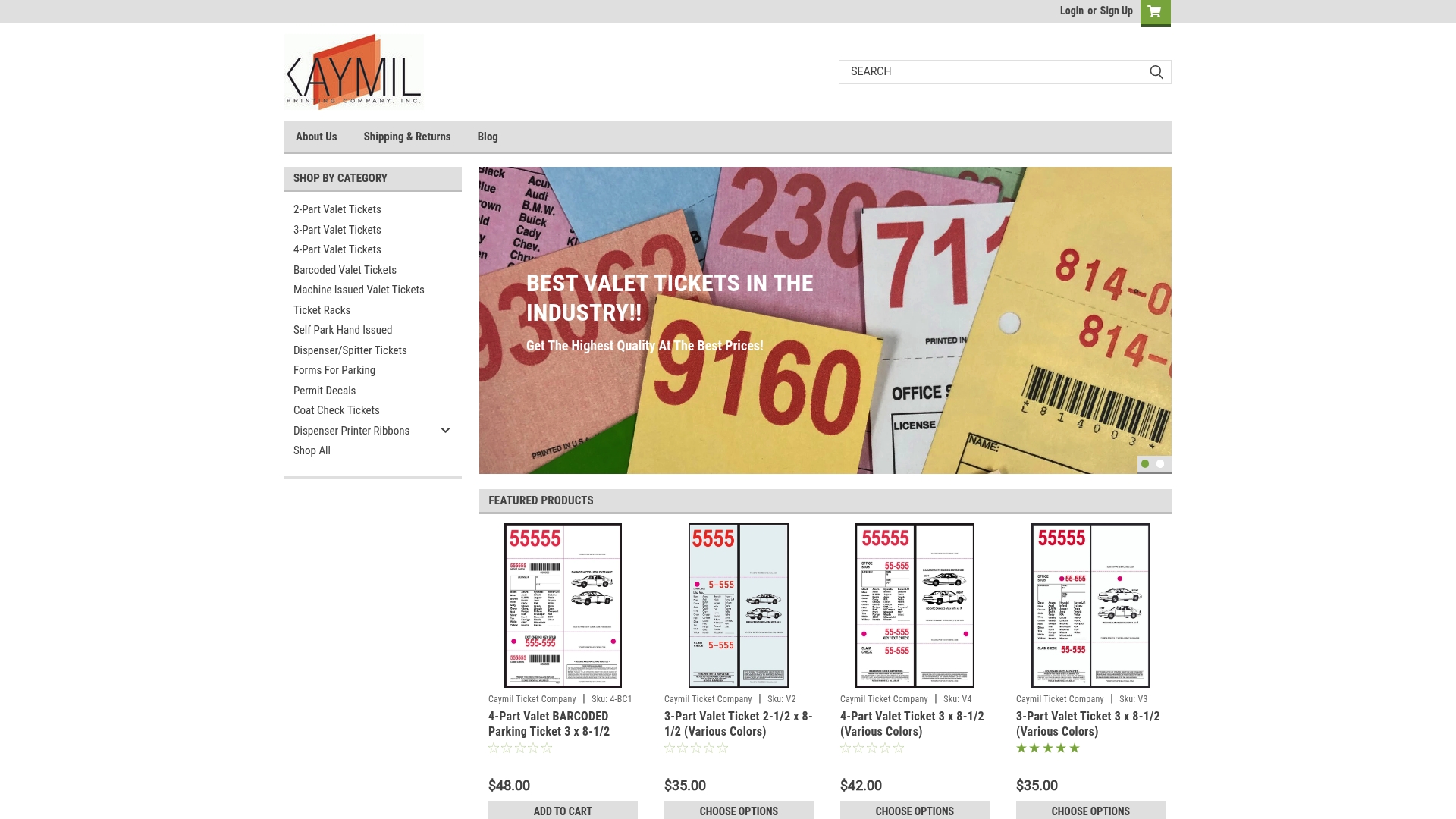
For properties running high-volume self-park with kiosk dispensers, machine-issued spitter tickets in Amano, TIBA, SKIDATA, or Flowbird formats are in stock and ship fast nationwide. For valet programs that need a clean audit trail, 3-part carbonless formats give every department the copy it needs without adding a printer to the curb. Request a sample or place a custom order at caymil.com to match your format to your system and your volume.
Further reading and source links
- Guest Experience Doesn’t Start in the Lot: It Starts in Their Inbox | Parking Today
- Quantifying the impact of Park Assist’s Parking Guidance Solution on customer experience (customer story, Park Assist / TKH Security)
- Beyond the lobby: why parking is the hotel amenity guests notice first | Lodging Magazine
- How Metropolis Is Bringing Parking Into The Future With AI And Recognition Technology | Bisnow
- Parking as the first touchpoint | Parking & Mobility Magazine
- Smart hotel parking: Is your car park the last thing on your list? | Hozah
- Smart Parking Management | Strategic Enhance Asset Value (Towne)
- The first and lasting impression: How parking impacts guest experience and revenue | WA Hospitality
FAQ
What are guest experience parking touchpoints?
Guest experience parking touchpoints are every interaction a guest has with your parking operation, from the first mention of parking in a booking confirmation through arrival, wayfinding, payment, and exit. Optimizing these touchpoints reduces friction and directly influences reviews and repeat bookings.
What are the five stages of the guest experience cycle?
The five stages are pre-arrival, arrival, in-stay (or in-visit), departure, and post-stay. Parking affects at least three of them directly: pre-arrival communications set expectations, arrival and wayfinding shape the first physical impression, and departure payment and retrieval determine the final one.
How does a Parking Guidance System improve the guest experience?
A PGS displays real-time space availability at garage entrances and on each level, reducing the time guests spend searching for a space. Park Assist’s documented deployments show average Time-to-Park reductions of 33–36%, with some high-turnover levels reaching 50%.
Can a guest leave a car in a hotel parking lot after checkout?
Policies vary by property. Most hotels allow a short grace period of one to a few hours after checkout for guests with late departures, but extended day-parking typically incurs an additional fee. Operators should state this policy clearly in pre-arrival messaging and at the parking entrance to avoid disputes at checkout.
What is the most important parking KPI for hospitality operators?
Time-to-Park is the single most useful starting metric because it captures wayfinding quality, signage clarity, and PGS performance in one number and correlates directly with guest anxiety and review sentiment. Track it first, then layer in revenue capture rate and retrieval time as your program matures.
Recommended
- Hotel Parking’s Role in the Guest Experience - Caymil Printing Co., Inc.
- Premium Valet Ticket Guest Experience: 2026 Guide - Caymil Printing Co., Inc.
- Optimize hotel parking: Integration, valet, and guest experience - Caymil Printing Co., Inc.
- Parking Garage Lost Ticket Fee Policy: Operator’s Guide - Caymil Printing Co., Inc.